
Today’s episode of The Habit Weekly is a miscellany of interesting stories and ideas I’ve run across lately…
In the spring I taught a mini-course on the personal essay. The topic was “Leaving Home” stories. Dozens of great stories came out of that class, and we’re featuring about twenty of them on The Habit Podcast through July and August. We kicked off the series last Friday with a story from Judith McQuoid about leaving Northern Ireland during the Troubles and arriving in Amarillo, Texas, just in time to celebrate America’s bicentennial on July 4, 1976. It’s a beautiful love letter to America, and I commend it to you. In this week’s episode, Beth Matheson reads an essay about what it was like to move fifty times in her first eighteen years, and what it was like to make a home of her own; Jamie Vanbiber tells about a time she left home and stepped into a scene straight out of a sitcom; and Greg Finley reads an essay about going off to college a few weeks after the death of a close friend.
The stories in the “Leaving Home” podcast series cover a wide array of subjects and evoke the full spectrum of human emotion. I am delighted to be able to showcase some this small fraction of the great work the writers of The Habit Membership are putting into the world.
I’m an avid listener (too avid, my wife would suggest) of the podcast The Rest Is History, by Tom Holland and Dominic Sandbrook. In this week’s episode they tell the story of the duel between Aaron Burr and Alexander Hamilton. if you’ve seen the musical Hamilton, you know about this duel. Burr and Hamilton had a long-running feud that ended with Burr killing Hamilton in a duel. Burr was Vice-President of the United States at the time, but the duel absolutely destroyed his reputation. Also, his reputation wasn’t helped by the fact that he tried to set up his own empire in the American West and was tried for treason. After he was acquitted of treason, he went went into self-imposed exile in Europe.
When Burr finally came back to the US, he lived under an alias. He practiced law in New York City and lived in relative obscurity. Later in life he spent a lot of time reading Tristram Shandy, a hilarious and maddening novel by Laurence Sterne. Apparently the book mellowed him out; he said, “Had I read Sterne more and Voltaire less, I should have known the world was wide enough for Hamilton and me."
One of Aaron Burr’s songs in the musical Hamilton is “The World Was Wide Enough.” I thought you might be interested to know where the phrase comes from.
In October my comic novel The Charlatan’s Boy is being re-released by Rabbit Room Press. I’ve been thinking about my own commitment to the comic novel—why comedy as a genre is important even though it seems less serious than, say, tragedy or memoir. Aaron Burr’s remark is a clue. Burr, it seems, was a through-going rotter, unable to think of the world in any terms other than a zero-sum competition. It wasn’t Voltaire, but a comic novel that invited him to think in more expansive terms. In the comic vision, the lion finally lies down with the lamb.
Besides co-hosting The Rest Is History, Dominic Sandbrook also co-hosts a podcast called Book Club. I picked up quite a funny fact from the episode on P.G. Wodehouse’s The Code of the Woosters. If you’ve read it, you’ll remember Wooster’s horrified recollection of an especially mushy bit of interior decorating:
I once stayed at the residence of a newly married pal of mine, and his bride had had carved in large letters over the fireplace in the drawing-room, where it was impossible to miss it, the legend 'Two Lovers Built This Nest', and I can still recall the look of dumb anguish in the other half of the sketch's eyes every time he came in and saw it.
I was amazed to learn that this little tableau was inspired by—more than inspired by, copied from—the home of H.G. Wells. Wodehouse had visited Wells at the house where he lived with Odette Keun and wrote the following in a letter to a friend:
When you go to his residence, the first thing you see is an enormous fireplace, and round it are carved in huge letters the words: TWO LOVERS BUILT THIS HOUSE. Her idea, I imagine. I can't believe Wells would have thought of that himself.
I like to envision Wells slogging away at The War of the Worlds under the banner TWO LOVERS BUILT THIS HOUSE.
Flannery O’Connor wrote of short stories, “there has to be a beginning, a middle, and an end, though not necessarily in that order.” This sounds at first like mostly a quip, but it contains a whole lot of truth. In either Short Story Summer Camp or office hours last week we got on the subject of mystery stories. A mystery story has a beginning, a middle, and an end: causes lead to effects, which lead to more effects. But a mystery story always starts not at the beginning, but the end. The sleuth is confronted with the final effects (typically a dead body and some clues) and works backward to the causes.
I’ve been reflecting on the extent to which this idea (beginning, middle, end, but not in that order) applies to the way we move through the world. We encounter effects more often than we witness causes. And, like sleuths, we are constantly working backwards from the effect to the cause. Or maybe not; often we encounter the effect without ever knowing anything about the cause, perhaps not caring to know anything about it. When you encounter a grumpy cashier at the grocery store, there was a chain of causation that led to the grumpiness, though probably all you ever experience is the effect. Every story—except “In the beginning God created…”—is a sequel.
My friend Joel Miller recently posted this image on Substack Notes:
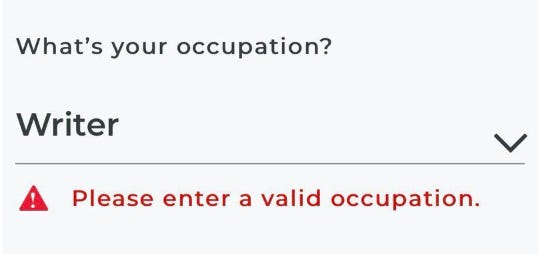
It reminded me of a story from one of Flannery O’Connor’s letters in which she described getting admitted to the hospital:
When I came in & gave the information about myself at the admitting place, the woman, who had carrot-colored hair & eyeglasses to match, asked me by whom was I employed.
‘Self-employed,’ says I.
‘What’s your bidnis?’ she says.
‘I’m a writer,’ I says.
She stopped typing & after a second said, ‘What?’
‘Writer,’ I says.
She looked at me for a while, then she says, ‘How do you spell that?’
Thank you for reading The Habit Weekly. My posts are always public, so feel free to share.

Virtual Writing Rooms on Monday, Tuesday, Wednesday, Thursday and Friday
This afternoon: Historical Fiction Group
This evening: Short Story Summer Camp, Week 3
Thursday afternoon: office hours
There’s a place for you in this vibrant community of writers. Find out more about The Habit Membership here.

In this episode, Beth Matheson leaves home fifty times, Jamie Vanbiber has reason to wish she had stayed home, and Greg Finley leaves for college in an especially vulnerable moment in his life.
“Leaving Home Stories,” is a special summer series in which writers from The Habit Membership will read personal narratives on the theme of leaving home, literally or metaphorically, temporarily or permanently.
Sponsored by The Habit Membership.
Comments
Nothing yet. Say the first thing.
Sign in to join the conversation.