
Grim Reminder: A Grim Historian is a reader-supported newsletter and depends on your 5$ donations to keep the most depressing politics and history in your inbox. Please consider becoming a paid subscriber or sharing with someone who loves misery.
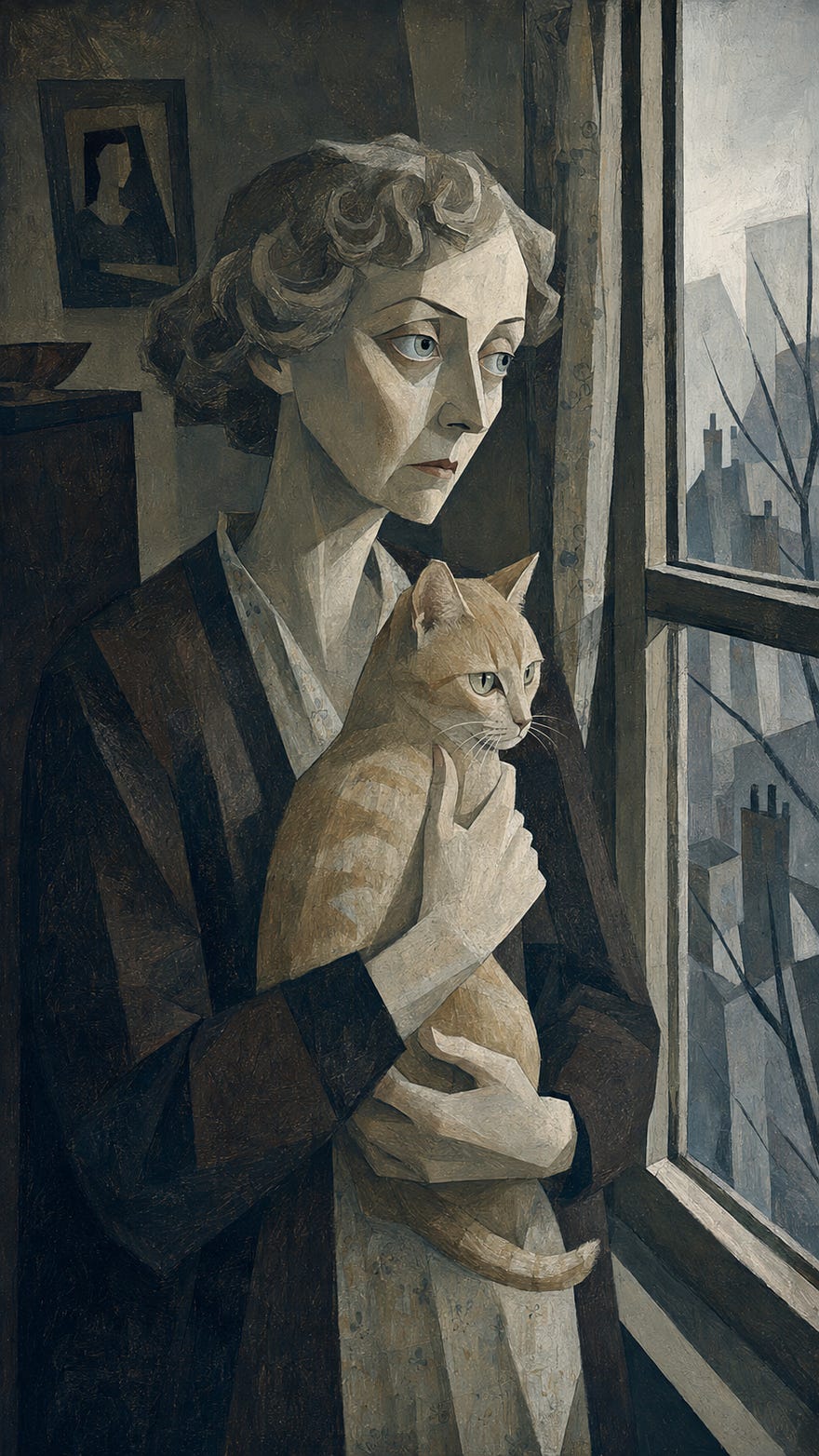
The cat had to die.
His name was Muschel — meaning shell — though Klemperer sometimes called him Mujel. He was eleven years old, and had been the Klemperers’ beloved pet since 1931.
Victor Klemperer had been a professor of Romance languages in Dresden. His wife Eva had been a concert pianist. Professor. Pianist. The Klemperers once used these labels to describe themselves.
Until they couldn’t.
According to Nazi law, Klemperer was Jewish, although he wouldn’t have used that label first. He had converted to Protestantism thirty years earlier and had served Germany in the First World War. But these facts belonged to the old world, where facts still had weight. The new world measured him by blood.
Eva was not Jewish either, but she had refused to divorce Victor. This refusal, quiet and stubborn and almost unbearably brave, was one of the thin legal threads keeping her husband alive.
Everything else was gone.
They had lost the university post in 1935, the house in Dölzschen by stages, the car in 1941, the typewriter, the right to sit on a park bench, the right to buy flowers, the right to receive milk deliveries, the right to subscribe to a telephone, the right to smoke, the right to use the public library. Each rule had been survivable on its own. There were several pages of them by 1942, in the official gazette, in close-set type.
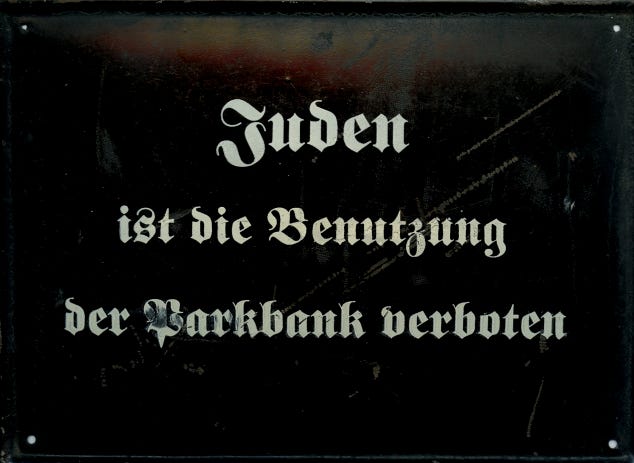
The Klemperers had been moved into a Judenhaus — one of the houses where Jews were gathered before the state decided what to do with them next. They lived in a half-room with other people’s breathing, other people’s fear.
Their cat Muschel came with them. He slept where he pleased. He crossed the room as if no decree applied to him. In that half-room, he was the last creature who still behaved as though the world had not changed.
Then the state noticed him.
By May 1942, Jews were forbidden to own pets. All animals were to be surrendered. The Gestapo was coming for the cat.
Eva had been making the inquiries for a week. The Klemperers knew what was coming — what the Gestapo did to confiscated Jewish pets was not what a veterinarian did.
On the afternoon of May 19, word reached the Judenhaus that a “handover” order was on its way; once it arrived, Victor would no longer have the legal right to dispose of the cat as he saw fit. The Klemperers sat in their half-room and hesitated until four o’clock. The veterinarian’s hours ended at five. Eva went. Victor stayed home and made the smallest possible entry in his diary:
Muschel ✟. A small cross.¹
He wept for the cat in a way he had not wept for his house, his job, his typewriter, or the dismantling of his life by close-set type.
Muschel, he wrote, was the one that broke him.
The Germans had a word for what had happened to the Klemperers. A jurist and a psychiatrist had coined the phrase in 1920, in a slim academic book that almost no one read at the time. The Nazis read it.
Lebensunwertes Leben. Life unworthy of life.
In 1920, the jurist Karl Binding and the psychiatrist Alfred Hoche published Die Freigabe der Vernichtung lebensunwerten Lebens — promoting the destruction of “life unworthy of life.” They were writing first about disabled people, the chronically ill, and those they deemed incurable.
That is where the classification began. Then it expanded. By 1942, the Nazis expanded the definition of enemy.
We know how this story ends. Once the state grants itself the power to decide which lives count fully, the category never stays where it started. First it marks the disabled as burdens. Then it marks others as contaminants, parasites, enemies, invaders. The vocabulary changes, but the mechanism remains the same: define the life downward, and the law can follow.
First dignity. Then rights. Then homes. Then bodies. Then, finally, a cat named Muschel, who had committed no crime except belonging to the wrong people.
The state did not have to hate him. It only had to classify him.
Victor Klemperer hid his paper and pencils in different places while Eva smuggled his pages to friends for safekeeping. Even the paper had become contraband.
By February 1945, the machinery was closing in. Victor and Eva were scheduled for deportation on February 16. Three days before that, on February 13, Allied bombs hit Dresden. In the wreckage and fire, Eva cut the yellow star from Victor’s coat, and the two of them disappeared into the stream of refugees.
Victor and Eva Klemperer survived. So did the diaries.
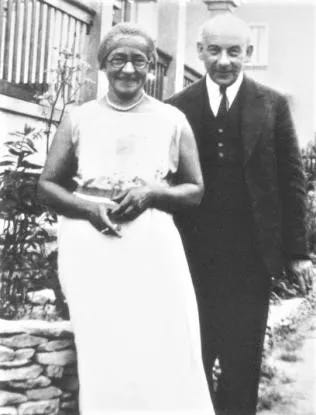
Two years later, in 1947, Klemperer published LTI: The Language of the Third Reich, a notebook drawn from the observations he had kept under Nazism. Klemperer was a philologist — a scholar trained to study how words change, where they come from, and what they reveal about the people using them. Before the war, he had spent decades teaching Romance languages at the Technical University of Dresden. He listened to words the way a doctor listens to a heartbeat. He could hear when a language was getting sick.
So while the regime was taking his job, his car, his typewriter, and his beloved cat Muschel, Klemperer sat in his half-room with a pencil and recorded how the language of Nazism changed Germany. Not only in speeches or laws. In slogans, euphemisms, bureaucratic formulas, adjectives, jokes, headlines, and ordinary conversation.
Over time, Klemperer came to one sharp-eared conclusion: The Nazis did not need to invent a language. They only needed to corrupt the one people already spoke.
Fanatisch — fanatical — had once been an insult. The Nazis turned it into praise. Volk had meant the people, the nation, the public body; they loaded it with blood. System became a slur for the republic itself. Old words were not discarded. They were narrowed, poisoned, and redeployed.
However, the most dangerous words were not always the ugliest ones. Sometimes they were the cleanest.
Einigkeit means unity. It is a beautiful word until the state decides what must be removed to achieve it.
Under democracy, unity can mean living together across difference: people who disagree, worship differently, vote differently, and still belong to the same country. Under authoritarianism, unity means something colder. It means sameness, purity, and the nation can only become whole after the contaminating parts have been named and cut out.
That is why authoritarian language always moves from the in-group to the out-group. First it tells the faithful who they are. Then it tells them who is preventing the nation from becoming itself. The Jew. The communist. The foreigner. The degenerate. The traitor. The terrorist. The enemies contaminate society.
That was Klemperer’s warning. Change the words, and the things those words used to protect begin to disappear. Pluralism becomes decadence. Dissent becomes sabotage. The opposition becomes the enemy.
And once the category is built, people can be sorted into it.
Where Klemperer watched the words, French sociologist Pierre Bourdieu named the power behind them. Bourdieu called it “symbolic power.” He believed that power does not live in the dictionary. It lives in the institutions that hold what he called the monopoly on legitimate naming: the power to make a classification official, and therefore binding.
Anyone can call you a name. Only certain bodies can make the name stick. They can turn a slur into a status, a status into a file, and a file into a consequence.
“Terrorist” is a word. In my mouth, it is a playground insult. In the State Department’s mouth, with the statute and the whole apparatus behind it, it can freeze accounts, trigger surveillance, and make ordinary support into a felony.
But Bourdieu’s harder point is that this power works best when you do not notice it as power. When a judge says “married,” you do not think, “An institution has stamped a legal category onto my body.” You think: married now. The force hides inside the feeling of “well, that’s just true.” Bourdieu had a ten-dollar word for this: misrecognition.
Once you see it, it is everywhere. A diploma is only paper. If I print “M.D.” on cardstock and start opening people up, I go to prison. If Harvard prints the same letters, I get a parking spot at the hospital. The paper is not magic. The institution is.
Which brings us back to the present question: who gets to redefine the meaning of a word?
That is Bourdieu’s warning. The frightening power is not always the cop with the gun. Sometimes it is the clerk with the stamp, because that power does not feel like force. It feels like reality, and sometimes, unity.
The Nazis did not have to work this out for themselves. A jurist had already written it down.
In Carl Schmitt’s 1922 work Political Theology, his argument was stark: politics reduces, in the end, to the distinction between friend and enemy.
For Schmitt, the enemy was not merely someone who had wronged you. The enemy was defined as the person, group, or movement cast as an existential threat to the political order. Once that category exists, ordinary rules begin to look optional.
Schmitt’s most famous line describes it best: “Sovereign is he who decides on the exception.” In other words, the real ruler is not the person who follows the rules. The real ruler is the person who decides when the rules no longer apply.
For example, in normal times, everyone praises the constitution. But the moment there is an emergency — a crisis, a threat, a terrorist — someone claims the power to suspend the usual protections. That is the exception. And the exception reveals who is really in charge.
According to Schmitt, if you want to know who runs a country, do not only read its laws. Watch who gets to break them and not go to jail.
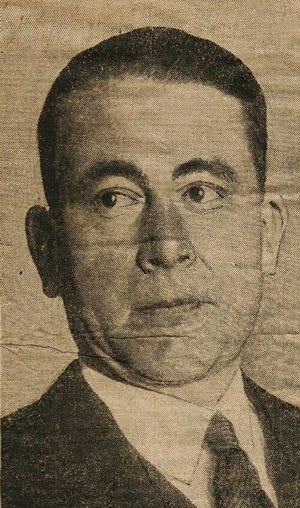
This is why Schmitt keeps resurfacing around the authoritarian right lately. He gives them a clean theory of dirty power. First name the enemy. Then declare the emergency. Then treat law as an obstacle to salvation.
J.D. Vance gestured at this in 2024 when he told The New York Times that liberals had all read Carl Schmitt and understood that “there’s no law, there’s just power.” That was not just projection. He was admiring the machinery.
Trump has put the same idea in cruder form on X: “He who saves his Country does not violate any Law.” That is Schmitt in bumper-sticker form. The savior does not break the law because the savior decides when the law stops binding him.
Stephen Miller has been even less subtle, describing presidential power as “plenary” — complete, whole, unshared. That is the exception said out loud.
For a decade, the American right ran its propaganda. Own the libs. Bad hombres. Immigrants are coming for your jobs. Whatever trans panic was on special that week. Now the category is “antifa,” “terrorist” or “communist” — labels with an elastic meaning.
Here is why legal scholars are panicking: federal law defines domestic terrorism, but it does not create a standalone federal crime called “domestic terrorism.” The government still has to prosecute the underlying act — the murder, the arson, the bombing, the conspiracy, the threat. “Domestic terrorism” is a classification, not usually the charge itself.
Foreign terrorism works differently. Once the State Department designates a group as a Foreign Terrorist Organization, the label activates the material-support statute. Money, training, services, personnel — all of it can become its own felony, carrying up to twenty years in prison.
That is why the firewall matters. If the state can blur domestic enemies into foreign-terrorism machinery, the word does not merely describe danger. It creates legal exposure around the people, groups, donors, lawyers, and organizers placed near the category.
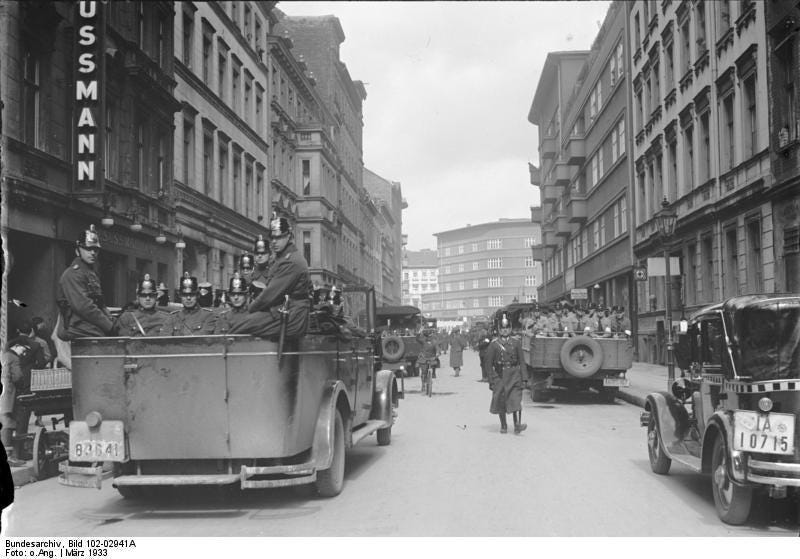
Now watch America’s firewall disintegrate.
On September 22, 2025, an executive order declared Antifa a “domestic terrorist organization,” a designation that has no normal statutory home in American law. Three days later, National Security Presidential Memorandum 7 ordered the Joint Terrorism Task Forces to investigate not only perpetrators, but the networks, funders, and entities behind political violence.
Then came the foreign hook. In November 2025, the State Department designated four European antifa-aligned groups as terrorist organizations, switching on the material-support machinery — the one with real prison time, the one that can reach Americans. That’s the naming trick.
By July 2026, the State Department had convened representatives from dozens of nations for a campaign against “far-left terrorism.” Stephen Miller framed the left as “enemies of civilization.”
Klemperer would have recognized the grammar. The state does not have to measure a threat. It only has to assign one. The apparatus is built to face in one direction, even though the government’s own historical data has long shown that right-wing extremists account for a greater share of deadly extremist violence in the United States.
That is the objective enemy. Schmitt gave them the bridge between the two. No one has to prove you did anything. “Terrorist” becomes a category with a moving boundary. Today it means the person who plants the bomb. Tomorrow it means the person who funds the person who knows the person who planted the bomb. After that, it means whatever the movement needs it to mean once the current targets are used up.
The protester becomes a terrorist. The teacher becomes a groomer. The immigrant becomes an invader. The Democrat becomes a communist.
And none of this requires personal hatred or racism. Schmitt’s sovereign does not have to hate the enemy. He only has to name him.
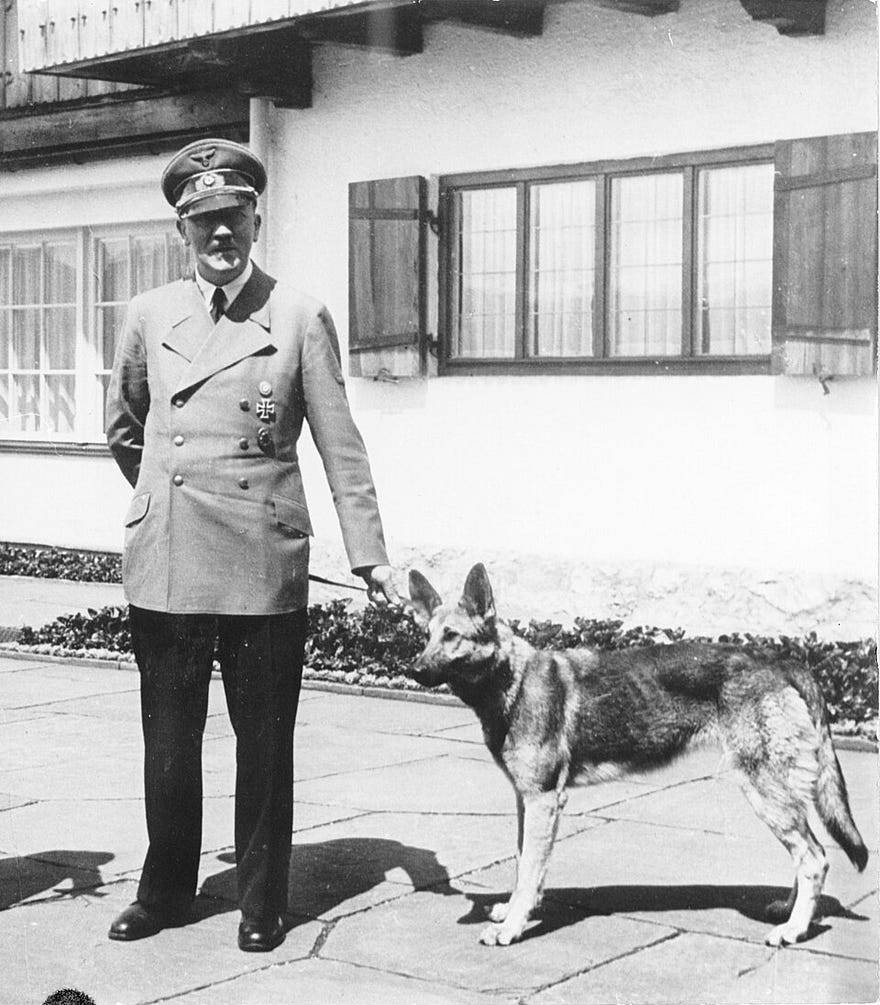
The official who signed the pet decree in May 1942 did not target Muschel. He had never heard of Muschel. He signed a sentence containing the word “pets,” and in a half-room in Dresden, a philologist wrote a line in a notebook: “this is the death sentence for Muschel.”
Days later, Klemperer wept over a cat he was no longer permitted to keep.
The state did not have to hate Muschel. It only had to make him belong to the wrong category.
(1) Klemperer, V. (2001). I will bear witness, volume 2: A diary of the Nazi years, 1942–1945 (M. Chalmers, Trans., p. 55). Modern Library. Original work published 1995.

Carlyn Beccia is an award-winning author and illustrator of 13 books. The Grim Historian is a reader-supported publication. To receive new posts and support my work, consider becoming a free or paid subscriber.
No posts
Comments
Nothing yet. Say the first thing.
Sign in to join the conversation.