
Grim Reminder: A Grim Historian is a reader-supported newsletter and depends on your 5$ donations to keep the most depressing politics and history in your inbox. Please consider becoming a paid subscriber or sharing with someone who loves misery.
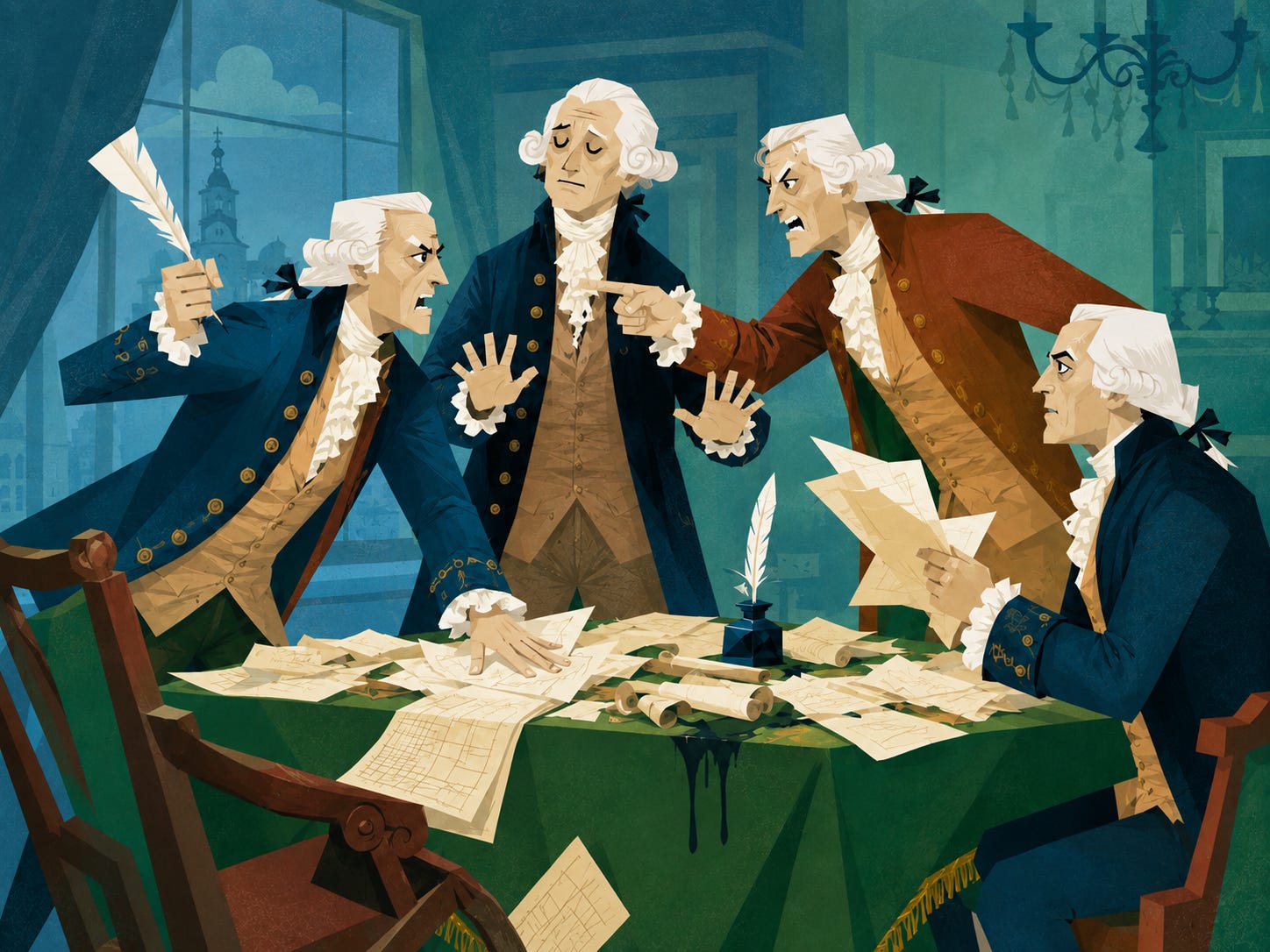
The first fight over banks should have broken America. Mostly because each bickering Founder was a tiny bit right and no one wanted to admit where they were wrong.
Alexander Hamilton understood that a republic without credit could quickly become a republic without money, soldiers, or friends. Thomas Jefferson clapped back that concentrating financial power near government was a terrific way to manufacture an aristocracy with better bookkeeping. James Madison — always a stickler for the rules — worried that the Constitution didn’t give Congress the power to create a bank. And George Washington had to decide which danger frightened him least.
America survived because history eventually gave them all something they wanted.
But first they had to nearly kill each other.
In 1791, three years after signing the Constitution, America’s finances looked like the morning after a tavern burned down. The fledgling nation was buried in war debt, public credit was shaky, and the Continental dollar had been inflated to near worthlessness.
The new government needed a way to collect taxes, move money, borrow in emergencies, and most importantly, convince creditors that lending to the United States wasn’t the fiscal equivalent of setting a pile of cash on fire to stay warm.
We were trying. The United States had adopted the dollar as its monetary unit, but it had not yet opened a federal mint. (The Coinage Act that created one would not arrive until 1792.) Consequently, Americans were still conducting business with a grab bag of foreign coins, local paper, and whatever else another human being could be persuaded to accept as money.
Hamilton looked at this monetary yard sale and said:
Bros…we need a bank.
And by “bank,” Hamilton did not mean a place where George Washington could stop in to cash a check. He meant a powerful public-private financial institution that could hold federal money, extend credit, move funds across the country, and issue notes people would actually accept as money.
So he proposed the First Bank of the United States, capitalized at $10 million, with the federal government subscribing to one-fifth of it and private investors supplying the rest. The bank would hold government funds, facilitate financial transactions, and help establish America’s creditworthiness.
In modern translation, Hamilton’s stance was basically I cannot run a Treasury on thirteen different interpretations of “the check is in the mail.” Properly constructed, Hamilton understood a national bank could only make the republic stronger. Credit meant the government could borrow, banks could mobilize capital, and commerce could expand. Obviously, a country that reliably paid its debts would command the confidence of investors at home and governments abroad. It was a solid plan.
Thomas Jefferson heard all this and saw approximately seventeen different ways Alexander Hamilton was going to reinstall the British monarchy.
Jefferson already distrusted Hamilton’s broader financial program. He feared that banks and public debt would create a privileged financial class whose fortunes depended on government policy. The last thing Jefferson wanted was to defeat hereditary aristocracy and replace it with a clique of financiers bending the republic toward their interests.
Jefferson’s objection to the bank also had teeth. Sure, Congress had powers listed in the Constitution, but creating corporations was not one of them. If the federal government could simply infer a new power whenever a convenient institution would help it execute an existing one, Jefferson wanted to know where exactly this charming little journey ended.
Thus, Jefferson’s February 15 opinion to Washington argued that the power to establish a bank had not been delegated to the federal government.
And then James Madison entered the chat. That’s when feelings got hurt.
Hamilton was especially miffed because Madison had been Hamilton’s ally during the fight to ratify the Constitution. The two men had collaborated on The Federalist Papers. Now Madison was standing in the House opposing Hamilton’s bank and effectively saying:
Alexander, remember that Constitution we spent months explaining to everyone? Funny story. I have read it.
The objections were serious enough that Washington did not simply sign it and go feed his horses. He asked members of his administration for feedback. And oh boy, did he get some.
Attorney General Edmund Randolph came out swinging against Hamilton’s bank, warning that it risked becoming a doctrine “so indefinite, as to grasp every power.”
Randolph was hardly alone. Senator Pierce Butler was already chastizing everyone on an “aristocratick influence” creeping into the new government. Senator William Maclay feared the bank could become a “machine for the purposes of bad ministers.”
Apparently everyone in 1791 was determined to scare the bejeezus out of George Washington. The president was conflicted enough that he quietly asked Madison to draft a veto message, just in case he decided to kill the whole damn thing. Madison, who had spent weeks trying to kill it himself, was happy to oblige.
Washington took the objections and essentially said to Hamilton: your buddies say your bank is unconstitutional. You have the floor…
Hamilton responded on February 23. At considerable length. Of course he did.
Hamilton’s argument was that a functioning government must have implied powers. Therefore, Congress had the constitutional authority to tax, borrow money, and regulate commerce. If creating a bank was an appropriate means of carrying those legitimate powers into effect, Congress did not need the Constitution to contain a separate line reading: ALSO YOU MAY HAVE ONE BANK.
And here is the maddening part.
Hamilton had a point.
So did Jefferson.
So did Madison.
We know how this story ends, or we would still be bartering in shillings and seashells. Washington read the arguments and chose Hamilton’s side. On February 25, 1791, he signed the bill establishing the First Bank of the United States.
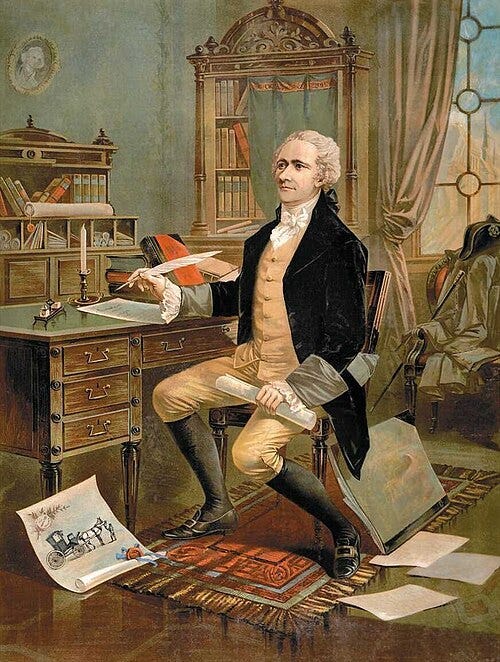
Of course, Jefferson could be a gossipy little wench. He didn’t suddenly announce that Alexander was right and invite him over for madeira. He accepted Washington’s decision and then, within days, he and Madison began working with Philip Freneau on an opposition newspaper — the National Gazette. Its main purpose was to attack Hamilton’s financial program. (It also turned a policy dispute into the beginnings of America’s first party system. So there’s that to discuss.)
On the other side of the fracas, Hamilton feared Jefferson would summon a mob. To Hamilton, Jefferson was a bit too enamored with the vive la résistance spirit of the French Revolution and its eagerness to spill blood. He thought Jefferson was exactly the kind of ambitious idealist who’d cheer the whole thing on, guillotine and all, while drawing a government paycheck.
Washington had wanted a cabinet containing different points of view. Mission accomplished, George. He now had his Treasury secretary and secretary of state behaving like two divorced parents communicating exclusively through hostile newspaper columnists. The attacks may have been slower than social media, but they could get equally vicious.
But underneath all that powdered-wig bitchery was a question the country has never really answered:
What is a bank supposed to be in a republic?
Hamilton believed banking power could serve the state. Jefferson feared banking power could capture the state. Madison insisted that whatever power government exercised over finance needed legitimate constitutional boundaries. Washington probably just wanted everyone to stop bickering.
So who was right?
Hamilton’s banking system proved useful enough that after the First Bank disappeared and the War of 1812 exposed the financial weaknesses that followed, President James Madison eventually signed the Second Bank of the United States into existence. Madison remained cautiously optimistic, while still fretting that power without boundaries eventually creates powers nobody intended.
Jefferson was also right. And he would spend the next two centuries being repeatedly vindicated about what happens when financial power becomes concentrated among privileged insiders.
And Washington was right that none of those competing principles could govern a country by itself.
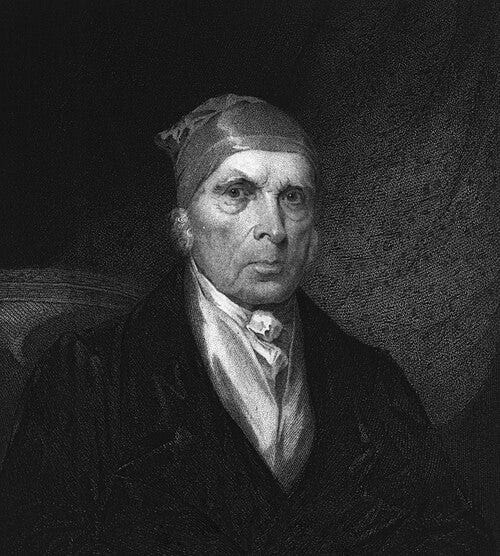
That was the bargain America gradually struck. Build something strong enough to satisfy Hamilton, suspicious enough to satisfy Jefferson, bounded enough to satisfy Madison, and dependent upon enough presidential restraint to satisfy Washington.
Unfortunately, every generation since seems to discover a new way for financial power to get too large, concentrated, politically useful, or close to the people writing the rules. Our current generation has produced a variation so exquisitely weird that Hamilton, Jefferson and Madison never bothered arguing about it: What happens when the president’s own family gets into the banking business?
That fresh hell is called World Liberty Financial.
World Liberty did not begin as a bank. It originally sold itself as something close to the opposite.
Donald Trump and his family helped unveil the crypto venture in September 2024, while Trump was still a candidate for president. Eric Trump and Donald Trump Jr. promoted it alongside Zach Witkoff, son of Trump friend and future special envoy Steve Witkoff.
The first step in legitimacy came with the fancy titles. Trump crowned himself “chief crypto advocate.” His sons became “Web3 ambassadors.” Barron Trump was designated the “DeFi visionary,” which is a magnificent job title for an eighteen-year-old and one I deeply regret not inventing for my own children.
The pitch was decentralized finance, or DeFi — financial services that use blockchain technology to let people lend, borrow, and move money without depending on traditional intermediaries like banks. World Liberty still describes its mission as breaking down traditional banking barriers and making financial services more accessible through open, blockchain-based infrastructure.
Cute. Jefferson might have been intrigued.
So you want to loosen the grip of powerful financial institutions and distribute financial power more broadly among ordinary citizens? Sure you do.
Then came the part where the Trump family started making money.
World Liberty sold a cryptocurrency called WLFI. At first it was marketed primarily as a governance token, in which holders could vote on certain decisions involving the project. It was not stock in the conventional sense. Buying WLFI did not mean you owned the Trump Organization or got Eric at the annual shareholders meeting explaining why the ice machine at Turnberry remains broken.
But the financial arrangement behind the token was very real. Reuters calculated in June that World Liberty had funneled more than $1.6 billion to the family, most of it from token sales. Investors, meanwhile, had collectively accumulated an estimated $674 million in losses based on Reuters’ analysis of token prices through April.
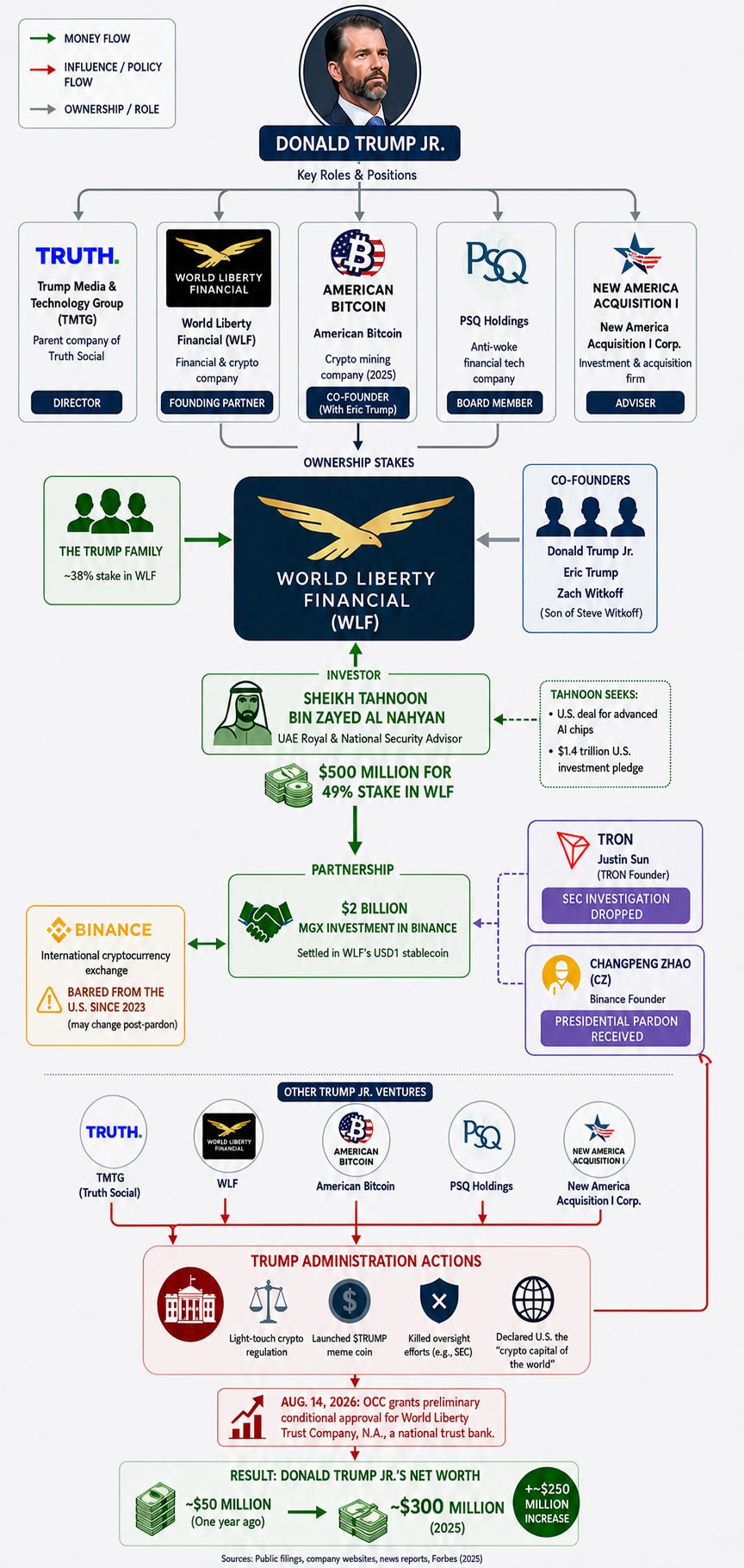
The above graphic would have sent Thomas Jefferson into a tizzy. Hold that thought.
Then World Liberty created something much more important than another crypto token. In March 2025, it launched USD1, a stablecoin.
If you are already contemplating scrolling past this paragraph because I said “stablecoin,” stay with me. This is where the story becomes banking.
A stablecoin is basically crypto designed not to behave like crypto. USD1 equals one U.S. dollar, backed — World Liberty says — by dollars, U.S. Treasuries and other cash equivalents. So instead of buying Bitcoin and hoping Elon Musk does not tweet something strange before breakfast, you are holding a digital dollar that can move across blockchain networks.
That can be extremely useful. It can also become extremely large. In May 2025, an Abu Dhabi–backed firm called MGX used $2 billion worth of USD1 to close an investment in Binance, the world’s largest crypto exchange. By this month, roughly $4 billion of USD1 was in circulation, making it the fourth-largest stablecoin.
And now Hamilton is interested.
Because once billions of digital dollars are circulating, somebody has to issue them, safeguard the real assets backing them, custody customer assets, and settle transactions.
World Liberty had begun by promising to route around traditional banks. By January 2026, it was asking the federal government for permission to become one.
More alarmingly, World Liberty applied to the Office of the Comptroller of the Currency — the OCC — for a charter creating World Liberty Trust Company, National Association. Of course, federal regulation gives World Liberty credibility.
Federal oversight will also make USD1 more trustworthy to institutions and help the company expand. That is not inherently sinister. Other crypto companies have sought federal trust charters for exactly that reason. A federal banking charter tells potential customers that somebody with a badge, a rulebook and considerably less interesting hair is watching the books.
There is just one teensy problem.
The regulator deciding whether World Liberty deserved that federal banking charter is Comptroller Jonathan Gould.
Gould was appointed as Comptroller by President Trump.
On August 14, the OCC conditionally approved World Liberty’s charter anyway.
Elizabeth Warren and nine other senators responded by introducing the Ending Presidential Corruption in Banking Act, which would prohibit presidents, vice presidents, certain senior government officials, and their immediate families from owning or controlling banks or using federal banking privileges to benefit financial institutions they control.
Think about the sentence Congress has been forced to contemplate writing into federal law:
The president’s family cannot own the bank his corrupt regime regulates.
Oops. Madison forgot that one. Or, more accurately, nobody imagined we would need legislation to prevent such flagrant self-dealing.
Have we learned nothing from 2008? Ostensibly, banks run on trust. Hamilton’s entire financial project was built around that insight. Public credit mattered because lenders had to believe that the United States would honor its obligations. Investors had to believe financial rules were reliable. Markets had to believe the bureaucracy underneath them was not being operated for the private benefit of whichever family temporarily controlled the government.
Let’s also not forget that if the president’s family can retain a large financial interest in a company while the president appoints officials who regulate that company, then the next president inherits the same permission. Perhaps that president’s spouse owns a pharmaceutical company. Perhaps the children operate a defense contractor. Perhaps the family owns a financial institution taking enormous investments from foreign governments while those governments negotiate with the White House.
A functioning democracy needs rules we still want when somebody we despise takes office.
Hamilton, Jefferson, Madison, and Washington did not save the new republic by discovering that one of them possessed the complete answer. They argued, sometimes ferociously, because each could see a danger the others underestimated.
Over time, America incorporated pieces of all those warnings into its financial system: stronger institutions, suspicion of concentrated financial privilege, regulatory boundaries and an expectation that public officials would maintain some meaningful distance between public power and private enrichment.
Those protections were never handed down finished in 1791. Americans built them after discovering where the system could break.
The Trump regime has shown us the cracks in the system.
The question now is whether we still possess the capacity our Founders demonstrated in their first furious banking fight.

Carlyn Beccia is an award-winning author and illustrator of 13 books. The Grim Historian is a reader-supported publication. To receive new posts and support my work, consider becoming a free or paid subscriber.
No posts
Comments
Nothing yet. Say the first thing.
Sign in to join the conversation.