
Hello and welcome to The Green Techpreneur - the magazine and marketplace where climate founders raise faster, scale smarter, and rise together.
On our Climate Marketplace, over 200 startups have listed and raised more than €200M. With 2,000 investors on the platform and 10,000+ in our wider community, we’re connecting the global ecosystem driving climate innovation and funding.
Contact us for Fundraising Support
There’s a number that’s circulating in investor inboxes this week: $26 billion. That’s how much climate tech raised in the first half of 2026. Up 55% on the same period last year. The best first half since 2022.
If you’ve seen it, you may have felt a flicker of something. Hope, maybe. Or relief. A sense that the sector is back.
I want to sit with that feeling for a moment - and then complicate it.
Because the same report that contains the $26 billion number also contains this: deal count fell 25% to a five-year low. Seed and pre-seed activity is at its lowest proportion of total investment in a decade.
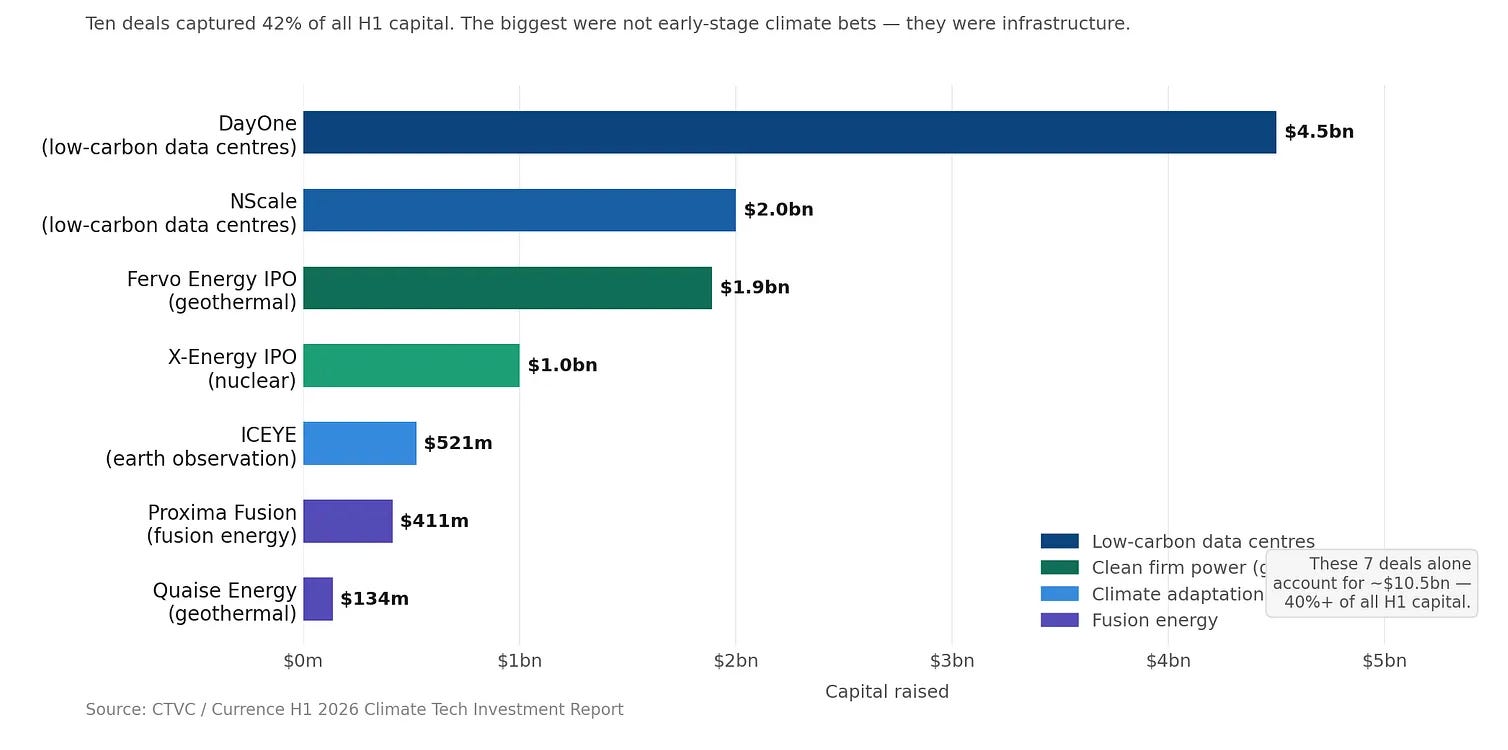
One of those ten: DayOne raised $4.5 billion to build low-carbon data centres. The largest single climate deal since 2020. One company. One deal. That is what a 55% recovery looks like when you zoom in.
What’s happening in climate tech is not a recovery. It’s a sorting.
And the question that matters for every founder reading this is not “is the sector back?” It’s: which side of the sort am I on?
The CTVC H1 2026 Climate Tech Investment Report - released this week - is the most comprehensive climate VC data package of the year. It paints a picture that is simultaneously more optimistic and more difficult than most headlines suggest.
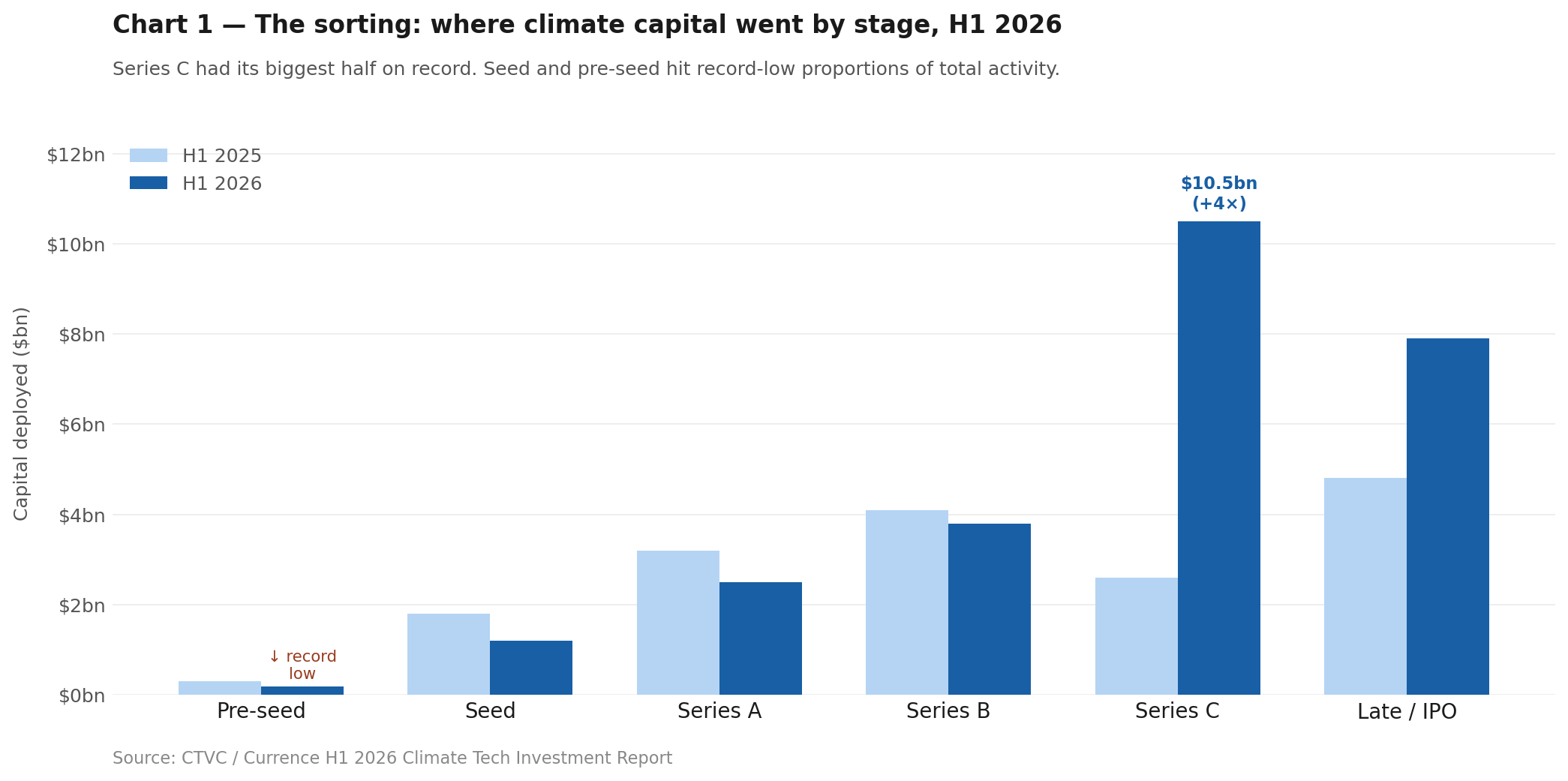
At the top of the market, the numbers are extraordinary. Series C had its biggest half on record: $10.5 billion, up 4x year-on-year. The exit window has opened for the first time since 2021: Fervo Energy IPO’d at $12.4 billion (35% pop on debut), X-Energy raised $1 billion in its IPO (27% pop), General Fusion completed a SPAC at $1 billion. The climate companies that have reached commercial scale and proven their technology are attracting institutional capital at a pace not seen since the peak of the 2021 boom.
At the early stage, the picture is the opposite. Pre-seed and seed deal counts are at record-low proportions. The bar for a first meeting has risen sharply. Investors who once backed founding teams with a strong slide deck now want a working product, a named first customer, or — ideally — both.
The gap between these two markets has never been wider.
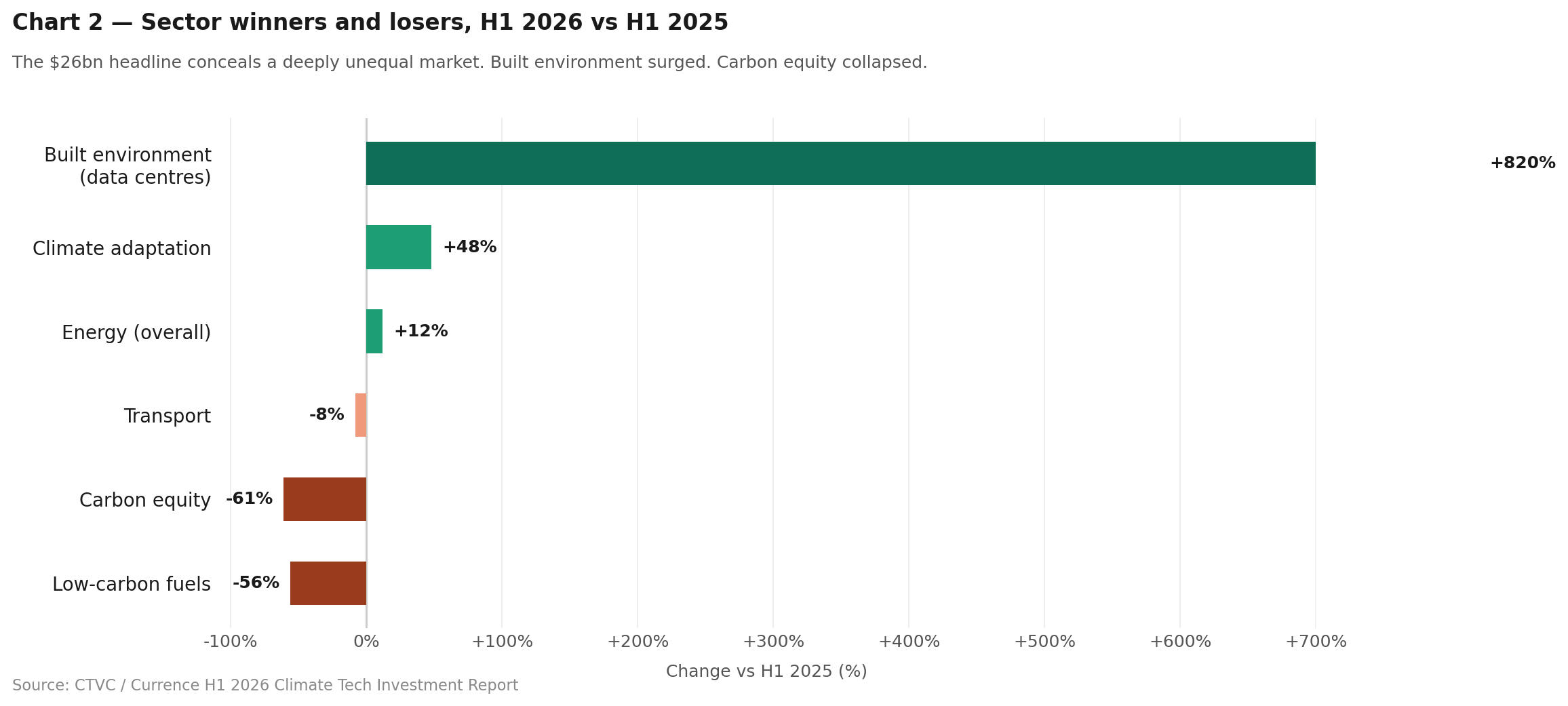
Not because of a construction boom, because of data centres. DayOne’s $4.5 billion raise, NScale’s $2 billion, and a wave of AI infrastructure deals pushed the Built Environment vertical ahead of Energy as the largest climate tech sector for the first time. The AI-energy nexus is no longer a thesis. It’s the biggest single capital flow in the sector.
Fervo, X-Energy, General Fusion, Quaise ($134M for superhot geothermal drilling), Proxima Fusion (€411M from Google and others). The common thread: 24/7 baseload power with no intermittency. Every hyperscaler on earth needs it. That need is now pulling public market capital into technologies that were considered too long-cycle for traditional VC just two years ago.
Down 61% in H1 — the weakest half since 2020. Low-carbon fuels fell 56% as US subsidies sunset and European buyers await 2027 policy reviews. This is not a temporary dip. The funding mechanism is changing structurally: Amazon’s 2-million-ton nature-based carbon removal deal this week — one of the largest corporate offtake agreements ever signed — signals what replaces VC equity as the primary carbon market funding source. Corporate procurement is the new carbon VC.
ICEYE raised $521 million for radar satellites that monitor floods, wildfires, and crop failure in real time — the largest non-energy, non-transport climate deal of the half. Tomorrow.io raised $175 million. Earth observation funding tripled. Pension funds are, for the first time, seriously grappling with what JPMorgan is calling “climate black swan risks.” The investors are arriving before the media coverage.
Layered on top of the investment picture is the most consequential US policy development of the year for climate founders: the One Big Beautiful Bill Act.
The verdict is sector-specific and decisive. Nuclear (45U credit) and geothermal survived and in some cases strengthened, the AI data centre energy demand gives both bipartisan political cover that climate policy has never previously enjoyed. Advanced manufacturing (45X credit) largely survived, with wind components excluded. CCS (45Q) remains intact.
Solar and wind face a compressed window: projects must be operational - not just started - by December 31, 2027. Early-stage developers in these sectors face a choice between accelerating to meet the deadline or pivoting their commercialisation geography. Green hydrogen and offshore wind are most exposed: the US subsidy floor has been removed, and the financial models built on it no longer close.
The EU and UK policy frameworks remain intact. The UK’s Seventh Carbon Budget passed. Sizewell C secured a CfD at £70.50/MWh - below current wholesale prices. For founders whose business model works in Europe, the case for focusing commercialisation there first has never been stronger.
I’ve been watching closely which founders are closing rounds in this environment. Five patterns show up consistently:
Not a deck. Not a concept. Something that works in the real world, however early. The bar at pre-seed has moved permanently - investors who once funded ideas now fund evidence.
A named first customer. A letter of intent. A pilot partner. A signed offtake agreement. The demand-side risk is the first thing investors price. Founders who reduce it before asking for capital close faster.
Clean firm power, grid flexibility, cooling, water management for data centres - the commercial urgency AI is creating is pulling capital faster than any policy mandate ever did. Founders who can articulate their technology’s relevance to AI infrastructure are accessing a pool of capital that didn’t exist two years ago.
“Energy security” and “grid resilience” open doors that “sustainability” and “ESG” are now closing. This isn’t a betrayal of mission - it’s a translation. The founders closing rounds lead with the commercial and operational case, then let the mission be visible to the investors who value it.
The founders treating the UK and Europe as co-equal commercialisation targets - not as fallbacks - are finding more active investor conversations. The policy diversification makes them a better bet.
An MVP, a working pilot, a letter of intent from a first customer - whatever gets you from idea to evidence. The investors who are still writing early-stage cheques want that one proof point before they move.
Don’t wait for your next investor meeting to discover that the policy tailwinds you built around no longer exist. Some of these business models still work, in Europe, with different customer bases, with different revenue structures. But the remodel needs to happen before the raise, not during it.
The question isn’t whether to raise VC - it’s whether corporate offtake might be the more direct path. Long-term purchase agreements with large corporates provide the capital certainty that VC rounds were supposed to provide. Build the business model that makes corporates your primary customer, and the funding follows.
The pitch that lands right now leads with the operational cost savings and the insurance risk reduction, not the climate benefit. Both are real. Lead with the one investors are currently pricing.
The investors who are still writing early-stage climate cheques exist, but they’re harder to find than they were three years ago, when the sector had more generalist VC attention. The specialisation of climate capital is real: the investors who know geothermal from grid flexibility from carbon removal are not the same investors who funded your friend’s solar company in 2021.
The active investors on the platform are there because they want curated dealflow in climate - not because they stumbled across a cold email. If you’re raising in H2 2026 and you haven’t created a profile, that’s worth doing this week.
→ List your startup on Climate Marketplace. Free to list. Upgrade options include a Featured listing from €350 or an Active listing from €600. climate-marketplace.com
🧪 Rhizo PTX
Sector: Green Chemistry | Industrial Decarbonization | Deep Tech
HQ: United Kingdom
Round: Pre-Seed/Early Seed - £2M equity (+£700k Innovate UK grant)
Traction: 2 signed LOIs including a 10,000 t/y Chemelot deployment finalizing, 3 wastewater LOIs in progress (Ofwat, Anglian Water, Surrey Wildlife Trust); backed by Zinc VC and Innovate UK; Oxford collaboration; founding team of ex-Ceres Power electrochemists plus an ex-Shell/BP chairman.
Opportunity: Single-step Direct Aqueous Electrosynthesis produces green ammonia on-site, on-demand at $550/tonne — no hydrogen step, no supply chain, no geopolitical risk — a 45% cost advantage over the €1,000/t imported benchmark. Targets industrial chemical buyers (plastics, rubber, resin, nylon) facing acute Scope 3 and CBAM pressure amid a 7.2M t/y European ammonia supply deficit by 2030.
♻️ Ionic Desalination
Sector: Water & Desalination | Clean Energy | Agriculture HQ: United States Round: Seed 3.5€M ($4M) Traction: $6M+ raised from HNWIs and strategic partners including a major citrus grower; University of Tennessee validated, commercial pilots launching 2026.
Opportunity: Ionic’s membrane-based desalination system extracts freshwater from saline sources using low-grade heat or solar, at 25% of the cost of reverse osmosis. First commercial pilots launching 2026 across agriculture, brine management, and mine de-watering.
👉 To connect with the founders just reply to this newsletter, or email them directly by logging in as an investor on Climate Marketplace.
If you’re a climate founder raising capital, list your startup on the Climate Marketplace and get in front of verified climate investors.
Contact Us to List on the Marketplace
“July is hot afternoons and sultry nights and mornings when its joy just to be alive. July is a picnic and a red canoe and a sunburned neck and a softball game and ice tinkling in a tall glass. July is a blind date with summer.”
— Hal Borland, Sundial of the Seasons
Thank you for reading The Green Techpreneur.
#SparkTheTransition 🥂
No posts
Comments
Nothing yet. Say the first thing.
Sign in to join the conversation.