
I started down the Jeffrey Epstein rabbit hole when I was asked to contribute to The Houston Associated Experimental Press. I was at the Museum of Fine Arts in the Beck Building which has a huge wall of the donors who helped pay for it—many of the elite names of Houston society were there. The building was completed in 2000. The Epstein files had just been released to the public last spring, and as I walked through the Beck building’s foyer and saw the donor wall, I wondered if any of them were also in the Epstein files. The focus on people involved in one local institution was the point. I concluded “The Museum of Fine Arts vs The Epstein File” with this thought: “Because every city has powerful citizens that may have, at one point or another, crossed paths with Epstein, local writers are researching their own leaders’ unsavory dealings with the child abusing ultra-rich.” I read today about an inspiring example of such hyper-local Epstein research that happened in Marin County, California.
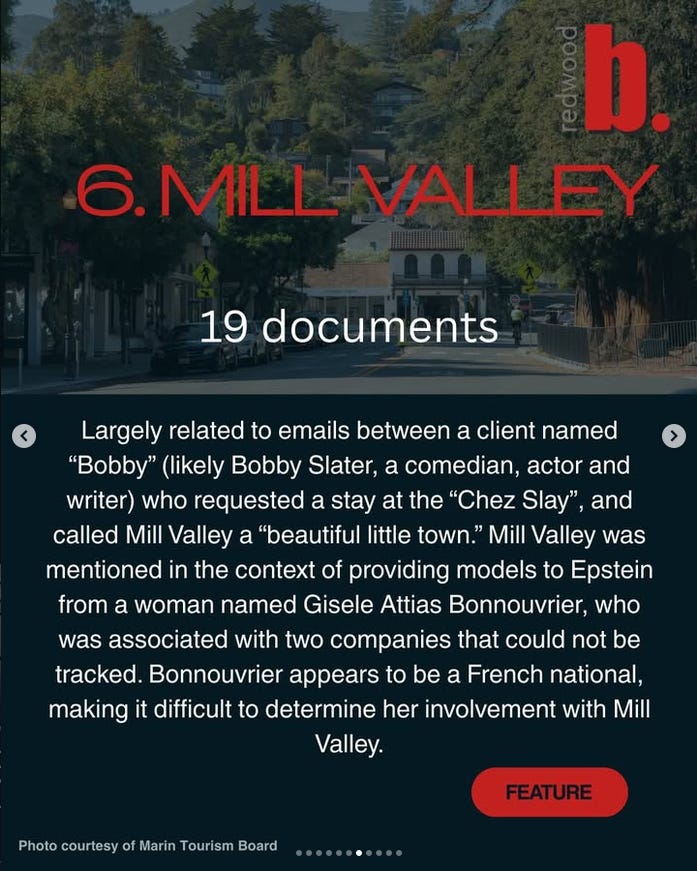
Ben Mueller is a senior at Redwood High who was taking a journalism class. He had an assignment to do a news story for the school newspaper, the Redwood Bark—on any subject—in the form of a slide show to be put on Instagram. This was in February, when access was granted to the public to view the Epstein files. Mueller’s idea was to see if there were any Marin County connections in the files. It is a logical supposition—Marin County is one of the richest in the USA and rich people like to hang out together. You can read his story “Which Marin Towns Were Mentioned in the Epstein Files” at the Redwood Bark’s Instagram feed. As I write this, his story has 5840 likes, but I expect that number to rise substantially now that Wired has published an article about him and the story, which caused a minor scandal in his community. Mueller’s approach was simple—he just entered the names of various Marin County hamlets into the Justice Department’s Epstein files search engine and reported the results. The slide that caused him and the Redwood Bark trouble was one about the town of Mill Valley. He wrote, “Mill Valley was mentioned in the context of providing models to Epstein from a woman named Gisele Attias Bonnouvrier, who was associated with two companies that could not be tracked. Bonnouvrier appears to be a French national, making it difficult to determine her involvement with Mill Valley.” The story was posted on February 12 this year.
Apparently word got back to Paris, because on February 23, Bonnouvrier emailed the principal of Redwood High claiming the post was defamatory and to take it down within 48 hours or they would be sued. However, there is nothing inaccurate about the article. Bonnouvrier did in fact email Jeffrey Epstein in 2013. The email starts in a purely business-like manner, describing the fees she charged for various modelling services, and concluding with the sentence, “Regarding Hannah, my Austrian model, we can come and see you this evening if you are interested , and in that case let me know how can I get my fees.” Epstein apparently found her fees too expensive.
The students lawyered up, of course, and their lawyer told them that nothing would happen because 1) every word in the piece was true, and 2) no lawyer would take a libel case from someone who was in the Epstein files (which is a little bit of a relief, honestly). Nonetheless, school officials were justifiably alarmed and the students temporarily took the story down. The journalism teacher Erin Schneider saw this as interference in the students first amendment rights and took a leave of absence to reevaluate whether she wanted to continue teaching the class in a censorious environment she had encountered in this and other cases. Bonnouvrier never followed through with her threat, and the post was put back up.
“Which Marin Towns Were Mentioned in the Epstein Files” is similar to “The Museum of Fine Arts vs The Epstein File” in that a local journalist followed up connecting the dots with the vast Epstein case and his hometown. But what really impressed me was Erin Schneider’s expansive idea of what student journalism could be. Wired wrote, “Schneider and her students had pushed the Bark beyond old-school print and basic web articles, expanding into Instagram, Facebook, TikTok, LinkedIn, and a podcast.” Her theory was that this was where most of her students were getting their news—it was their natural environment, unlike a print newspaper. It made me think that The Great God Pan Is Dead should expand into Instagram slideshows as well as this substack. It also makes me feel like my technique for dealing with the enormity of the Epstein rape empire by examining a fragment of it that is close to my already existing interests—art and the art world—is the right strategy.
Furthermore, I am of the opinion that for the good of America, Jeffrey Epstein’s best friend Donald Trump must release everything related to the Epstein case (unredacted), disband ICE, and resign.
[Please consider supporting this publication by subscribing, by becoming a patron, or you can also support it by patronizing our online store.]
No posts
Comments
Nothing yet. Say the first thing.
Sign in to join the conversation.