
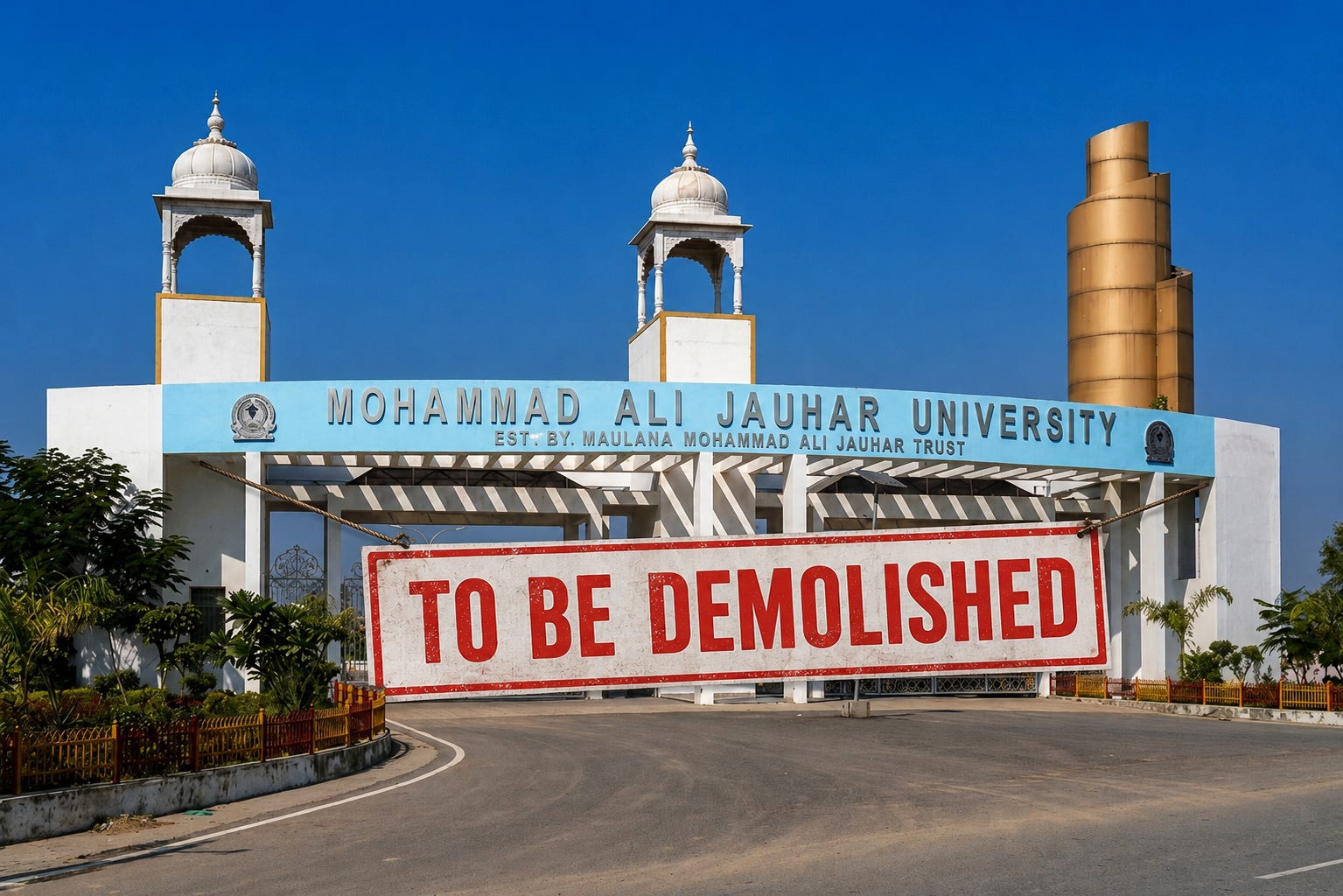
In the heart of Rampur, Uttar Pradesh, a university named after a freedom fighter is staring down the barrel of the bulldozer. Mohammad Ali Jauhar University — established in the mid-2000s and named after Maulana Mohammad Ali Jauhar, the Khilafat leader, Congress president and co-founder of Jamia Millia Islamia — faces an order to demolish 38 of its 40 buildings. The Rampur Development Authority issued the notice on 15 July 2026, giving the institution a short window to raze structures that house faculties, hostels, a library, an auditorium and more or watch the state do it and recover the cost.
Only the medical college block and one academic building have been deemed acceptable. The rest, spread across tens of thousands of square metres, are labelled unauthorised for lacking approved building plans under the Uttar Pradesh Urban Planning and Development Act. The university’s defence is straightforward: the campus in Singankhera village fell outside the RDA’s jurisdiction until September 2024. Construction happened earlier under Zila Panchayat oversight. Approvals were obtained where required at the time. Yet the authority has rejected this, insisting the management knew the rules because it secured permissions for two buildings and ignored them for the rest.
The timing is telling. The university was founded under the Mulayam Singh Yadav government (2003–2007) and continued operating through Mayawati’s full term (2007–2012). If the violations were as flagrant as now claimed, the entire state machinery had years to act. It did not. Serious, multi-agency pressure intensified only years later under the Yogi Adityanath administration, long after Azam Khan — the Samajwadi Party leader who drove the project and remains its chancellor — had become a high-profile political target. Nearly a hundred cases have been filed against him and associates since 2017, many linked to the university. In 2019 alone, a cluster of FIRs over alleged land issues appeared in quick succession more than a decade after the events they describe.
In June–July 2026 the coordination became impossible to ignore. Income Tax issued show-cause notices and cancelled the trust’s registration. The Fire Department, Public Works Department, and Jal Nigam followed with their own demands and boards. Then the RDA delivered the demolition order. Agencies that had remained silent for the better part of two decades suddenly discovered urgency in the same narrow window. Critics call this selective enforcement dressed up as the rule of law. Supporters of the government insist it is simply enforcing planning regulations that were ignored. The optics, however, are of an institution being squeezed from every direction at once.
The human cost is not abstract. Roughly 3,000 students study here. Many come from families for whom this campus offered accessible higher education in engineering, law, pharmacy, agriculture, and other fields. Nearly half are women. A significant number are Hindu. Protests erupted outside the gates. Students sat in the heat demanding the order be withdrawn, arguing that demolition would not merely punish a politician but erase years of education and leave them without a clear alternative. Some have said openly that the idea of renaming it “Jai Shri Ram University” or “Jai Gau Mata University,” install one of the self-appointed cow-protection goons roaming the streets as Vice-Chancellor and watch every pending notice, every map objection and every demolition threat evaporate in minutes. Bail orders would clear. Trust registration would be restored. The same buildings that are suddenly “illegal” after nearly two decades would become perfectly regularised. The message is clear — the problem is not the construction itself, but whose name the institution carries and whose politics it is associated with.
Land controversies have shadowed the project for years. Courts have examined claims of excess acquisition beyond the usual ceiling, alleged encroachment, and violations of conditions attached to earlier permissions. Portions of land have already been reclaimed. Those disputes remain live in various forums. Yet the current demolition order rests primarily on building-plan approvals, not a fresh adjudication of the entire land title. Turning an established university into rubble over map formalities, after the institution has functioned for nearly two decades, produced graduates and received recognition, raises a basic question of proportionality. Regularisation exists as a policy tool in many Indian states for constructions that have long been in place. Here the official position has been that agricultural land cannot be regularised and demolition is the only path left.
An interim stay by the Moradabad Divisional Commissioner has paused the bulldozers for now. The legal process continues. That pause is welcome, but it does not erase the message sent by the original order and the simultaneous barrage of notices. Education is not a partisan privilege. Institutions that serve thousands of students, including those from minority and disadvantaged backgrounds, should not be treated as disposable political trophies. When the response to longstanding regulatory questions is a sudden, multi-departmental campaign culminating in an order to demolish almost an entire campus, it looks less like neutral administration and more like the settling of scores.
The Yogi government has made “bulldozer justice” a signature style. Applied to illegal encroachments it can claim popular support. Applied to a functioning university named after a freedom fighter, with thousands of students whose futures hang in the balance, it reveals a different priority: power over pedagogy, symbolism over substance. If the goal is genuinely the rule of law, the state has courts, regularisation mechanisms, and time. Choosing the bulldozer instead tells its own story.
Sources
- Al Jazeera, “‘Future at stake’: India moves to demolish university Muslim leader founded,” 28 July 2026.
- Times of India, “‘Constructed without plan approval’: 38 buildings at Azam Khan’s Jauhar University to be demolished,” 15 July 2026.
- The Indian Express, “Fire, PWD, Income Tax, Jal Nigam: For a month now, notices from across departments to Jauhar University,” 27 July 2026.
- Mint, “Why 38 buildings at Azam Khan-founded university in Rampur face bulldozer action,” 16 July 2026.
- The Wire, “UP Govt Asks Mohammad Ali Jauhar University to Demolish 38 of 40 Buildings on Campus,” 16 July 2026.
- The Print, “Students, courts & bulldozer fears. The fight for UP’s Mohammad Ali Jauhar University,” 29 July 2026.
- India Today, “Why demolition sword hangs over Jauhar University?” 29 July 2026.
- Wikipedia and contemporaneous reporting on campus size (approximately 121 hectares / 300 acres) and institutional history.
No posts
Comments
Nothing yet. Say the first thing.
Sign in to join the conversation.