
Hi folks, I’ve spent the first half of this year writing a memoir, piece by piece, and putting up mini-chapters on Substack. This has been a wonderful project but for financial reasons I need to put it on hold for the foreseeable future. Thank you so much for reading, and if this resonated with you, I hope you will find ways to tell your own story and amplify the stories of others.
There’s clearly more work to do here.
“Every good tree bears good fruit, but the bad tree bears bad fruit. A good tree cannot bear bad fruit, nor can a bad tree bear good fruit … Thus you will know them by their fruits.”
In the beginning was the family. And the family was with God. And the family was god. We were with God, crammed into a Central Pennsylvania townhouse, in the beginning.
I joined the family on a sunny Sunday in the late eighties, too late to be the privileged firstborn son, and too early to be one of the magical twins. My big brother had a complicated birth, and carrying twins caused my Mom to swell so much she had to sit sideways at the dinner table. I was the easy one, she told me: smooth, painless, convenient. I didn’t make things complicated or stressful. Not in birth and not in life.
There was, I think, more connection to India in those early days. I heard stories about a trip to India in the eighteen months and two weeks between my birth and the arrival of the twins. I don’t know much about this interregnum but I did find 21 grainy, washed-out images of the trip that suggest it did happen.
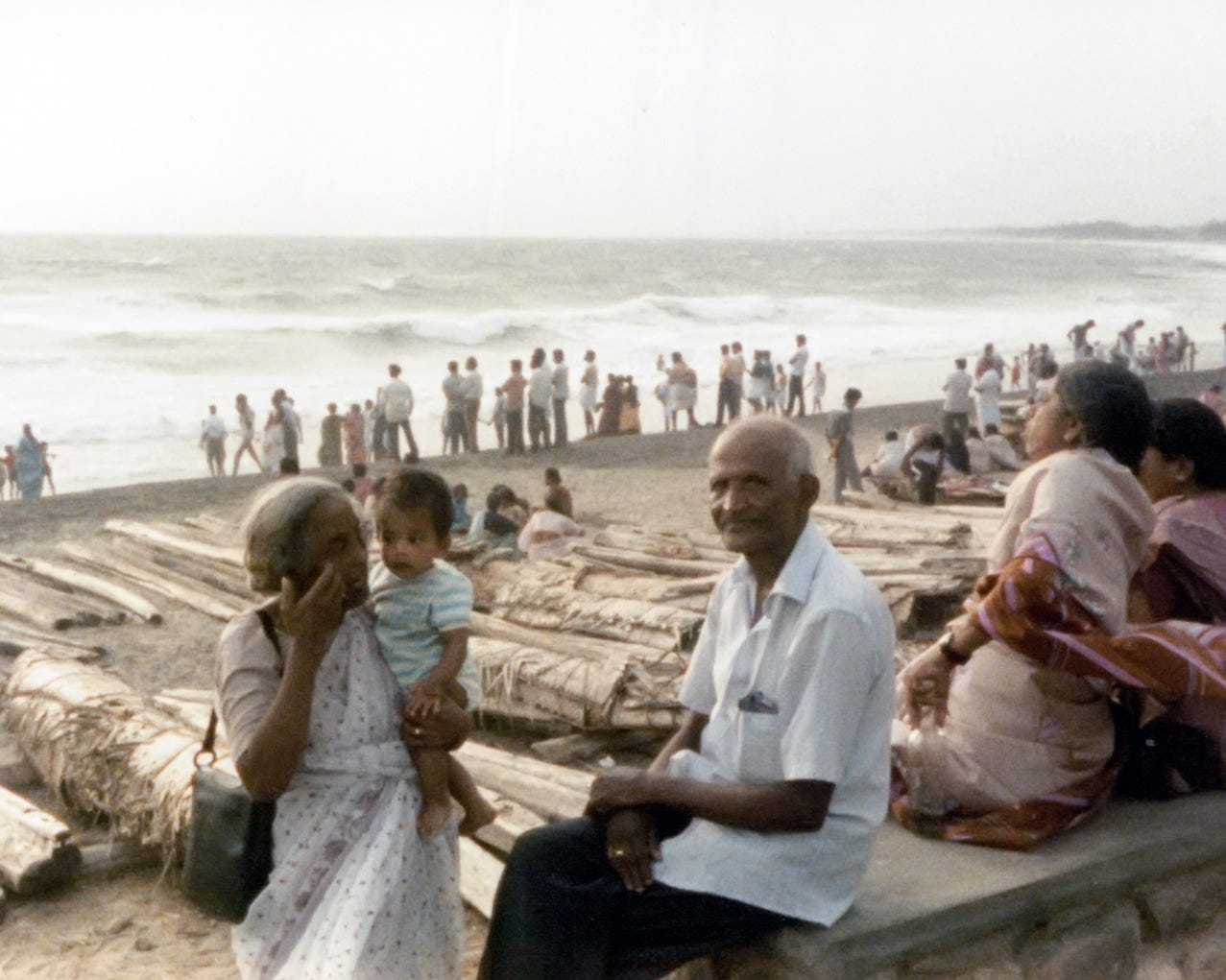
In one, I am at a beach with my Dad’s parents. Ammachi is holding me in the crook of her left arm, her right hand wiping her eye even as the wind catches her purple-flowered white sari. Appachin is seated to her right, in the center of the frame. Clad in a white collared shirt and dark slacks, his hands are in his lap, his eyes fixed dolefully at the camera. They already look like the elders I remember. Their hair gray, or in Appachin’s case, (mostly) missing. The surf, sand and sky are all gray too. I don’t know exactly when Ammachi’s dementia set in, but this may have been the one and only time I met her before she became lost in a blend of memory and present, fused by her imagination.
When my Mom was pregnant with the twins one of her sisters from the orphanage came over to look after me. After that, my aunt would pop in when she wasn’t jet-setting as a flight attendant for Cathay Pacific, a Hong Kong-based airline. She would bring presents, laugh a lot, and tell stories of far-away places and adventures on the other side of the globe. Her life was a cocktail of adventure and play, beautiful people and thrilling destinations, quite different from my cloistered suburban existence. But she was the only one of my Mom’s sisters that I had any regular contact with.
A steadier source of connection to India could have come from my Dad’s relatives. All of his siblings came to the States, with a contingent settling in South Jersey. But pretty quickly into my parents’ marriage, a rift opened up. The story I’ve heard is that one of my Dad’s sisters borrowed a car and there was a disagreement about how or when she was to return it. But whatever the circumstances, the result was severe: my Mother cut off all contact with this aunt. She refused to reconcile, much less be civil or be in the same room with my aunt. The result was that visits to our Jersey family were brief and sporadic.
After a few years in Pennsylvania, my family moved to Ontario, in Canada, for my Dad’s job. At that point Appachan and Ammachi had come to America and they came to live with us. But Ammachi’s dementia had gotten pretty bad by that point. She ended up locking us kids in a bedroom and sitting in front of the door with a knife in her hand to keep our Mom from getting to us. I think my Dad had to come home to get her to stand down. My grandparents didn’t live with us for a while after that.
My parents did not watch Bollywood films and did not listen to Indian music. They did not speak Hindi to each other or to us. And they only speak their mother tongues of Marathi and Malayalam on the phone to relatives. English was the soundtrack of our home: Disney movies on VHS, children’s books and tapes, Christian worship songs from church, and Sesame Street on PBS.
Remember, this was the 80s. Schoolhouse Rock was singing about “The Great American Melting Pot,” the idea that immigrants would shed their cultural distinctions to blend into white mainstream culture.1 Once, when I asked my Mom why she didn’t teach us kids Marathi or Hindi she said she didn’t want us to grow up confused between languages. I suppose that if I had gone to daycare or school, I could have learned one language at home and another outside the home. But since I was homeschooled, home was pretty much all there was.
A few years ago now, I was out with my Dad and someone tried to speak Malayalam to both of us. My Dad laughed and started to make fun of me. “He’s an American,” my Dad said, “he doesn’t speak Malayalam.” This time, after decades of awkwardness and quiet shame, I was ready to challenge him. “And whose fault is that?” I asked. “Whose job was it to teach me Malayalam?”
Words failed him.
There’s a very mean way of referring to children of the South Asian diaspora raised in majority white countries: coconuts. Brown on the outside but white on the inside.2 I used to tell my white friends that’s what I was: a white kid who happened to have brown skin, black hair and a funny name. Other than that, I was just like them.
But of course, I wasn’t. And after being born in Pennsylvania and living in Ontario, I was headed to the place where all the contradictions about religion and race in America come to the surface: the South.
https://genius.com/Schoolhouse-rock-the-great-american-melting-pot-lyrics
https://www.independent.co.uk/news/uk/home-news/coconut-racist-palestine-march-sunak-braverman-b2447123.html
Comments
Nothing yet. Say the first thing.
Sign in to join the conversation.