
Every once in a while something happens which is too big to ignore. An event that changes the way we think about limitations - and over the past week we had one of these.
DARPA is a US military research arm specializing in “moonshot” research. They’re best known for creating ARPANET, which we now know as The Internet.
About one year ago, they posed a challenge: Build a drone which can lift four times its weight, and carry it 4 nautical miles. And over the past week, competitors in that challenge came together to show what they could do.
Up until last week, it was generally considered that the maximum payload any flying machine could lift was about equal to its own weight. Everything from specialized heavy-lifting drones up to cargo planes and military helicopters limit out at just about 1 to 1.
Even 2 to 1 was considered an impossible task and 4 to 1 was called crazy, but the domain of “crazy” is where DARPA lives.
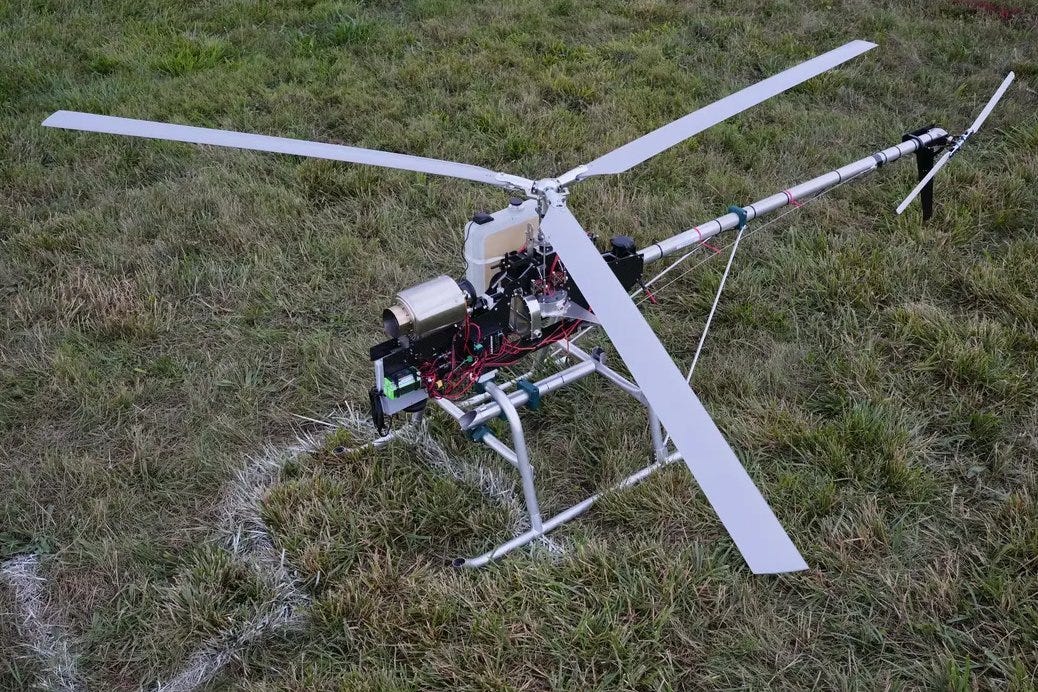
Now we know, 2 to 1 lift is actually very realistic. 3 to 1 is hard, and 4 to 1, while not fully demonstrated, is now clearly within the realm of possibility. The three top prizes went to Avidrone with an electric helicopter, Mtech with a classical style drone running very special auto-pilot software, and Xtreme Aerial with another helicopter, this one powered by an 8 pound micro-turbine putting out around 25 horsepower.
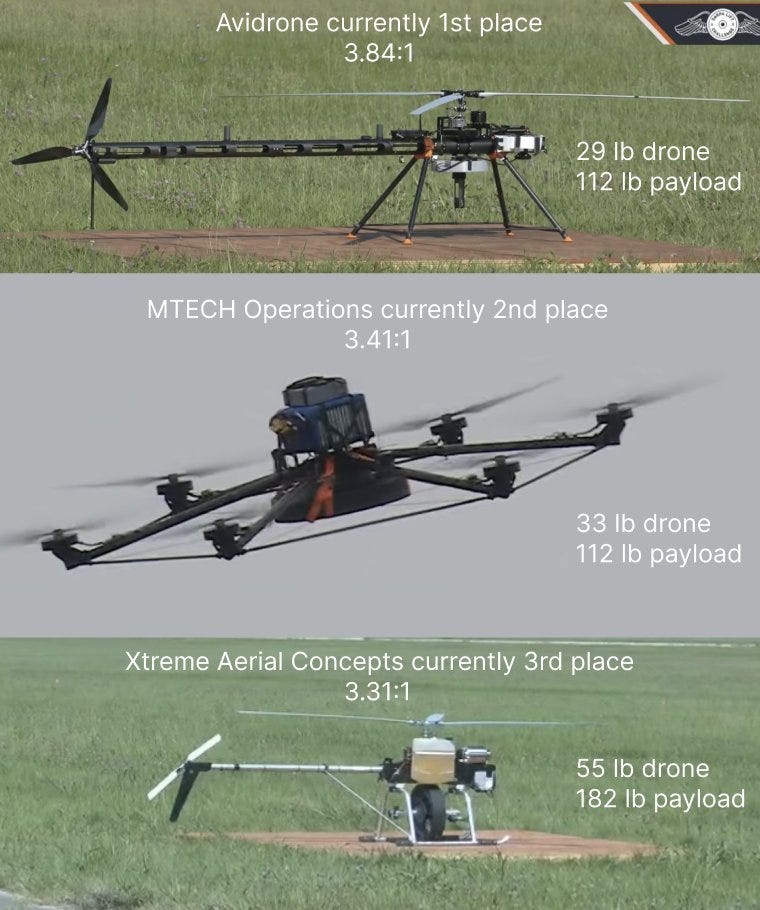
Nobody managed to carry 4 to 1 the entire course, but Avidrone and Mtech both attempted it, and both had spectacular failures. Avidrone lost the drive belt to their tail rotor, and came down spinning. Mtech broke a motor mount and fell into a catastrophic battery fire.
But Mtech was undeterred, they pulled an ALL NIGHTER to build another drone from spare parts so they could compete in the final day. And this final run by Mtech would be the most nail-biting drama of the entire event.
Because of time constraints, each team would only have one flight window - 30 minutes to make their run, that’s it.
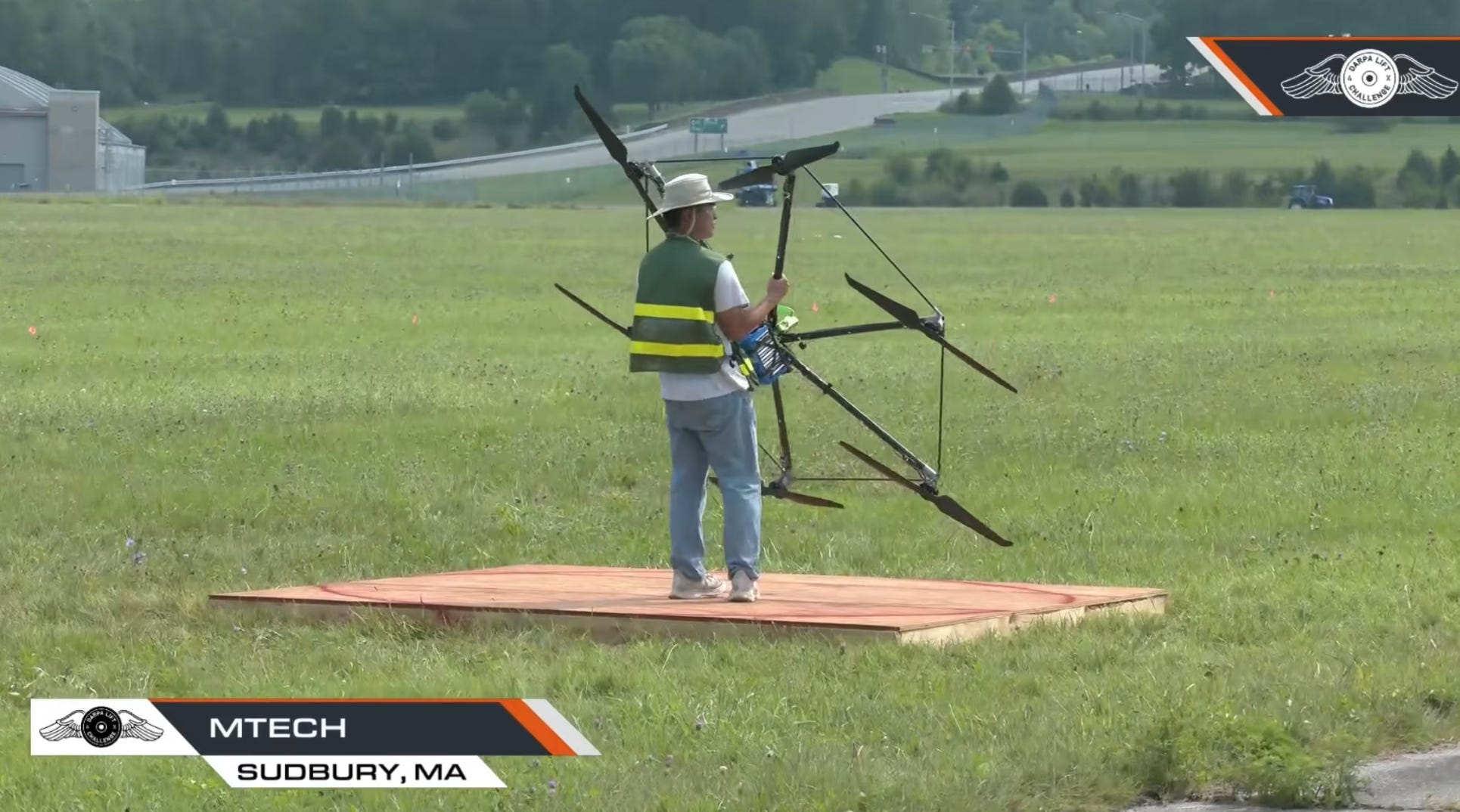
And when Mtech got onto the field in their 30 minute flight window, they found their compass wasn’t working and they had to re-calibrate it. Re-calibrating the compass is a laborious process involving holding the drone while turning in 360 degree circles so that the software can differentiate what is the earth’s magnetic field from magnetic interference of the drone itself.
With the clock ticking, they finished their calibration and went up for a run at 4 to 1. But they were abruptly forced to end it because the compass FELL OFF OF THE DRONE. With no sleep, building a drone from scratch, they had apparently not remembered to secure it properly.
Their entire strategy depended on a fine tuned autonomous flight program and without the compass, it was not going to work.
Back on the ground, they had just about 20 minutes left to fix the compass, swap in the spare battery, and send it. JUST KIDDING, the spare battery went up in flames the day prior. They actually had 20 minutes to shove whatever charge they could into the only battery they had left - whilst cooling it with a leaf blower, then re-attach it, and pray.
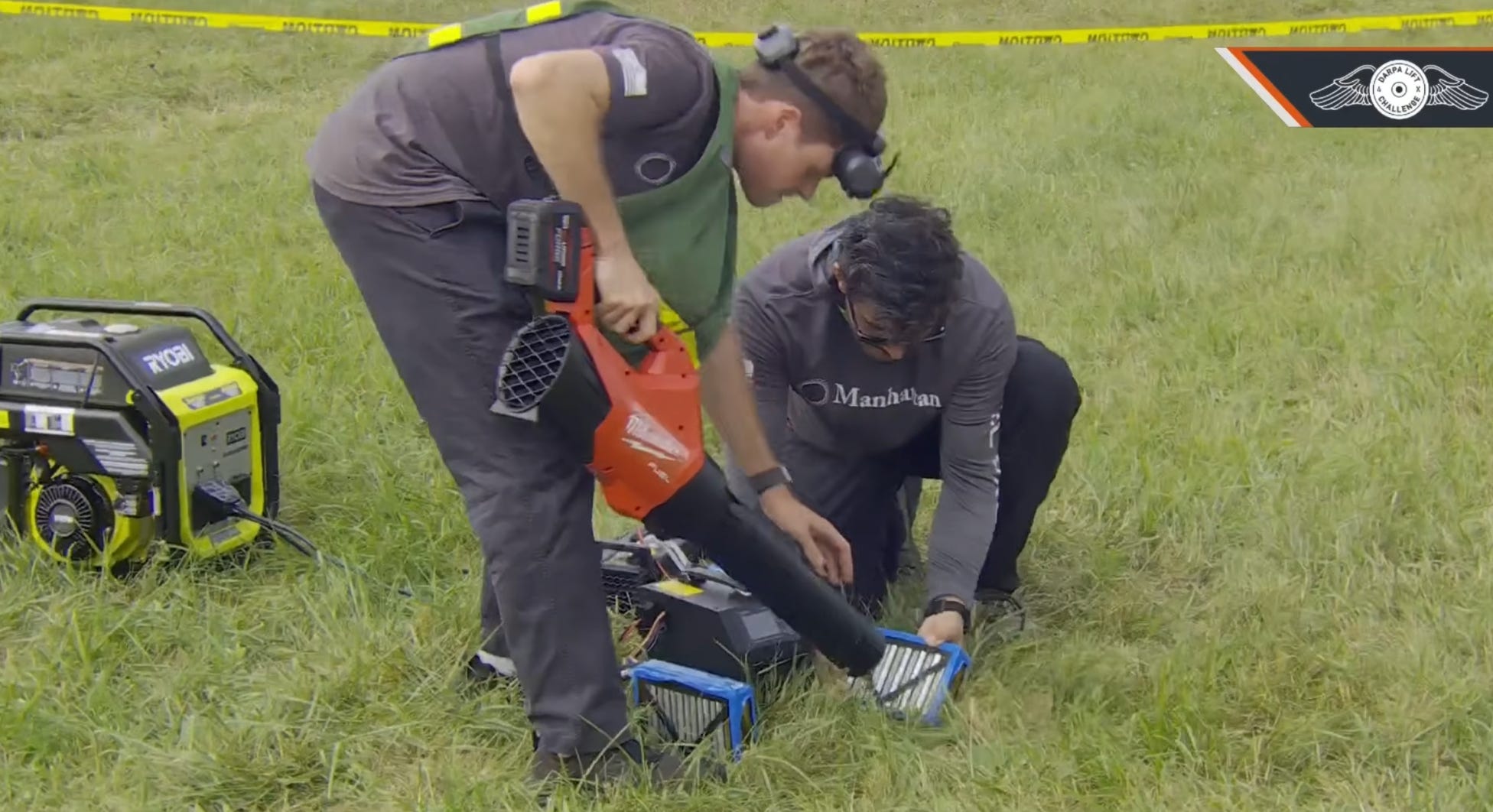
Strapping down the batteries while running the leaf blower on the (still hot) propeller motors. Now with just over 10 minutes to spare, they let it rip.
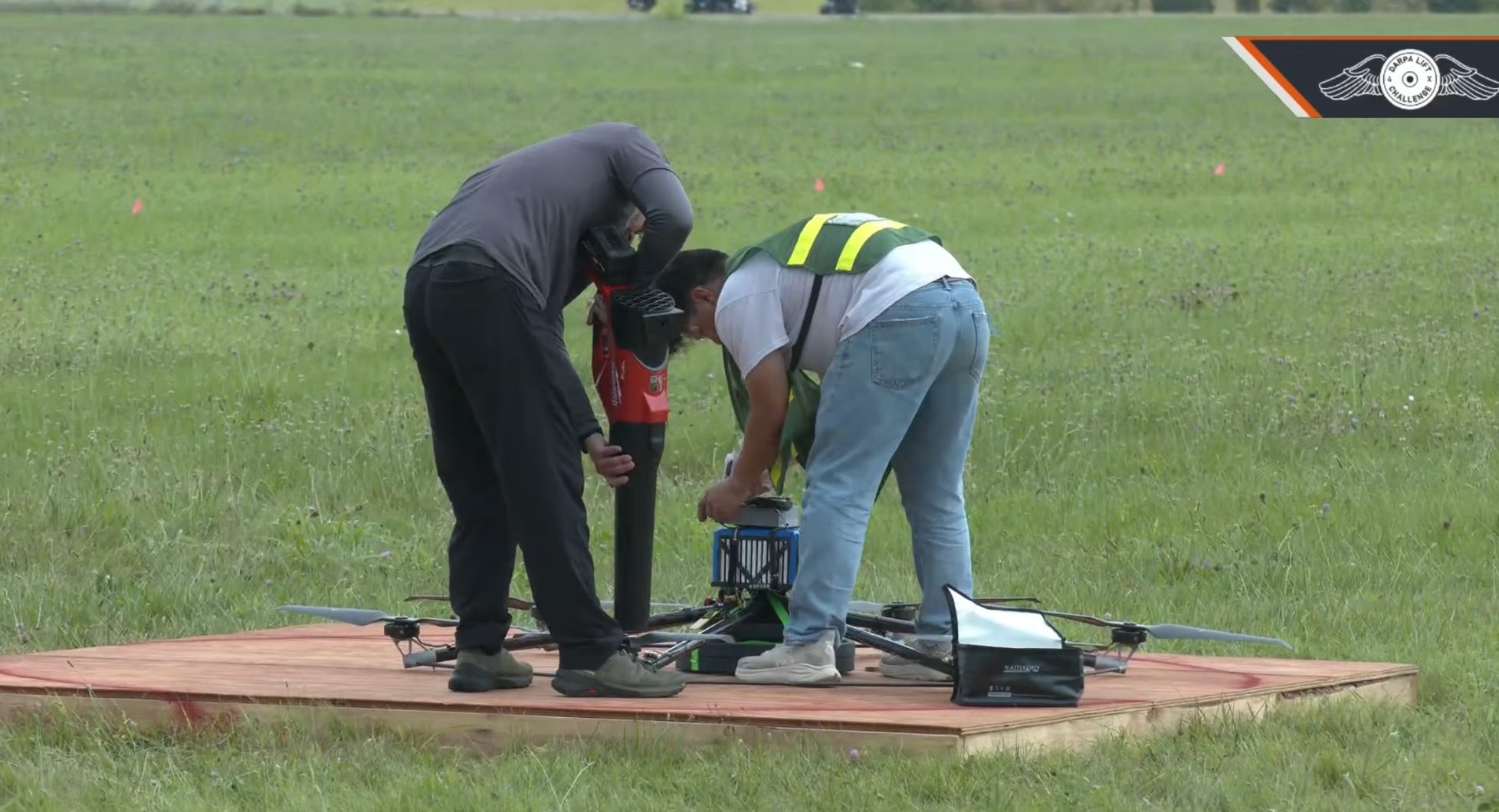
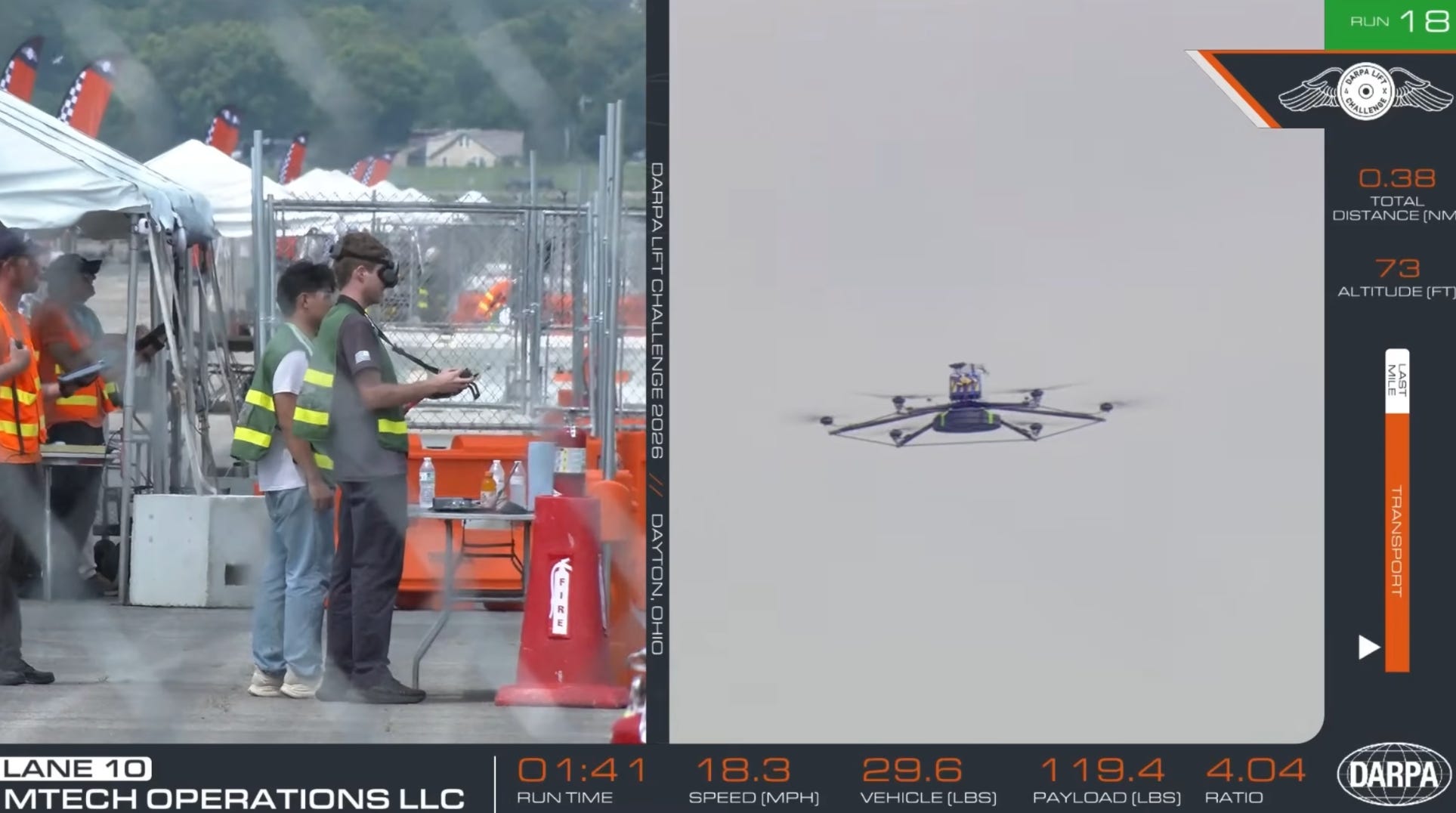
And boy did it ever. The 30 pound drone strapped with 120 pounds of plates took off like it had been fired out of a slingshot, rapidly reaching 30 miles per hour.
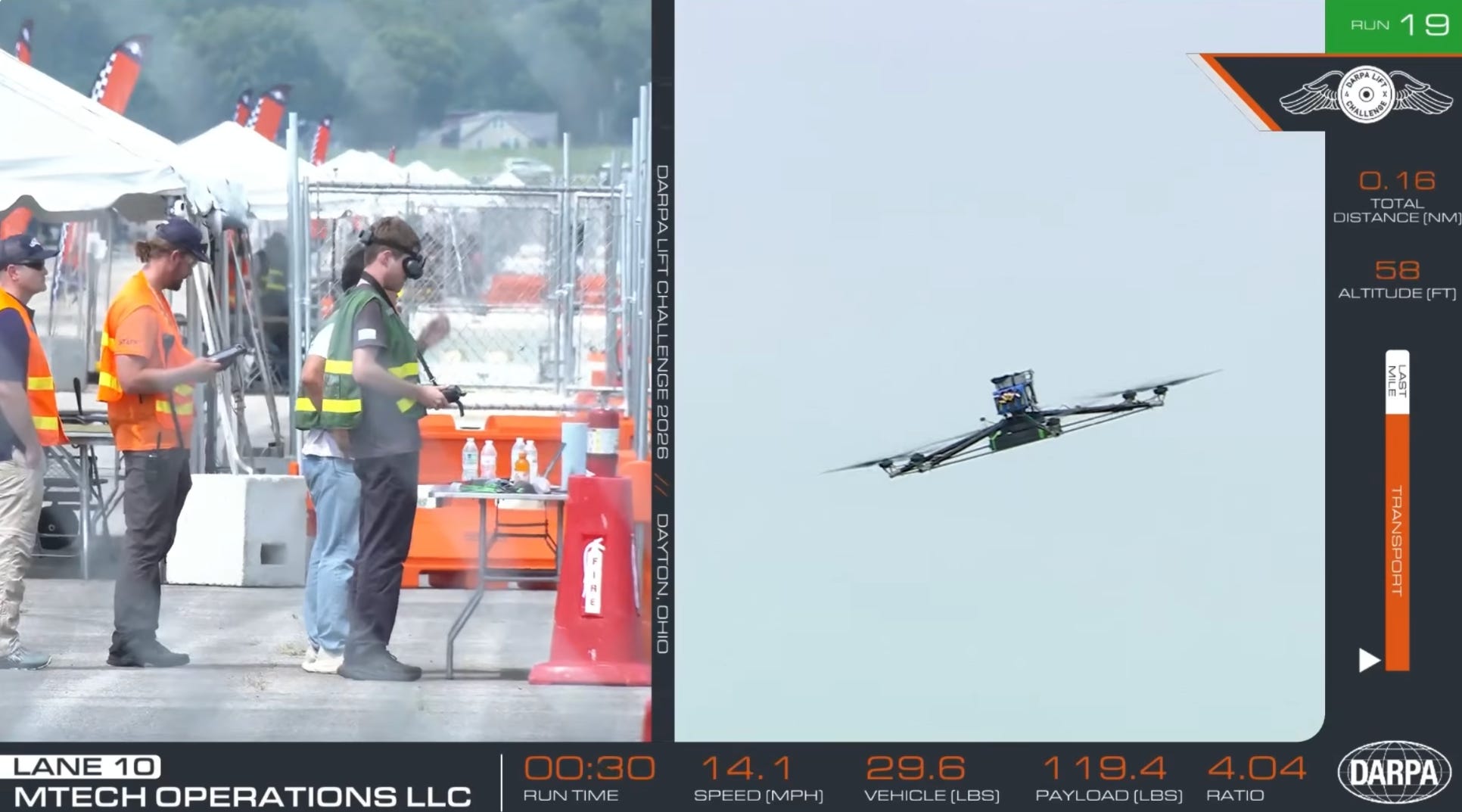
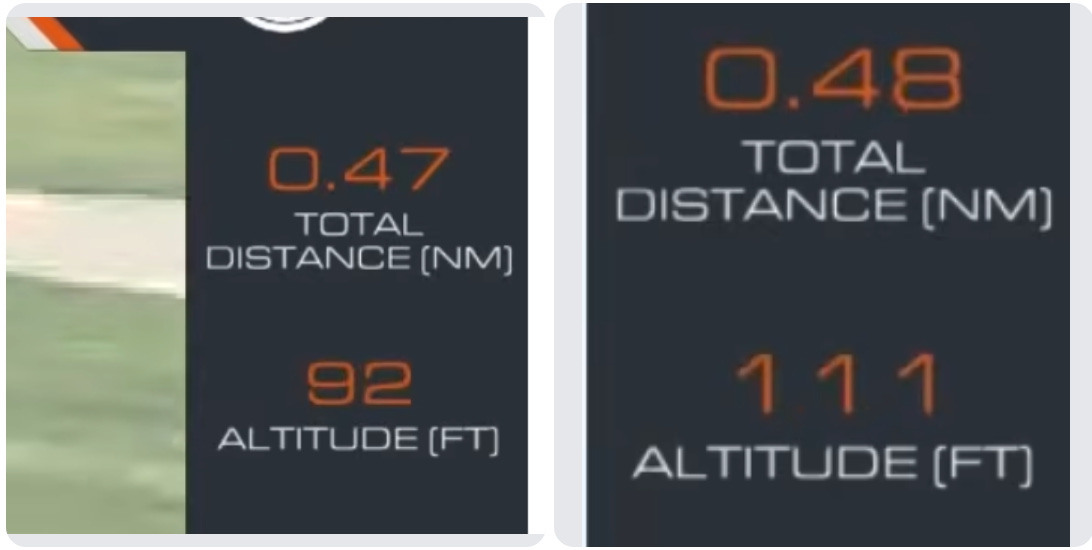
But as it approached half a nautical mile, it became clear that something was wrong. The drone was flying too low. By the rules, contestants need to keep an elevation no less than 100 feet - but they have the first 0.50 nautical miles to climb to that elevation.
At 0.45 they were well below the limit.
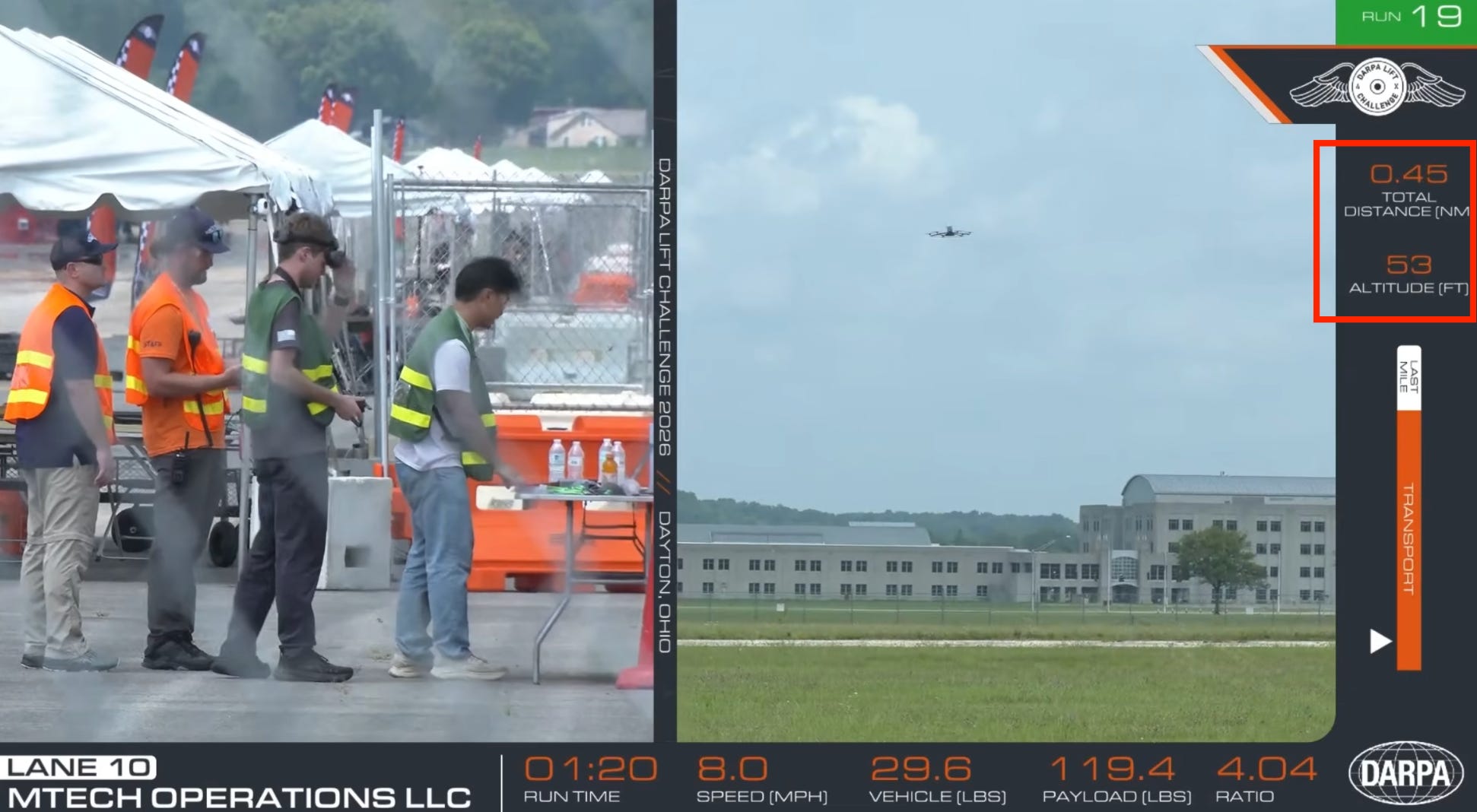
Luke Bell said later in an interview that had programmed the autopilot to target 45 meters (150 feet), but he was getting so frustrated with the metric units for his programming and the American units for the competition rules - eventually he switched to all American.
But having not slept at all the night before, he forgot that it was still 45, so it was targeting 45 feet.
They caught this just in time, the drone was doing 30 miles an hour when they fixed the number. As soon as they changed it, the drone shot up like a rocket, crossing 100 feet with 40 yards of a disqualification.
From that point on, the run was absolutely impressive. Less than 10 minutes left before the closing of the flight window, it ripped the course averaging 30 miles an hour between turns.
This drone flew nothing like any of the others - which generally focused on slow steady methodical progress. For a 30 pound flying machine to carry 120 pounds of plates is impressive to begin with.
Seeing it rip-roaring at 30 miles an hour down to one end, slamming on the brakes, turning around, and accelerating back - was a sight to behold.
The announcers supposed that they were going for broke because they were up against the clock. Later in a interview Luke (a multiple-time drone racing record holder) indicated that actually the auto-pilot goes very fast because every minute spent in the air is drawing power out of the battery. So it's actually better to just fucking send it.
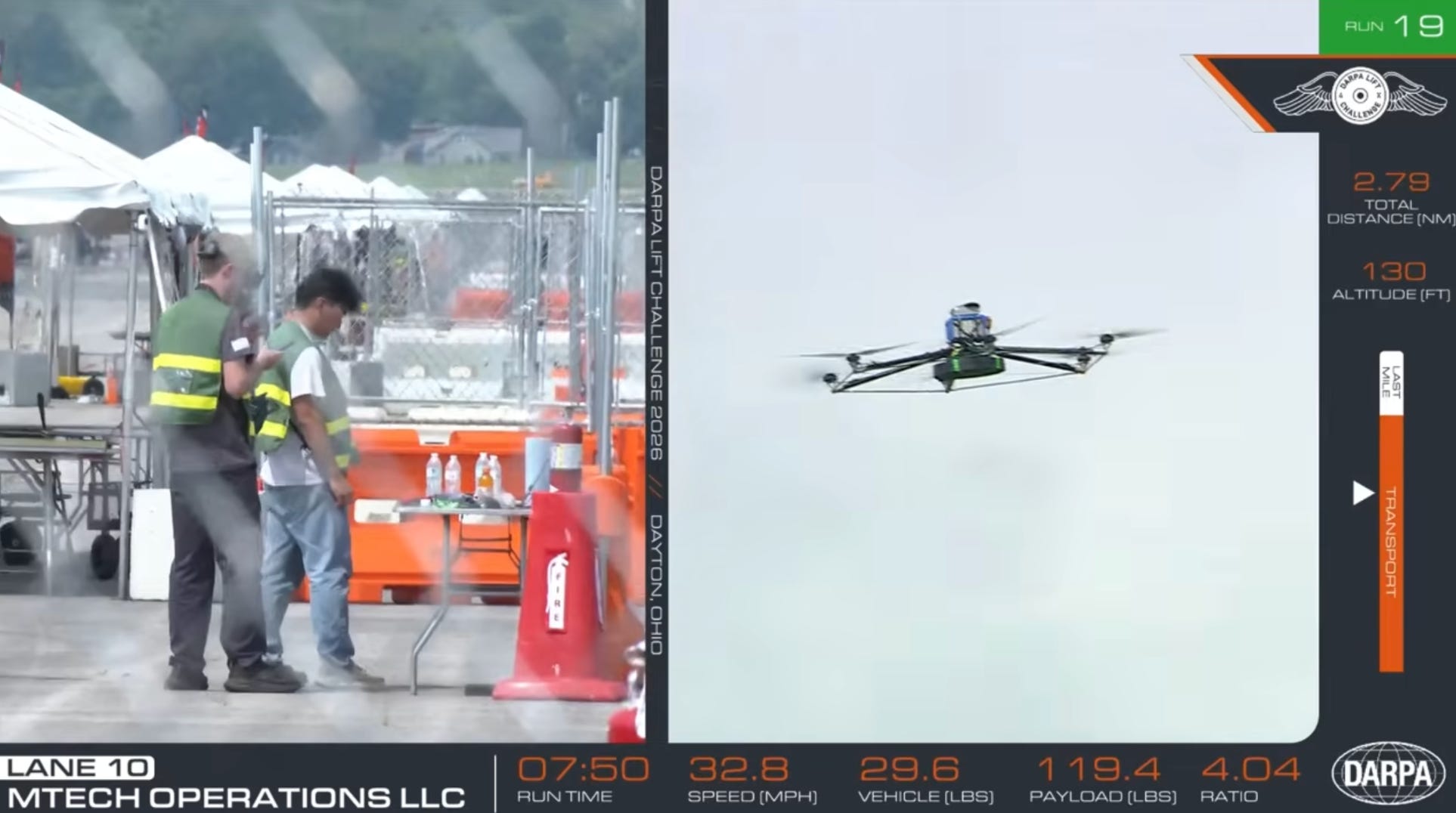
Mtech was on track to win first place with the only 4 to 1 lift ratio when (for some reason) at 2.99 nautical miles, the drone just gave up.
As it was falling, Luke grabbed manual and held the throttle wide open, but to no avail. It had had enough.
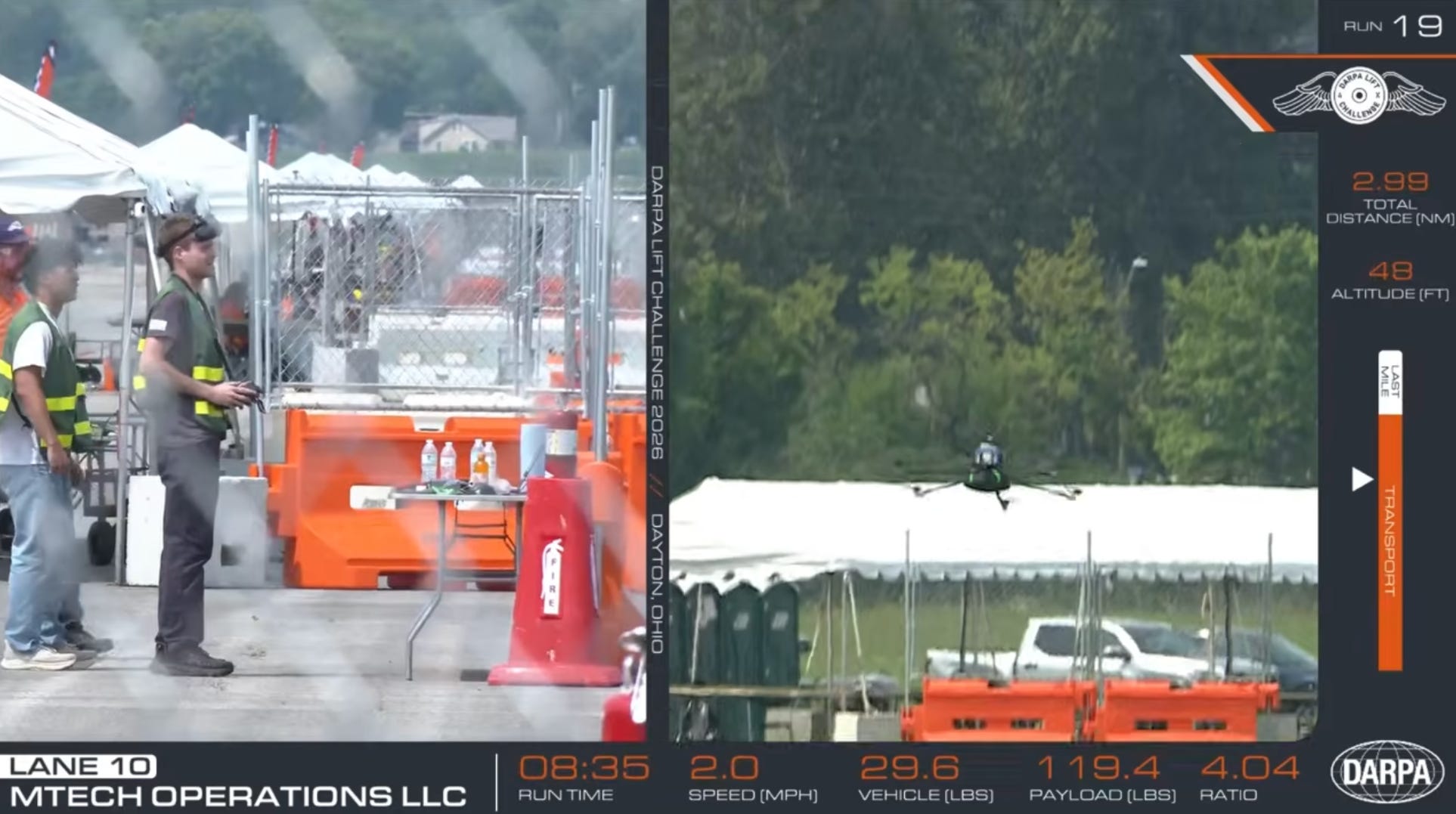
It's still not known exactly what happened, but as they walked off the field, all of the top organizers came to shake their hands because even if they hadn't managed to take first place - they just did something that nobody else has ever done before. They carried 4 times their weight 2.99 nautical miles.
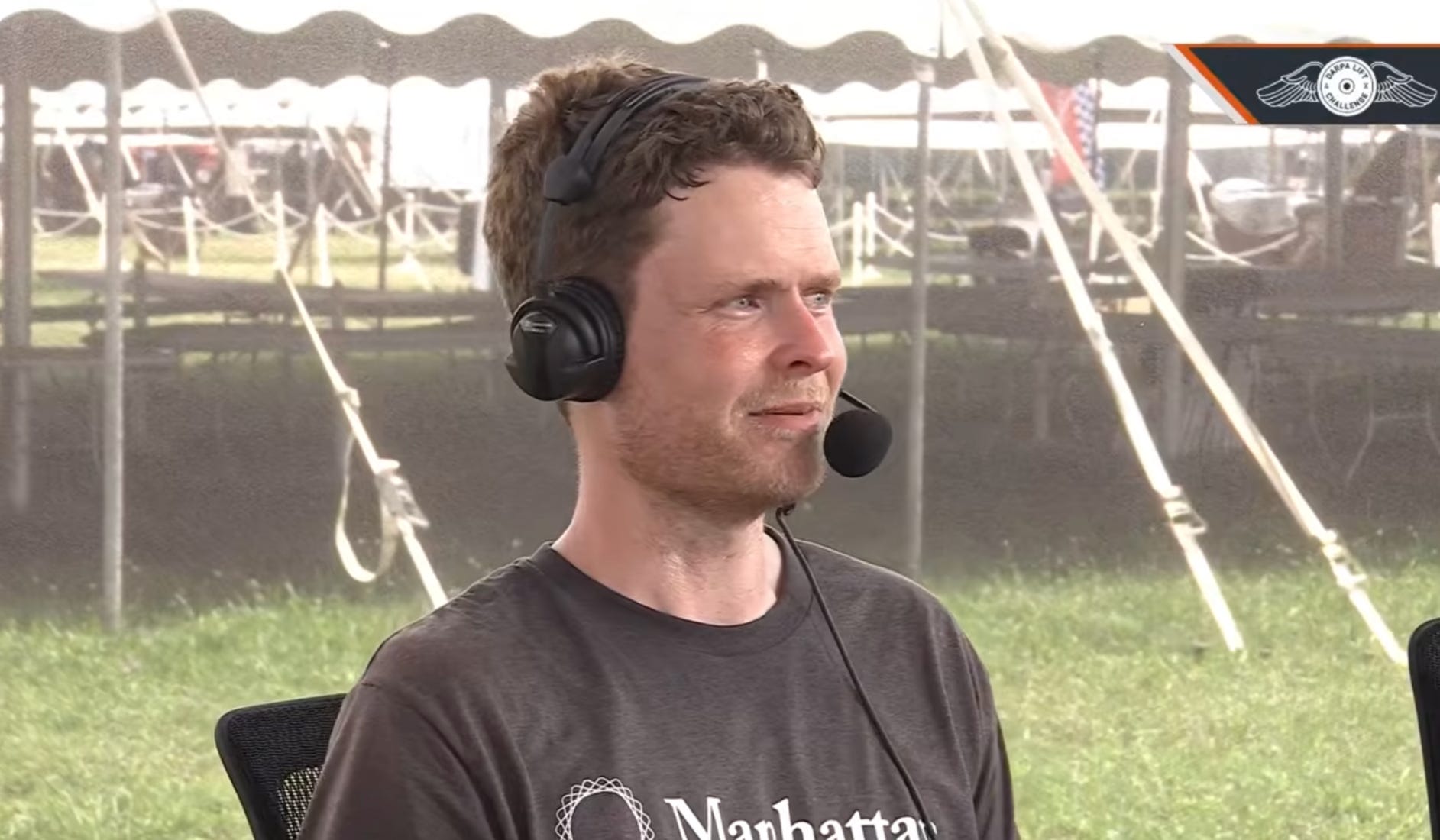
Luke Bell, and his father Mike, hold the Guinness book of world records drone speed record for a racing drone that managed 408 miles per hour.
They also hold endurance records for longest hovering drone, and they almost managed 1st place for the lift challenge and a 4 to 1 lift ratio.
As it stands, they got second place, but their final run was definitely the most exciting in the competition.
They're from Cape Town South Africa, so raise a glass for Boer engineering!
The 3rd place winner (Xtreme aerial) was a microturbine helicopter. And that turbine is extremely light and small - which is very impressive.
The 1st place winner (Avidrone) was an electric helicopter. The advantage that helicopters have over a quadcopter / hexacopter drone is control.
For a drone to react to a gust of wind tilting it forward, it must add power to the forward two rotors while reducing power in the rear. This works fine when it is not heavily loaded, but as it nears its full load capacity, there is no more power to add, and any reduction of power will cause a loss of altitude.
A helicopter by contrast is able to pitch its main rotor blades near-instantaneously, and in fact they change pitch as they swing around, so if more lift is needed in the front, then the blade will bite more air as it passes around front and less as it passes around back. The motor or engine is thus able to maintain continuous load.
Even though Mtech is “just a battery powered 6-copter”, the cleverness of their racing autopilot, the low cost that allowed them to rebuild after total destruction, and the sheer grit of the team has a special place in my heart.
I think the takeaway from this event is that “quadcopter” style drone technology is NOT tapped out. Helicopters are great, but quadcopter style drones can achieve the mission, and their cost and simplicity will probably win in the end. Furthermore, the same is true for turbines. Yes, they are very effective, but batteries can also achieve the mission, and their cost and simplicity will probably win in the end.
One particularly interesting competitor was a company called DefendTex. They came with a drone in the 11-16lb range (it gained some weight after subsequent crash and rebuilds).
The minimum weight you could carry was 110 pounds (50ish kg), so their weight ratio was 9 to 1, and later 6 to 1 - very impressive numbers.
They didn't last very long in the air, but their big "wow" concept was that they had 4 regular drone motors, geared down to drive larger props slower. This is kind of brilliant because as you increase the prop size, you lower the speed, and you get more thrust for the same power input because larger blades are more efficient.
The challenge is that those motors still need to rapidly change the speed of the propellers to react to gusts of wind. So if the props are too heavy, the motors are lazy and the wind flips you over. If the props are too light, they snap - which is how their last run ended.
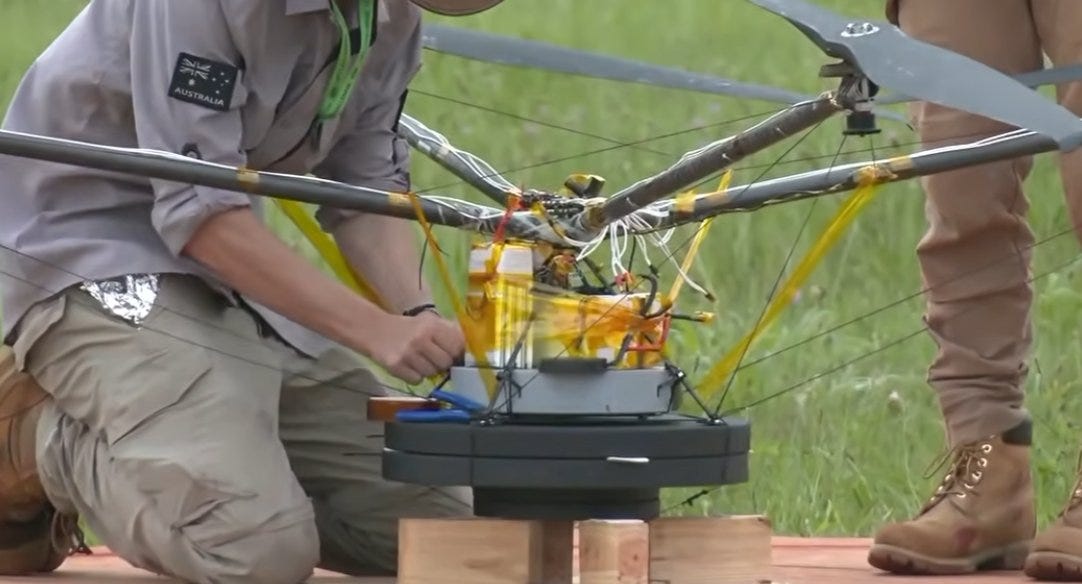
Another idea that is just too good to ignore came from a company called Dmaterial.
The main body of their drone was a “balloon” made of Dyneema ultra-high-molecular-weight polyethylene fiber. They inflated it to 30psi (about the same as a car tire) giving it fantastic rigidity.
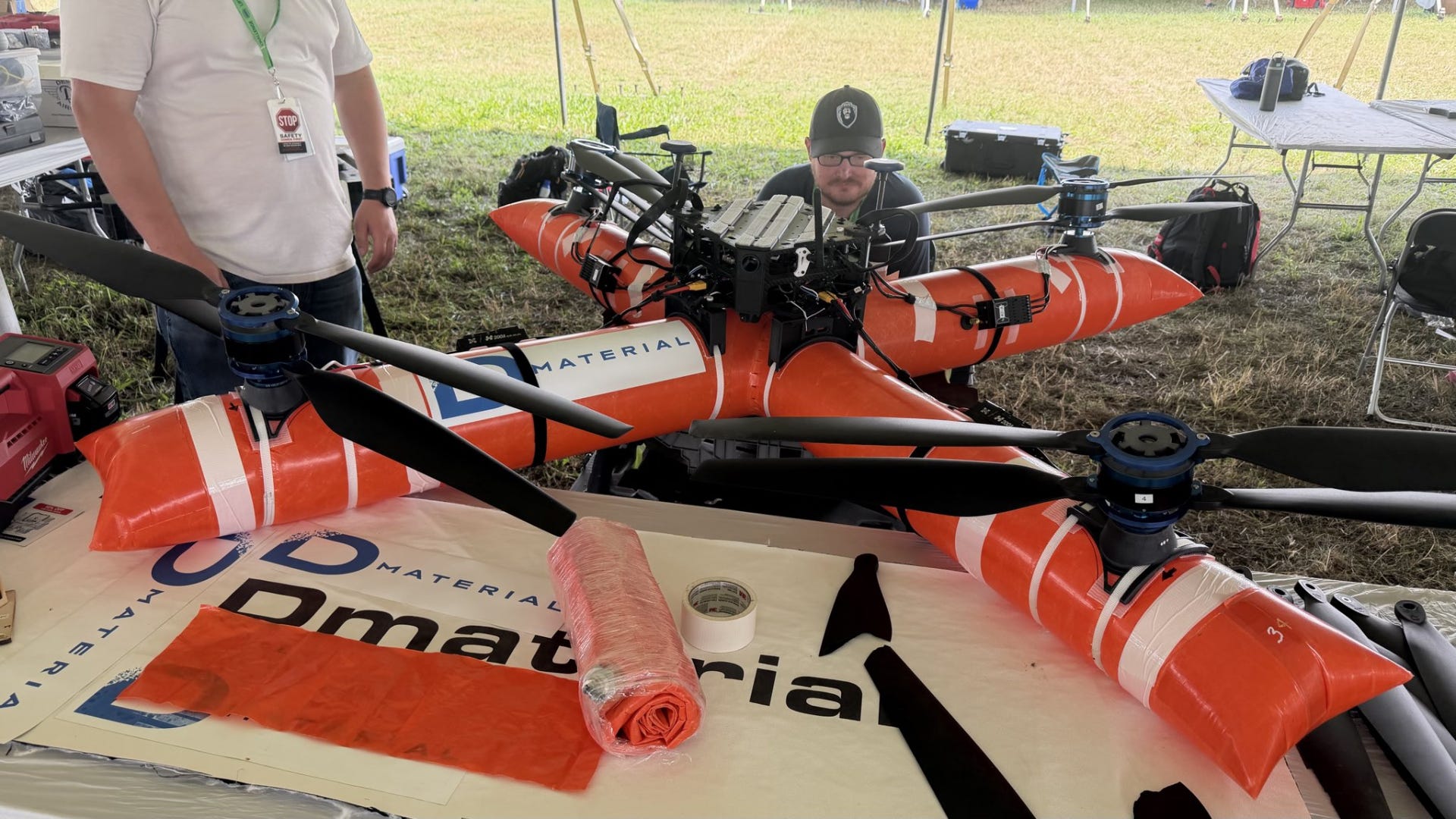
Its generally understood that the best shape to handle bending load is a tube. A tube is better than a solid rod because the outer skin of the tube has the best leverage to resist the bending force. So not making it hollow adds unnecessary weight.
For a given weight, the biggest, thinnest walled tube will have the best leverage against bending. A tubular frame member has another failure mode where collapses and kinks - because the tube has both a tension side and a compression side. As the wall becomes thinner, the compression resistance weakens.
So practically, tube frames must be balanced between diameter which provides better leverage, and wall thickness which improves performance under compressive load.
Dmaterial did an end-run on this entire problem by making “tube frame” very large, and adding a secondary material which only handles compressive force. This material is exceedingly light weight because it is compressed air.
They had navigation difficulties which prevented them from getting into the top contestants, but when their drone crashed, it just bounced off the ground with no visible flexing or frame damage at all.
Comparing that to carbon fiber which shatters every time it impacts the ground, this is just a game changer. And it has a wide array of potential applications, from wings or tail assembly made as high pressure balloons, to closed cell form moldings that are cast under high pressure so the trapped gas provides compressive support.
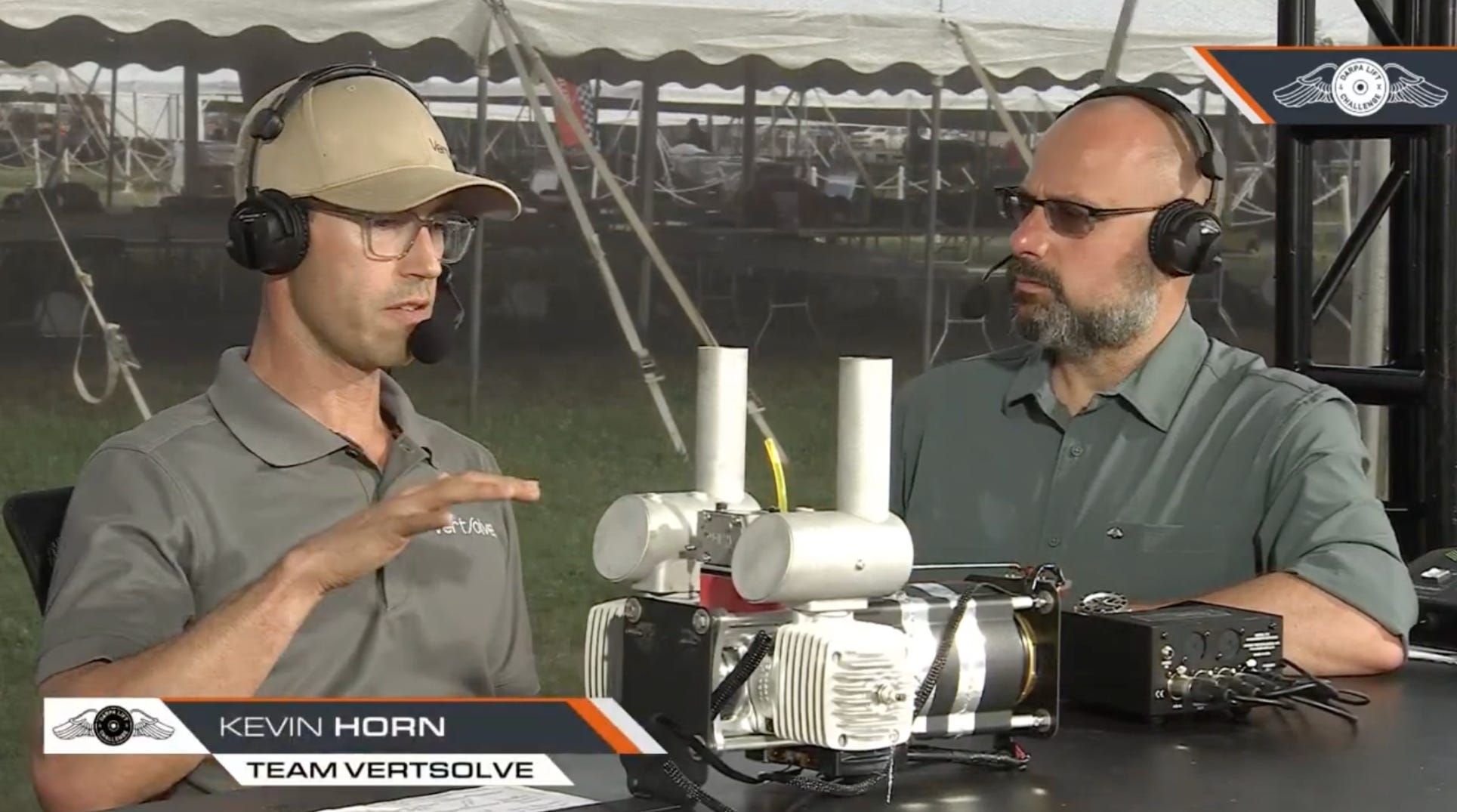
Another contestant which I think deserves special mention is Team VertSolve. They did many people have thought of, but which is typically dismissed because it sounds so dumb. They bolted an internal combustion engine to a generator, then used the electricity to drive the rotors on a classic quadcopter.
This is considered “dumb” because you have a generator (weight) to convert mechanical power to electrical power (loss) to then send it to a motor (more weight) to convert it back to mechanical power again (more loss). This is an idea that gets thought of over and over, and then it gets dismissed over and over, because every time you compare it to a mechanical drivetrain, it looks like nothing more than a bunch of unnecessary weight and energy loss.
Even most hybrid electric cars don’t work this way, instead using the motors as an assist booster to help the engine - which is still mechanically coupled to the wheels.
However, quadcopters are a very special case, because the entire control theory for a quadcopter rests on the controller being able to adjust the speed of the 4 propellers quickly. Internal combustion engines cannot change speed fast enough, which is why nobody builds a quadcopters powered by 4 nitromethane model airplane engines.
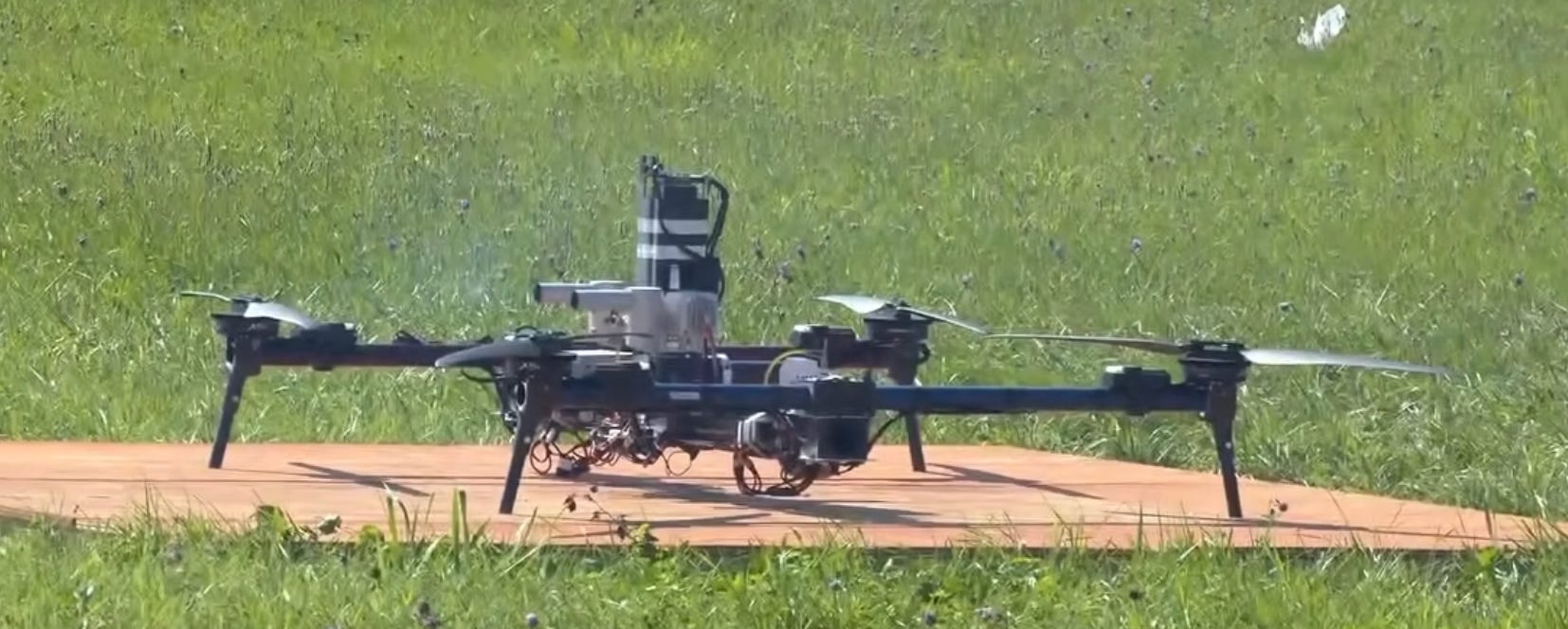
Furthermore, what makes this idea smart is the fact that the engine becomes a drop-in replacement for a battery. And while it is heavy and lossy compared to a hypothesized mechanical drivetrain, it is actually very competitive when compared to a battery. The VertSolve team made multiple flights with both the engine and a battery, showing that they are indeed fully interchangeable.
There were a number of self-propelled rotor entries that can only be described as a flying ceiling fan.
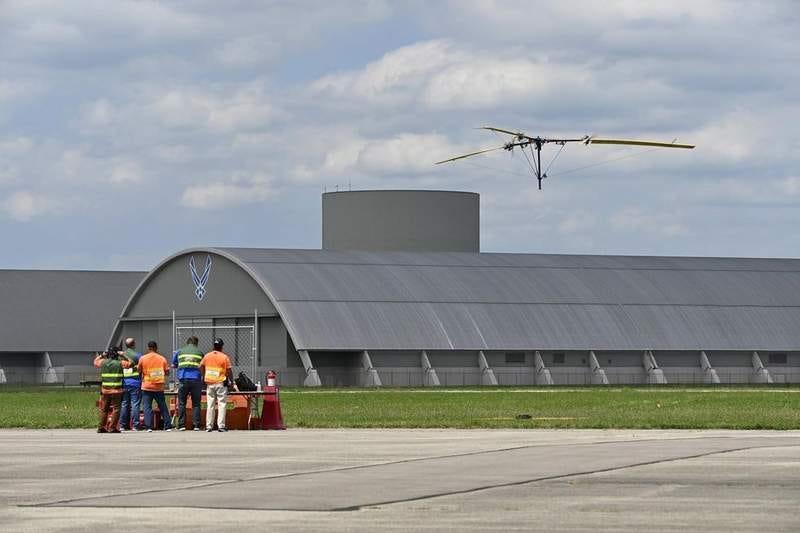
The idea is that if you take a helicopter and drive the rotor using a propeller fixed to the rotor itself, you can eliminate the tail, which allows you to eliminate the fuselage, which allows you to eliminate pretty much everything other than the rotor itself. What remains is best described as a big flying ceiling fan.
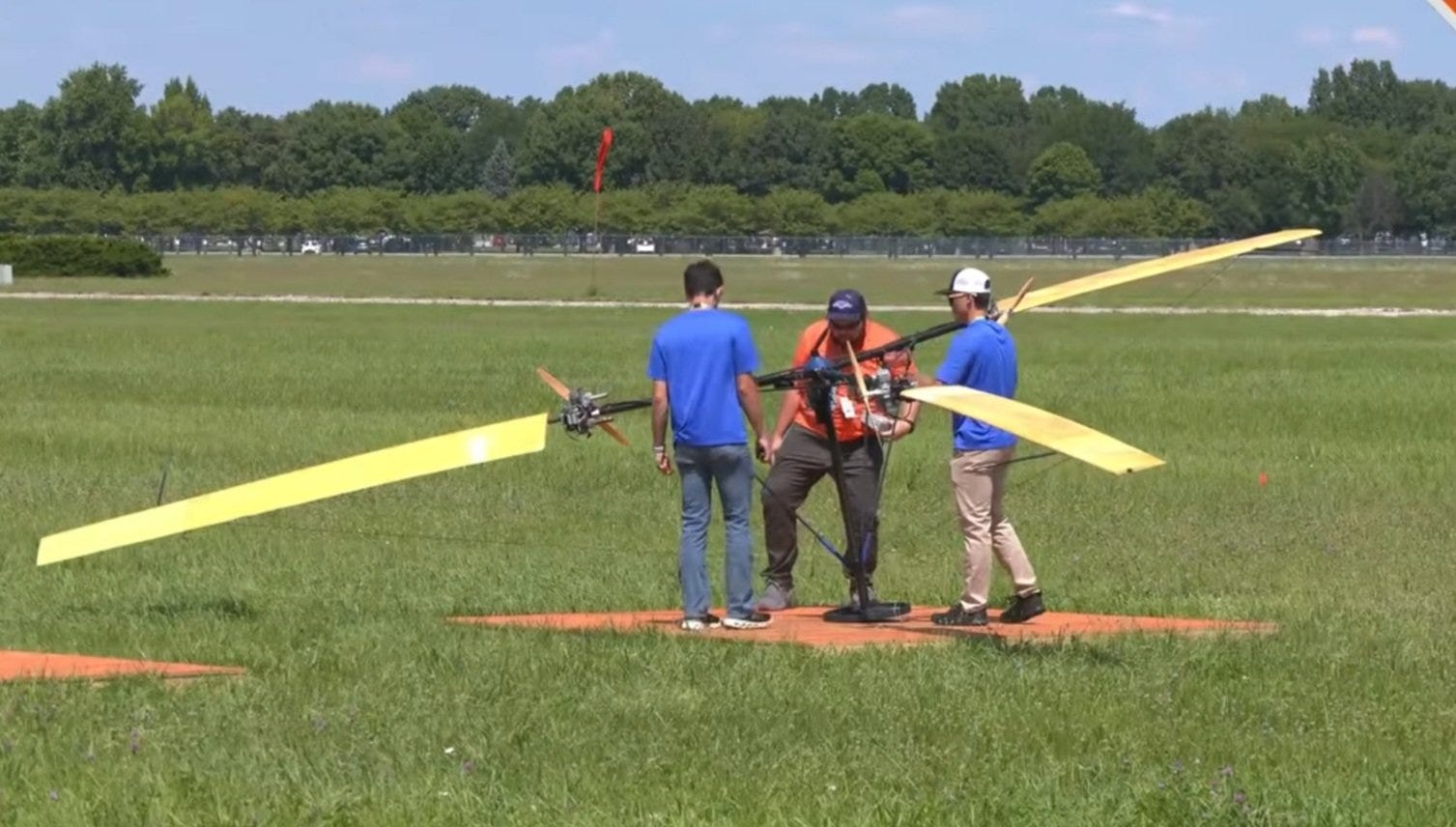
These have the same advantages as the helicopters in that they do not need a “reserve” of unused power because they steer by pitching the rotors rather than adjusting the power output. They also have the same advantage in that their rotors are positively massive which dramatically improves efficiency.
This technology strikes me as something that will require a lot of R&D to become stable, but on the other hand it shows a lot of promise in the longer term so I suspect we may see more of this in the future.
DARPA gave the prize for most revolutionary aerodynamic design to University of Maryland which came with a ceiling fan. Tragically they were not able to compete because of a freak accident on the first test run that caused their drone to crash and go up in flames. But for a brief moment before that, the control they had over their craft was spectacular.
The project that won DARPA’s prize for the “most revolutionary propulsion system” was Portal Aircraft Company, which used a gas turbine to make compressed air that they can send to 4 air motors for the 4 rotors.
I couldn't find any video of them actually running, but I found a video of them not flying.
I accept that it’s “revolutionary” in the sense that nobody’s really tried it before, but (with every respect to the hard working team who made it) I don’t think this revolution is going to be successful.
Though impressively lightweight, this idea runs into the same problem as a quadcopter with 4 independent gas engines. The controllers that make a quadcopter work rely on the fact that they can violently raise and lower propeller RPM, something that only electric motors can effectively accomplish.
One might imagine using compressed air to drive rotors that don’t require such fast reaction, but it is also not as efficient as shaft drive - leaving it in an odd position of being the best at nothing. Where compressed air may have potential is in driving a propeller which is not powered during most of flight. For example a gyrocopter prerotating its (normally non-powered) rotor before takeoff. In this case the drive mechanism should be light, and energy efficiency doesn’t matter because it’s only used briefly, and it doesn’t requite millisecond-level power adjustments.
This competition proved that 4 to 1 lift ratios are not just imaginable, they’re actually possible. Nobody completed the course with 4 to 1 weights, but multiple teams got close enough that the idea has crossed over into the realm of what can be real.
A battery helicopter, a battery hexacopter drone, and a turbine helicopter all showed that old ideas are still not tapped out, and that batteries and fuel engines are both still highly competitive.
We also saw something that should be expected expected - those who brought home the medals were the ones capable of surviving, re-building from crashes, facing adversity, reprogramming live, and just plain winning competitions. A lot of ideas potentially could have won, if they has the experience, preparation, and sheer force of will that Luke Bell and Mtech had.
Despite never completing the course, DefendTex’s astonishing lift ratios have called into question everything we think we know about limits. And DARPA gave their project the award for “most promising” - which I think is well deserved.
Finally, as I’m writing this it’s August 10th, the anniversary of SkyKing’s first and final flight. I want to dedicate a moment not only to hub, but all of our men who are driven to suicide each year.
This isn’t a “mental health crisis”, it is a society, culture, economy, and government which crushes the life out of our very best. No one was ever meant to live under the dire circumstances that are considered normal today. And men who come from a lineage forged by hardship, know in their blood that the answer is to take up arms - but cut off from their tribe, their culture, and their traditions, they can only conceive of turning the arms against themselves.
Though they never found the enemy nor made it to the battlefield, we must remember them none the less.
But even as we do, we must also remember that we are a civilization of winners, survivors, and record-breakers. Every problem we face now has been faced by our ancestors many times in the past, and they prevailed. The best amongst them sailed the oceans and colonized the planet and now the best amongst us have pushed the limits of flight beyond what anyone thought was possible.
We’re gonna make it.
Comments
Nothing yet. Say the first thing.
Sign in to join the conversation.