
“The world is healing.”
“Name a time where the world feels more alive than the World Cup.”
“This is what world peace looks like.”
“Someone said the World Cup is just the U.S. having a giant sleepover with the cousins we never see because our parents hate each other.”
“Turn off the news, go outside, and see how easy it is not to hate each other.”
“The World Cup is a sweet reminder that we can all get along.”
“America needed this.”
“The World Cup is proof that there’s a lot more good than evil in this world.”
— Overheard on Instagram, June 2026
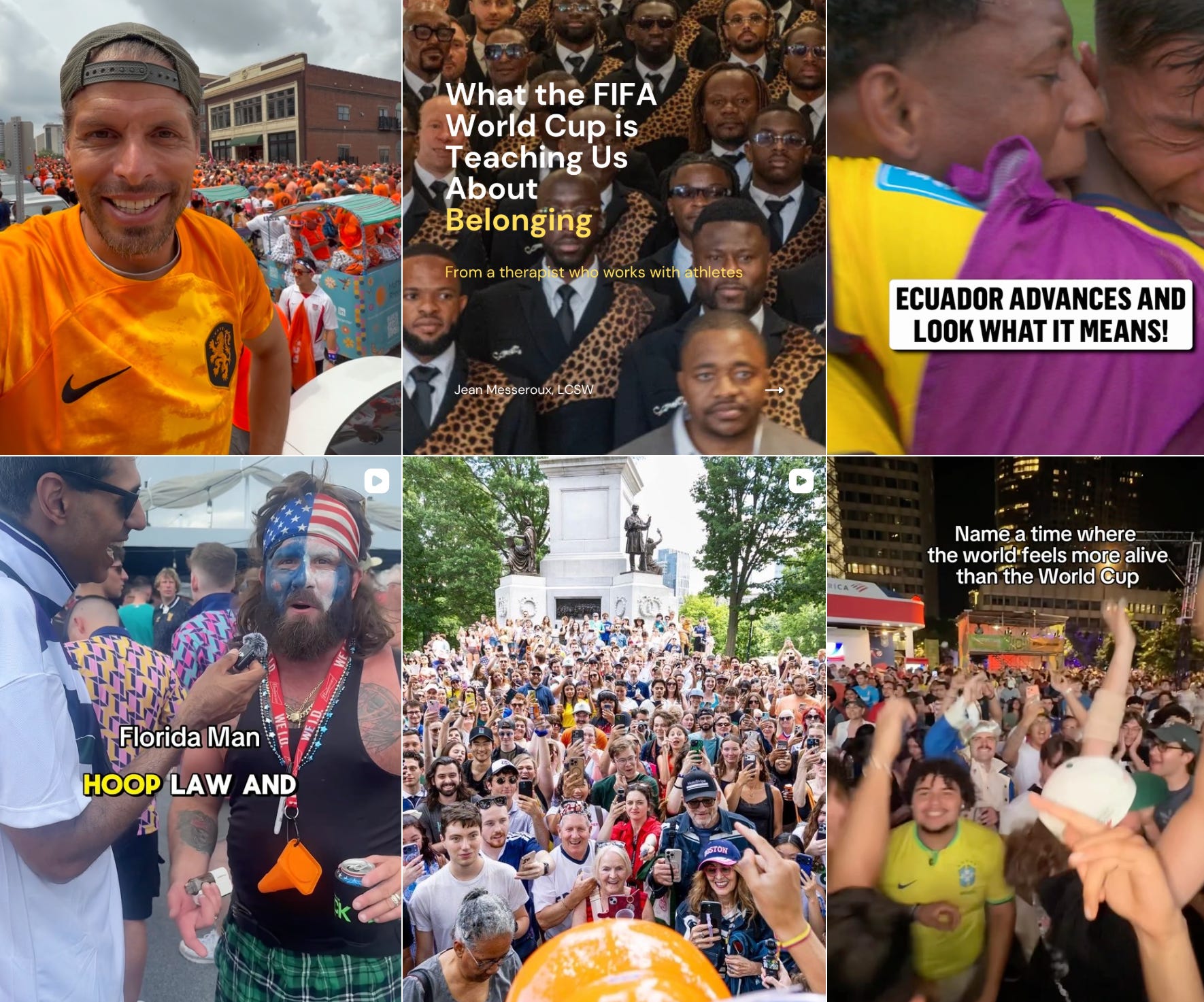
These quotes aren’t from diplomats or world leaders. They’re from regular people watching something remarkable unfold in real time, and they’re all saying the same thing: this feels bigger than the game.
I know it sounds a little cheesy. But I genuinely believe the World Cup is one of the most powerful forces for good on the planet right now. It reminds us how quickly strangers can become friends.
If you’ve been watching the Instagram Reels and local news segments coming out of Boston, Kansas City, Dallas, Seattle, and everywhere else the FIFA World Cup has touched down across the U.S., Mexico, and Canada, you already know what I’m talking about. If you haven’t seen them yet, do yourself a favor and spend ten minutes scrolling through World Cup videos online. You’ll understand immediately.
When the World Cup kicked off two and a half weeks ago, North America got ambushed.
The friendliest ambush in recorded history.
And somehow, that feels like exactly what we needed.
The Scots arrived in Boston and immediately turned the city into one giant celebration. They drank the plane dry on the way over (ha!), filled the streets in kilts and bagpipes, donated to local hospitals, cleaned up after themselves, and somehow managed to place traffic cones on nearly every statue in sight. Their joy was so infectious that Boston is now exploring a sister-city relationship with Glasgow.
The warmth that poured into social media comments from people in Scotland only reinforced what this entire tournament seems to be revealing: people are far kinder, funnier, and more welcoming than we’re often led to believe. I was so moved by witnessing the Scots, aka the “Tartan Army”, I posted a video about it on Instagram.
But the Scots were simply the opening act.
In Kansas City, more than 35,000 Dutch fans in bright orange flooded the streets for their famous Oranje Fanwalk, turning the city into one enormous block party before marching together to the stadium. Norwegian supporters introduced what may become this tournament’s signature tradition: the Viking Row, sitting shoulder to shoulder in Viking helmets, rowing in unison to pounding drums, even as they rode escalators.
And then there was Cape Verde.
A small nation of ten volcanic islands off the west coast of Africa, with a population roughly the size of Fresno, California, became the smallest country in history to advance to the World Cup knockout rounds.
In Boston, home to the largest Cape Verdean community outside Africa, ties were celebrated like championships. Dance parties broke out in the middle of Monday afternoons. As one local resident put it: “We don’t have to explain where we’re from anymore. Now the world knows Cape Verde.”
Then there’s Iran, navigating perhaps the most complicated path to this tournament of any team, who left a handwritten note in their Los Angeles locker room after their match:
“May peace, respect, and friendship prevail among all nations.”
And the Japanese supporters, true to a tradition that has made them beloved around the world, stayed after matches to collect every cup, wrapper, and scrap of litter in their sections, leaving the stadium spotless. No one asked them to. They simply believe in leaving a place better than they found it.
That might be the entire lesson right there.
What keeps striking me most is how pleasantly surprised everyone seems by one another.
Strangers from opposite ends of the globe, separated by language, culture, religion, and politics, sharing a beer, laughing at accents, taking photos together, and cheering side by side. The World Cup makes that kindness impossible to ignore.
Because we are. That’s the thing.
So much of what we’ve been fed in recent years has encouraged us to fear one another. And then millions of people from forty-eight nations show up, and everyone remembers:
We aren’t our governments.
We are the people.
And what people want, almost universally, is to laugh, dance, eat something delicious, share a drink, and cheer loudly for something that makes them feel alive.
Social media has been flooded with videos from fans who arrived expecting tension and division because of everything they’d seen in the news, only to leave talking about how kind, welcoming, and genuinely curious Americans have been. They’re delighting in the wonderfully oversized parts of American life that many of us take for granted: wandering through Costco and Walmart for the first time, making pilgrimages to Buc-ee’s, marveling at free refills, and laughing about how quickly strangers strike up conversations. The headlines may have made some visitors nervous. The people made them feel at home.
Travel has always known this.
It’s why I started The Gomes Guide: to inspire more people to step out of their hometown bubbles, explore the world, and meet the wonderful humans behind every state, country, and culture.
I’ve been saying for years, on this newsletter, on the podcast, and around countless dinner tables, that travel is the greatest antidote to fear and division.
You cannot truly hate someone you’ve actually met.
It’s very difficult to fear people once you’ve shared a meal, missed a train, or gotten lost together.
The World Cup has simply handed that experience to millions of people at once. On home soil.
That’s why it matters so much right now. It turns travel’s greatest lesson into something visible, collective, and impossible to miss.
If you haven’t been watching, now is the time to tune in.
The United States takes on Bosnia and Herzegovina on Wednesday, July 1 at 5 p.m. PT, and the energy is only going to grow as the tournament marches toward its July 19th finale. Be sure to watch the fans as much as the players. Let this moment remind you what the world looks like when millions of people choose celebration over cynicism.
Maybe that’s the magic of it: a simple ball, rolled onto a patch of grass, somehow reminding us who we are when we choose each other. So pass me the ball. I’m in. Let’s keep this going. ♥️
Did you enjoy this post? Have you been watching the World Cup, or perhaps even attended a game? Please leave a comment below, give it a quick ♥️, and please share The Gomes Guide will your travel-loving friends. Your support means the world to me and helps this community grow. Cheers!
Wishing you safe and memorable travels always,


Comments
Nothing yet. Say the first thing.
Sign in to join the conversation.