
Hi. I’m at the beach for a week with my parents, husband and kids. One night a small family of deer crossed the beach at dusk.
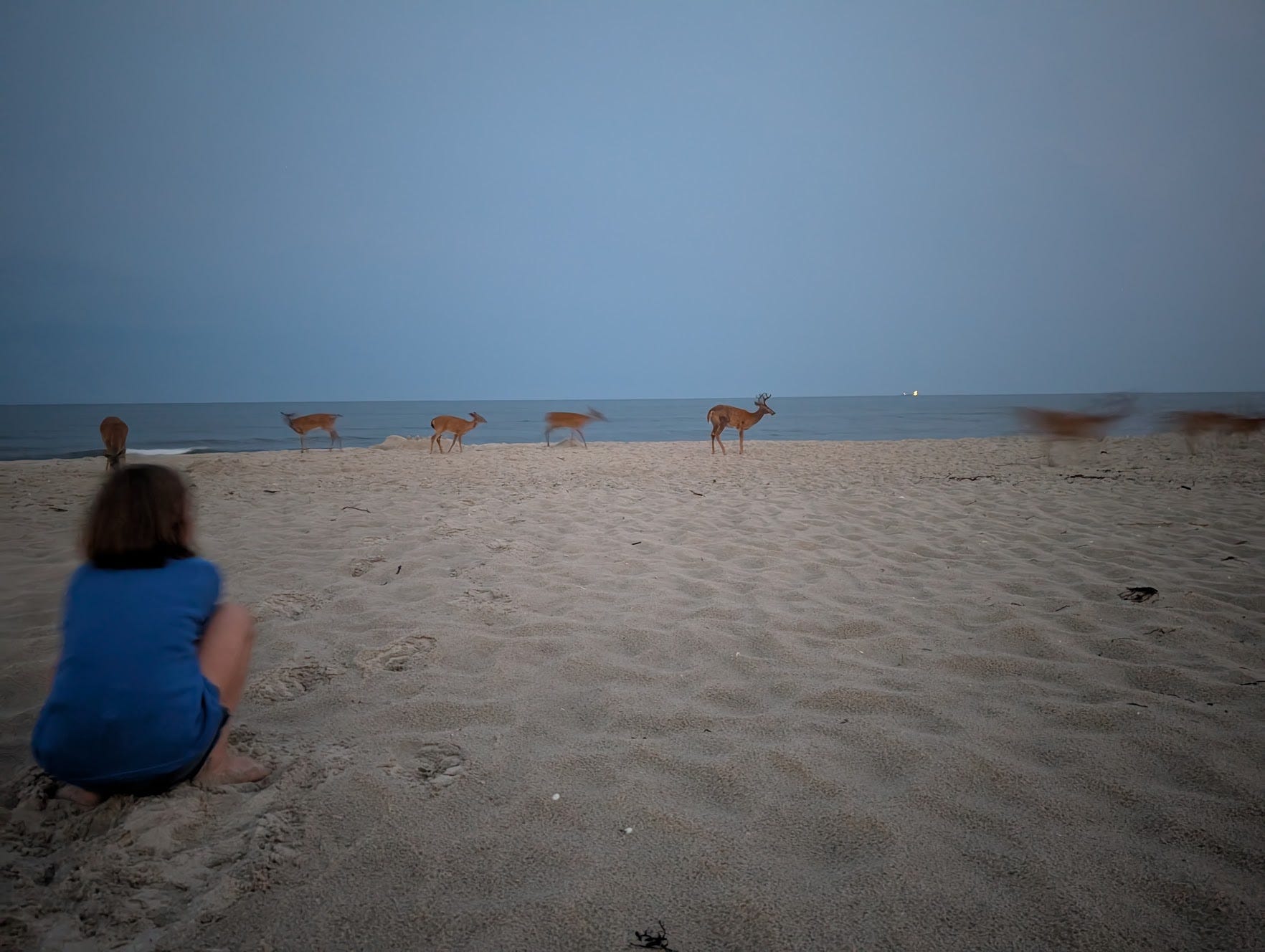
We also passed under the solar eclipse, standing in a perfectly calm sea. And that night, spied a meteor from the Perseids, streaking the cloudy sky. Undeniably a moment of transition.
I had a different post lined up ahead of time, so that I wouldn’t have a piece of writing to work on this week. But we’re in such an intense climate moment, and the post I published last week has garnered so much conversation that I felt the need to scrap the planned thing — I don’t know why I ever try to load stuff up in advance, anyway.
Here’s what I want to say to you now, especially if you’re new (hello!):
No matter how bad the bad thing is, no matter what it is, it helps to talk about it.
August has always been a very tough month for my family. It’s the month we lost my baby brother, on the day he was born. It’s the month Katrina hit my hometown. And eight Augusts ago, I was here on this beach where I am right now, with several other families, my partner, my two beloved children, one of whom was just a toddler, and I was absolutely overcome with dread. Paralyzed. It was the summer of kids in cages, the same year as the Parkland school shooting, both of which I was covering as part of my job. Meanwhile I was reading Deep Adaptation,
a paper which confirmed my intuition that the climate crisis was very bad, perhaps even catastrophic for the future of humanity.
I felt terrified, crazy, and all alone with those feelings. It seemed like no one else was noticing or caring about everything that was happening. Worse, some fellow Americans thought it was good, actually. The affected normalcy of daily life grated on me like splinters rising from the weathered grey planks of the boardwalk. I wondered if I even had a right to these feelings, because I was fortunate. I was free. My babies were with me.
That summer everything changed for me, because I started talking about it. One night, over a glass of rose, I told the other moms on the trip that I was spinning out over climate change. And I quickly discovered the illusion known as “pluralistic ignorance.” We are living in what researchers call a “false social reality.” People think other people don’t care about what’s happening to the planet because people don’t talk about it. But the real reason people don’t talk about it is because it’s terrifying and makes us feel powerless and hopeless.
Here’s what I learned when researching my new book, tentatively titled Falling In Love With The World Again:
Speaking our feelings in detail is inherently good for our mental and even our physical health, even when those feelings are debilitatingly negative.
And: most people are carrying the weight of the world, it’s just that we don’t have socially acceptable places to talk about it. Friends, family, and mental health professionals are expecting to talk with you about your personal life, not about your feelings about the crises of our times. Because these feelings are often mediated through the news and the algorithms, they get pathologized and distanced as “doomscrolling,” or at best maybe people will engage you in a political debate.
But these are real feelings. For the book I interviewed emotions researcher Lisa Feldman Barrett, who is among the 1% most cited scientists in the world. This week we were fact-checking her bits of the book, and she dropped another absolute gem, which I have to figure out how to fit into the draft:
If you are imagining something happening to someone else, and it is affecting you, then de facto something is happening in your life.
Get it? These feelings, about global injustices, about national harms, are real. They are yours. They are in your body. They are proof of your connection, through your alive human nature, mind and heart, to the forests that are burning and the fathers and mothers taken away from their children and thrown into the American gulag.
And the thing to do with feelings is to talk about them (which complements other strategies —managing emotions using your body is another important way to intervene, like taking a walk, splashing your face with cold water, deep breathing.)
I know it sounds unpleasant and / or futile to dive into despair, rage, grief , fear, numbness.
Here’s some reasons to try anyway.
This might seem obvious, but sharing your feelings person to person is the basis for close and supportive friendships and other relationships. In this case it must be a two way street where you give and receive support.
In exposure therapy for phobia, “affect labeling” or “emotion labeling”—talking in detail about how the phobic object makes you feel—is a proven- effective strategy. It decreases physical arousal and reduces activity in the amygdala, which is sometimes called the “fear center” in the brain. It makes you braver, that is, more able to approach the thing you’re afraid of.
“Emotional granularity”, the skill of parsing your feelings with a greater degree of verbal detail and precision, can be taught and has a wide range of benefits. A shocking number of people, most of the time, rarely go much deeper with negative emotions, than “I feel bad.” We also fail to dwell on the details of positive experiences and all the gifts they bring.
For people who are able to delve into the nuances of regret vs. remorse, or shame vs. guilt, or enthusiastic vs.elated, emotional granularity is associated with a wide range of mental and physical health benefits. They go to the doctor less frequently, use medication less frequently, are less likely to drink when stressed, drive recklessly, or smoke cigarettes, and they spend fewer days hospitalized for illness. The research on emotional granularity even shows a decrease in the onset and severity of systemic and chronic illness, such as diabetes, gastrointestinal disorders and coronary heart diseases.
Talking about how you feel can create internal and external pressure to take action in line with your expressed sentiments and beliefs. Action in turn will often reduce your fear and sadness.
That night, here on this island, when I opened my mouth, I stepped through the looking glass and into a realm where the rules are very different. Vulnerability is strength, fear summons courage, grief is a lighthouse that guides me home to what I love the most. When I peer closer into the darkness it yields a thousand facets of different colors like a dragonfly’s wing.
SO many terrible things have happened in the nation and the world in these past several years. Objectively things are not great! And, compared with then, I feel immeasurably more in touch with joy and meaning and my sense of purpose.
It’s not Candyland. I’m not shilling for spiritual bypassing here or some quick fix. I still spend plenty of time feeling like absolute shit, enraged at the morons, hopeless at the mess, despairing at my friend’s friend who just got kidnapped by ICE, guilty and complicit for not doing enough, zoned out on bad TV. It’s just that I’m more in touch with all of it, including my own dissemblings and disassociations.
I'm not advocating for endless ruminating or catastrophizing either. That can become its own form of avoidance. But there has to be a point where you dive into the feeling itself, and see where it leads you.
Say hello in the comments, find a Climate Cafe , a Good Grief Network group, a Work that Reconnects workshop or an ecodharma retreat. Stay tuned here for a workshop I'll hold in New York City next month.
Or reach out to a friend or two, or your partner, and ask if they’re open to setting a timer so each of you gets some time to share while the other one just listens.
No posts
Comments
Nothing yet. Say the first thing.
Sign in to join the conversation.