
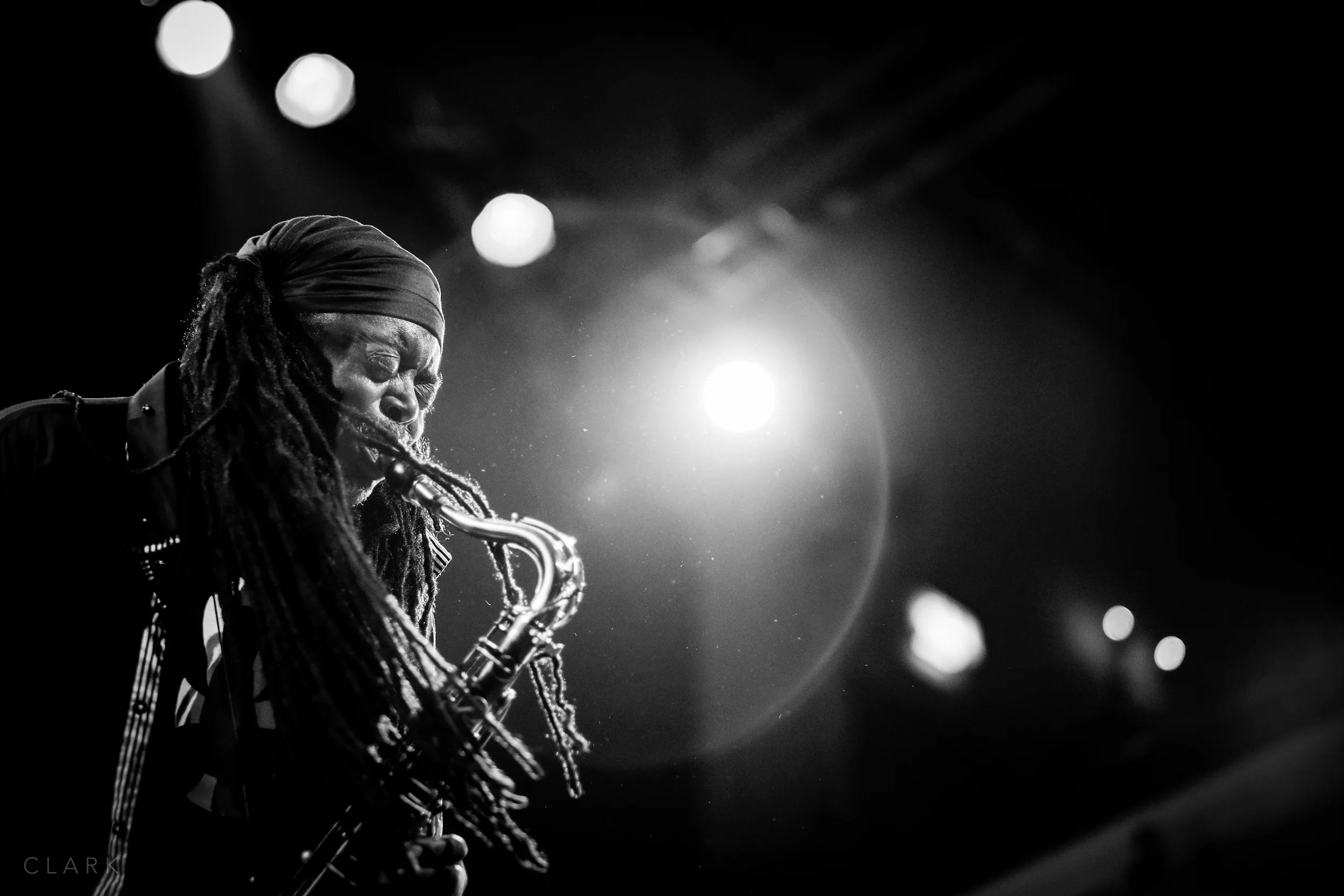
Last Wednesday evening, as a solar eclipse approached totality over Europe, I was quick-stepping across London streets toward The Jazz Cafe. There I had an appointment to experience natural wonders of a different sort, courtesy of the pathfinding British saxophonist, bandleader and composer Courtney Pine.
Pine, 62, is one of the most consequential figures in the modern history of UK jazz: a garrulous, quick-witted improviser fluent in a range of post-bop dialects, along with streetwise musics of the Afro-Caribbean diaspora, like reggae, dancehall and ska. He has a terrific new retrospective, Out of the Ghetto: A Modern Day Jazz Story, that compiles choice output from the mid-1980s up through 2000. I’ve been listening a lot to this double album, available digitally and as a 2-CD set, in order to broaden my view on an artist I knew first and foremost for his assertively stylish Verve releases of 30 years ago, like Modern Day Jazz Stories (1995) and Underground (1997).
This summer, Pine took “Out of the Ghetto: A Modern Day Jazz Story” on the road for a UK concert tour, hitting places like Ronnie Scott’s, the Glasgow Jazz Festival, and the Love Supreme Jazz Fest. I was in London last week, and extended my trip by a day in order to catch Pine’s tour in Camden, at a storied 500-capacity venue that he clearly savored headlining. “Tonight is a special night for me,” he said from the stage, grinning as he added, in homegrown Jamaican Patois: “Somebody asked for the sun to kinda do a ‘ting.”
Pine’s working quartet features Robert Mitchell on piano, Rio Kai on bass, and Romarna Campbell on drums. (I was only familiar with Mitchell, a longtime fixture of the British jazz scene, and an early member of Anthony Tidd’s Quite Sane.) Throughout a riveting, nearly two-hour show, the potent cohesion of Pine’s group attested to its shared experience on the bandstand. It also spoke to the enduring vitality of a style forged by the John Coltrane Quartet in expeditionary mode.
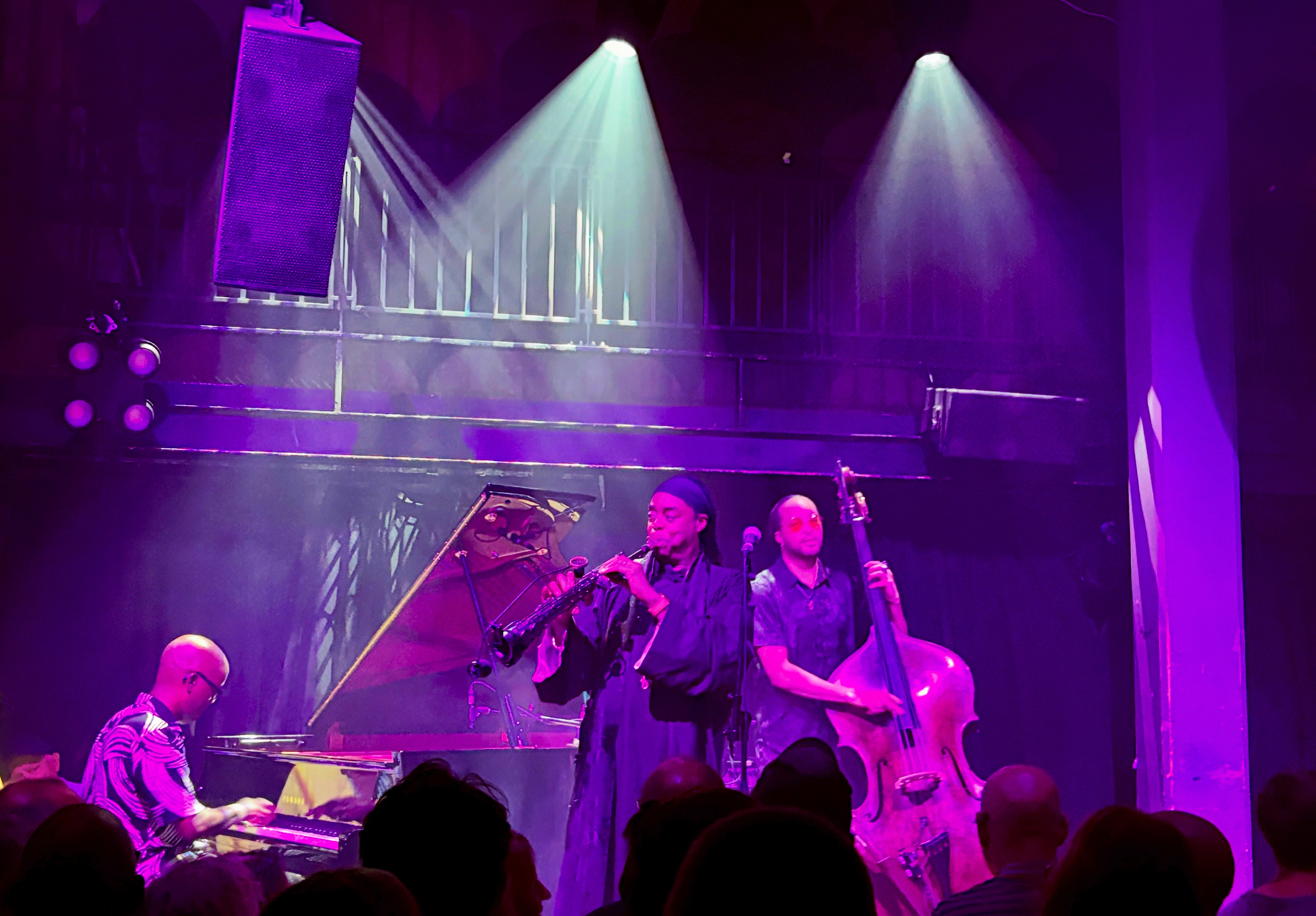
Pine’s opener was “In the Garden of Eden (Thinking Inside of You),” a track off Modern Jazz Stories that, in its original version, incorporated a core sample of Stanley Clarke’s “Desert Song,” along with programmed beats and a turntable-scratching DJ. Here the droning aspects of the song were entrusted to the acoustic quartet, as Pine coaxed a steady tone out of a Tibetan singing bowl. When he put down the bowl and picked up his soprano saxophone, the song promptly took flight. Pine’s sound on the instrument suggests a strong, clear beam: intensely focused, perfectly pitch-centered, unabashed about any and all similarities with Coltrane in this mode.
He switched to tenor for “Sacrifice,” and I was instantly struck by the agreeable swagger in his style, which surprised me by calling to mind David Murray (or perhaps, from a next-gen POV, someone like James Brandon Lewis). The tune, originally introduced on the 1988 album Destiny’s Song + the Image of Pursuance, features an A-section vamp with a swinging B, redolent of the era’s prevailing Young Lion aesthetic. Destiny’s Song was produced, in fact, by Delfeayo Marsalis — and so too was The Vision’s Tale, which provided the following tune, a muscular “Countdown”-ish swinger with a shrewdly momentous title: “Our Descendants’ Descendants.”
There was a point in the early ‘90s when, no doubt biased by the Delfeayo connection, I basically regarded Pine as “Branford across the pond.” Some of this was in the music: even now, when I hear certain soprano-forward Courtney Pine tracks with a straight-eighth backbeat, I think of Branford’s era of productive pop dalliances. (Consider something like “Children of the Sun” from Underground, which could almost pass for a cut off the soundtrack to Mo’ Better Blues. There’s also Pine’s extensive collabs with ‘90s turntablists, which conjures a faint whiff of Buckshot LeFonque.)
If this comparison was fair at the time — and I’m not sure it ever was — it doesn’t hold up at all today, as I was reminded at The Jazz Cafe. Pine has his own tough, billowing style on soprano, as he demonstrated atop breakbeats, dub riddims, and the polyrhythmic waltz of his Coltrane-ish anthem “Zaire.” The band worked that tune into a succession of crashing waves, delivering a robust highlight of the show.
On tenor saxophone, as I’ve already implied, Pine can sound like a brawler. He put this to great effect when pushing into the red, past any available pattern or frame. One of these moments came on the back end of a modal tune whose title escapes me. Campbell, who was less than fully persuasive with her swing feel, brought a swarming intensity that worked beautifully here. When she and Pine squared off for a spontaneous exchange, it loosely recalled the late Trane of Interstellar Space — although (as you’ll hear in the clip below) Pine’s version of freeform still holds space for a motif as schematic as the core étude from Oliver Nelson’s “Cascades.”
Hours before Pine took the stage, I had a late-morning coffee with tenor saxophonist Nubya Garcia, one of many British improvisers who consider him a touchstone and vital predecessor. (You can look forward to hearing that conversation at The Gig.) I’d turned off my recorder at this point, so I’m paraphrasing — but Garcia said something to the effect of “He really is the guy. Wherever I go, when the subject of British jazz comes up, people talk about Courtney Pine.”
I wouldn’t dare to suggest that one good night of exposure makes me an expert. But I definitely have a better sense of Pine’s magnetism, mystique and artistry than I did previously. And I’ll keep his example in mind as I continue to engage with the scene.
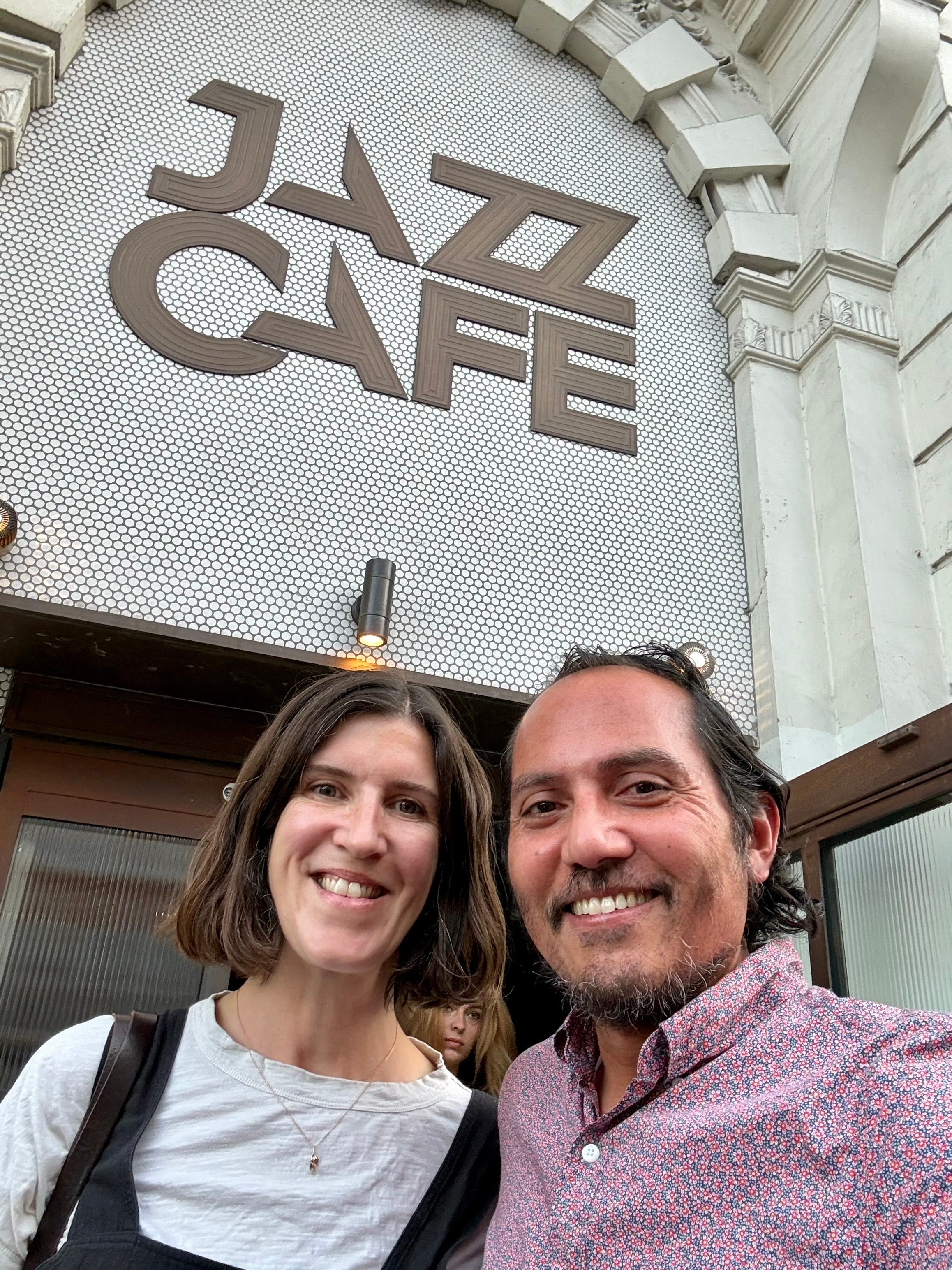
My +1 for this show was an old friend and colleague, narrative audio wizard Peggy Sutton. When I worked as a New York correspondent for the BBC’s Jazz on 3, Peggy was my producer — and at times, as in a 2007 dispatch from the Vision Festival, my fellow field reporter. It was great to catch up, and catch a show.
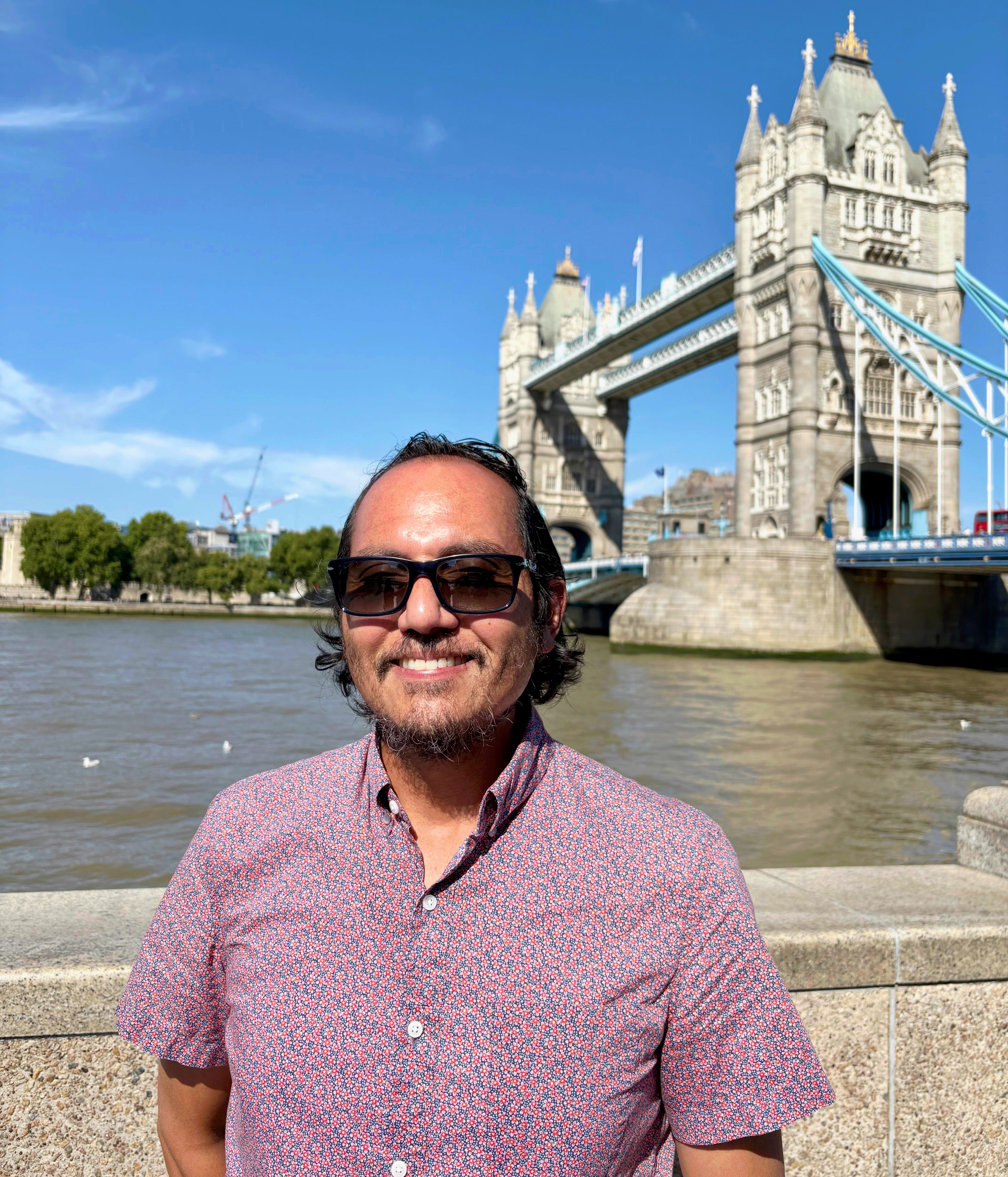
What, you think I don’t also do touristy things abroad? Here, this is where I was earlier in the day. (The ticketed schlep up the bridge is worth it, btw.)
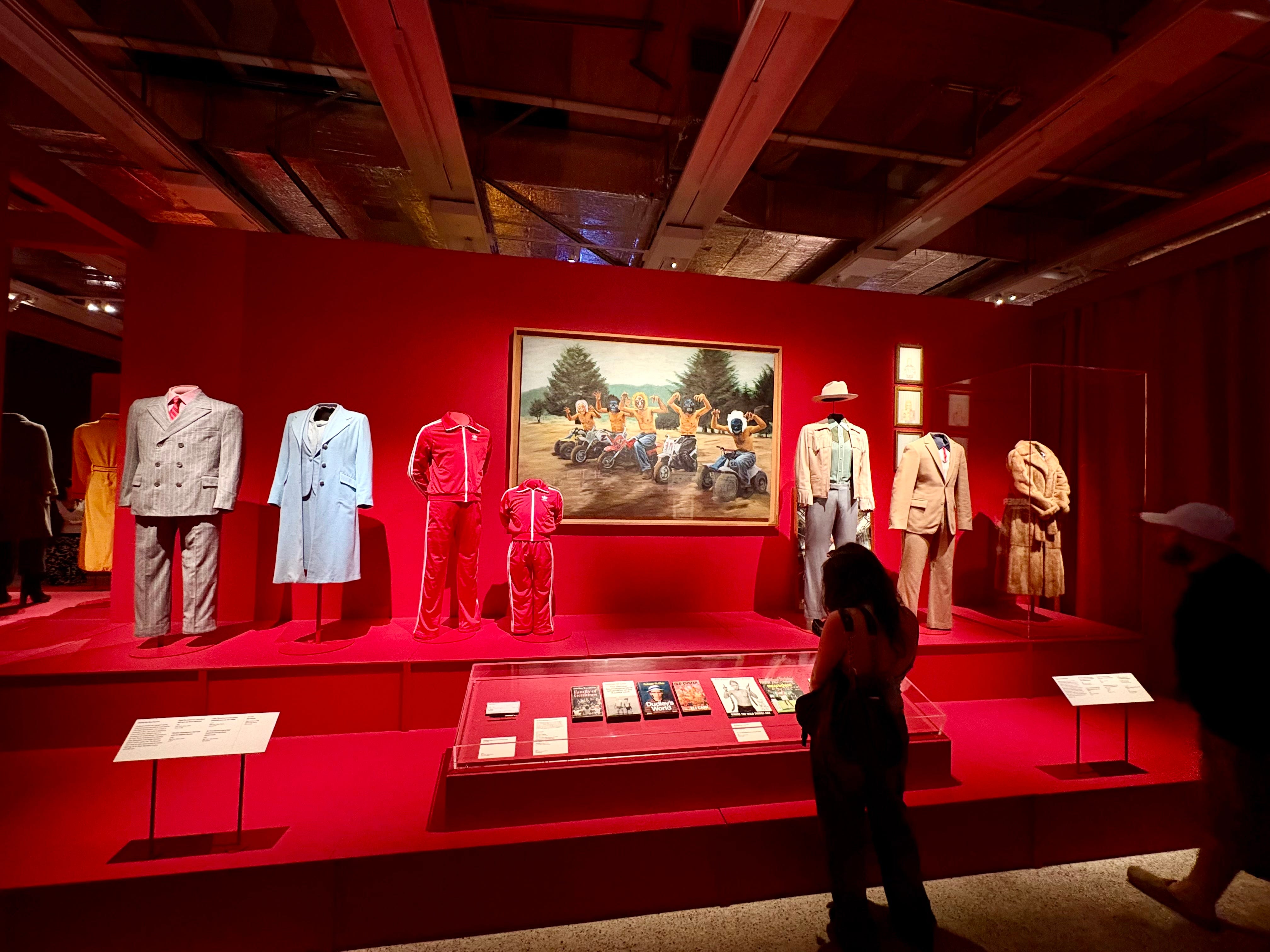
Courtney Pine wasn’t the only one having a retrospective in London during my trip. The Tate Modern is showing acclaimed exhibitions for Ana Mendieta and Tracey Emin, for instance. And at the Design Museum, I caught one of the last days for Wes Anderson: The Archives, a show as wonder-filled as anyone could have the right to expect. Here’s one view of costumes and accoutrements from The Royal Tenenbaums. (The painting was, as I understand it, an Andersonian thrift store purchase in Mexico City: “Bad Route,” by Miguel Calderón.)
Not London-related, but today saw the release of a new episode of The Late Set, devoted to the band SML. Julian Booker, WRTI’s Associate Program Director for Jazz, talked with Anna Butterss, Jeremiah Chiu and Josh Johnson, and had what I’d call a fantastically insightful conversation. Check it out.

One of the few things I posted while in London was a call to action: “So who is working on the investigative exposé about the L.A. Jazz Festival?” Thankfully, I now have my answer: Julia Wick, the Editorial Director at L.A. Material, who reported a deeply informative story about what went down — and just as crucially, what didn’t — in the days, weeks and months before everything went belly up.
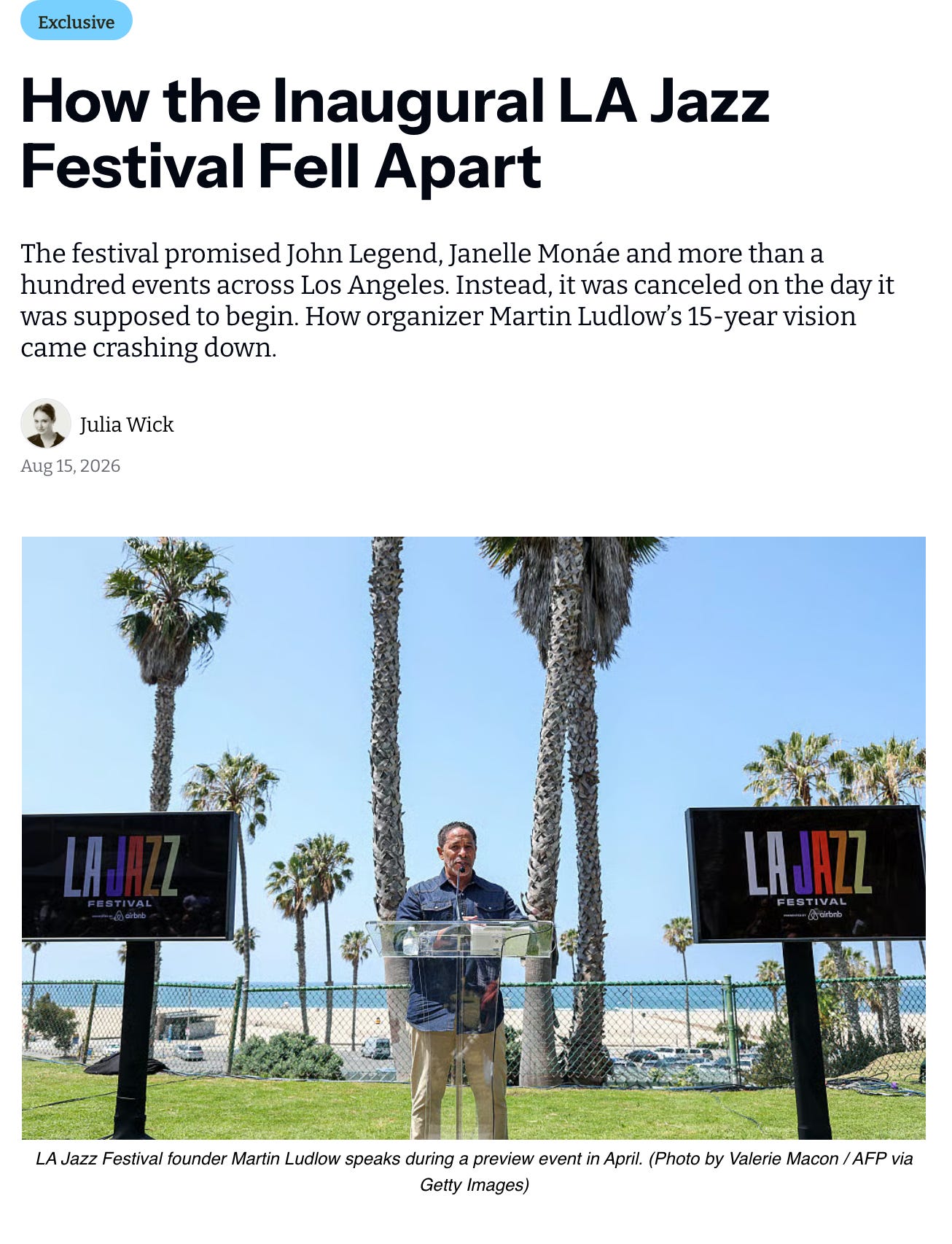
I’d rather not reduce Wick’s methodical reporting to a series of bullet points, so I urge anyone who’s curious to read the piece. (You’ll just need to sign up for a free subscription to L.A. Material, which is good for accessing three stories a month.) Suffice it to say that would-be impresario Martin Ludlow comes off as hapless at best, and that’s my most charitable read on the situation.
As Wick explains, her article draws on “internal city documents, artist contracts and correspondence, a recording of an internal Jazz Festival Zoom meeting, and more than two dozen interviews with festival contractors and employees, performers and their representatives, government officials, staffers and others with inside knowledge of what transpired, along with Ludlow’s first interview since the cancellation of the festival.”
I’m sorry for all who were affected by this event’s collapse — and many were, from artists to vendors to community members. When I talked with Nubya Garcia, she mentioned that she’d been booked on the festival, and the news thankfully broke before she flew out to L.A.
So now we have a story, if not the story, of the L.A. Jazz Festival’s demise. Now, who’s working on a behind-the-scenes report about the BKLYN Jazz Festival? C’mon, I know you’re out there.
No posts
Comments
Nothing yet. Say the first thing.
Sign in to join the conversation.