
It is an honour to host this guest article, written by one of our subscribers. Originally written in Italian, it is a deeply personal reflection on loss, impermanence, and the resilience of practice in the face of catastrophe.
The flood that devastated Romagna in May swept away all my belongings: objects, photographs, books. We fled in haste, following the municipal alert, with only our documents, a few papers, and the cat—just before a furious wave of water and mud inundated the rooms up to a height of two meters. Something unthinkable for those who have not seen and experienced it. The trauma was so severe that in the weeks that followed I had a very high fever, so I understood little of what had happened, until I was hospitalized. Now I am better.
I had a wonderful twenty-year collection of Sati magazines and an equally rich collection of books, talks, and notes from the greatest masters, as well as many articles in English from around the world, various notebooks in which I had recorded my practice for years, and small paintings with images of the Buddha that I kept on my bedside table and scattered here and there. A couple of these precious images—precious sentimentally—I later found all muddy, and I felt even more gratitude and love for my poor muddy Buddha.
Buddhist practice, for me, is a great love that began almost thirty years ago. I remember that at the beginning I devoured everything I could find about Buddhism on the web and in bookshops, hungry for this food that seemed the only one capable of finally satisfying my hunger. Then, somewhere, I read that someone once asked the famous Thai master Ajahn Chah why he meditated, and he reportedly replied, “And why do you breathe?” (This story is told in various ways, but the meaning is that of an urgent, almost biological need). Then I understood: practice was for me like air.
Now that we have rented a small studio apartment not far from what remains of the house (not even the doors are left), because who knows when and after how many expenses we will be able to return, while we wait for the summer sun to dry at least a little of the walls, I have time to reflect. I am writing to understand how such an extreme event, striking a human being, can be observed from the perspective of the Dharma. How do I feel it? How do I live it? What can it mean?
The first consideration that comes to mind concerns the First Noble Truth: there is suffering—in Pali, dukkha. Our life is full of suffering. But the suffering that the Buddha addresses is the subjective one, the one provoked by our mind, more subtle and less easy to recognize than the objective pains that inevitably strike us. The loss of all our possessions in a natural disaster is an objective pain, but how we react to this loss depends on us. Over the years, meditation and practice teach us to distinguish these two types of suffering and, hopefully, train us to react more appropriately to what happens to us, preparing us to suffer better. The suffering remains intense, but it is of another quality; it has a less bitter, less resentful taste. So, instead of tearing my hair out and falling into complete despair, while suffering greatly I said to myself: okay, this is how things are, what can I do to avoid falling into desperation? It is a constructive question that I did not ask myself consciously; it is something that happened within me—I realize it now as I write.
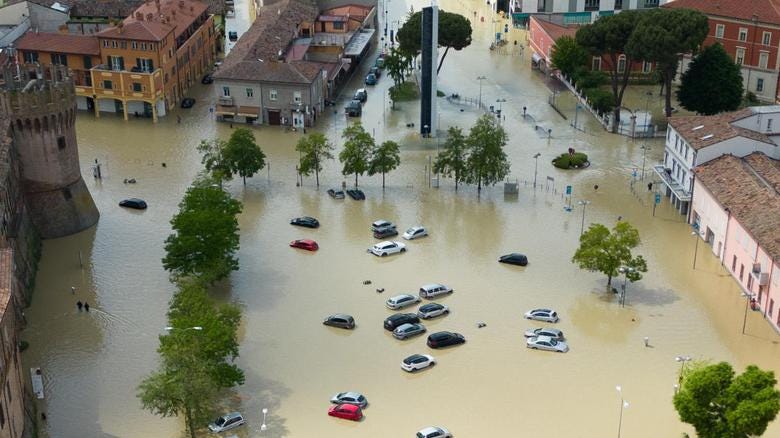
The second consideration concerns impermanence—in Pali, anicca. Everything is impermanent, and consequently, what you possess you can lose from one moment to the next. In this case, however, what matters is not the intellectual confirmation of this truth—the same one that Heraclitus preached in the West—but having experienced it tangibly. Buddhism, in fact, is a practice, not a theoretical philosophy. The Buddha taught impermanence so that we might experience it concretely in life, to prepare us to face one day with a little more serenity the great impermanence: the impermanence of our self, our death. The flood was an opportunity to experience anicca on my own skin… Could it perhaps be a privilege? An opportunity?
The third consideration concerns attachment, which is discussed so much in Dharma talks as one of the main causes of suffering. We find it hard to accept that everything changes, that everything is like water slipping through our hands and does not have the solidity and security we attribute to it. If everything is impermanent, what is the point of desperately clinging to people and things? The result will be disappointment and dissatisfaction. Yet we always do this, even though we understand it is not good for us; it is difficult to free ourselves even a little from this consolidated mechanism that lies at the base of samsara, of our earthly life.
The Buddha went so far as to say that we should not cling even to his own teaching:
“I have shown you, monks, how the teaching is like a raft, built for the purpose of crossing over, not for holding onto. When you understand that the teaching is like a raft, you should abandon attachment even to wholesome mental states, and even more so to unwholesome ones.”
In my case, what is there to cling to when I have nothing left? I could fall into states of mind like regret, nostalgia, sadness, depression. As a human being, I actually experience these emotions. Sometimes I am overcome with nostalgia for a certain book with a beautiful love dedication, for that old photograph of my grandmother in the garden with that marvelous early 1900s hat… and I feel bad, I fall into aversion and anger. But in the end, I think: what matters—the love we have given and received, the values we have believed in, all our history—is inside us. No flood, terrorist act, or earthquake can take that away from us.
Then there are memories. The mind, as usual, wants to transform them into painful lack, into melancholy, into regret. But practice suggests: why not instead see their beautiful sides? Why not transform them into joy?
Finally, there is the Present. The birds are singing their scales on the trees overlooking the little balcony from which I write; my partner, who also survived the Deluge, is making me a good coffee; children and friends are well; I have seen the generosity of so many people… There is no shortage of reasons, even in this circumstance, to be grateful.
I could make many more observations, but I will stop here. I hope so much that the mud has also carried away the ugly things that, out of habit, we no longer notice: stale customs, selfishness, rigid mental patterns, crystallizations, closures, hardness of heart… That wave could be the possibility of renewal, because, as Corrado says, one can always start again—or at least we can try!
Fiorenza Simonazzi
No posts
Comments
Nothing yet. Say the first thing.
Sign in to join the conversation.