
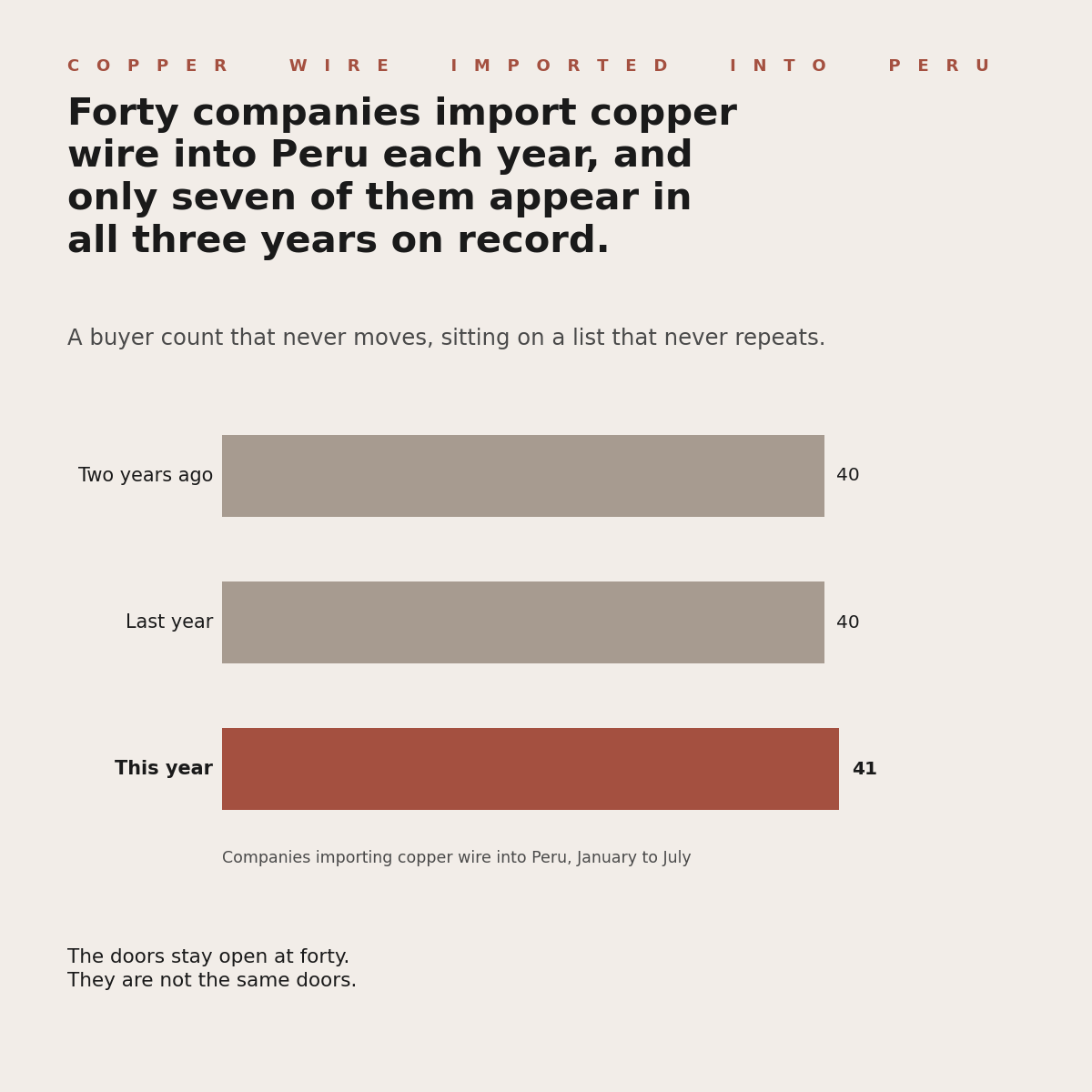
Forty companies imported copper wire into Peru in the first seven months of this year. The two years before that came in at the same number, and a number that steady usually means a market that has settled.
Underneath it, almost nothing is steady. Only seven of those companies show up in all three years. Twenty-two of this year's importers were not buying the year before, which is more than half the list.
So the count of doors holds and the doors themselves keep changing. That is a different market from the one the count describes, and it asks for a different kind of selling.

A buyer list built from one year of records is the standard first step for a supplier looking at a new country. It is cheap, it is concrete, and here it decays faster than the sales cycle that uses it.
By the following season roughly half those accounts are no longer importing under this code. The replacements are not the same companies under new names either. They are buyers with no incumbent relationship, which is the part worth paying attention to.
For a supplier arriving from outside, an incumbent competitor holds less ground here than it would in a market with a stable roster, because every season hands out accounts that nobody has locked down yet.
The typical order is worth $120 and weighs seven kilos. A typical buyer places two of them in a year. That combination decides how this market can be served, before any question of price comes up.
No single account justifies a visit, a local representative or a long qualification cycle. The arithmetic only works through somebody who already carries a book of these accounts and already absorbs the cost of serving them.
A couple of things are worth naming before anyone acts on it. The money moving through this code quadrupled, and that figure is not the market growing. Five shipments by one manufacturer in March carry most of it, and stripping them out leaves this year as the smallest of the three.
The second is that a customs code is not a customer list. A company can stop appearing because it changed the code it declares under, or because it bought through a trader instead. The turnover is real, and part of it is bookkeeping rather than a lost account.
If the plan was to build a list once and work it for three years, this market will not repay that. If the plan is a distributor who refreshes the list every season, the rotation stops being a problem and starts being the reason to be here, because the incumbents are meeting the same new names you are.
The expensive mistake is to read a steady count of buyers as a steady set of buyers, and to spend a year building relationships with accounts that will not be importing by the time that work pays off.
Garay | Trade Intelligence follows what moves into Peru.
Sin posts
Comments
Nothing yet. Say the first thing.
Sign in to join the conversation.