
It’s approaching two years since my first open-heart surgery. I still haven’t fully left the hospital.
I don’t mean physically... I’m at home. I’m healthy. I’m back to life. But emotionally, I find myself returning there all the time.
Yesterday, I came across the WhatsApp group my wife created just before the first surgery. Dozens of friends and family were in it. She had been sending updates while I was under, keeping everyone informed, holding the weight of it all.
As I scrolled, I felt it again. Not panic. Not fear. Something more complex. A mix of comfort, curiosity, and awe.
I could see the love. The support. The humanity. Then I hit the point where I started contributing to the updates myself during hospital recovery, and it shifted. It became my voice. My story. And it all came rushing back.
That’s the part no one prepares you for.
No one told me that surviving would come with this many questions.
The surgery ends. The experience does not.
I’m approaching the two-year anniversary of that first surgery, and there’s still not a day that goes by where I don’t revisit some part of it.
At one point, I took nearly six months off from writing my book because it was too hard to go back through all the moments. But at the same time, those moments have fueled everything I’m building now. They’ve shaped how I think, how I speak, how I show up.
In some ways, revisiting it has been therapy. In other ways, it’s been something else entirely. A transformation.
We need to stop calling this a treatment journey.
A treatment journey suggests something clean. Linear. Predictable. A path you move through step-by-step. A clear start and a clear finish. That’s not what this is. What patients actually go through is far more complex. It looks more like this…
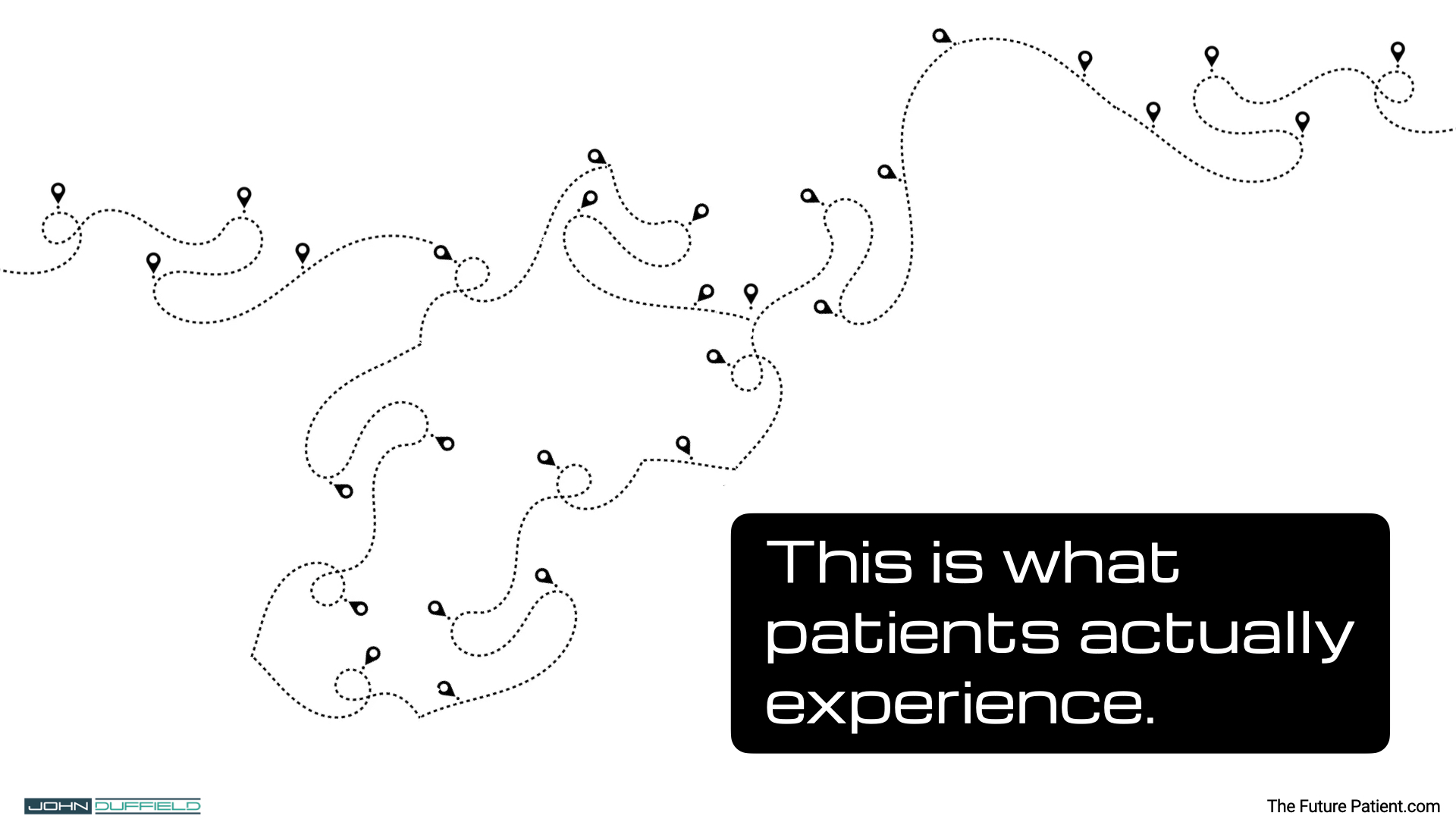
It loops. It spirals. It pulls you forward with hope and backward with fear, sometimes within the same hour. It doesn’t follow a map. It doesn’t respect timelines. And it definitely doesn’t end when the system says it should.
My experience shattered the idea that this was a process I could move through step by step. There was no “next stage.” There was only what was happening now.
And I wasn’t the only one going through it. My wife, Janet, lived an entirely different version of this experience.
While I’ve found myself strangely drawn back into it, watching medical documentaries, studying patient stories, trying to understand every dimension of what people go through, she’s had the opposite reaction.
I was recently asked to share my perspective on the hit ER show The Pitt on HBO Max, where I talked about that exact pull, how, after everything, I find myself going back into these environments, trying to better understand the human stories behind them.
After 43 nights across three health systems, after carrying the weight of decisions, updates, medications, and constant vigilance, her experience left a different imprint. For her, the sounds of a hospital. The rhythms. The unpredictability. They don’t pull her in. They push her away. In everyday life, that shows up as something simple but profound: a need for a break. From caregiving. From monitoring. From being on.
That’s something I didn’t fully understand at first. But now I do.
The system discharged both of us. Neither of us was done.
Caregiving isn’t something you sign up for. It’s something that gets handed to you. And I’m not sure it has ever fully left Janet.
Since then, I’ve spoken with dozens of patients who have gone through cardiac procedures and other major health events.
Over time, the patterns become impossible to ignore. The anxiety shows up early and stays longer than expected. The curiosity turns into a need for control. And even the strongest people eventually feel the emotional weight catch up to them.
And almost everyone, without exception, is changed by it. Not just physically. As a person.
I feel that change in myself every day. In the questions I ask. Am I doing enough? Am I present enough with my family? Am I appreciating this second chance the way I should be?
Before surgery, I don’t think I would have asked those questions in the same way. Now, they sit just beneath the surface of everything I do.
That’s the part that doesn’t show up in charts. It doesn’t get measured. It doesn’t get coded. But it’s real. And it matters.
But the part that changed me most happened outside of the system. In the quiet moments. In the uncertainty. In the spaces where no one was guiding me.
The healthcare model is incomplete. The system is designed to treat events. What patients actually live through is ongoing.
So if there’s one thing I’ve come to believe, it’s this: Surviving something major doesn’t return you to who you were. It introduces you to someone new. And learning how to live as that person… that’s a process no one really prepares you for.
That’s when you realize something no one tells you:
surviving isn’t the end of the story.
it’s the beginning.
If you’re a patient or caregiver and you find yourself going back, replaying moments, trying to make sense of what happened… That doesn’t mean you’re stuck. It means you’re still becoming.
And if you’re part of the healthcare industry, designing experiences, building programs, launching therapies…There’s a whole layer of the experience that doesn’t show up in your models. But it’s where the transformation actually happens.
Of the 36 specialists and clinician meetings I had over my health experience… only two focused on emotional support. Everything else was clinical.
That imbalance isn’t accidental. It’s how the system is designed.
And it’s leaving something essential behind. And it may be the most important part of all.
John Duffield
TheFuturePatient
No posts
Comments
Nothing yet. Say the first thing.
Sign in to join the conversation.