
I’m a sucker for a fresh start. I tell people it’s an ADHD thing but I secretly know it’s an any-excuse-to-buy-new-stationery thing.
This urge is the strongest in September. I wonder if that’s imprinted from my school days or the result of something more ancient. Trace back customs and celebrations over millennia and we’ve always done something to mark the changing of the seasons.
Or at least that’s my justification for buying yet another new Moleskine.
But this September has lost some of its sparkle. Because after years of fresh starting, it’s finally sunk in that no matter how many good intentions you have, new habits you adopt, plans you make or notebooks you buy, they don’t change who you are or how your brain works.
Which is why this year, we’re trying something different.
If you’ve been here a while, you’ll know I have a strange relationship with time. But the way I’ve been conceptualising it as this ineffable, nebulous, slippery thing is (surprise, surprise) no longer working for me.
Instead, I’ve been imagining it as if I’m carrying around an old pocket watch.
Now, my sturdy little watch works. The hands move and the hour is right. But at times it feels like it’s out of sync. It’s a little too slow, then a little too fast, and sometimes it stops completely. Don’t worry, I give it a little shake and it eventually works again. But something is… off.
And when I prise open the pocket watch and look at the cogs inside, that’s when I see that by default I exist in one of two states.
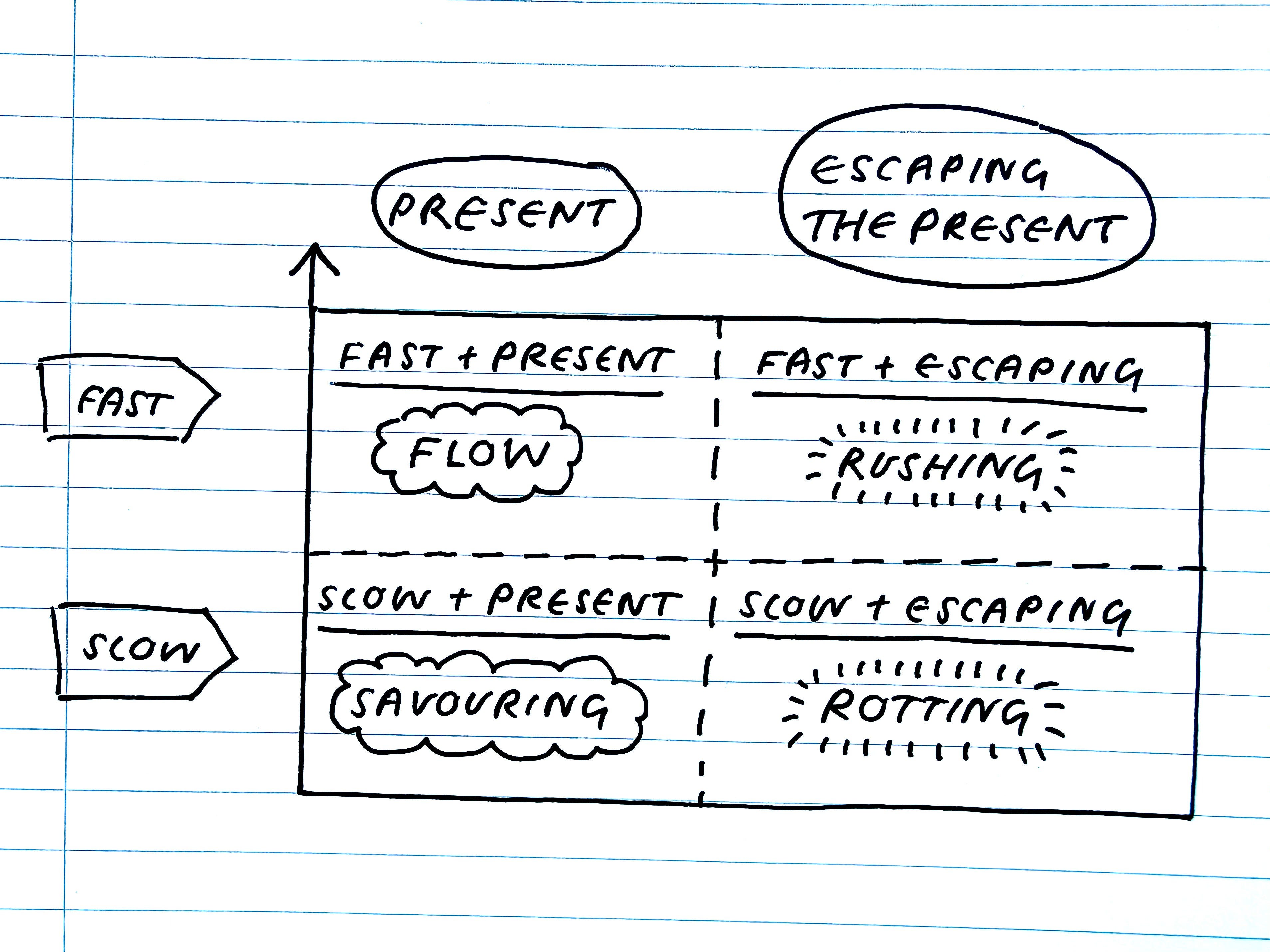
Sometimes I am rushing. I am walking too quickly and eating too quickly. Listening to everything at 2x speed. Burning myself when I’m cooking or curling my hair. Injuring myself trying to fit in a quick run between calls. Trying to finish this thing so I can get onto that thing while already thinking about the thing after that.
And sometimes I am rotting. I am faffing about. I am scrolling. Sometimes I am in a stupor watching videos of people getting their hair done as it must fire some mirror neurons. I’m thinking about all the things I need to do while somehow doing none of the things. I’ll decide I’m starting something at 2pm, look at the clock at 2:07pm and think, well, 2:30pm makes more sense now.
I am rushing or I am rotting. And there’s very little in between.
Rushing makes time feel very frantic. Like a fistful of sand I’m desperately trying to stop slipping through my fingertips. Rotting morphs time into thick, gloopy treacle. It’s slower and stickier, but I still can’t hold onto it.
They may sound like opposites, but I think they’re doing the same thing.
When I’m rushing I’m trying to get through the present as quickly as possible. When I’m rotting I’m trying to make the present disappear. Both are ways of not really being here, right now.
And once I noticed this in the way my pocket watch works, in myself and my own behaviour, I started seeing the same pattern everywhere around me.
Many other people listen to podcasts at 2x speed and watch TikToks while watching TV. Or they ask AI to summarise things they apparently wanted to read. Or bed rot, doomscroll, binge-watch and lose entire evenings to their phones.
We seem to be simultaneously obsessed with this idea of saving time and yet really very good at making it disappear. Maybe all our pocket watches, all our internal clocks are a little out of sync. And before September begins, we’re going to fix them.
Our sense of time isn’t malfunctioning in isolation. It’s a side effect of trying to keep pace with an ever-accelerating world.
We’ve spent decades inventing technologies designed to save us time. Email is faster than sending a letter. Googling something is faster than going to the library. Food arrives at your door quicker than you could cook it yourself. AI can now do in seconds things that once took us hours.
We are saving so much time, so why does it feel like we have less than ever?
The German sociologist Hartmut Rosa has spent decades studying what he calls social acceleration. This is the idea that modern life is speeding up in all sorts of ways all at once. Technology gets faster, society changes faster and the pace of life speeds up with it.
Which seems sort of backwards. Surely faster technology should give us more time, right? But how often do you actually make good use of the time technology gives back to you?
Did you use that extra time to get outside, connect with people, create something, laugh, eat, nourish yourself, just luxuriate in doing nothing?
Instead, many of us fill that saved time with another email, another task, another podcast.
It seems the faster we can do things, the more things we expect ourselves to do.
Rosa has also written about the idea of frenetic standstill, which I really like. All of this speed and activity without the feeling that we’re really getting anywhere. We’re overwhelmed, overloaded and struggling to keep up.
Now, I know what you’re thinking. Time to slow things r i g h t. d o w n. I get that reaction. But even though the world might be moving too fast, we still have to be active participants in it. And actually I want to go fast sometimes and I bet you do too.
I want to get swept up in my writing, experience time slippage and realise three hours have passed. I want to run, race for a train, fire out a messy first draft instead of thinking about it for weeks.
Sometimes I want to stretch time right out. Whether that involves reading for an afternoon or staring at the birds in the trees. I’ve recently been getting joy from mixing paints at a glacial pace and watching the shades transform.
So no, fast isn’t the answer. But neither is a slow life. Which is why I prefer the idea of a recalibration. Our ultimate goal isn’t to slow down all the time but to stop treating the present as something to get through.
Unfortunately, there isn’t a simple fix for our collective time problem, and seven days certainly isn’t going to undo a lifetime of rushing and rotting. But I think we can interrupt some of our automatic behaviours and better notice when our clocks are drifting out of sync.
So how about we commit to a seven day experiment before September kicks off. We’re going to make a few tiny adjustments to our clocks and see what happens.
Before we change anything, we need to know what’s going on. Today, notice every time you rush, rot or feel present.
For example, I rush cooking so much that I sometimes end up with little burns on my hands. I fired off an email so quickly last week that I didn’t notice autocorrect had changed my name to Vecna. These are clues.
Jot yours down as they happen or whenever you realise what you’re doing. Maybe you notice yourself rushing to get ready, then later scrolling for 40 minutes.
If you want hard mode, account for every hour of an entire day. And if you really want to ruin your mood, look at your screen time stats.
This first day is all about finding out whether your watch is running fast, slow or occasionally exactly on time.
Today we’re introducing some deliberate friction.
You could wait for the kettle without picking up your phone or stand in a queue and just, well, stand there. Walk somewhere without a podcast. Arrive five minutes early and don’t immediately find something to fill the gap.
Yes, it might feel painful and unnatural and the urge to check your phone or fill the time will rise. But give it a moment and I promise the urge will also fall.
If you’re anything like me, this could result in some collateral damage as other weird habits and stims emerge. My fingernails getting chewed to pieces is the most obvious one.
The point here is to prove to ourselves that we don’t have to fill every minute.
A few months ago, I was wondering why my mind felt like it was constantly racing when I realised I’d been listening to every podcast and watching every video at 2x speed for months. I’d been doing it for so long that sometimes I wanted to press and hold on everyone’s face in real life to make them talk faster.
Notice how often technology lets you concertina time down like this. If a video should take two minutes, let it take two minutes. Instead of asking AI to write an email in 30 seconds that would have taken you two minutes, let it take two minutes. Intentionally stretch time back out.
You don’t need to do this with everything. For one day, just choose one thing and put it back to normal speed.
You probably know your favourite way to make time disappear that isn’t serving you, your rotting activity of choice. Today, we’re going to close just one of those escape hatches.
Maybe that means no TikTok for an afternoon or only checking Instagram at lunch. Choose something that feels doable, then notice what appears in the time that used to disappear.
Maybe you feel bored or anxious. But you might also get on with something important or just do absolutely nothing.
Let’s notice what happens when we stop trying to escape the present moment.
Take something you’ve been procrastinating over and do it fast and imperfectly.
For example, I’d been mulling over how to write this essay for weeks, months even. I loved the idea of giving people a little lead-in to September. I thought about it throughout July and then August and then suddenly, oh shit, we’re nearly there.
At some point, more thinking just becomes avoidance for me. So set a timer and write the first draft. Send the email you’ve been overthinking. Make the decision you’ve been putting off.
Sometimes the clock needs slowing down, and sometimes it needs a shove.
Now we’re deliberately going in the other direction.
Choose something you enjoy, something you instinctively know is nourishing, and let it take longer. It might be reading, painting, cooking or doing yoga. Take your time with it and lean into the physicality and the ritual.
This is the opposite of closing an escape hatch. We’re deliberately giving more time to something we actually want to experience.
Today is all about consolidation. Maybe you’ve learned something about what deserves slowness, what actually benefits from speed and what you don’t want swallowing your time at all.
What deserves your full presence, regardless of whether it happens quickly or slowly? Where have you been rushing unnecessarily? And where have you been allowing hours to disappear?
There are no wrong answers to these questions, but it’s important we ask them. We’re deciding when we might want our little clock hands to move quicker or slower or when we can stop observing them altogether.
And then, keep paying attention.
Because I think that’s the way we make this recalibration stick. You become better at noticing when you’re rushing through life or trying to make it disappear, making a tiny adjustment and then coming back to right now.
Comments
Nothing yet. Say the first thing.
Sign in to join the conversation.