
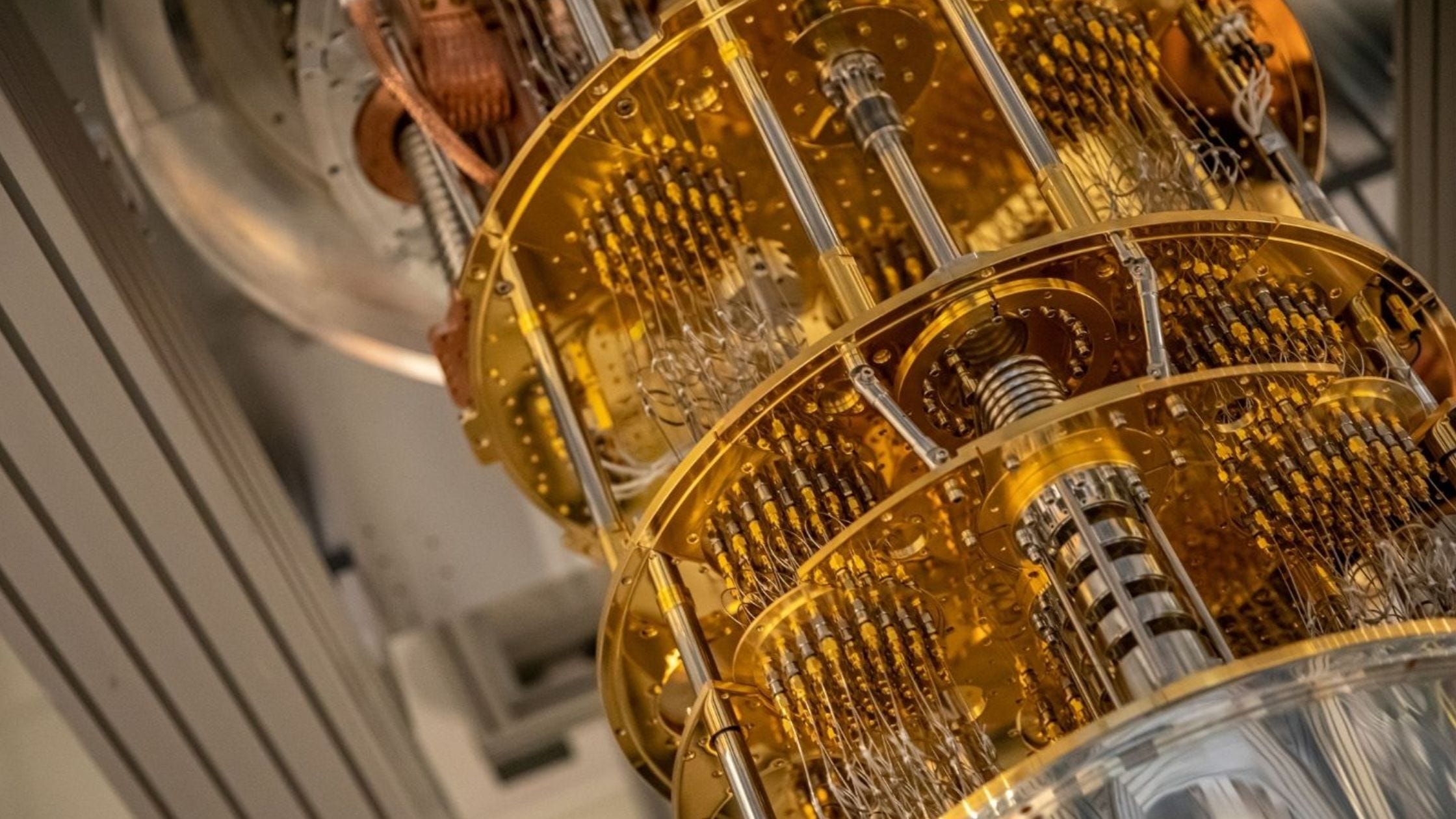
The Fusion Report has spent a fair amount of ink (OK, digital ink) on the various relationships between artificial intelligence (AI) and fusion energy, from how AI can speed up progress on fusion energy to how AI’s domination of the venture capital (VC) market negatively impacts investments in commercial fusion energy development. However, the potential value of quantum computing to benefit commercial fusion energy efforts is more straightforward. Researchers at the Cleveland Clinic, Oak Ridge National Laboratory (ORNL), IBM’s T.J. Watson Research Center, and Michigan State University have recently utilized quantum supercomputing to investigate different molecular configurations of FLiBe, a molten salt of lithium fluoride and beryllium fluoride, which is a prime candidate for use in tritium breeding blankets during fusion reactions.
Another area of technology not involving AI is that of high temperature superconducting (HTS) magnet design. In the case of Thea Energy, their system utilizes pixel-like arrays of ‘programmable’ magnets to sculpt complex magnetic fields for use in stellarators and other applications. Recently, Thea was awarded $20M by the US Department of Energy ARPA-E Seeding Critical Advances for Leading Energy Technologies with Untapped Potential (SCALEUP) program, which funds critical supply chain capabilities. We will cover both of these in this article.
Quantum computing and AI are different in both purpose and foundation; quantum computing is a computing paradigm built on quantum mechanics to tackle certain complex calculations, while AI is a field focused on making machines learn from data and perform tasks that normally require human intelligence. In simple terms, quantum computing is about how information is processed, and AI is about what machines can do with that information. Quantum computing is most promising for problems like simulation, optimization, and cryptography, whereas AI is widely used for pattern recognition, predictions, automation, and decision-making in areas like chatbots, recommendation systems, and robotics. The two can work together, but they are not the same thing: quantum computing is mainly hardware and physics-driven, while AI is mainly software and data-driven.
Quantum computing can be better suited than artificial intelligence for some fusion problems because fusion research often hinges on simulating extremely complex physics, especially plasma behavior and quantum-scale interactions. Those simulations can become too difficult for classical computers, and quantum computing is being explored as a way to represent and evolve those systems more naturally. Artificial intelligence is still very useful in fusion, but it plays a different role: it is better at finding patterns, optimizing operations, and helping analyze data than at directly simulating the complex underlying physics of fusion energy. In that sense, AI does not result in “transformative scientific discovery”, as was stated in the recent DoE press release; rather, AI provides meaning to data which is discovered through targeted experimentation.
Interestingly, the announcement of using quantum computing to solve the tritium breeding problem was contrasted by the US Department of Energy (DoE) awards totaling of $800M in committed partner support through the Genesis Mission Consortium to further integrate AI with scientific research. These were announced last week at the Genesis Mission Summit in Washington, DC, one award which was to the University of Wisconsin-Madison (UW-M) to integrate AI workflows into their work on a fusion breeding blanket. So it seems that both will be approaches that will be used to solve the tritium breeding issue, though quantum community seems to have the lead in that race…
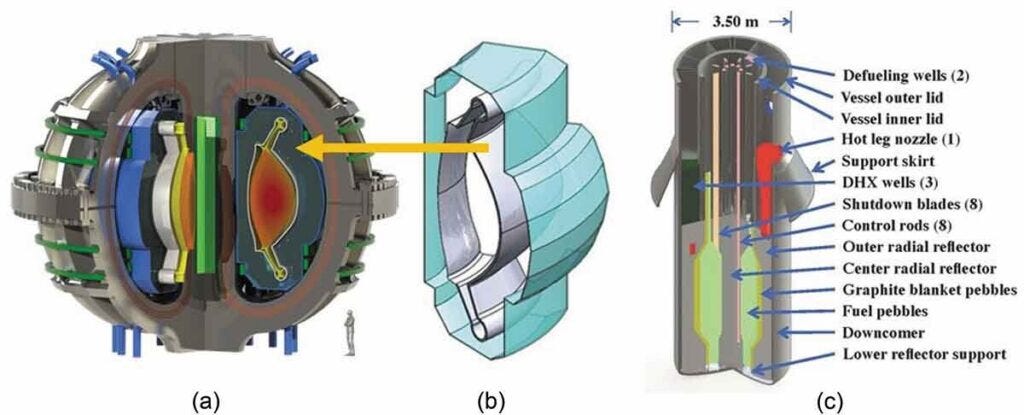
The physics of fusion energy involves the quantum mechanical behavior of atoms, particularly the nucleus of deuterium and tritium in D-T fusion reactions, though quantum computing is equally applicable to other types of fusion fuels). Quantum computing exactly simulates the relationship between these nuclei, while AI is limited to identifying relationships based on physics that are assumed to be correct. Nailing the correct configuration of the FLiBe molecules, which has at least nine known configurations, is critical to designing the thermal blanket that absorbs neutrons and changes their energy from inertia to thermal energy (the thermal blanket is symbolized by the silver layer in the illustration above).
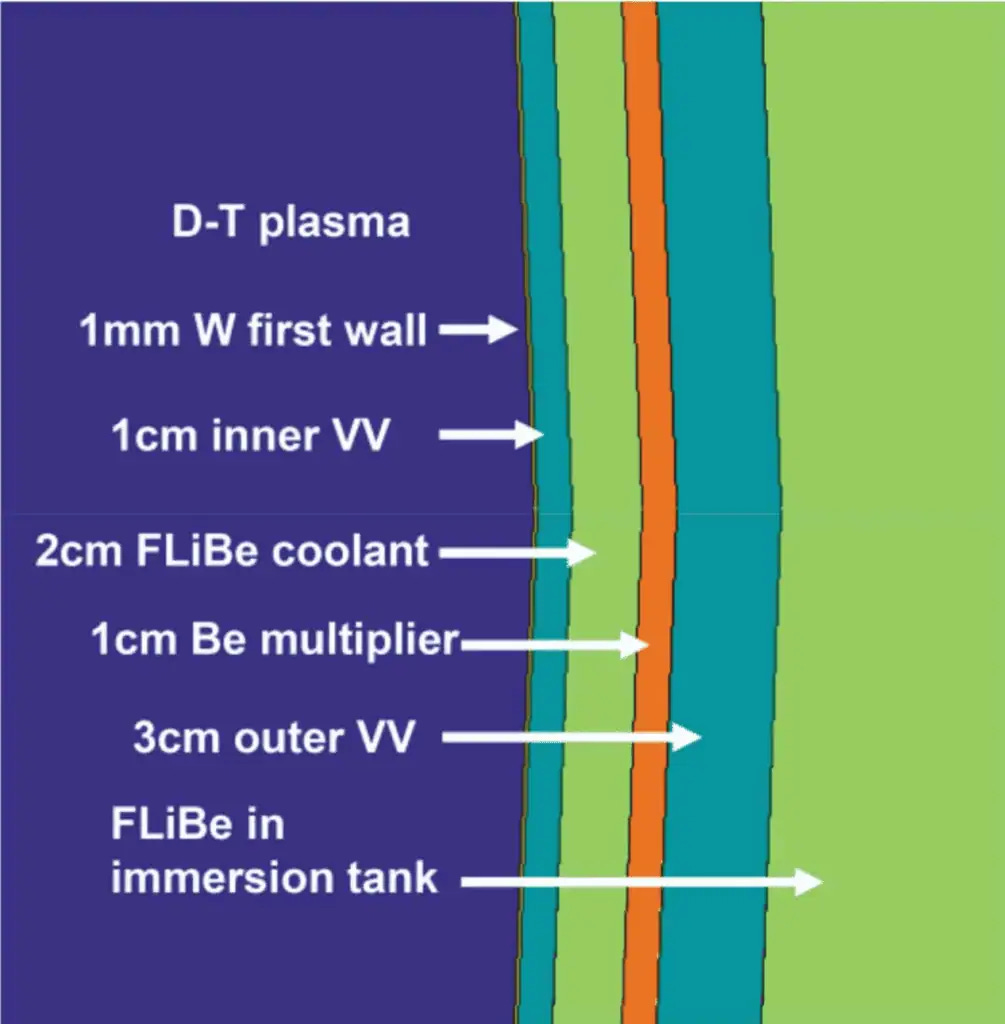
That thermal blanket is also critical for breeding tritium, which is naturally very rare on Earth and has a half-life of 12.32 years. The tritium is bred from the lithium in the FLiBe, while the beryllium multiplies the number of neutrons produced, resulting in a breeding ratio of 1.1 to 1; i.e., 1.1 neutrons (and hence tritium ions) are produced from the fusion of each deuterium and tritium nuclei. Finally, the FLiBe cools the first wall which provides the shielding of the rest of the fusion machine from the plasma chamber. Both the tritium breeding and the radiative cooling are highly complex mechanisms that is not necessarily well understood, which is also where quantum computing comes in. By predicting the ground-state energies of the nine different FLiBe molecule configurations, it is significantly more likely the combination of FLiBe molecules that works under fusion’s extremely high temperatures and high magnetic fields will be “discovered”.
Thea Energy, Inc., a technology company advancing the stellarator for the commercialization of an abundant source of baseload fusion power, today announced the U.S. Department of Energy’s (DOE) Advanced Research Projects Agency – Energy (ARPA-E) has recently selected the Company for a $20 million award as part of the Seeding Critical Advances for Leading Energy technologies with Untapped Potential (SCALEUP) program.
With this funding, Thea Energy is scaling its manufacturing and test capabilities to support the first domestic production line of modular high-temperature superconducting (HTS) magnets. The Company’s core magnet technologies are being actively scaled across the fusion landscape as well as adjacent technology sectors that utilize compact, efficient, high-performance HTS magnet systems. Over the past two years, Thea Energy has developed its foundational HTS magnet technologies. The Company has also validated the performance of these magnets and the manufacturing technologies that prime them for high-volume, efficient production.
“Our magnets are designed to be mass manufactured and in just a couple of years, we’ve iterated these coils over a hundred times, finalized the design, and derisked this core technology, positioning us for this next phase – manufacturing scale up,” said Brian Berzin, Co-founder and Chief Executive Officer of Thea Energy. “We will utilize approximately 300 of these planar shaping coils in our first large-scale integrated stellarator system, ‘Eos’. Expanding our capabilities and the use of our superconducting magnets across the fusion industry will accelerate commercialization of various system architectures. Ultimately, this same high-performance technology is also primed to revolutionize adjacent industries beyond fusion. SCALEUP allows us to expand this business with our initial partners and customers interested in powerful HTS magnets produced via scalable, efficient processes.”
Following a competitive review, awardees were chosen based on technical maturity and commercial scalability of key innovations that strengthen domestic energy supply chains. SCALEUP focuses on the next generation of energy and ways to accelerate technologies from portfolio toward market adoption. The SCALEUP program provides funding to previous ARPA-E awardees, including Thea Energy as a spin-out of Princeton University and Princeton Plasma Physics Laboratory. Thea Energy’s planar coil technology was developed as part of the ARPA-E Breakthroughs Enabling Thermonuclear-fusion Energy (BETHE) program. For more details on the SCALEUP program and full list of awardees, visit: arpa-e.energy.gov
Dr. Dave Nye, SCALEUP Federal Lead, added, “ARPA-E’s mission is to develop technologies that deliver affordable, reliable, secure energy for all Americans. Thea Energy has validated its magnets and outlined a clear strategy to scale the consistent, high-yield fabrication of these coils. Modular, factory-built magnet components will enable the rapidly growing fusion power industry to create power at unprecedented scale.”
This award comes on the heels of Thea Energy’s $100 million Series B capital raise, HTS magnet validation campaign, and “Helios” power plant design review, representing a series of milestones that establish Thea Energy as a leader in commercial fusion.
Breeder blankets are just one area where fusion can be helped significantly by quantum computing. Improving inertial fusion energy beam and target geometries, magnetic fusion energy field geometries, stellarator magnet configurations, and program magnetic fields are just a few areas where quantum computing could be helpful. While artificial intelligence is helpful in spotting patterns that would otherwise stay obscure, it is less helpful in areas where changing the properties of a fusion machine requires changing the physical geometry of the machine, which generally involves both time, money, and lost opportunity costs; these are problems where quantum computing can help significantly. And it is just the kind of application where smart magnets can work best.
Comments
Nothing yet. Say the first thing.
Sign in to join the conversation.