
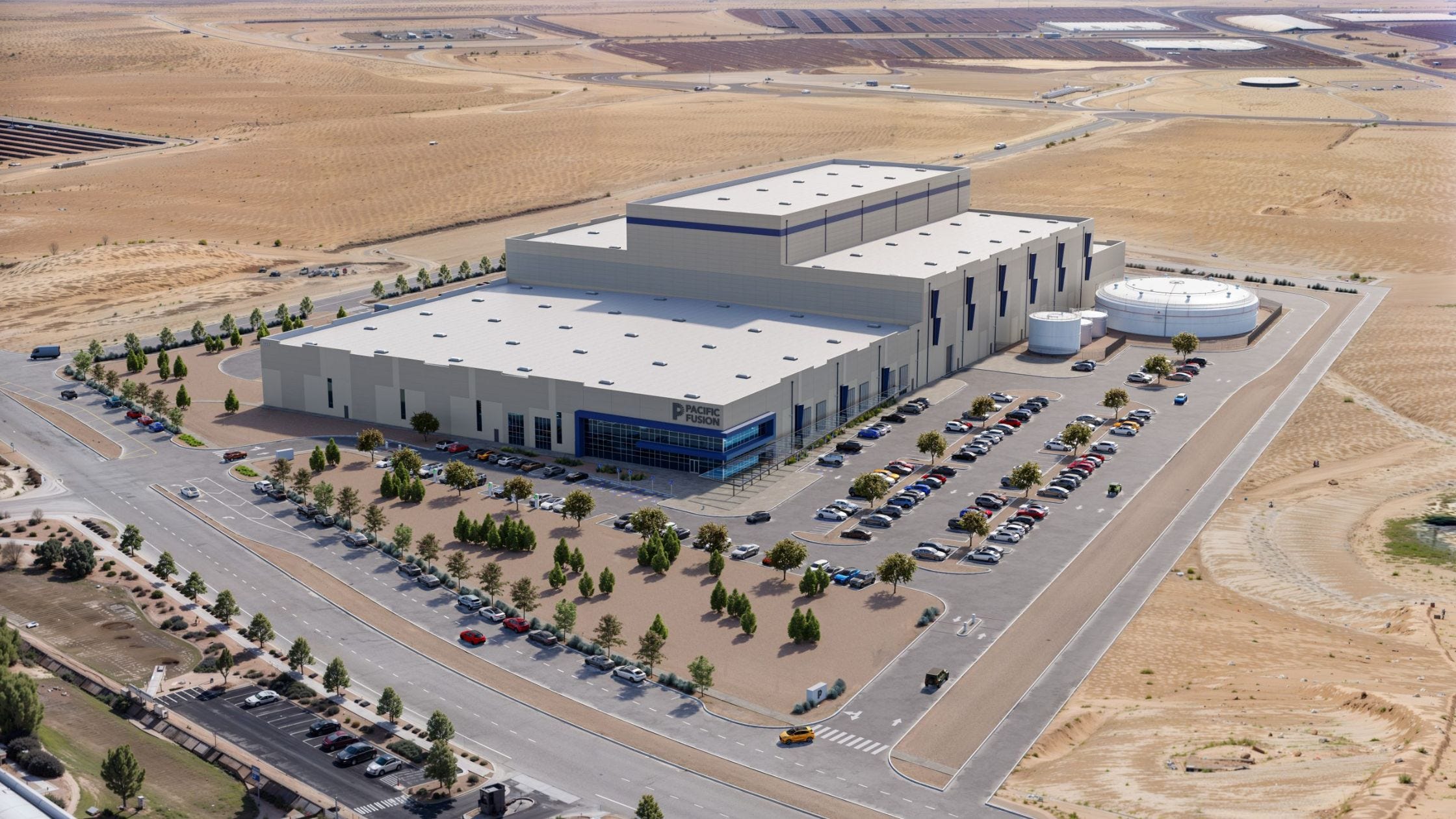
Today, The Fusion Report is covering the announcement by Pacific Fusion of their groundbreaking on a first-of-a-kind fusion facility in Albuquerque, New Mexico. This facility will house Pacific Fusion’s “Demonstration System”, designed to achieve net facility gain by 2030, which is a critical step towards the achievement of commercial fusion energy. The company has also signed a Memorandum of Understanding (MOU) with the US Department of Energy (DoE) National Nuclear Security Administration (NNSA) to collaborate on “high-yield” fusion research and development in the new facility. Finally, Pacific Fusion is also kicking off a manufacturing facility in Albuquerque to go along with its research and development facility there, helping establish the city as a center of fusion energy development. We will first present the press release, and after that we’ll talk about the importance of this announcement.
Pacific Fusion today broke ground on a $1 billion Research & Manufacturing Campus in Albuquerque, New Mexico, where the company will build a fusion facility designed to achieve two first-ever milestones: net facility gain, an essential breakthrough on the path to commercial fusion power, and high-yield fusion, a critical capability for U.S. national security.
The campus at Mesa del Sol will house Pacific Fusion’s Demonstration System, designed to achieve net facility gain by 2030, producing more energy from fusion than the total energy initially stored in the machine. Net facility gain has never before been demonstrated and represents a key milestone on the path to commercial fusion power.
The Demonstration System will also produce bursts of high-energy fusion output exceeding 100 megajoules, making it the only “high-yield” fusion facility under construction in the United States. “High yield” fusion refers to the capability to create certain conditions relevant to national security research, providing a long-sought platform to support the science required to maintain the U.S. nuclear stockpile without explosive nuclear testing.
The United States identified the need for this capability more than 30 years ago. Underscoring its importance, the Department of Energy’s National Nuclear Security Administration (NNSA) today executed a Memorandum of Understanding with Pacific Fusion. The MOU memorializes the parties’ agreement to identify collaboration opportunities related to high yield fusion, high-energy-density science, pulsed-power technologies, advanced materials, modeling and simulation, and other areas of shared national interest.
Pacific Fusion was founded in 2023 to deliver practical, affordable, and scalable fusion energy. The company is developing a pulser-driven inertial fusion system using modular, mass-manufacturable components made of readily available materials. Its technology advances decades of U.S. government investment at America’s national laboratories, including Lawrence Livermore National Laboratory, Sandia National Laboratories, and Los Alamos National Laboratory.
“America pioneered the breakthroughs that brought fusion within reach. Pacific Fusion is focused on converting that scientific leadership into industrial capability and infrastructure that strengthens U.S. energy leadership and national security,” said Dr. Keith LeChien, co-founder and Chief Technology Officer. “Today’s groundbreaking shows that America can still build the hard things, and build them faster than any other country, including China.”
China is investing billions in next-generation fusion for both energy and national security, attempting to beat America in a field that the U.S. national labs made possible. Pacific Fusion’s privately funded, U.S.-built fusion facility is designed to keep America ahead in one of the most important technologies of the century.
Federal, state, and local leaders joined energy and technology executives and investors at the groundbreaking to recognize the project’s significance for both America’s energy and national security missions.
Public Service Company of New Mexico (PNM) President and CEO Don Tarry highlighted fusion’s potential to help New Mexico meet growing electricity demand while maintaining reliability, increasing affordability and advancing toward a carbon-free grid. PNM is New Mexico’s largest electricity provider.
“At PNM, we’re proud to welcome and support Pacific Fusion for bringing this kind of energy innovation to New Mexico and strengthening the state’s leadership in energy, economic development and advanced manufacturing,” said Tarry. “Under the Energy Transition Act, we are looking ahead to new sources of carbon-free energy to meet the growing energy demands of the future. Fusion has the potential to help us achieve the state’s ambitious objectives with reliable, affordable and clean energy, and we’re excited for the opportunity to help explore its potential as part of our future generation mix. It represents another way we are Powering New Mexico, Together and delivering on our commitment to customers.”
New Mexico leaders also highlighted the state’s opportunity to become a center of the emerging U.S. fusion industry, building on its longstanding leadership in applied physics, energy innovation, and advanced manufacturing.
“New Mexicans believe in science, innovation, and the importance of clean, affordable energy. Pacific Fusion saw that commitment when it chose to make a billion-dollar investment in our state,” said New Mexico Governor Michelle Lujan Grisham. “We hope New Mexico will be the first state to put fusion energy on the grid, and Pacific Fusion’s progress can help turn that vision into reality.”
“This is what investment in American innovation should produce: cutting-edge industries, high-quality jobs in New Mexico, and broader impact through clean energy for the world,” said Senator Ben Ray Luján. “To make that possible, we need continued federal engagement and funding to get fusion commercially deployed on the grid.”
The urgent need for federal collaboration extends beyond energy. Pacific Fusion’s technology could also expand the experimental capabilities available for science-based stockpile stewardship, including high-yield fusion and high-energy-density research. NNSA and Pacific Fusion have jointly signed the Memorandum of Understanding Regarding Collaboration on High Yield Fusion, High-Energy-Density Science, and Related Technical Areas.
“Public-private partnerships are essential to unleashing American innovation, strengthening our national security, and ensuring the United States wins the global fusion race,” said NNSA Administrator Brandon Williams. “NNSA looks forward to collaborating with Pacific Fusion on the science that keeps our nuclear stockpile safe and reliable. China is moving quickly in this area, and America cannot afford to fall behind.”
Pacific Fusion’s investment is also designed to establish the foundation for a broader fusion manufacturing industry in New Mexico. The Research & Manufacturing Campus represents a $1 billion-scale investment and will support approximately 200 permanent jobs, in addition to hundreds of construction and regional jobs. The company is also expanding manufacturing operations in Los Lunas, where it will build modular pulsed-power components for its fusion systems.
“The country that figures out how to manufacture and deploy these systems at scale will create an entirely new energy industry around them,” said Carrie von Muench, Chief Operating Officer and co-founder of Pacific Fusion. “We want that industry, its supply chains, and its jobs to be built here in America.”
Pacific Fusion is now moving into the next phase of its growth, scaling production of its modular pulsed-power technology and expanding its manufacturing footprint in New Mexico. The company’s next major technical milestone is the demonstration of a full-scale pulser module, which will serve as the core building block for its fusion system.
There are several reasons why this announcement by Pacific Fusion is important:
Pacific Fusion placed a date on achieving net facility gain (2030): Net facility gain is more important than achieving Q>1: it means the entire facility will create more energy than it consumes. While Q>1 was demonstrated first in December 2022 at the Lawrence Livermore National Laboratory (LLNL) National Ignition Facility (NIF) and has been achieved several times since then (reaching Q>4 in April 2025), that Q only measures the laser energy input versus the fusion energy output (also known as “QSCI”, or scientific gain), a measure of the physics around the plasma core itself. What Pacific Fusion promises to deliver is a fusion machine (an entire facility) thatcreates more energy than it consumes. Well, Pacific Fusion will be the first to make such a promise (Helion promised to deliver commercial fusion power by 2028 on May 10, 2023), Pacific Fusion’s will be a “high-yield” facility, delivering a fusion energy output expected to exceed 100 megajoules.
Pacific Fusion MOU with the National Nuclear Security Administration (NNSA) promises to deliver high-yield fusion: if you read our article from last week Thursday, you understand the importance that commercial fusion energy development has for the US national nuclear security establishment. This is the capability that the NNSA needs to push their experimental physics investigation to the next level.
While what Pacific Fusion delivers in 2030 will not necessarily be a working fusion energy power plant (it won’t necessarily have a breeder blanket, or the capabilities to convert fusion energy into electricity), it is a big step towards that.
Comments
Nothing yet. Say the first thing.
Sign in to join the conversation.