
This month I have something a little different for you. First there’s a brief introduction to the photographer Francesca Woodman and then a video I co-created which responds to her work.
Francesca Woodman (1958-1981) was working long after the ‘classic’ period of Surrealism in the 1920s and 30s but was a devotee of Dada and Surrealism. Her most obvious debt is to the many surrealist photographic techniques of double exposure, manipulation of light and many other methods designed to produce strange and unsettling effects used by Man Ray and Lee Miller to mention just two. But her strongest link with Surrealism is with a specifically female tradition of the self portrait (often nude) which includes Frida Kahlo, Leonora Carrington and Léonor Fini among others. The amazing work of Claude Cahun who, in photographing herself, played with every aspect of her identity (most especially her gender) is surely Woodman’s direct artistic ancestor. These female surrealist predecessors are just as important as the 1970s context of feminist performance art by women such as Carole Schneeman which created the conditions for women to take themselves as the subject of their art.
Woodman was born in Denver, Colorado to artistic parents. After high school she took an honours degree at Rhode Island School of Design, which included a year in Rome. She spent some time as an artist in residence in Peterborough, New Hampshire, and was living in New York at the time of her death. She was 22. In her short life, she achieved a body of work including between 500 to 800 pictures, of which 180 are in circulation, as well as three books combining words and photographs and some film projects. Despite the fact that much of this was created when she was barely out of her teens, she is now regarded as one of the most original artists of the 1970s. You might say she was a Mozart of the camera.
Woodman’s first known photograph, taken at age 13, already has the signature style and basic ingredients of all her future work. It’s a self-portrait, as the majority of her photographs are and her face is obscured, as it often is, although here the effect of the hair covering her face is comical as well as mysterious: it’s as though she’s channelling Cousin Itt from The Addams Family! The setting is characteristic too: a domestic interior made strange by the way it’s been set up and furnished, and the use of streaming natural light and blurring.
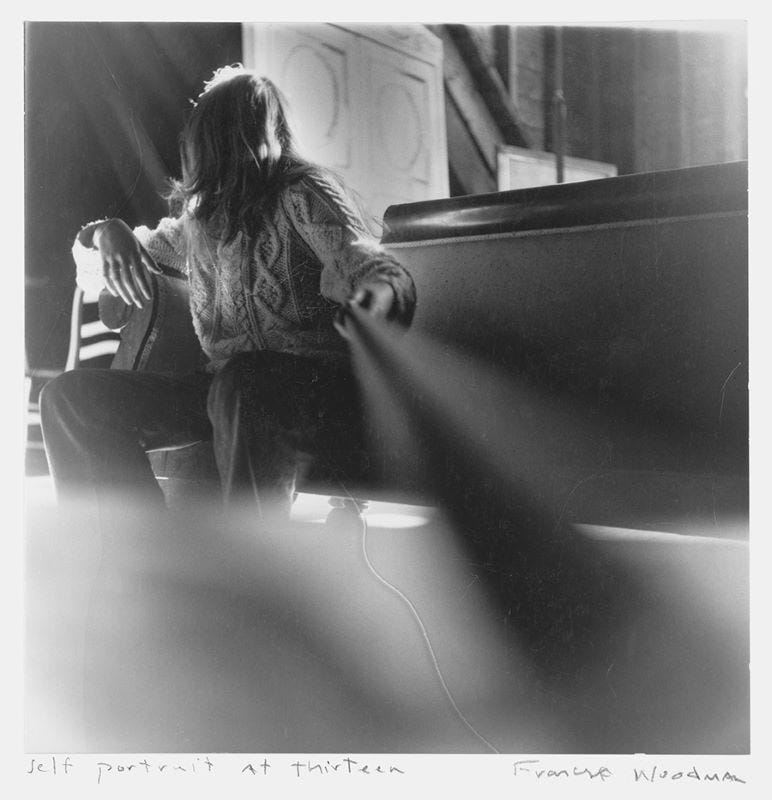
Woodman’s main project, it seems to me, is to make herself strange to herself in as many ways as possible. She seeks to reconceive, extend, de- or over-sexualise her body as a way of claiming it for herself. Her longest visual conversations are with domestic spaces which threaten to swallow her whole. She puts on old-fashioned clothes to pose questions about her role as a modern woman. She wears little-girl shoes to ask if she can still be a child or to issue a riposte to their use by Hans Bellmer in his series of fetishistic schoolgirl doll photographs. For me, the repeated photographing of her own body gradually and thoroughly takes back the male-defined imagery of women as perverse object or anonymous, inspirational muse found in Surrealist art.
Woodman’s pictures are staged and carefully composed. She is not really in disguise, like for example Cindy Sherman, who impersonates others such as the femme fatale film star, or characters in historical paintings. Sherman, who was born in 1954 and is still working, has spent her entire career making herself into other people. In contrast, although there is often a moment of uncertainty when viewing a Woodman self-portrait for the first time as you try to determine if it is indeed of the photographer herself, this is not because she is in disguise. It’s because she has transformed herself.
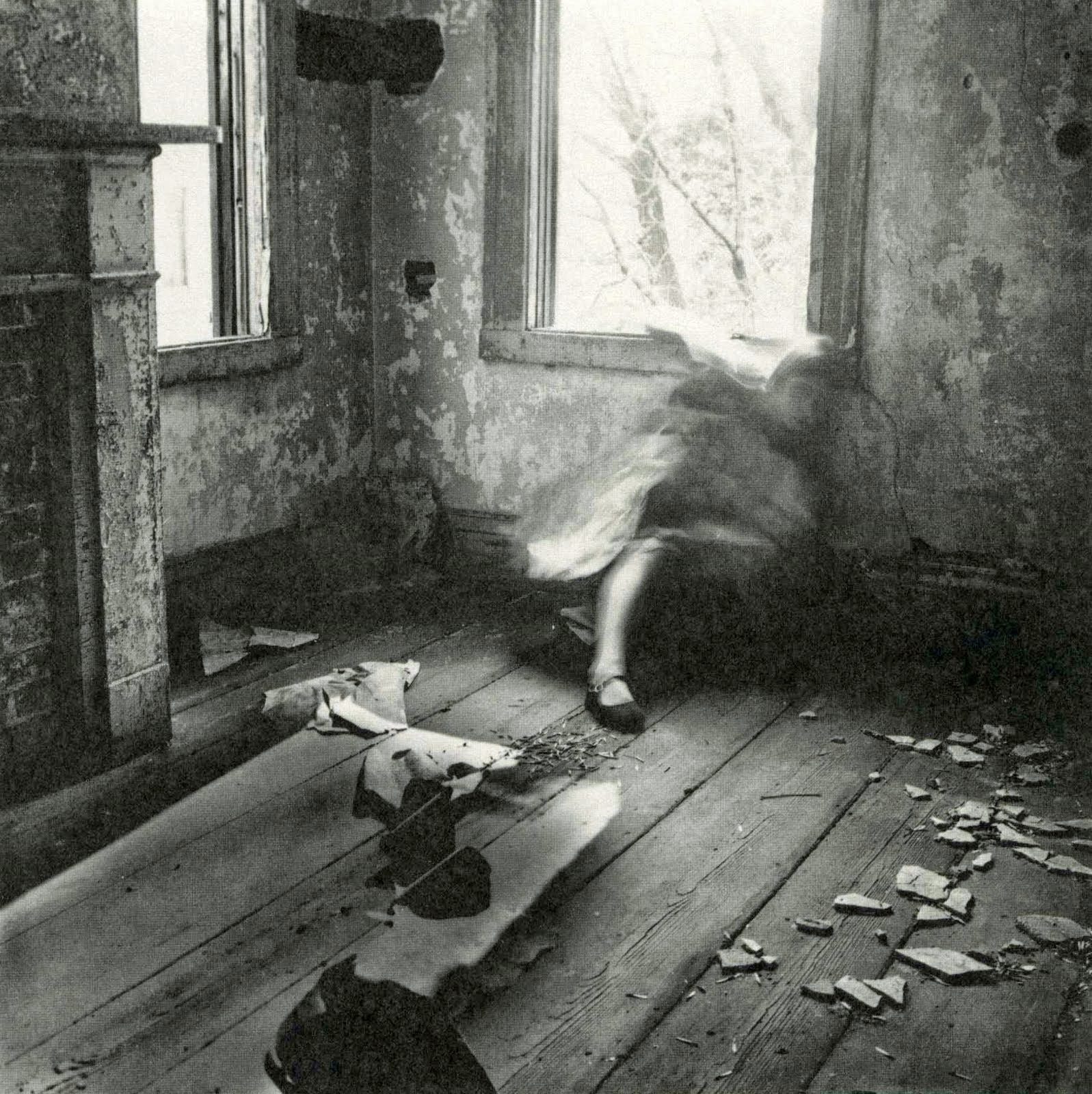
Often, it’s the physical environment that is the cause of the transformation as if to say that our identity is created by the spaces we inhabit. The third image from the series House (1976) presents a dilapidated room in a derelict house in clear focus but Woodman is, characteristically, swathed in a blur of light and wrapped in decaying matter. She is covered by wallpaper that has peeled off the walls, perhaps invoking Charlotte Perkins Gilman’s story of 1892 in which a confined woman goes mad and believes herself to be a part of the yellow wallpaper of her prison. Woodman is arrested in motion, about to be engulfed in the long history of domestic confinement and the moment of dissolution seems to pose the question who is this? Is this me? It’s also strangely beautiful, a sort of dance with light and shape.
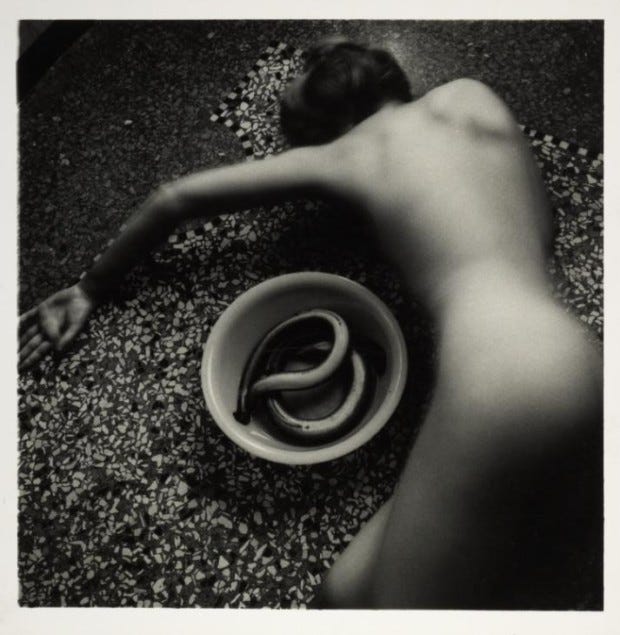
Another kind of questioning of identity is via the imitation of objects. One particularly haunting photograph shows Woodman posed next to a bowl containing an eel. It’s an endlessly ambiguous and fascinating image. Is the eel representative of some phallic threat or promise next to her soft and undefended body? When I saw the picture in the exhibition it suggested to me the prospect of pregnancy: an uncanny portrayal of something curled up outside the body that might equally be furled inside. The beauty of the shapes and the textures, the lit edges of the uncanny fish and the homely bowl all contribute to make it an extraordinarily compelling image.
The video below is something I created with my partner and band member, David Hopewell. We perform as Hopewell Ink, a spoken word and music band, and this section on Woodman is part of a longer video called Soundtrack for a Found Notebook which you can watch in full here.
The words are mine, apart from the quotations from Woodman, but the visual concept was all David’s: it’s actually shot in our garage! This part of the video features field recordings from Prague.
Some of the material in this post appeared first on my old blog.
No posts
Comments
Nothing yet. Say the first thing.
Sign in to join the conversation.