
Happy Thursday! Think about two ways to own a piece of a skyscraper. Buy 10% of the building today, or buy 40% of it and let a new partner slowly buy you down to 10% over the next five years while the building doubles in size twice. Same 10% stake, same building, wildly different amount of money it took to end up there.
That’s the exact problem playing out in venture right now, just with cap tables instead of buildings. Back in June, we asked whether ownership still matters when a handful of companies are reaching trillion-dollar scale. A month later, the answer got sharper. New data from Commonfund shows the power law isn’t just intact, it’s steepening, and Stanford GSB’s Ilya Strebulaev just laid out exactly why the mechanism that lets you defend your ownership, pro rata, is the term VCs fight hardest to keep. More below!
AngelList - As VC firms scale their institutional LP base, finance is no longer just back-office hygiene—it’s a strategic advantage. AngelList’s fund admin operates like an outsourced COO, streamlining operations, meeting institutional diligence standards, and delivering timely, accurate reporting. See why 25k funds and syndicates trust AngelList.
Pliancy - Experience the freedom of IT that just works. Partnering with Pliancy means regaining the time & energy to focus on your mission—without having to worry about the day-to-day tech that makes it possible. Discover why VC firms from coast to coast choose Pliancy (or ask about us in VCBC).
Standard Metrics - Structured portfolio data and LLMs are enabling VC firms to automate portfolio reporting, from tear sheets to valuation memos. Explore 17 workflows that modern fund teams are automating with AI.
Airstream Alpha CFO - Modern CFO support for venture funds and investment firms. With 50+ CFO mandates, Airstream Alpha brings structured, tech-forward oversight and guidance to fund finance, from reporting and compliance to service-provider coordination, so partners stay focused on investing and LP relationships. Learn how funds work with Airstream Alpha from first close through scale.
We’re not talking about the same power law you learned in venture 101 anymore. It’s more extreme than that.
What the data shows:
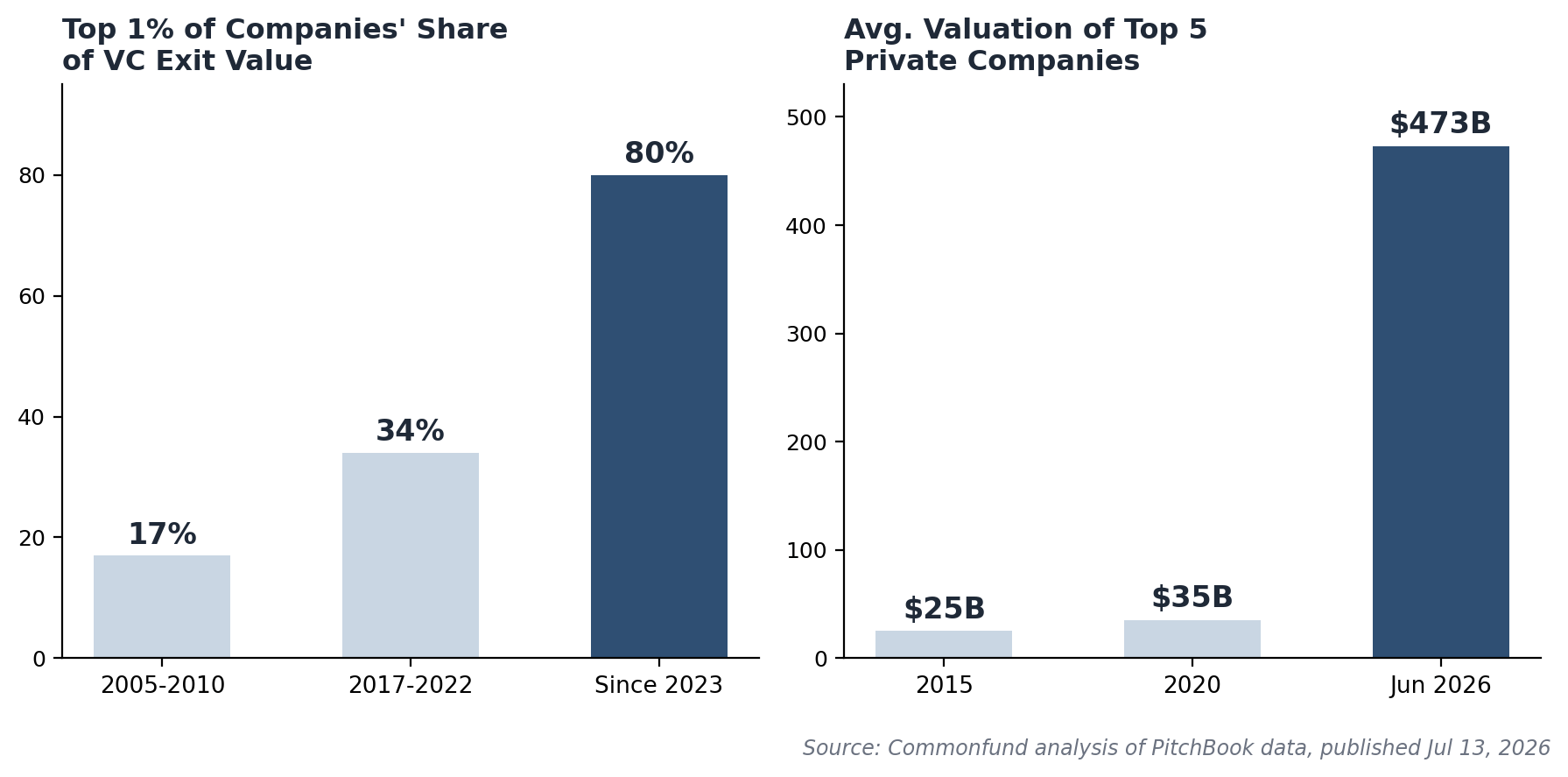
Commonfund’s analysis of VC exits since 2005 found the top 1% of companies now represent 80% of total venture exit value since 2023 (45% even if you strip out SpaceX’s IPO entirely), up from 34% in 2017-2022 and just 17% in 2005-2010.
The average valuation of the top 5 private companies climbed from about $25 billion in 2015, to $35 billion in 2020, to roughly $473 billion as of this June, nearly 17 times the 2015 level.
AI alone now absorbs more than 80% of US venture dollars, up from 64% in the first half of 2025.
What this means for you: this isn’t a gradual trend anymore, it’s compounding. The gap between your fund’s eventual winner and everything else in the portfolio is wider today than it was even two years ago, and it’s getting wider by the quarter.
If the winners are capturing more, the question becomes whether you’re actually holding onto your piece of them.
What the data shows:
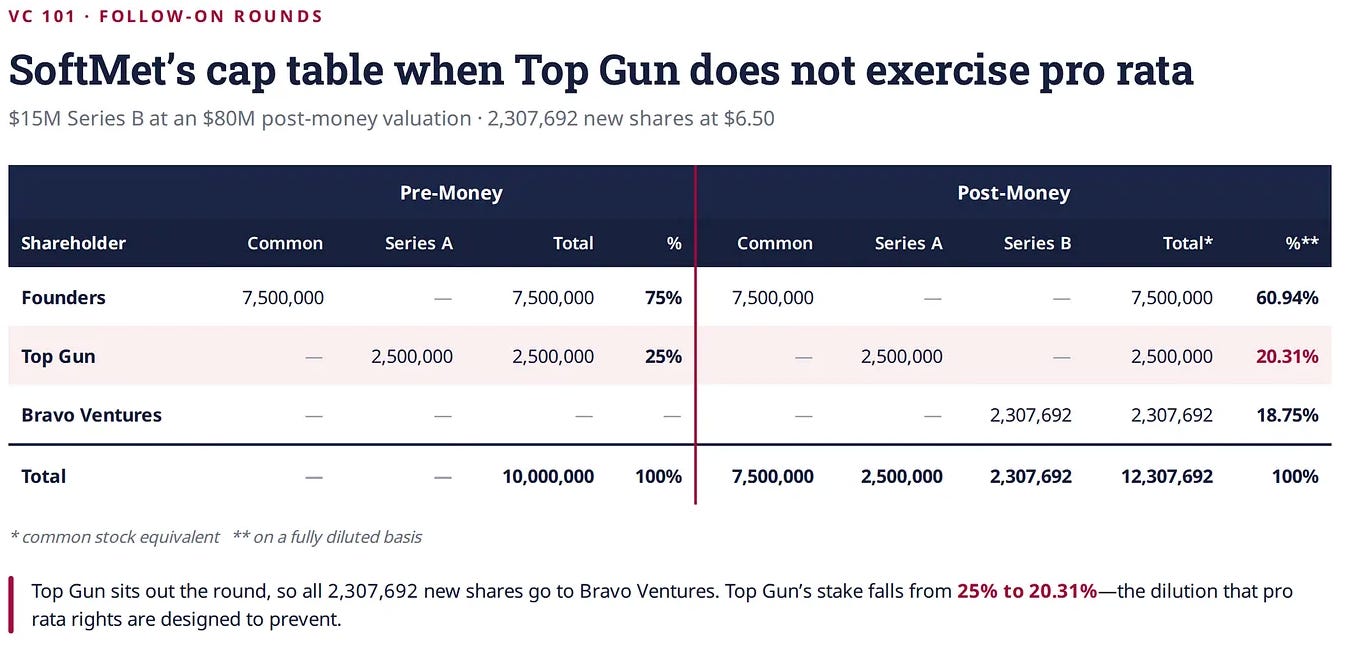
Stanford GSB professor Ilya Strebulaev’s research surveyed VCs on the twelve most important contractual terms and found pro rata rights are the single least flexible term investors negotiate, ahead of liquidation preferences, board seats, and anti-dilution.
His case for why: the portfolio-concentration argument (doubling down on winners without paying for a whole new round), the control argument (staying above governance thresholds for board seats and veto rights), and the signaling argument (declining your own pro rata tells the market you’ve lost conviction).
The mechanics are simple but unforgiving: if you own 25% and don’t buy 25% of the next round, you don’t own 25% anymore. There’s no partial credit.
What this means for you: reserves get the mindshare, but pro rata is the actual lever. A reserve line that never gets exercised at the moment a company inflects is money that protected nothing.
Would your fund actually exercise its full pro rata in your best company’s next round, or does the reserve line exist mostly on paper?
Here’s the same exit, run two ways, to make the math concrete.
What the data shows:
Say a fund invests early and holds 15% ownership going into a company’s growth stage. If the fund exercises pro rata through each subsequent round and holds that 15% all the way to a $500 million exit, its stake is worth $75 million.
If that same fund skips its pro rata along the way and gets diluted down to 6% by the time of the same $500 million exit, the identical initial investment is now worth $30 million.
Same company, same exit, same entry check. The only variable that moved is whether the fund kept buying its share of every round in between.
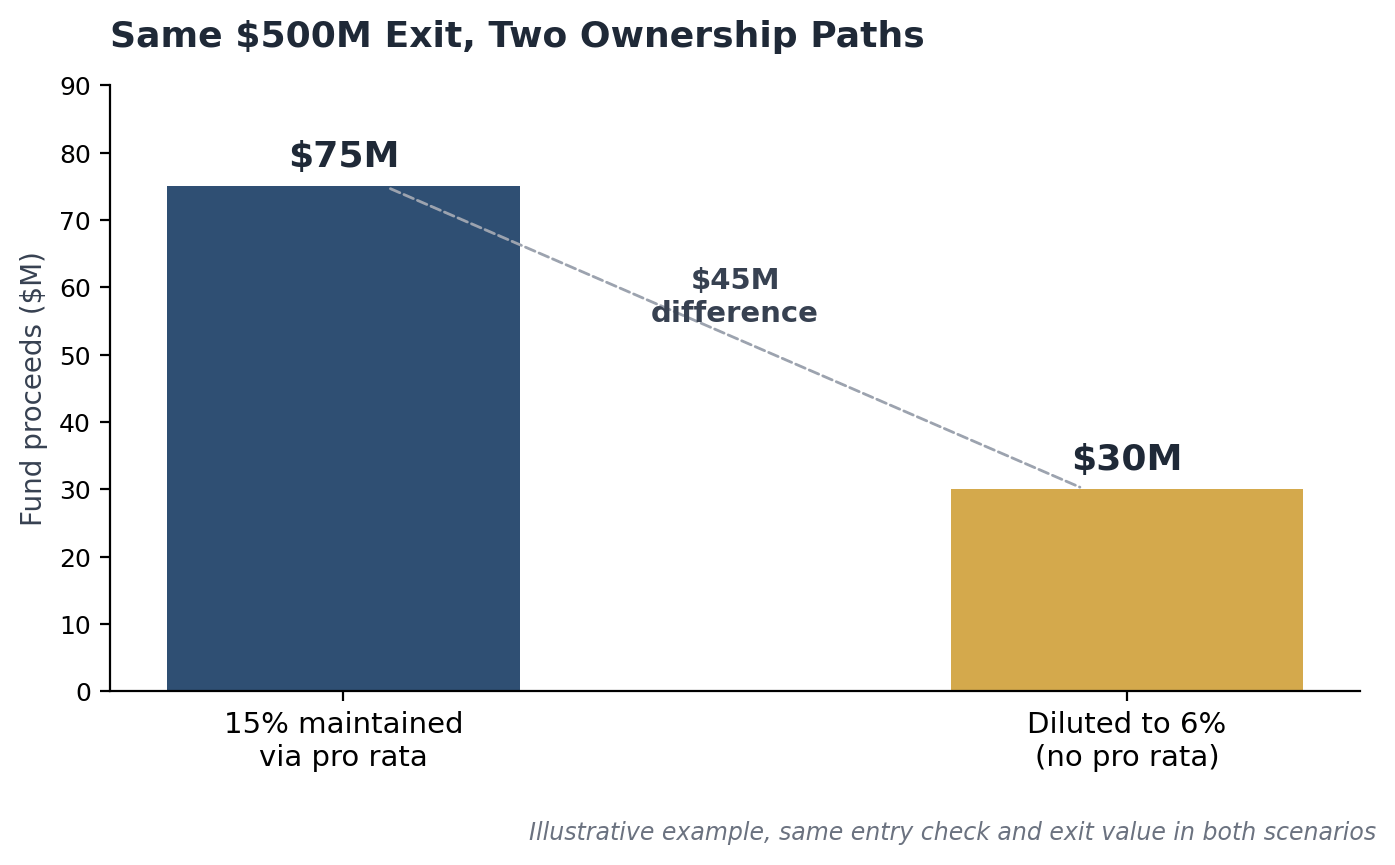
What this means for you: a $45 million swing on paper from a decision that often gets made under time pressure, with a partner half-focused on three other term sheets that week. That’s not a rounding error, that’s the difference between a fund that returns capital and one that doesn’t.
It’s not just company outcomes getting more concentrated. Who gets to write the checks is narrowing right alongside it.
What the data shows:
U.S. venture funds raised about $48 billion in Q1 2026, and the five largest firms captured roughly 73.1% of all commitments, according to PitchBook data cited by Commonfund.
That’s on top of what we covered in #361: three firms alone took in 48.1% of all venture capital raised in H1 2026, and megadeals of $100 million or more captured 87.5% of the $412.7 billion deployed.
The firms with the biggest funds are also the ones with the deepest pockets to defend their pro rata in every round, exactly the mechanism smaller funds are increasingly getting squeezed out of.
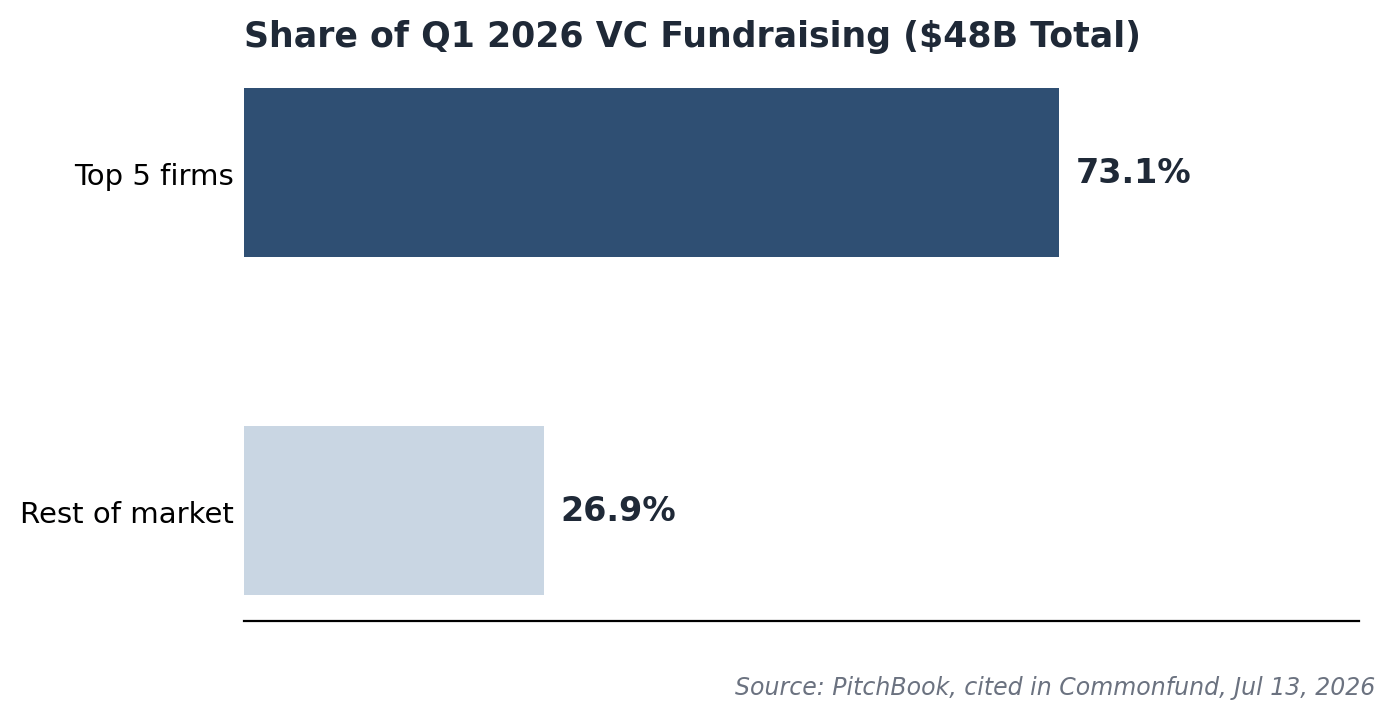
What this means for you: the same concentration reshaping company outcomes is reshaping who gets access to those outcomes in the first place. Bigger funds aren’t just out-competing on deal terms, they’re out-competing on the ability to actually keep the ownership they start with.
None of this is really about picking better companies. It’s about what happens after you’ve already picked one that’s working.
What the data shows:
Revisit your initial ownership target before your next term sheet, not after. If you’re underwriting to 8-10% ownership but rarely defend it past the first follow-on round, your actual exposure to your winners is smaller than your fund model assumes.
Decide your pro rata stance in advance, company by company, using something closer to the gut-check from #361: does this specific company at this specific price earn new capital compared to every other use of that same dollar.
If a bloated reserve line is what’s stopping you from committing to that stance, recycling, covered in the same issue, is one way to free up capital for the follow-ons that actually matter without holding 40-50% of the fund idle the whole time.
What this means for you: ownership isn’t a number you set once at the term sheet and forget. It’s a decision you have to keep making, round after round, for as long as the company keeps raising.
The power law has steepened meaningfully since 2023, the top 1% of companies now capture 80% of all venture exit value, up from 34% just a few years earlier.
Pro rata, not the reserve line itself, is the actual mechanism that determines whether a fund keeps its ownership stake as a company grows.
A diluted stake can cost a fund tens of millions of dollars on the exact same investment, exact same exit.
Capital access is concentrating at the fund level too, the 5 largest VC firms captured 73.1% of Q1 2026 fundraising.
Ownership is a decision made every round, not a number locked in at the first check.
Bottom Line: For decades, ownership mattered because outcomes were large enough to matter and rare enough to fight for. Now the outcomes are larger and rarer than ever, which makes the fight for ownership matter more, not less. So here’s the one worth sitting with: when your best company’s next round comes up, will your fund actually write the check to defend its stake, or will the reserve line stay untouched on a spreadsheet?
VC Fund Model - model the exact math behind this issue’s $75M-vs-$30M example: what maintaining ownership through every round is actually worth versus letting it slide.
DPI Forecast & Premium Carry Template - forecast when your ownership actually turns into distributions, not just paper markups that move with the power law.
Year-End Finance & Compliance Checklist - the operational and governance readiness LPs are now diligencing before they even ask about your returns.
Comments
Nothing yet. Say the first thing.
Sign in to join the conversation.