
Readers of The Frontier Psychiatrists—today’s article is an interview, with some light editing, with Dr. Mark Horowitz, MBBS, Ph.D., a psychiatrist and co-founder of Outro Health. I’m an advisor to that company.
They exist to allow patients to taper off of antidepressant medication safely.
I’ve written about the lack of efficacy in these oral drugs before. For example, in my book Inessential Pharmacology. (Amazon affiliate link). I've got three other physical books already, two of which are poetry, the least commercial art form on earth. One is a therapy manual published by Springer Nature.
Mark’s book is the Maudsley Deprescribing Guides.
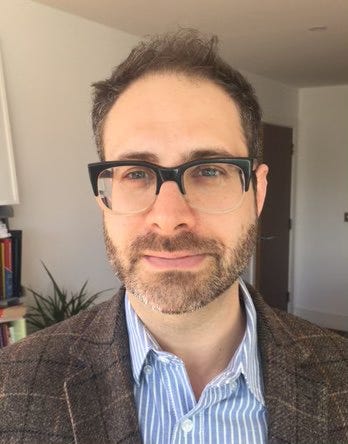
MH: So, look, I'm originally from Australia. I grew up in Sydney. At the age of 17, I made a very ill-informed, immature decision to embark on a medical degree. I decided to add on a double degree. I earned a degree in philosophy of medicine and decided to add on a psychology degree. I've got an issue with degrees. I think, you know, four is good, two might be impressive, but six is pathology.
OM: I'm guessing you would advise against that now?
MH: I strongly advise against it. There are better addictions to have. Much cheaper. I advise you otherwise regarding both finance and time spent.
OM: The earlier you start the process of pursuing multiple degrees, the more likely it is you'll become addicted. (laugh)
MH: I'm a hardcore student. At some point, I had to tell people to block me from enrolling in another degree. I moved to London 15 years ago for a master's and a PhD in neuroscience and psychiatry. I was very interested in understanding the brain to make sense of depression and how antidepressants worked.
OM: Why London?
MH: In my early years, someone told me, “The best place to do psychiatry in the world was the Maudsley Hospital in London.” I'm a British citizen as well. My mother was born in Scotland because my grandparents escaped from the Holocaust.
Maudsley is a hospital that happens to be next door to the Institute of Psychiatry, the most prominent research institute for psychiatry in Europe. That's where I did my PhD, at the Institute next door.
I did a master's in neuroscience for a year, where we went around different labs, and then I chose a lab to complete my PhD. It was with a professor of biological psychiatry called Camino Pariante. I did it for about three years. I looked at the biology of depression. We used human brain cells in a dish, and we tried to simulate depression by adding stress hormones and inflammation and looked at the effect of antidepressants and whether they could reverse that process or not. This is an area of research that I now see as ridiculous.
OM: And when you say you '“now see it as ridiculous,” describe how you could have missed that at the time?
I think that I was profoundly drinking from the Kool-Aid that is everywhere, especially in America, that by understanding the brain, we will understand mental health conditions.
MH: You understand why people get rapidly beating heart and chest pain by understanding the physiology of the heart. That makes sense. There's an analog thought that we'll understand mental health conditions by understanding how the “brain works.” Understanding neurons, synapses, and neurotransmitters is the level at which to understand mental health conditions. I think that's the animating kind of theme of modern psychiatric research. I think that's ridiculous now. Mostly because I think it's premised on a category error. Because I believe that, essentially, people are miserable or anxious because of what happens to them in their lives, at least most of the time. Trying to understand that at the brain level is like trying to understand why a software program is broken down by looking at the hardware in the back of the computer. Yes, in one sense, all software issues exist in the hardware; that's true. Without the circuits, you can't have any software. But when software goes wrong— do you open up the circuit board and solder? That doesn’t make sense. There have been so few insights developed by looking at neuroscience to understand mental health conditions. However, there is a huge relationship between social circumstances and people's mental health symptoms. I spent years looking at nerve cells to understand human emotions. So, of course, my name is on several papers that came out of that lab. Most of them are null findings, I should say. I don't think anything of great help to any human being came out of that lab.
OM: What moment did you have the insight you're describing now that you felt biological science would not yield fruit?
MH: It was not until years later. I want to claim that I came to these insights through being clever, thoughtful, introspective, or anthropologically minded, but I'm not so clever. I came to become critical of the paradigm of biological psychiatry, not through any intellectual work, but because I almost died from the treatments that a psychiatrist gave me.
Well, it wasn't prescribed by a psychiatrist. I didn't see a psychiatrist until late in my career as a person taking psychiatric medications. When I was 21, I was a very miserable young man. If you've ever seen a Woody Allen film, I came from a family, a family like those films portrayed, I was very uncertain about life. I went to see a GP, I think what's called a primary care physician in America, and like one in two people, I was offered an antidepressant. It happened to be Lexapro.
The generic name is escitalopram, which is the most popular antidepressant in Australia these days. And they came onto the market a few years before I walked into my GP's office. I was given a starter pack from one of the drug companies. I took that for many years.
During medical school, during my training in psychiatry, and my Ph.D., I took this medicine. I guess there are two major effects it had on my life. Number one, I had a lot of health problems while I was on the medication. They were profound daytime tiredness and fatigue. Later, memory and concentration problems developed, and these increased over time.
As a younger man, I had a brilliant new photographic memory. As time went on, my memory and concentration got worse and worse until they became quite bad. It was quite pronounced and quite worrying, and it had a big effect on my ability to function well. It became quite embarrassing, forgetting things quite often. Most of the time, it was daytime fatigue.
Sponsors include:
With a great update—the Tickets to the event are now FREE!!!
OM: was lexapro the only medicine you were taking at the time?
MH: Yeah, for many years, I took just Lexapro escitalopram.
OM: My, my level of envy to hear that statement! I have bipolar disorder. Polypharmacy has been my life — then, I developed an autoimmune condition thereafter. So if there was a thing to blame, you knew which one.
MH: Well, it started as the only one for the first 10 years, but it didn't end up as the only one I ended up on, on five different drugs.
OM: Oh God.
MH: In retrospect, it was a prescription cascade. What happened was I was very tired. I would fall asleep during class. Eventually, a professor said, “This is very strange. You keep falling asleep every in every lecture.”
He sent me to a doctor. I was diagnosed with narcolepsy, type two narcolepsy.
OM: You had an MSLT for that? [ed: this is a medicine abbreviation for “multiple sleep latency test,” the gold standard for the diagnosis of narcolepsy]
MH: I had several of them, um, and that was positive, and so I was given a diagnosis of narcolepsy, and because of that, I have prescribed stimulants of various forms over the years, Ritalin, modafinil, and essentially what happened over time drug side effects, which accumulated more drugs. So, because it made me anxious, different and more drugs were added. Because it made it hard to sleep, different sleeping tablets were added. So, at the height of my career as a psychiatric patient, or I guess you could call it a neurological patient also, I was on two antidepressants, mirtazapine, escitalopram, methylphenidate, and Zopaclone. The next one—and the last drug I was on—was gamma-hydroxybutyrate or Xyrem.
I started off on five drugs, I've come off four of those, and I'm down to the last little tiny, uh, bit of mirtazapine is the last drug that I'm on, I'm just a quarter of a milligram, so a little speck of a drug.
I guess in coming off those drugs, one of the main things? All those symptoms I experienced have resolved. Daytime fatigue, memory, and concentration issues. Although I'm not back to being the 20-year-old that I was— I certainly don’t have anything like the level of impairment I had on all these drugs. I was impaired to the degree that whilst I was on these drugs, I worked only part-time because I was so fatigued.
OM: Oh my God.
MH: I've returned to full-time work. There was a point at which I was so impaired that I thought it was unethical to keep practicing as a doctor because I would write down everything that was said to me. And if I lost my piece of paper, I'd forget things. If someone asked me, “How was that patient you saw two days ago?”
I could barely remember who they were talking about. I reached the point where I thought it was unethical to keep practicing like this, and I could still take medical retirement. It was quite impactful on my life. I am getting back my ability to think straight. Being energetic during the day has been an incredible gift to me. I feel like I've been given a second chance at life. So that's the first aspect. The second aspect is the bit that almost killed me.
MH: The bit that almost killed me was coming off the drugs initially.
OM: One of them is Xyrem, which can absolutely kill you. [ed: abrupt withdrawal from Xyrem (generic: Sodium Oxybate) can lead to seizures and death]
MH: It wasn’t the Xyrem! It was coming off Lexapro (escitalopram).
OM: Wow.
MH: That was pretty close to not surviving.
OM: Oh, my gosh.
MH: Towards the end of my PhD, I came across a paper talking about withdrawal effects from antidepressants. I found that very startling because I hadn’t encountered talk about withdrawal effects from antidepressants in either medical school or my training.
One, drugs that cause withdrawal effects also cause tolerance because they’re the flip side of the same coin. So I thought, I’ve now been on a drug for 13 years at that point. How could it still be having any beneficial effect? Number one and number two drugs that cause withdrawal effects are generally not all that good for you.
You know, benzodiazepines, oxycontin. These are not drugs that you want to be on long-term. And so I found that jarring. It had been on my list. Maybe to try coming off my drug and reading that paper knocked it up to the top of my list. And so what I did was. I, you know, I’m a very nerdy human being.
I went and read all the academic literature about how to come off antidepressants. And a lot of it was written by people I was working with. I was working with professors at Oxford and Cambridge. They all said the same thing. Withdrawal effects from antidepressants are mild and last a week or two.
And you can avoid them by coming off over about four weeks. Well, that sounds reassuring. And then, because I’m a millennial—a geriatric millennial— I went and read online. I went to Google:
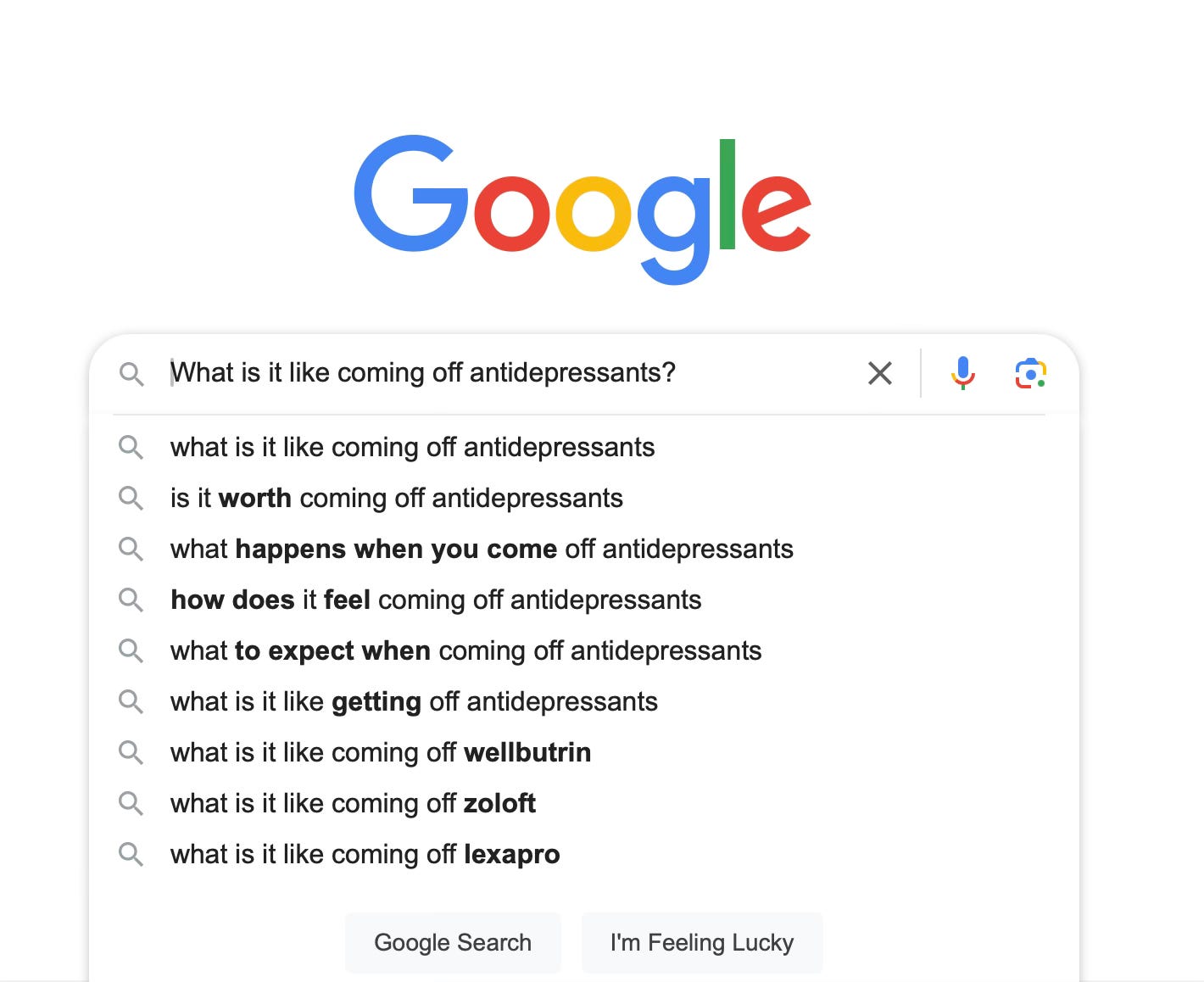
MH: I encountered a quite different narrative. People online said it was incredibly hard and took them months or years. Sometimes, I read that it could create much worse states. Even worse than the issues that people went on the drugs for. I’m an “institutionalized person.” I’ve got six degrees. I spend a lot of time listening to professors. I didn’t know whose opinion to take! I decided to split the difference and to come off over four months, not four weeks, but not four years. I did that by getting a liquid version of the drug and using a micropipette from my biological psychiatry laboratory. So, I used the equipment I was familiar with from the lab.
OM: Is there an irony there?
MH: Yes. I was shuffling equipment out of the lab at night to measure small doses at home. I turned into a kind of Walter White character! I halved my dose every month for about four months. I was on 20 milligrams, I think, to start with or 15 milligrams, and by then, I was at one milligram.
I got down to one milligram, and my life basically imploded. I had trouble sleeping, and every morning, I would wake up in full-blown panic, even terror. But I had an experience in my life before. It was animal-level terror, like wild animals chasing me on the edge of a cliff.
I hadn’t experienced before heart beating, palm sweaty, and that would last for about 10 hours of the day. By nighttime, I’d get a little bit of relief. I took up running, which would be a bit of relief. I ran so much my feet. I listened to hundreds, if not thousands, of repeats of body scan meditations.
It went on week after week after week. At some point in there, I thought, I’m not sure I can keep living like this. This is so unpleasant day after day. I was dizzy. Things around me appeared unreal. There wasn’t a single second where I thought this was me returning. At 21, I was a miserable human being.
I was pessimistic. I was ruminatory. I’d never had a panic attack in my life….and here I was. I’d never had trouble sleeping. I’d never been thinking of ending my life. What I experienced at age 21? That was a 3/10 existential-level dilemma. What I lived through when I stopped the drugs? That was 9.75 out of 10. Eventually, I thought I couldn’t keep going like this.
I went back on my drug. I returned to 20 milligrams, even higher than I’ve been on before.
OM: Oh, wow. That says a lot!
MH: I realized I was now on this drug, not because it was helpful, but because I couldn’t stop it. I was now on this drug. I met every definition of being physically dependent on this drug.
OM: I’ve been through a similar experience with pramipexole. As I wrote previously, it similarly almost killed me— Dopamine agonist withdrawal syndrome! I was following the taper my doctor prescribed. I went down from four milligrams, which is an insane dose, I later learned, down to 0.5 to 0.25mg. A month into the 0.25mg, I was thinking of pouring gasoline on myself:
The image of pouring gasoline over oneself and lighting a match is not a pleasant one. It’s not pleasant even when you’re thinking about someone else doing it, who is invariably a monk. Monks are in virtually all of the pictures that exist of this activity, because the most viewed image of this is on Rage of The Machine’s breakthrough album. Monks are different from regular people. Monks are not you or me on average. You don’t go to work wearing a monk outfits unless you’re a monk. Monks are conceptually far enough from early-40s, tubby, balding, white physicians as to allow for a sort of emotional and cognitive distance.
Your story, Mark, is very relatable. I also, it turns out, have something close to narcolepsy. Still, once you realize that you’re chasing the dragon, as it were, with these medicines that you can’t stop— is there the fear that, like traveling, going anywhere, is doing anything? “What if my supply of the medicine were to run out? Did you know that you were bound?
MH: Some of those thoughts did cross my mind. I think I’d had them before because I’d been on the drug for over ten years. I thought I’d always got to have the drug. I guess it became more clear to me. What I didn’t realize? I was walking on a tight rope, three meters above the ground, and if I tripped, I would end up falling only three meters.
It did make me think about flying and having a supply of the drug. But I guess to me, the biggest dilemma was something slightly different, which was, as I was reading about people’s experience on these drugs, I came across a lot of people who said exactly what I said. After starting these drugs, I fell asleep all the time during the day. I was diagnosed with narcolepsy.
And so I crystallized my thoughts, thinking maybe these drugs are what’s causing my fatigue. I thought I was caught between a rock and a hard place here. I’ve been fatigued, which has caused incredible trouble in my life. It affected relationships and work. So, I had to accept this fatigue as I returned to those drugs that caused it. I thought being on this drug was causing me so much trouble in my life. It’s hard to express the way it affects relationships. I miss events. I fall asleep. I arranged my life around naps; it’s entirely consuming, and coming off this drug almost killed me.
Now, I’m back on a drug that’s causing me all these health problems. Coming off, too, was incredibly dangerous. So, I felt trapped. I was! I’m trapped on a drug. It’s causing me a lot of different, terrible side effects. And it looks like I can’t come off it because it’s too dangerous. So I felt I have no moves left on the chessboard.
OM: That’s not the end of the story. Which is nice to know. Knowing the end of the story is always calming! People make a joke about playing 3D chess, and my response to that is that there are 10 ^ 40 moves available in chess. That’s what’s called the Shannon number. If you go to all the possible moves, including illegal moves in chess, you get 10123. On my math nerd soapbox, 3D chess requires more moves than there are atoms in the entire universe to calculate the change in those moves. There are between 1078 to 1082 atoms in the observable universe. That’s not plausible. There are more than enough combinations on the regular chessboard. So here—running out of moves for being stuck on a drug— was a moment of…in the hero’s journey, we’d call this “tests, allies, and enemies” or something like that?
You’re also a psychiatrist and psychiatric researcher who has these tools at his disposal to do your job. What are you doing? That’s what I’m thinking anyway.
MH: That’s good. I appreciate you raising the stakes on this and making it more dramatic than it might be. So I’ll tell you how I solved that issue. I was so shaken by what had happened coming off the drugs. I quit my job in London and moved back to my parent’s house in Sydney. I was an ostensibly grown adult human being in my thirties. But I ended up basically in a kind of crumpled mess on my parents’ floor. I, having moved out of the house ten years before, was so relieved when the symptoms went away after a few weeks back on a higher dose I put it to the back of my mind for a while.
I was back in Sydney, I was working as a psychiatry trainee, and I had this sort of thought in the back of my mind: these drugs are not quite what I had been taught they were. But I was just back in whatever role of life and trying to keep up with work, so it didn’t occur to me—I was living relief.
Because I was back with my family, I had access to my parent’s private health insurance, which I didn’t have in London. I ended up seeing more doctors. I was still quite confused. And I had doctors saying to me, you’ve got terrible narcolepsy. You need more different medications.
I still had terrible fatigue, and I wasn’t confident at that point the drugs caused it. I had an inkling, but I wasn’t certain. I followed their advice. I was given more drugs and more stimulants, which led to more anxiety, which led to more antidepressants. They tried these newer drugs, xyrem, and sleeping tablets. And I ended up on five drugs back in Sydney now a few years. And I didn’t see it, but in retrospect, it’s quite clear the more drugs I was on, the less able I was to function. I found work hard, memory, concentration. At some point, I decided to take a break from work. I went, and I took eight days of leave.
This is where it gets a little bit cliched. It turns into a kind of eat, pray, love. I went to do a yoga meditation retreat in Thailand. I couldn’t be more of a bourgeoisie cliche if I tried. I did a lot of walking meditation there in a Thai jungle Buddhist temple.
And I thought, why am I on all these drugs? Have they improved my life? I decided I would try coming off them to see what’s underneath. I solved that chess dilemma by following people who’d done it before me. So, it wasn’t being trained as a psychiatrist. It wasn’t psychiatric research. Recall there are 10^40 legal moves, but you said many more illegal moves in chess? I made one such move, not according to the rules I knew. I turned to peers on the internet.
They said you do it much more slowly than a few months, sometimes more than a year or even longer. You followed a specific pattern, reducing your most recent dose by 10 percent every month.
So it gets smaller and smaller. You can reduce by 10 milligrams at a hundred milligrams, but when you get down to 10 milligrams, you reduce by one milligram. There were all these people, actually tens of thousands of people, on these peer support sites saying when they followed this way of coming off antidepressants, it was easier.
It wasn’t a walk in the park, but it was nothing like coming off over a few weeks, as most doctors recommend. I didn’t have to work out anything myself. I had all these people saying, “This is what works.“ And the reason why I trusted them was that I tried the traditional way of coming off over a few weeks. I’d even gone slower. And it almost died. I knew who the experts were now. They weren’t my professors at my university. There were these people online who, through trial and error, mother being the necessity, whatever necessity being the mother of invention being the mother of necessity, whatever it is, had worked out how to do it.
OM: The plural of anecdote is not data unless so many anecdotes exist?
MH: It depends on what you look at, what data is, and what anecdotes are. The data that my professors were basing their opinions on was that after eight weeks of exposure to antidepressants, most people have mild symptoms that last for a week or two.
OM: That’s true. Most people can come off over four weeks.
MH: That’s also true! Of course, at that point, I’d been on the drug for 13 years.
OM: So, they based it on the wrong sample.
MH: Exactly. It’s a bit like crashing a car into a wall at 5km an hour and saying it’s safe and extrapolating that to people driving around 80km an hour. In other words, the data that existed was not very good. In that context, looking at the hierarchy of evidence, 10,000 people talking about not being able to come off in one way and coming off in another way was the best data around. So, I followed what these people recommended on these websites.
And I thought, what’s the harm? How can going off more slowly be wrong? I’m guessing the answer is that the experts were basing their opinions on the incorrect data. They had a very select data set of people who’d been on for brief periods.
OM: Why would pharma study people who were on for 13 years?
MH: They’re just not in the available data. And the people online were a much larger group.
OM: They had a different biology.
MH: I think there are two important points to make here. First, drug companies are required to do 6—to 12-week studies to get their drugs approved by the FDA. That’s why they do a 12-week study. And about, there’s probably about a thousand studies of antidepressants done. 97 percent of them were done by drug companies. And 97 percent of them go for no more than 12 weeks. And there are no studies on long-term people who have stopped long-term antidepressants.
For example, the guidelines from the American Psychiatric Association today tell people how to stop antidepressants? They say you can stop over several weeks. And that is based on people who’ve been on the drugs for eight weeks. So, as you just said, the current evidence-based guidelines are only appropriate for short-term users.
Whereas in America, we know that half of people have used these drugs for five years or longer. And more and more people have been using them for ten years or longer. And we know that the longer you’re on these drugs, the harder they are to stop.
OM: Yeah!
MH: Exactly—it’s not that the people online have different biology; it’s that they have been using drugs for a long time. Much longer than the studies. There are 46 million people on antidepressants in America. Twenty-three million of them have used it for more than five years. It’s reaching 10 million plus, and I have been on it for over ten years.
OM: There’s an insight that you recognize—which was that being on a drug for 10 years is not the same as being on a drug for 8 weeks.
MH: That’s right. And data backs it up. Now, there’s research that shows the longer you’re on these drugs, the greater the chance of withdrawal effects and the greater the chance that they’re severe. Which is obvious, of course, the longer you’re on a drug, the more you adapt to it, the harder it is to stop it.
So, no, there’s no rocket science there. What happened then to me was I took this approach. I took 10 percent a month approximately, and two major things happened. Number one, it was a lot easier to do that than to come off the medication more rapidly so I could tolerate the process. It wasn’t horrible. Many of my symptoms also started to resolve as I came down off my drugs.
My tiredness improved, and my memory and concentration improved. That was the start of me realizing, very clearly, that it was these drugs doing it. That gave me a lot of hope and push to keep going. The second thing that I did was think this was utterly unbelievable.
I’ve got a PhD—in antidepressants!— from an institute that, while I was doing my PhD, passed Harvard as the most cited institute in the world. I’m trying to be a psychiatrist, but I’m getting more helpful advice from online peer support forums run by retired software engineers and homemakers. How is this happening?
So, I wrote an academic article combining the things I’d learned from this website with some academic research that reflected what was going on. I published that paper in Lancet Psychiatry. Over the last five years, that paper and the work around it have led to quite large changes in the guidelines in the UK [ed: NICE guidelines] on how to stop antidepressants.
It ended up being several papers. Number one was theoretical work, and number two was an observational study. So, the theoretical work is that we looked at the neuroimaging of antidepressants.
OM: Similar to Kapur’s work on antipsychotics?
MH: It’s a Harvard guy, a guy called Jeffrey Mayer, who did in 2004; he scanned a whole lot of people on different doses of standard antidepressants. Look at how big the effect was on people’s brains and what he found. Can I show you an image?
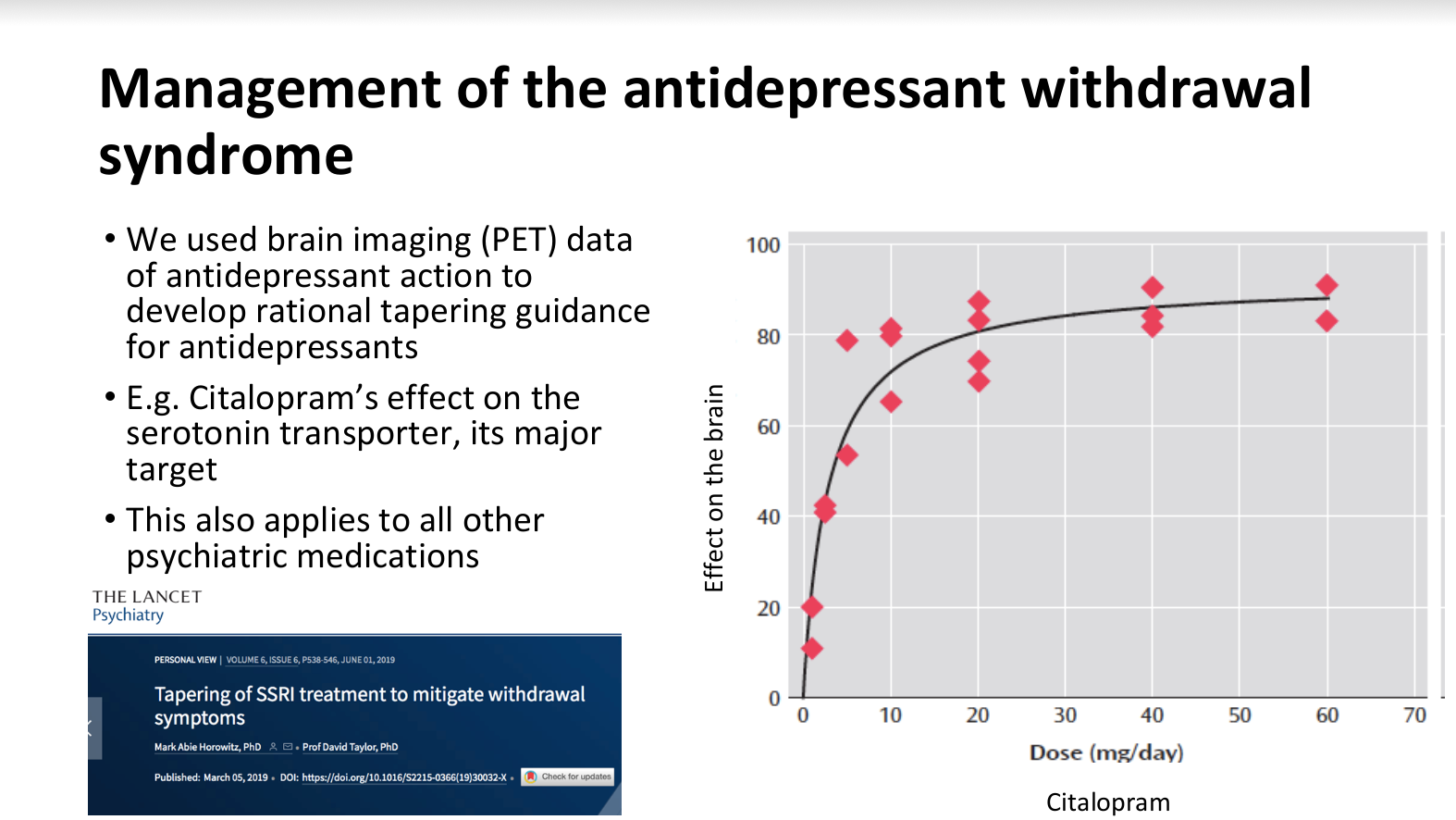
So, this is PET imaging of people on different doses of citalopram, a widespread medicine in America. It’s looking at the drug’s effect on the brain, which is inhibition of the serotonin transporter.
The key point is that the relationship between dose and effect is not a straight line. So, doubling from 20 milligrams to 40 milligrams doesn’t double the effect on the brain. Huh. This is because of the law of mass action. When there’s not much drug in the brain, all the receptors are unoccupied and “open for business.”
And so every milligram of drug has a significant effect, like the game of musical chairs at the beginning. It’s very easy to find a chair by the time more and more of the drug is in the system; more and more receptors are occupied. So, every extra milligram of the drug has less and less effect. And that’s why you get this sort of law of diminishing returns.
And so one of the consequences of this is very tiny doses of drug, like two milligrams, Which people would laugh at and say is a homeopathic dose has about half the effect of 20 or 60 milligrams. So tiny doses like 2 milligrams have much bigger effects than you would think. You can use this relationship to try to understand what happens when people follow the kind of advice that most doctors give.
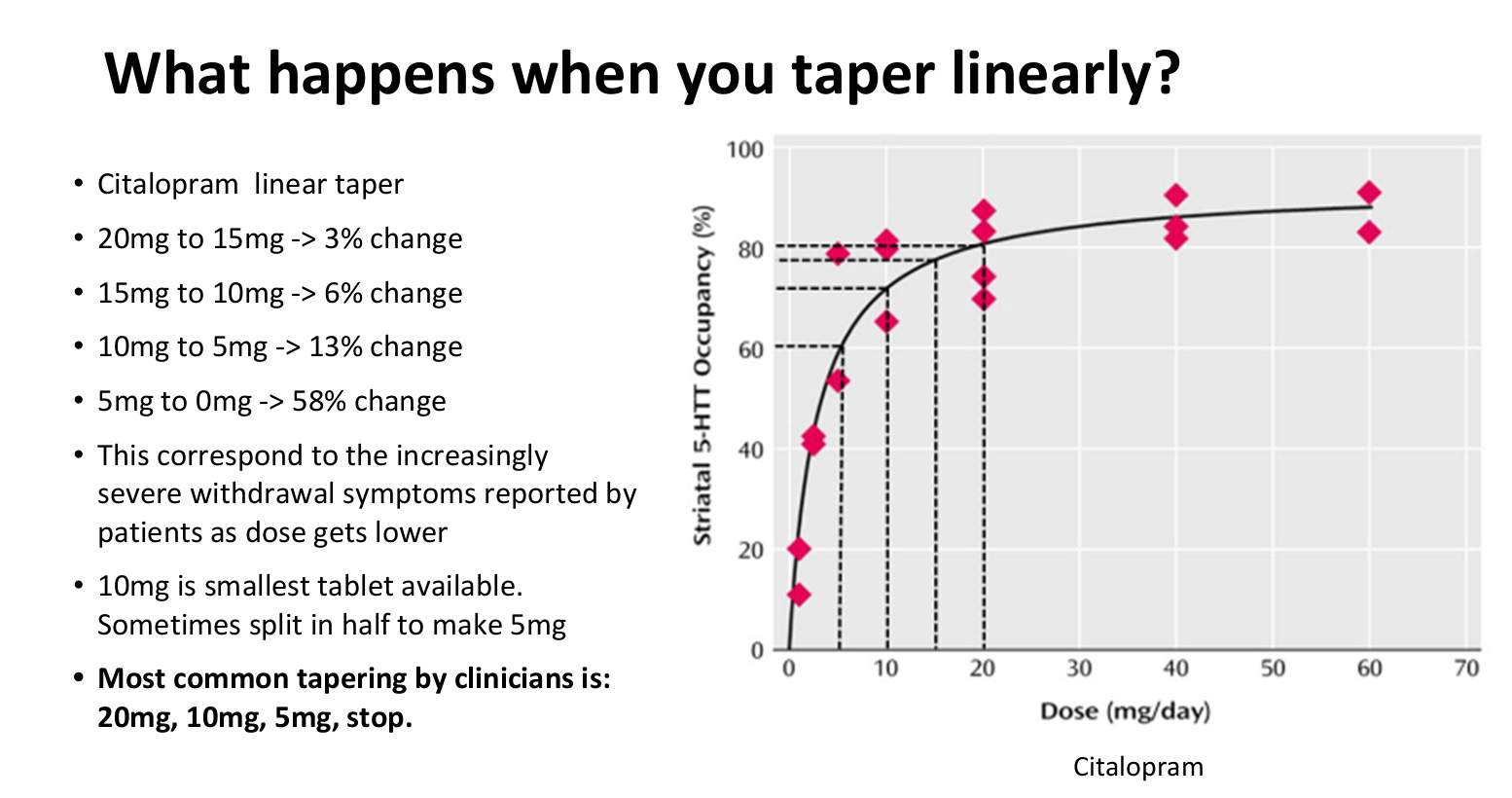
So, most doctors would recommend coming off 20 milligrams of citalopram by recommending halving the dose. And then half the dose again before stopping it is, but what your data shows is that no, essentially, stopping at five milligrams…
OM: you still have the vast majority of the effect of the drug to be rug-pulled…
MH: Exactly. You’ve got it. So you can imagine walking down. If this was a path, it starts as a garden path. You can walk very easily. It turns into a steep hill, and then it turns into a cliff.
OM: But there’s a bias here because every doctor recommending to go down from 10 to 15 is correct. They get to feel better about their role as doctors again when someone goes from 15 to 10. And from 10 to 5, things go fine. So they have this smug sense that things are going to go fine.
MH: Yes, yes, exactly. People are a bit reassured because the earlier reductions are easy. This is going fine. Yes, my doctor has got things under control!
OM: But on both sides, it’s wrong! The doctors are convincing themselves they’re doing a good job, and their patients are feeling like the doctors are doing the right thing. And there’s no data to suggest to either party that it could be a disaster…until the cliff.
MH: Exactly. So what happens at the cliff is that people jump off. They can end up in a state of terror like I was. And because most doctors don’t understand his relationship, they think they must need the drug; maybe the last five milligrams are the most important.
OM: Your depression has come back!
MH: Yes, exactly. So, they tend to misdiagnose relapse of depression or anxiety. I’m sure if I’d walked into any doctor’s office, When I was panicked, terror stricken, I’m sure anyone would have said to me, you’ve relapsed clearly, your condition’s gotten worse.
OM: I have a question for you: How long after a discontinuation or taper event can this kind of experience of horror and dread appear?
MH: It’s a fascinating question because the textbooks say it should take three to five half-lives, which is about three to five days after most drugs.
OM: Those are textbooks about drugs. Not about neurons responding to what happens later, there’s counter regulatory effects that the drugs have been doing for years.
MH: Perfect marks! Precisely. So, a study looked at the average onset of withdrawal effects in a cohort of patients. It found that it was about four weeks with a standard deviation of 13 weeks; in other words, it’s enormous. It’s a large variation, but what it’s telling you is that some people experience withdrawal effects one, two, or three months after stopping their drugs. And there are two explanations for why that might be. Number one is “the mousetrap explanation,” which is that “you drop the ball. It hits the stick that presses the steps that do the whatever.”
OM: Rube Goldberg!
MH: It takes a while for things to unravel! Number two is based on a fascinating study that posits, “It takes a lot longer for the drugs to leave the central compartment than we think.”
For example, after a couple of weeks off a medicine, you can still see it affecting specific transporters inside the brain. In other words, the brain elimination half-life is longer than the plasma elimination half-life. Between those two explanations is probably why you can have withdrawal effects that come on weeks or even sometimes months after stopping the medicine.
OM: There isn’t a “liver in the brain” to metabolize the drug. Most drug metabolism takes place in the liver for compounds in the blood, of course.
MH: Oh, you are asking if the drug must go into the blood across the blood-brain barrier and hit the liver? But there’s another interesting study that shows that the elimination half-life in the brain is slower.
OM: And that fits with data from Kapur’s lab at UCL, where he showed with PET scan data that aripiprazole has this tremendously long half-life, and its dopamine receptor occupancy one week later is the same as on day one.
MH: That drug has a long half-life.
OM: But it also hangs out in the brain for a long time. And so does its active metabolite and blah, blah, blah, blah, blah. So, there are plenty of reasons why things could hang around longer. The drugs— if the unwinding of the effects is longer? It messes with the human ability to make a causal inference.
MH: You can imagine the doctors reading the textbooks. It says mild and brief symptoms come on two days afterward. Someone’s in their office a month later.
OM: They look like death. They’re sick. And it doesn’t match the description in the textbook. So they think it can’t be withdrawn.
MH: It must be terrible mental illness, relapse, something else. You can see where the trouble comes from! They are guided by short-term studies that underestimate the withdrawal effects, which cause havoc in clinical practice! Well, this means that doctors are reading books that are not accurate for their patients. That’s huge trouble! We now have hundreds of thousands of people who have left their doctors and gone to online forums, just like me, because they find those forums more accurate and helpful than their doctors.
OM: Some people do have a mental illness—whatever that means and who are sick and could relapse.
MH: That exists. However, I want to problematize it a little bit. The vast majority of people who are prescribed antidepressants are prescribed by a GP or primary care physician; they’ve never seen a psychiatrist.
The vast majority of people who are prescribed antidepressants have mild to moderate conditions. The vast majority of people who have mild to moderate conditions see a GP or a primary care physician in the context of a major stressor: job loss, divorce, or physical illness.
OM: It’s hard to have a relapse of a specific divorce.
MH: In other words, it’s hard to have a relapse of a particular stressor in your life. Most people who are prescribed antidepressants do not have severe recurrent disorders. They have contextual stresses, which are in the past.
So, the idea of relapse, which is so prominent in doctors’ minds, isn’t often accurate, on average—the majority of starts on medicine are based on acute and non-recurring stressors.
OM: Essentially, this is my same argument about dubious “bipolar disorder.” If you treat everyone’s “bipolar disorder” with Seroquel, it works for their “mania” 100 percent of the time—because they never had the underlying disorder.
MH: Yes. Doctors get to convince themselves they did a great job of preventing the relapse of mania in someone who doesn’t have bipolar disorder.
OM: You argue that most people who are coming for help would be best served by someone helpful, listening, and supporting them psychosocially.
MH: I’m making two points. Number one, in most doctors’ minds, relapse is the horse, and withdrawal is the zebra. I think the data is clear.
OM: The overwhelming majority of people have been prescribed these medicines for mild problems that are in their lives?
MH: That the horse is withdrawal and relapses is the zebra for most people, some people, there’s some, there’s people out there with very severe conditions, but that’s not most people and do exactly what you’re saying.
The NICE guidelines in the UK, which evaluate cost-effectiveness, found that the most cost-effective treatment for even severe depression was problem-solving therapy:
That means you tell somebody what your three major problems are. What’s the first step to take for each one? And report back in two weeks on progress or barriers encountered. That’s more effective, and that’s more cost-effective than antidepressants. It’s more even cost-effective than various forms of psychotherapies.
I think that gets to the heart of the issue: people. It’s the things going on in their lives that tend to explain why people are miserable and anxious, and there are lots of ways to help them with that, of which I think only one is an antidepressant. And I believe that the way that antidepressants generally work is they numb people’s emotions.
I don’t know how much there are all these kinds of descriptions of biological effects and neurogenesis and inflammation that I was very Taken by, but I think when you ask most people on antidepressants, they say they feel emotionally restricted or numbed. And that’s why people can feel better in the short term, which is a bit different from fixing their problems.
OM: It’s fascinating that you’ve landed on the opposite end of the spectrum as I have in my career as a physician. I focus on very high-acuity individuals but have come to similar conclusions about the utility of these drugs.
In summary, if I am getting this right, in the world of primary care—where, on average, patients don’t have a severe chronic psychiatric problem—these drugs are causing one. In the world of high acuity problems, where you do have a severe problem, the drugs aren’t solving those. Riffing on what Dan Karlin once said to me, we perfected the algorithms to make these compounds as safe as water, at least initially. We have a generation of agents with the potency of water, but similar to withdrawal from water, that can be fatal, too.
Thanks for Reading!
You can find my books (amazon affiliate links):
The Hellthread: Collected Poems
Why We Skeet: Further Collected Poems
Adolescent Suicide and Self-Injury: Mentalizing Theory and Treatment
Comments
Nothing yet. Say the first thing.
Sign in to join the conversation.