
This is a conversation with Dr. Colin Keeley, CEO of NeuroSigma, about external trigeminal nerve stimulation (eTNS), what it does to the brain, and the newly launched second-generation Monarch device.
Disclosures: I am a child and adolescent psychiatrist and a past prescriber of the first-generation Monarch device. I also work with Neurolief, a company that makes and eCOT-AS device for depression and another one for migraine—that’s a trigeminal and occipital nerve stimulation device, which puts me in an adjacent part of the neuromodulation field, although not “direct competition.”
I think my readers deserves to know that going in. I am enthusiastic about this technology, and I have skin in the broader game—I’m also a cofounder at Radial, which prescribes these devices. I have no equity in Neurosigma, and receive no compensation from them.
Owen Muir: It is great to talk to you again. Feel free to introduce yourself for our readers.
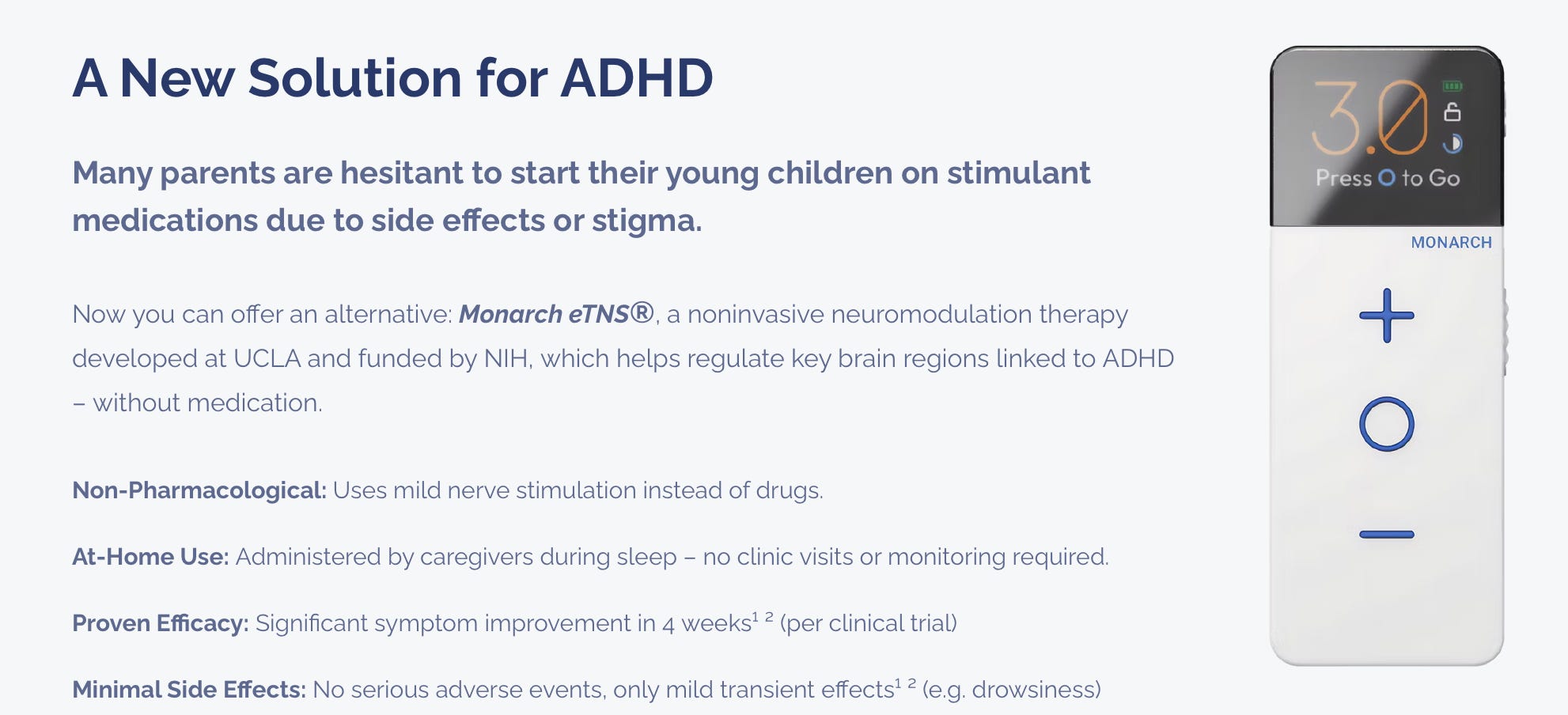
Colin Keeley: My name is Dr. Colin Keeley. I am the CEO of NeuroSigma, and we are commercializing the Monarch External Trigeminal Nerve Stimulation System, the Monarch eTNS system, for treating pediatric ADHD. About two weeks ago we launched the second-generation version of the Monarch device in the United States.
Owen Muir: I am excited to talk to you about this, for both personal and professional reasons. But I want to start with the origin. I had a conversation recently with our mutual friend, and the creator of eTNS as a modality, Ian Cook. Can you walk me through what Dr. Cook did to work out that stimulating the trigeminal nerve, and specifically trigeminal nerve division one, so it sits on your forehead, could change the brain? How was that figured out originally?
Colin Keeley: It is an interesting story, and like a lot of invention stories, there is some serendipity and luck along the way. The original concept for TNS was to use it as a treatment for drug-resistant epilepsy. That was thought of by Dr. Christopher DeGiorgio, an epileptologist at UCLA who did a lot of work with vagus nerve stimulation, back when that was not even FDA approved as an implantable treatment for drug-resistant epilepsy. He conceived of this noninvasive cranial nerve stimulation modality as an alternative to an implantable vagus nerve stimulator, and he started running clinical trials, both open-label and then a blinded study. One of the consistent points of feedback was that people were coming in and reporting mood improvements, improved clarity of thinking, better sleep, deeper sleep, things like that.
Owen Muir: They were both at UCLA. They were probably down some kind of hall from each other.
Colin Keeley: Correct. So DeGiorgio took those clinical observations to Dr. Ian Cook, a psychiatrist at UCLA who specializes in the treatment of adult depression. Ian was very interested, because he was a pioneer in the use of transcranial magnetic stimulation, and he felt that TNS could be a nice addition to the armamentarium. One of the cleverest things Ian did right off the bat was a small PET study, which was published about nine months ago, though it took a while to get out. It was a small PET study in adults with major depression. It was an acute study. They had never received TNS before. He used an on-off treatment paradigm, something like six scans, three with TNS on and three with TNS off, and then analyzed the scans for areas of significant activation and deactivation. It was really interesting, because there was a dual mechanism that was not necessarily anticipated.
Owen Muir: So in the temporal region, the hippocampus, you saw changes in regional cerebral blood flow, which is a proxy for electrical activity. Because this is positron emission tomography, they are using a radio-labeled tracer, correct?
Colin Keeley: This was O-15 PET.
Owen Muir: So this is radio-labeled oxygen. It is the PET analog of the BOLD signal change you would see in functional MRI.
Colin Keeley: Correct. Sorry for getting into the weeds a little.
Owen Muir: No need to apologize for getting into the weeds! I want to make sure we get it right. We are measuring the fact that if the brain is more active, it is using more oxygen. Cells need oxygen to function, so they used specially labeled oxygen to follow how it is being utilized in the brain. And in the hippocampus, the memory center, at least for short-term memory, you saw increased activity, and...
Colin Keeley: Actually, that was an area of decrease. The hippocampus and the temporal regions showed decreased activity.
Owen Muir: Challenging my preconceptions!
Colin Keeley: What is interesting about that is that the temporal lobe is the most common anatomic area where seizures originate.
Owen Muir: Right. Temporal lobe epilepsy, hippocampal seizures, things like that.
Colin Keeley: And then conversely, there was a significant increase in blood flow to regions of the prefrontal cortex.
Owen Muir: So you saw a change that challenged your preconceptions.
Colin Keeley: Absolutely. This dual mechanism of action was not expected. Parts of the brain light up, parts of the brain decrease. We think the decrease explains the anti-seizure effects, and the increase explains the cognitive and mood effects.
Owen Muir: It may be that these things are related, and this is speculative, but we may be remembering differently when we are depressed. And these were depressed people.
Colin Keeley: That is a great point. I agree.
Prior Articles on the Topic include:
Owen Muir: Let us backtrack a little and just explain the technique itself. External trigeminal nerve stimulation, which is what we can put people in a scanner and watch change the brain. What is it, and how big of a deal is it to get this treatment?
Colin Keeley: This is not an advertisement, this is my opinion as a physician: this is a very benign medical treatment. You have the trigeminal nerve, the fifth cranial nerve, which primarily provides sensation to the face, although it is a lot more complicated than that. You apply an electrical patch to your forehead, and that patch stimulates the V1 branch of the trigeminal nerve, bilaterally, on either side of your head. When I say stimulate, we are using very low levels of electrical current, generally between two and three milliamps. The patch connects to a little box smaller than a cell phone, the pulse generator, which administers the current with a specific proprietary waveform and treatment algorithm. In the clinical trials, children with ADHD did this overnight while asleep. They take it off in the morning and go about their day. It is a pretty easy therapy to integrate into your life.
Owen Muir: There was thinking behind the overnight schedule originally. Can you take me through that? It sounds like it is basically a less nasty Band-Aid, easier to get on and off than a Band-Aid.
Colin Keeley: Yes. On the nighttime piece, we have to go back to the early days when DeGiorgio was working with epilepsy patients and comparing his approach to implantable vagus nerve stimulation, which works 24 hours a day. He asked himself, how do I get people to use this as much as possible? He is just trying to prove it works. And he decided to have them use it overnight while asleep. That paradigm worked for us, so we carried it forward, because it does not interfere with people’s day. That said, one of the things we are working on, and I do not want to get ahead of myself, but we think we will soon announce a clinical trial where people would use the device for two hours in the evening rather than the eight-hour overnight paradigm. It is possible that eight hours is overkill. We honestly do not know yet. So that is something we are trying to figure out.
Owen Muir: It is an answerable question. You had a paradigm that worked, and you went with it. So you stick a sticker on the forehead, it has some gel, it hooks up to a pulse generator, and that is the whole medical device.
Colin Keeley: That is the whole thing. And we have never had a serious adverse event. I believe it is a very safe medical treatment.
Owen Muir: That is great to hear. The FDA label for this is in kids. What is a kid in this context?
Colin Keeley: It is a patient seven to twelve years old who uses the device as monotherapy for treating ADHD.
Owen Muir: Monotherapy. That is a big deal, at least from my perspective as a child psychiatrist, because it means you do not necessarily have to also be giving them a stimulant as an adjunct. This is instead of a drug.
Colin Keeley: Yes. Part of that is an artifact of the trials we ran. The team we worked with at UCLA wanted to use this device as monotherapy, because, as you know, stimulants can be a very effective treatment. They are a great treatment. But I did not want to give them to my daughter, who has ADHD.
Owen Muir: You know what? My kid was offered them too. And we have not done it yet either, for the same reason.

Colin Keeley: In order to get rid of that potential masking effect, we excluded people from the trials who were on medication.
Owen Muir: So no kids on meds in the study. These are medication-free children. What did you see in those trials?
Colin Keeley: There were two trials, an open-label trial of 24 subjects and a blinded study of 62. In both cases the primary endpoint was the ADHD-RS-IV scale. The DSM-5 came out and now we are calling it the ADHD-RS-5, but this was a few years ago. The ADHD-RS-IV is a clinician-administered scale and one of the gold-standard scales in the field for assessing the severity of ADHD. The children used the device for eight weeks in the open-label study and four weeks in the blinded study. We went to eight weeks because the open-label showed that over 90 percent of the effect was apparent by week four, so we thought it was unnecessary to keep going. Both trials showed a statistically significant improvement in the children who received the therapy. The other finding I really like, from the blinded study, is that at baseline and at four weeks all the children received an EEG. Among the children randomized to the treatment group, there was a significant increase in EEG power over the right prefrontal region. That corresponds with Dr. Cook’s PET findings. And as you know, there is a good amount of literature showing that at least a significant portion of the ADHD population has decreased right prefrontal cortex activity.
Owen Muir: Yeah.
Colin Keeley: So that is very interesting to me. One, I love anything biological I can point to, like the PET data, that says this thing is doing something to the brain. Two, there is the potential to use that EEG signal as a biomarker. That is something we are actively looking at now: how do we turn that EEG finding into a way to both predict and track treatment response over time.
Owen Muir: So it may be that for children who are likely to find this treatment helpful, EEG could give us a signature letting us know that is the case?
Colin Keeley: That would be the ideal. Everybody in psychiatry is looking for these kinds of biomarkers. There is obviously a lot of work to do to prove it is true, but that would be great.
Owen Muir: And if we found the way to tell, that matters, because every parent wants to know: is this going to work for my kid? For years the problem with ADHD, at least as I see it as a child psychiatrist, is that ADHD was almost synonymous with getting treated with a stimulant medication. Those are controlled substances. In people who do not have ADHD they are frequently abused, so people are wary of them, and they have adverse effects. Even though they are very effective, some of the most effective drugs in all of medicine, they still have adverse effects, and nobody wants to feel like they are poisoning their kid. So what I am hearing is that Monarch, which I am proud to have historically prescribed frequently with the gen-one device, and what I found in both kids and adults is that many of them had a really nice response, and when it worked well it worked great. I would love to know that in advance. And some of your science says there are ways to measure it in the brain, so we do not just need the opinion of the kid or the parent about whether it is working.
Colin Keeley: Yeah, we want to be able to.
Owen Muir: Move more and more toward something that is just endlessly safe. So as a monotherapy, with no serious adverse events, what risks are there?
Colin Keeley: This is not a regulatory conversation, and I would have to go through our instructions for use to give you the full list. But in my experience, the two main complaints I get are, first, headache. We are applying a small amount of electrical energy to people’s foreheads, and some people simply do not like the sensation. They say it is painful, or that over time it gives them a headache-type feeling they do not like. Generally, if they turn it down and give it a little time to get used to, that can be mitigated, but it is not for everybody.
Owen Muir: We actually found the same thing. At Neurolief, which has a trigeminal and occipital nerve stimulator for depression, we found that depressed patients turned it all the way up in our study, even though that was not the right answer. So we built a one-week ramp-up into the commercial product that does not let you turn it all the way up, because, bless our patients, they want to get better and they want to jam the number all the way up, and that is not necessarily the physiologically correct answer. It is a known problem, but it also speaks to how much patients want to get well. They will sometimes do things that seem sensible but are actually a little contrary to their physiology.
Colin Keeley: Agreed. Some people get a headache if they turn it up too much. And the other thing we do see is skin irritation, because it is an adhesive on the skin. We use hypoallergenic materials and have done everything we can to mitigate it, but some people get a reaction over time, a redness at the site of the patch. Generally, if they take a few days off and use a little over-the-counter steroid cream or lotion, that can be mitigated as well. But nothing works for everyone.
Owen Muir: But it is not, I had to take a controlled substance and ended up shorter because of it.
Colin Keeley: No, it is nothing like that. We do not see effects on appetite, or heart rate, or things like that.
Owen Muir: Right. There is no black box warning for sudden death.
Colin Keeley: No, certainly not.
Owen Muir: Tell me what makes the gen-two device different from the gen-one device.
Colin Keeley: In the age of the iPhone, people expect more from their electronics than the gen-one was offering. Therapeutically the devices are identical. They deliver the same waveform and the same electrical parameters. But the gen-one was a little clunky. It was more of a research-type system. You had to change the batteries and charge them manually. The screen was difficult to read, and it was hard to know where you were in your therapy session. So we integrated the battery, just like a cell phone, and it charges with USB-C. We added an OLED screen to the front and had a professional designer build the interface, so it is very clean and it is clear exactly what is happening. It is a significant upgrade in usability, and in how easy it is for patients to interact with the device.
Owen Muir: And this is a prescription device.
Colin Keeley: It is.
Owen Muir: So you need to see your doctor if you want one. How do doctors get in touch with NeuroSigma if they want to prescribe it?
Colin Keeley: The easiest way is our email. For physicians, that is medical.affairs@neurosigma.com, or orders@neurosigma.com if you have questions about the ordering process. We also have a helpline, though I do not have the number memorized.
Owen Muir: That is okay. I am sure they can get it if they email orders.
Colin Keeley: The website is far and away the best place to start. That is www.monarch-etns.com, and we have a section for both patients and healthcare providers.
Owen Muir: Let me summarize, and you tell me if I am getting it right. NeuroSigma’s new Monarch gen-two device is a treatment, as a monotherapy, for kids seven through twelve, that treats ADHD.
Colin Keeley: That is correct.
Owen Muir: Monotherapy means it is not a drug. It is a device instead of a drug, and it is safe and effective according to the FDA. The risks are things like headache, if you turn it up too high and maybe even if you do not, and skin irritation, because there is a sticky patch on your head. Right now the label says you wear it overnight, and you are looking at future studies on wearing it during the evening to see how much you actually need. And it is available now. People can get it.
Colin Keeley: Yep. It is a pretty easy process. Send in the prescription and we mail it directly to your home through a pharmacy we work with.
Owen Muir: So it goes through a pharmacy you work with. It is basically like filling a drug, except you are filling a device.
Colin Keeley: Correct.
Owen Muir: I am very excited, and I look forward to having more conversations, but I want my readers to know about it now. Anything else you want the audience to know? Because I am, frankly, obsessed with this device. It works really well, it solves a lot of problems stimulants do not solve, and it is great to have a meaningful and, in my opinion, even safer option.
Colin Keeley: I really appreciate it. I have learned a lot about neurodevelopmental disorders during this process, and I hope we can expand into other neurodevelopmental disorders as we progress. We thank you for your interest, and people should feel free to reach out if they would like to learn more.
Owen Muir: Can’t wait. Thank you so much.
Colin Keeley: Thank you, Owen. I really appreciate your time.
Sponsors include:
Comments
Nothing yet. Say the first thing.
Sign in to join the conversation.