
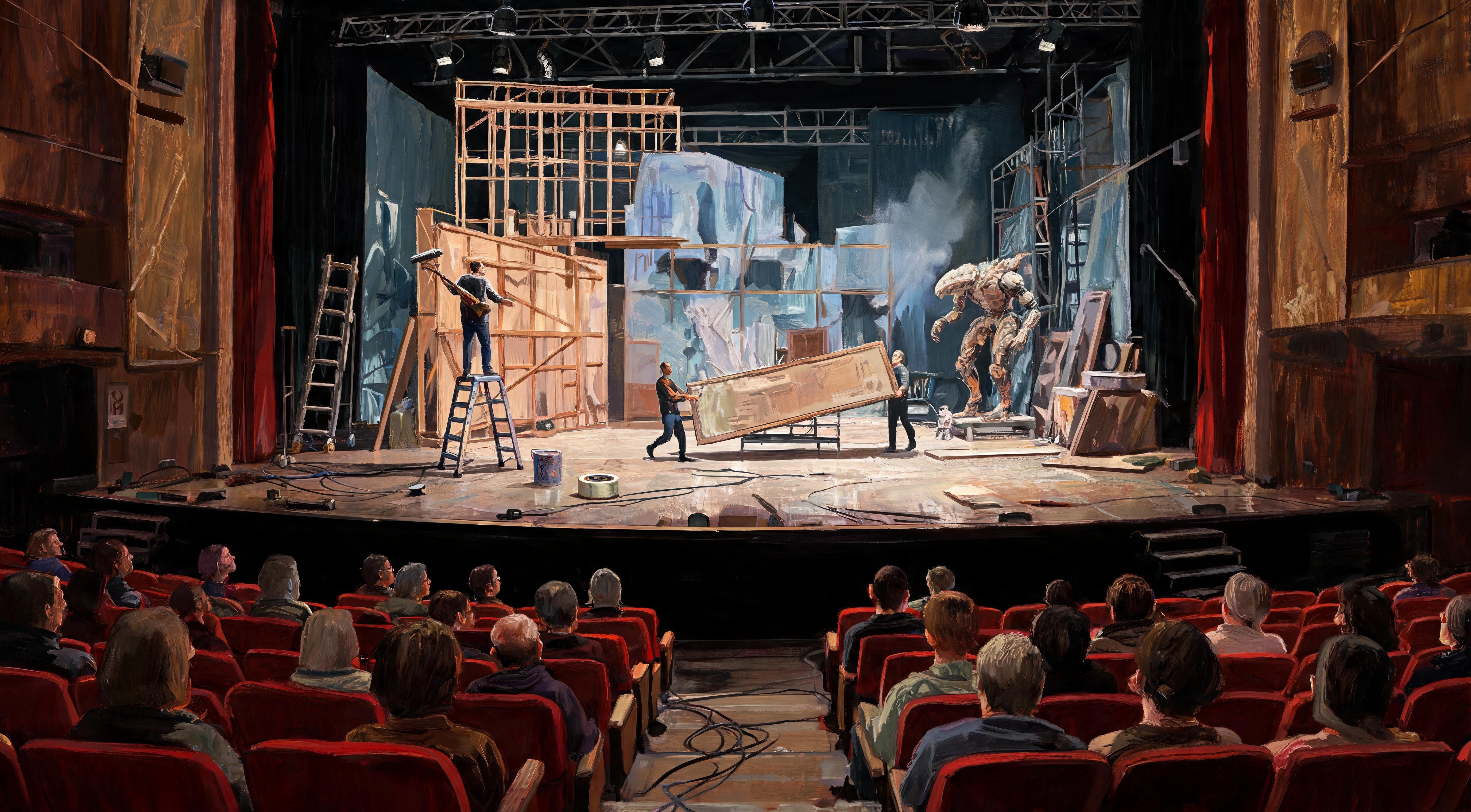
Across culture and media, something subtle is shifting: effort is becoming visible again. As AI systems and automated creative tools make high-quality output easier to generate than ever, audiences are beginning to respond less to polish and more to signs of labor. What matters is no longer just what something is, but how it was made.
This sits alongside a broader collapse in how we approach media creation and consumption. Generative AI compresses ideation, iteration, and execution into near-instant output; digital design software automates processes that once required years of education and training; media pipelines intentionally minimize the gap between concept and finished artifact. For years, designers and consumers worked toward perfection - clean execution and invisible production. That assumption is starting to loosen. Increasingly, constraint, imperfection, and process visibility are acting as signals of authenticity. The more easily something could have been generated, the more people seem to look for evidence that it wasn’t.
In film and visual culture, this is already visible. Seemingly “low-budget” aesthetics, lo-fi horror, and intentionally constrained production styles are being pushed into the limelight as projects like The Backrooms hit theaters. Their impact comes from visible constraints: maintaining compression artifacts, overly simplified environments, and rough continuity. These elements come across as proof of production under real, physical conditions. Even higher-budget production is moving in a parallel direction. While digital tools still dominate many aspects of filmmaking, there is renewed emphasis on physical environments, practical effects, and in-camera construction. In particular, major sci-fi and action productions - like Dune: Part Two, Project Hail Mary, Oppenheimer, and Spiderman: Brand New Day - are often discussed in terms of their practical filmmaking real sets, physical lighting, and tangible interaction between actors and environment.
This is not a complete rejection of digital production. Digital tools are still used to enhance and elevate practically-shot films. In the case of Project Hail Mary, the directors clarified that the film “still contains thousands of visual effects shots, including space environments, spacecraft exteriors, and the alien character - but these were added to footage that was filmed on real sets.” And there’s an important distinction between “no VFX” and “no generative AI” - even the simplest of VFX work, like adding stars onto a black background to represent outer space, still requires skilled designers iterating and executing hours of work. In other words, the presence of digital tools does not erase labor—it just shifts where that labor is visible.
There’s a similar shift visible in graphic design culture, where process is increasingly part of the output. Design directions for the coming years point toward textured, layered, imperfect visual systems—hand-drawn elements, collage structures, and compositions that retain signs of assembly. Behance’s 2026 Design Trend Report lists “Imperfect Aesthetics” as one of the key trends of the year - and they say it matters because “Audiences crave human touch in an overly polished digital world…Use imperfection deliberately. It should look intentional, not careless.” The key distinction here is that consumers aren’t seeking imperfection itself, but rather imperfection as an aesthetic: something that clearly required a human decision to leave in place.
Consumer research supports this shift. A 2024 Journal of Consumer Research study on analog revival behavior finds that people consistently assign higher value to products and experiences that require skill, patience, or sustained effort—even when more efficient alternatives exist. What is being valued is not inconvenience, but the legibility of effort: the sense that time, practice, and constraint were meaningfully involved in the final outcome.
To our team, these shifts suggest a significant change in cultural values. For decades, technological progress was defined by the removal of friction - making creation faster, distribution smoother, and consumption more immediate. AI continues that same trajectory, collapsing many remaining barriers between intention and output. But in environments where generation is cheap and abundance is default, effort becomes one of the few remaining signals that cannot be assumed or faked without trace. The most “desired” outputs are no longer necessarily those that appear most seamless, but those that still carry evidence of constraint - be it material, temporal, or human.
And in that sense, effort is no longer just a cost embedded in production: it becomes a design language in its own right, a way of signaling human presence in a world where that presence is increasingly difficult to see.
Potential Future Implications:
Designing for Perceptible Labor - Creative industries may begin intentionally reintroducing friction into production workflows—not for efficiency, but for legitimacy. This could reshape design systems, filmmaking practices, and digital tools around the need to make human involvement visible, even when it is no longer technically required.
Human Skill Assessment Infrastructure — As AI makes it increasingly difficult to verify the originality of student work, education systems may shift away from take-home assignments and essays toward live oral defenses, in-person critiques, and real-time problem-solving.
Key Data and Considerations:
Agency in the Analog Revival: Consumers are choosing difficult analog technologies over their labor-saving digital counterparts.
Imperfect Aesthetics: “Visual Honesty” is described as a key design trend in 2026.
Rebirth of Practical Filmmaking: Project Hail Mary’s directors chose to use real sets and puppetry techniques to enhance audience immersion in the space-based film.
Additional Sources:
Backrooms VFX Supervisor Edward J. Douglas on Bringing Kane Parsons’ Liminal Horrors to Life
Dune: Part Two Cast On How Practical Effects Make This Universe More Real Than Ever Before
How ‘Oppenheimer’s’ atomic bomb scene was created (without CGI)
SPIDER-MAN: BRAND NEW DAY - Practical Production
Comments
Nothing yet. Say the first thing.
Sign in to join the conversation.