
The approval of mFLUSIVA represents a major escalation in the expansion of nucleoside-modified mRNA technology into routine, repeated vaccination. We concluded that the FDA’s own clinical data demanded an independent risk-benefit accounting before this product becomes entrenched as an annual vaccine. The result is one of the most severe benefit-harm imbalances we have encountered in a licensed vaccine program, and it warrants immediate regulatory reversal.
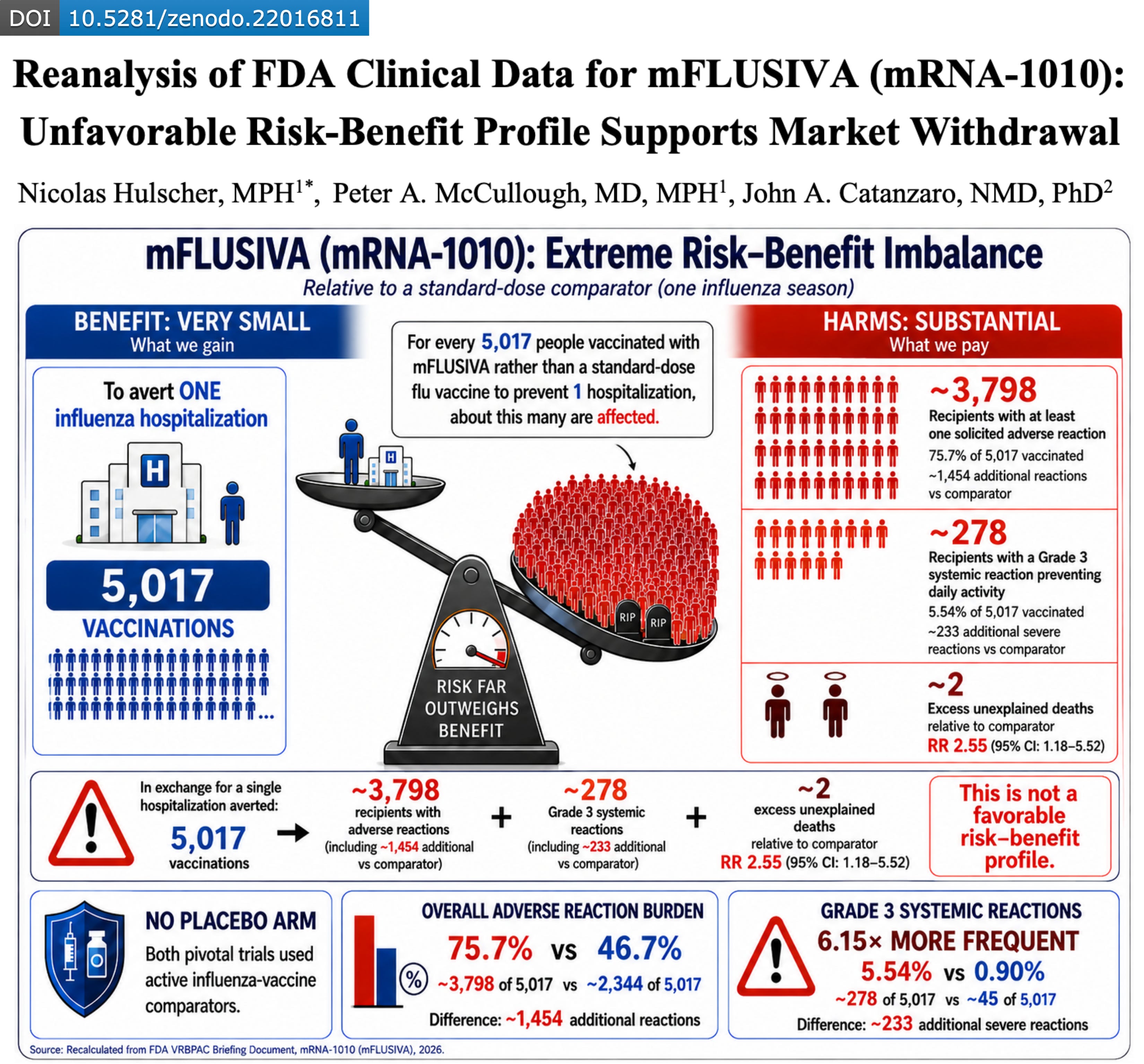
Our new manuscript, “Reanalysis of FDA Clinical Data for mFLUSIVA (mRNA-1010): Unfavorable Risk-Benefit Profile Supports Market Withdrawal,” directly reanalyzes the FDA briefing document and underlying clinical-trial counts used to support approval. Rather than accepting the regulatory presentation at face value, we placed the vaccine’s benefits and harms on the same absolute scale and asked the question that should have been made explicit before licensure: what is the human cost required to prevent one serious influenza outcome?
The answer is extraordinary. To avert ONE influenza hospitalization, approximately 5,017 adults had to receive mFLUSIVA instead of a standard-dose influenza vaccine, at the COST of:
Compared with the standard-dose flu vaccine, that amounts to approximately 1,454 ADDITIONAL adverse reactions and 233 ADDITIONAL disabling Grade 3 systemic reactions for every hospitalization prevented.
The broader safety pattern was just as one-sided. Unexplained deaths were 2.55-fold more frequent, Grade 3 systemic reactions were 6.15-fold more frequent, and every solicited symptom was more frequent in the mFLUSIVA group.
Neither pivotal trial included a placebo arm, and no properly adjudicated influenza-mortality endpoint was ever specified, collected, or reported.
This is the central regulatory failure our reanalysis exposes: the underlying numbers were available, but the benefit and harm were never presented together on the same absolute denominator. Benefits were presented primarily as relative efficacy, while harms were presented separately as event percentages. That leaves obscured the most important practical question in the entire approval decision: how many people must be exposed, and how many adverse outcomes occur, to prevent one serious influenza event?
Our analysis answers that question directly using the FDA’s own numbers. Once the calculation is made, the imbalance is impossible to ignore.
The manuscript sets out 17 grounds for reversal. The first nine arise directly from FDA’s regulatory record and trial arithmetic. The remaining grounds address the additional hazards of extending nucleoside-modified mRNA technology into annual lifelong administration, including published evidence involving residual DNA contamination, reverse transcription and genomic integration, ribosomal stalling and frameshifting, protein misfolding and proteostatic disruption, broad biodistribution, prolonged persistence, and cumulative biological effects with repeated dosing.
We decided that publishing these findings alone was not enough. We are undertaking the task of challenging this approval directly before it becomes another precedent for the unchecked expansion of mRNA products across infectious diseases despite an extreme risk-benefit profile.
Accordingly, we formally sent the manuscript and supporting information to Secretary Robert F. Kennedy Jr. and officials at HHS, FDA, CDC, and NIH, requesting immediate withdrawal of the approval and a halt to distribution before widespread administration begins.
Below is the exact letter sent to federal health officials.
Subject: URGENT: Immediate Withdrawal of mFLUSIVA (BLA 125869/0) Warranted Based on FDA Clinical Data Reanalysis
Dear Secretary Kennedy,
As physicians and researchers who have reanalyzed the licensure record for this product, we respectfully request that the Department, in coordination with the Food and Drug Administration, initiate proceedings to withdraw the approval of Moderna’s mFLUSIVA (Influenza Vaccine, mRNA; mRNA-1010), BLA 125869/0, approved August 5, 2026, and halt its distribution pending that review.
Attached is our manuscript, “Reanalysis of FDA Clinical Data for mFLUSIVA (mRNA-1010): Unfavorable Risk-Benefit Profile Supports Market Withdrawal.” The analysis rests principally on FDA’s own regulatory record and on the clinical-trial counts submitted in support of licensure. The full manuscript is also publicly available on Zenodo at: https://zenodo.org/records/22016811
The findings are deeply concerning. In the pivotal efficacy trial, approximately 5,017 adults had to receive mFLUSIVA instead of a standard-dose influenza vaccine to avert a single hospitalization. On that same scale, the switch was associated with approximately 1,454 additional solicited adverse reactions, 233 additional Grade 3 systemic reactions severe enough to prevent normal daily activity, and approximately 2 excess unexplained deaths.
Expressed another way, among 5,017 mFLUSIVA recipients, approximately 3,798 would experience a solicited adverse reaction and approximately 278 would experience a Grade 3 systemic reaction, while the demonstrated clinical benefit is one hospitalization averted.
The mortality findings are especially difficult to dismiss. Unexplained deaths were 2.55-fold more frequent among mFLUSIVA recipients, and related pooled fatal-event terms were also significantly elevated. Yet no properly adjudicated influenza-mortality endpoint was ever specified, collected, or reported anywhere in the development program, and no autopsy was performed on any mFLUSIVA recipient whose death remained unexplained.
The broader safety pattern was similarly one-sided. Every solicited symptom was more frequent in the mFLUSIVA group, and Grade 3 systemic reactions were 6.15-fold more frequent than with the standard-dose comparator. Neither pivotal trial included a placebo arm, meaning absolute vaccine-attributable harm and background event rates were never established.
Our manuscript sets out 17 grounds for reversal. The first nine arise directly from FDA’s own regulatory record and trial arithmetic and do not depend on the platform-level literature. The remaining grounds address the additional risks inherent in extending nucleoside-modified mRNA technology to annual lifelong administration.
Importantly, the core case for withdrawal does not depend on accepting any platform-level concern. FDA’s own regulatory record and trial arithmetic establish an extraordinarily unfavorable benefit-risk exchange and multiple unresolved deficiencies in the evidence supporting licensure. The platform-level evidence only compounds an approval that is already unsustainable on its own terms.
Those additional concerns include published evidence involving residual DNA contamination, reverse transcription and genomic integration, ribosomal stalling and frameshifting, protein misfolding and proteostatic disruption, broad biodistribution, prolonged persistence, and the possibility of cumulative biological effects with repeated dosing.
The approval is further weakened by the fact that the highest-risk age group was not shown to have superior clinical benefit against the preferentially recommended comparator before licensure. The required confirmatory study is a noninferiority trial powered under an assumption of 0% true relative vaccine efficacy and can succeed without demonstrating clinical superiority or a meaningful absolute benefit.
The central calculations underlying our request derive directly from the FDA briefing document and underlying trial counts. Yet the regulatory presentation never placed benefit and harm on the same absolute scale. Benefits were presented primarily as relative efficacy and harms as event percentages, leaving uncalculated the most decision-relevant question: how much harm is incurred for each severe clinical outcome prevented. Our reanalysis performs that calculation explicitly using FDA’s own numbers.
This is therefore not a situation that can be corrected through stronger labeling, routine pharmacovigilance, or promises of future evidence. The evidence required to establish a favorable benefit-risk profile was not demonstrated before approval. Allowing widespread administration to proceed would convert unresolved pre-licensure deficiencies into population-level exposure while the government waits for answers that should have been obtained before licensure.
We respectfully request that you direct the appropriate HHS and FDA officials to reexamine this approval, initiate withdrawal proceedings, and halt distribution before widespread administration begins during the 2026-2027 season.
If the Department concludes that mFLUSIVA should remain on the market, the American public is owed a clear accounting of how one hospitalization averted per 5,017 vaccinations is to be set against approximately 1,454 additional adverse reactions, 233 additional disabling Grade 3 systemic reactions, and an unresolved excess of deaths of undetermined cause, on the same scale derived from FDA’s own data.
Thank you for your attention to this urgent matter of public safety.
Respectfully submitted,
Nicolas Hulscher, MPH
Epidemiologist, McCullough FoundationPeter A. McCullough, MD, MPH
President, McCullough FoundationJohn A. Catanzaro, NMD, PhD
Chief Executive Officer, Neo7Bioscience, Inc.
We hope Secretary Kennedy and federal health officials make the life-saving decision to remove this extremely hazardous product from the market before widespread administration begins. In light of the evidence now before them, allowing mFLUSIVA to remain approved would be a grave mistake. The government has been given the data. It now has the responsibility to act.
Epidemiologist and Foundation Administrator, McCullough Foundation
Support our mission: mcculloughfnd.org
Please consider following both the McCullough Foundation and my personal account on X (formerly Twitter) for further content.
Comments
Nothing yet. Say the first thing.
Sign in to join the conversation.