
The past and future are not destinations that I am simply passing through. There is something poetic in living with the knowing that all moments continue to endure within each other, a seed within a seed within a seed. it saddens me to think that once something has happened it must be left behind, or that if something has not yet happened I must move towards it… and in that act of moving towards a “future,” I am distancing myself from what is or has occurred.
I have a penchant for wanting to linger, to hold onto the vibrancy of things. If I could, I would can every millisecond of my life in a sterilzed jar so that I can return to it with a silver spoon, returning to its sweetness ever-so-often. In some ways, my sense of time has not changed much since I was five years old. "Last year" feels as intense and immediate as "yesterday," and "tomorrow" is as tangible and embodied as "today."
This conceptualisation of time is in the same lineage as eternalism, an ontological view of time where all existence in time is equally real. Eternalism takes into account the relative nature of simultaneity — there is no such thing as absolute simultaneity or a universal present, because what one experiences as “now” depends on the frame of reference that is used to measure the occurrence of a set of events. No moment is more "real" than another; they simply occupy different coordinates.
For example, I might experience my current state: drinking coffee and writing as happening simultaneously, within the same frame of time. But simultaneity is relative. Two events that seem to occur at the same moment to one observer might not appear that way to another. There is no universal "now" that we all share, because what I call "present" is local to me.
Or take the barista across from me. What I observe as her “now” — steaming milk, pouring it into a paper cup, swirling the milk around to form a foamy lopsided heart — is where she was a fraction of a moment ago, the time it took light to carry her image to my eyes. The gap is imperceptible, but it’s there. We are sitting in the same café, but are living in slightly different presents.
Eternalism follows from this: if there is no absolute present, then no moment is more real than any other. The past is not gone. The future is not yet-to-arrive. All moments exist, fully and equally.
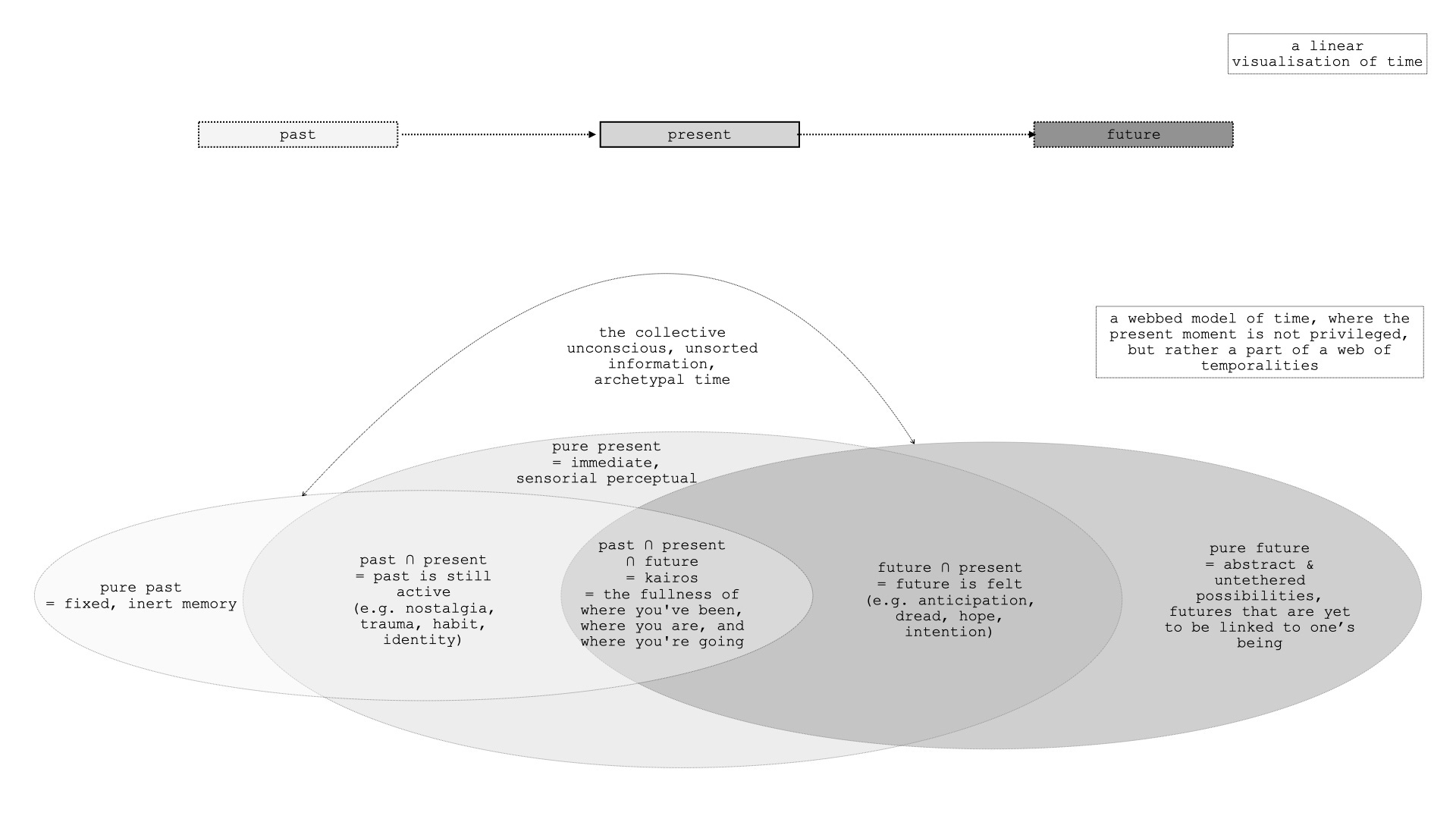
So, what if we modelled time not as a line but as a web? A structure in which past, present, and future are not separate destinations but overlapping temporalities, each embedded in the other, each bleeding into the next. Not past → present → future, but past ∩ present ∩ future, a Venn diagram of lived experience, where time doesn’t pass but rather stacks on top of each other, or pulsates outwards like the rings of a tree trunk.
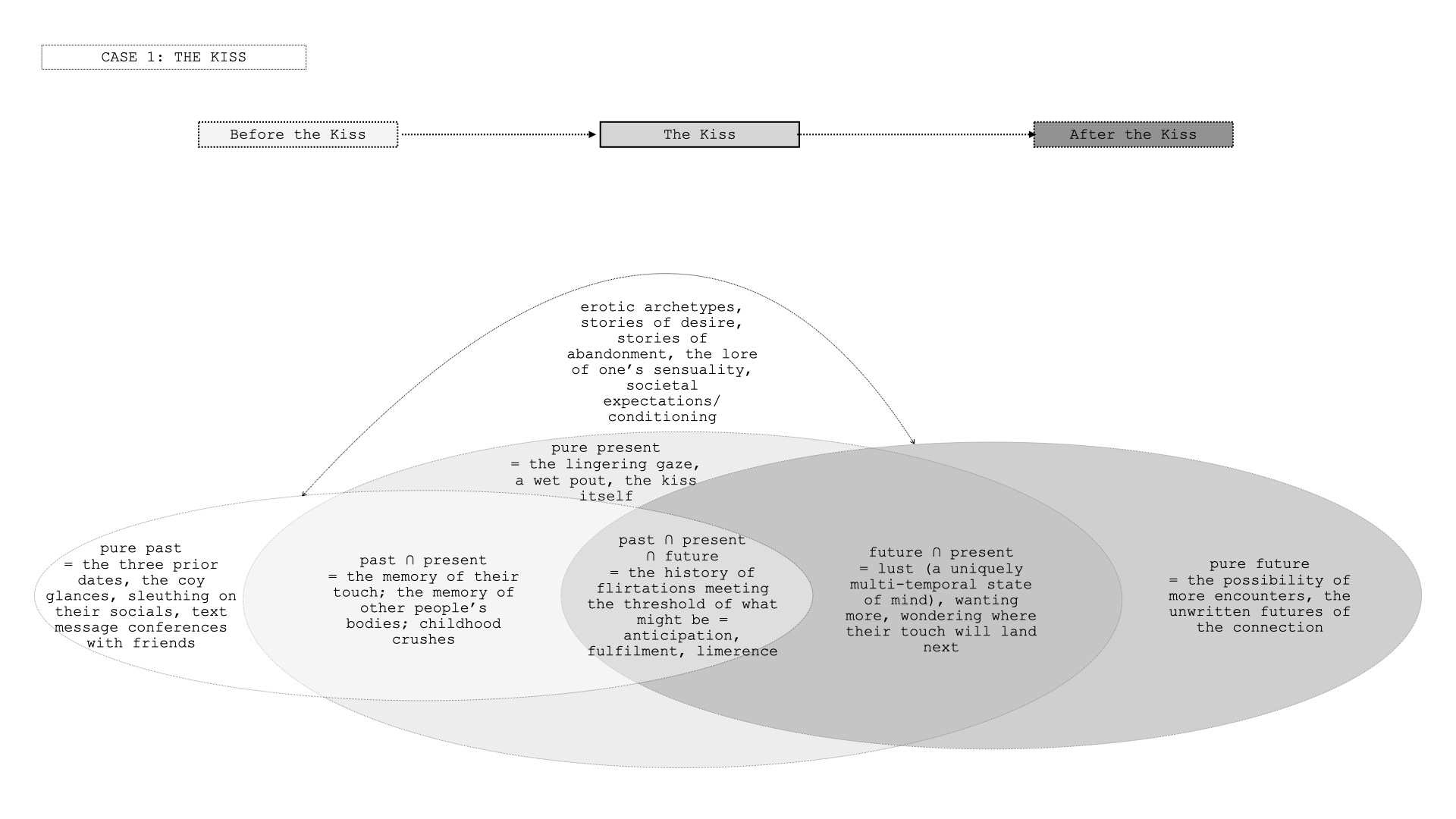
In this model, a kiss becomes much more than a kiss, because within that single peck contains an endless web of stories, both felt and yet to be felt. A peck on the cheek. A sloppy smooch, saliva linking lips in its wet gossamer. A soft graze of the lips against the nape of the neck. There is no hierarchy of intensity because this model permits — dare I say necessitates — a perfervid engagement with our lives. It asks us to comb through each experience with tender indulgence and curiosity, so as to deify our aliveness at both the micro and macro scale.
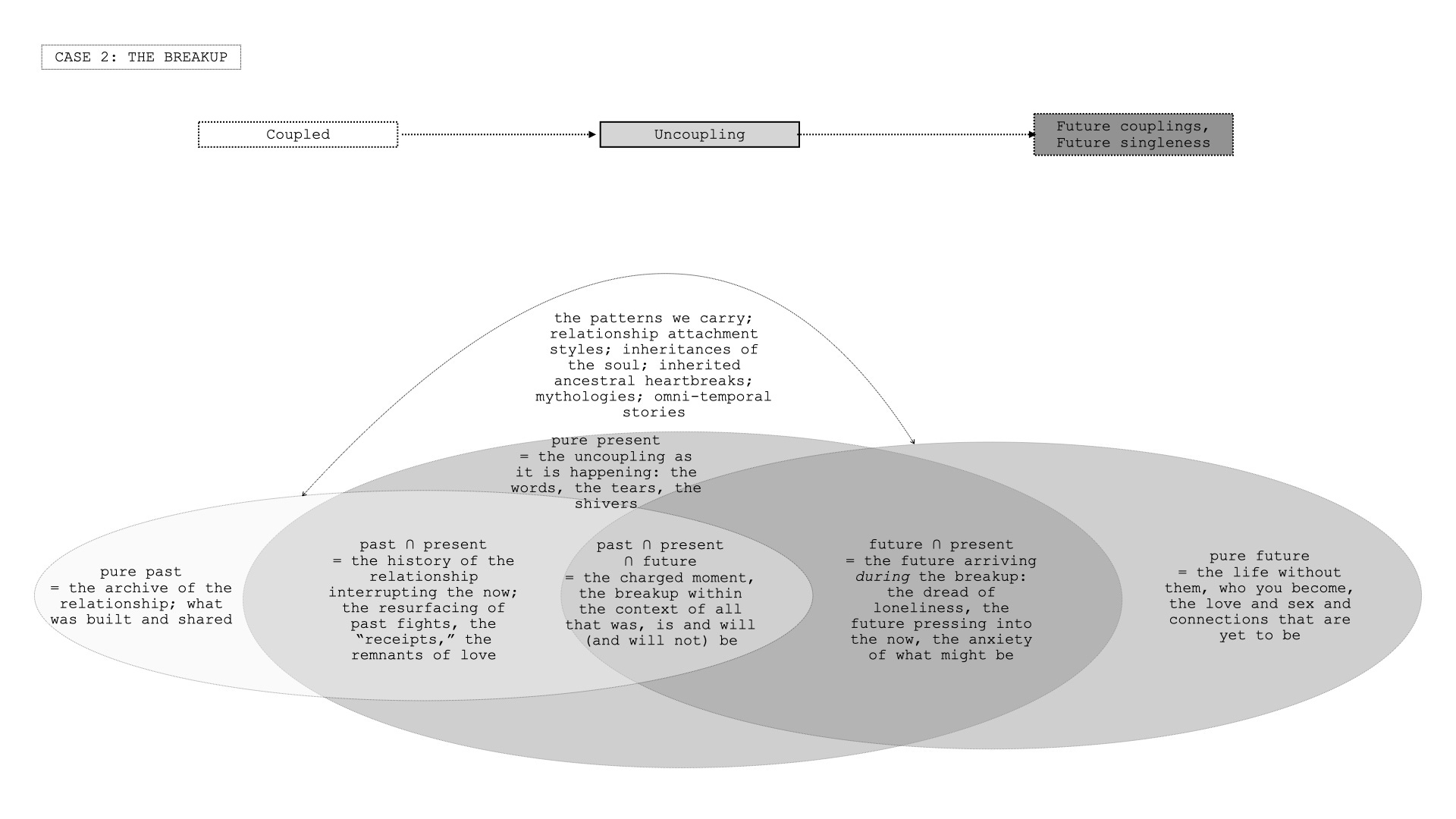
Or take a breakup. Its devastation is both softened and deepened when looked at within the web— the wound, the flesh before the wounding, the scars — the life cycle of heartbreak stretching out in every tense at once, neither behind nor ahead, but woven through.
I don’t want this model to be conflated with the contemporary (primarily internet-based) discourse on “romanticisation” though. I’m not presenting this webbed model of time as a tool for solipsistic escapism, nor do I encourage the mythologization of every detail of our lives.
I am pathologically prone to this — to assigning meaning, significance, weight to everything — and can attest to how exhausting it is to live this way, literally, intellectually, and processually. The disappointment when the narrative you have so elaborately concocted dissipates because there was nothing rooting it to reality.
The difference is not in the looking but in what you bring to it. Romanticisation imports meaning. It gives tenure to a moment that should have passed, grafting onto it a significance in our personal story that it didn’t earn.
The webbed model does the opposite: it finds what was already structurally true about a moment by making clear the soft threads that were always running through it. A single experience can be anatomised across these varying vectors of time, but this is not an invitation to exaggerate.
The inexactitude of a hug, or a kiss, or a conversation shared with an old lover over stale whiskey and a heavy-tar cigarette — within the web, these moments are not made out to be more than. But rather, it’s illustrated at the meta and the minutia, depicted as is, was and shall be.
The model intensifies, yes — but it intensifies everything equally. And in that equality, the impulse to mythologize dissolves. When every moment carries this weight, no moment is precious above others. What the web asks instead is care — a kind of tender attentiveness to the enormity that was already there, in the hug and the boredom and the cigarette alike, long before you thought to look.
Today was tomorrow for yesterday, which was once today, which was once a future that was being imagined years ago. All of these axes of knowing, these temporalities of knowing, make up this experience we call “time.”
And ah, what a delicious space to be in. Within this web, pain, joy, boredom cease to be nouns. We unravel into a realm of verbs and adjectives, of -ings, of perpetuity, of motion. How sensual it is to look at a moment and see it in its raw un-madeness.
Comments
Nothing yet. Say the first thing.
Sign in to join the conversation.