
Thoughts and Perceptions
“…the world is all messed up. The nation is sick. Trouble is in the land; confusion all around…But, I know, somehow, that only when it is dark enough, can you see the stars…I don’t know what will happen now. We’ve got some difficult days ahead. But it doesn’t matter because I have been to the mountaintop…Like anybody, I would like to live a long life…And, I’ve looked over. And I’ve seen the promised land. I may not get there with you. But I want you to know tonight, that we – as a people – will get to the promised land.”
Reverend Dr. Martin Luther King, Jr. – in a speech on April 3, 1968 (the night before his assassination), before the Memphis, Tennessee sanitation workers, as part of his effort to integrate civil rights with economic justice.
“As we mark 250 years since the dawn of American freedom: What will our children, grandchildren, and their descendants write about this time in our Commonwealth’s history – this chapter – 50, 100 and 250 years from now?”
Abigail Spanberger (D-VA) – following her oath of office as the Virginia Commonwealth’s 75th Governor and as the first woman to hold the position in the state’s history.
NOTE: The above quotes were derived from the January 17th and January 18th, 2026 blogs by Heather Cox Richardson – notable historian and Maine resident. Also, a “must-read” on a daily basis. Check her out!! I must admit that when I read the MLK quote, I got tears of remembrance and commitment in my eyes! Then, when I read Spanberger’s quote, it totally resonated with my thoughts coming out of Antarctica into the realities of all that we are facing throughout the world!!
Thoughts that evolve after the pause of time away from reality…
Over the last several weeks following the December holidays, I had the opportunity to step away from my daily responsibilities and “go on holiday”. I won’t bore you with the details except that we visited Antarctica, Patagonia, and other sites in Chile. And, to sweeten the opportunity, I was totally disconnected from the day-to-day of goings on throughout the world. It’s the kind of holiday that encourages one to “step back” and consider life…
In Antarctica, the penguins rule! There is a lot of squawking, but they stand in “community” as if Antarctica were the only place that existed in the universe. They have created “penguin highways” for getting around the island, which are communal and used by all of them together. But even though they are a dominant species in the cold environment, various birds also fly and flit around at will. And the seals occasionally engage the penguins for control of the waterways. However, it does not seem to impair the penguins’ ability to navigate freely throughout the various bays that mark the shoreline of Antarctica. It seems to me that we could learn much about how to get along in the world. The remarkable part of the experience is the degree to which they all get along in their existing environment. We – as a species – could learn much about “getting along” with our fellows throughout the world in ways that allow for mutual support and collaboration – despite our differences. It requires the “give and take” that I observed in the community of species that inhabit Antarctica.
And, then, beyond the species interactions, there are the thoughts that evolved as we considered the environment not only in Antarctica but also in Chile. The layers upon layers of sediment that dominate the landscape in both places reveal an environment that has been evolving for millions upon millions of years. In fact, it extends back to the time prior to the dinosaurs, when Gowanda dominated Planet Earth. It consisted of a portion of North America (i.e., Laurentia) combined with pieces of the South American, Antarctica, and Australian landmasses, as the dominant continent on Planet Earth. Or at least that is my understanding. I’m sure my friends who are geological experts will correct me if I am wrong when they read this piece. In essence, I had the chance to look at landscapes beyond hundreds of millions of years in the making.
Such an experience pulls you up short about what we (i.e., the human species) are doing at present. What is all of the intergovernmental control about when the world is increasingly connected across all such barriers? Who wants to follow individuals who are maniacal about their control of states around the world – whether it’s North Korea, China, Russia, Venezuela, Belarus, Iran, Syria, OR even the USA. Do “We The People” really want such an environment?
In fact, if we look at the reaction of the populace in those countries I mentioned, there is intimidation, disparate wealth, unequal health, incongruent access to education, and the list goes on… Why do we allow such an environment? When do we speak up? From my perspective, the value of a construction worker who builds office buildings is as important as the doctor who is an excellent diagnostician. There is a difference in pay due to level of education and impact, but both sides should be able to make a living wage.
It occurred to me while I was pondering the future of Planet Earth that my friends in the Far East, in the Southeast, in India, in Africa, in Europe – essentially in places all around the world would probably mostly agree that a civil society is in the best interest of everyone!! So, it seems to me that rather than pursuing the objectives of leaders – whether here or abroad – who are averse to the needs of the people:
We should all be working diligently to accomplish that objective rather than engaging in rhetorical or even real dismissal of populations pursuing betterment of their lives.
We should all be working to ensure that healthcare is available to everyone in society.
We should listen to one another across the world.
We should be providing baseline education to everyone in all societies.
The “We should” list goes on…
Books and Articles worth a Review…
An Important Analysis – Larry Levitt, MPP, is a prominent American health policy expert and senior executive serving as Executive Vice President for Health Policy at the KFF (Kaiser Family Foundation). He provides regular health policy commentary on issues related to healthcare. He has a recent article that appeared in the JAMA Forum entitled “How Unaffordable Is Health Care?” I wanted to provide a synopsis of the major points of his article. Why? Because I believe that health care costs are the looming crisis facing the USA and many nations throughout the world due to the aging of our populace, of which I am a leading member at the age of 75!! It is a specific policy issue in the upcoming mid-term elections where the issue of affordability has become a major issue for the electorate. Levitt provided an excellent overview, and I thought it was worthy of your consideration as we move forward toward those elections in the coming year. So, what are his thoughts? Here is a summary:
The core issue we are facing as a nation related to health care is: “What is an affordable level of health care costs that people should be expected to bear?” This is the reason that there is an ongoing debate related to the extension of the Affordable Care Act (ACA) enhanced premium tax credits, which impacts the ability of some 22 million people to obtain affordable insurance.
The costs of health care in the USA compared to the rest of the world are significantly more!! As a comparison, the USA spent $13,432 per person in 2023, or about 80% more than $7393 average per person in other high-income countries (NOTE: the comparison does not include moderate- or low-income nations).
When President Richard Nixon warned of a “crisis” related to health care costs, our percentage of GDP devoted to health care spending was approximately 7%. The latest USA health care spend is at 17.6% of GDP, growing to an estimated 25% by 2030 if nothing is done to mitigate costs. If we spend more on health care – as a nation – we have less to spend on other national requirements. Furthermore, high health care expenditure affects the competitiveness of USA products and stagnates worker wages. Plus, are we any healthier? No, is the short answer.
While health care costs have not necessarily become more significantly “affordable” under the Affordable Care Act (ACA), the increase in national spend has slowed significantly since passage in 2010.
For individuals who do not qualify for Medicaid or Medicare or do not have access to employer-sponsored coverage (NOTE: a sizeable number of the USA populace), the ACA offers the opportunity to use refundable tax credits for making health care insurance coverage. The affordability threshold requirements for participating were lowered in 2021 but expired in 2025 because the US Congress did not act! In essence, without the tax credits, the 22 million subsidized ACA enrollees will see an increase in the out-of-pocket expenditure by 114%, or $1016 per person. In particular, the “older, middle-income ACA enrollees” will experience the greatest increase in cost. Levitt provides an example of a 60-year-old woman making $64,000/year in North Carolina whose out-of-pocket expenses go from $5440 per year (8.5% of income) to $14,853 (23.2% of income). It’s clearly an unsustainable situation – in my estimation – for the vast majority of such individuals.
The article is EXCELLENT, and I encourage all of my readers to review it (See citation above). It outlines quite clearly what inaction on the part of the US Congress does to impact the ability of people to pay for the increasing escalation of health care costs. The cost of health care is why I have been so adamant over the last bunch of years that the primary objective we need to address in health care – aside from sustaining quality – is that:
The USA must begin to manage the ongoing escalation
of health care costs!!
Otherwise, our ability to sustain the other needs
of the nation will be jeopardized!!
Source: January 8, 2026 – doi:10.1001/jamahealthforum.2025.6929. An open-access article distributed under the terms of the CC-BY License. Levitt L. JAMA Health Forum; and, Corresponding Author: Larry Levitt, MPP, KFF, 185 Berry St, Ste 2000, San Francisco, CA 94107 (larryl@kff.org) – in case you want to reach him directly on the commentary of the original article.
Opinions and Reflections
Progress Or Not? Let’s Be Clear – As I returned home, I was overwhelmed with the number of emails and “policy” updates that populate my in-box. As I plowed through the incoming, it became increasingly clear that here in the USA, we are “undoing” decades of progress on the healthcare front. That DOES NOT mean that I am opposed to doing a better job by fostering efficiencies, reducing waste, decreasing waste, and the like. But the slash-and-burn approach of the Administration, coupled with the policy decisions of the U.S. Congress, will have lasting and important implications for care delivery. As a result, I thought it might be helpful to provide an overview of the impact of policy changes occurring during the last quarter of 2025 that are having the most profound implications across the board. AND, BTW – IF ANY OF MY READERS DISAGREE WITH MY DATA POINTS OR ASSESSMENTS, PLEASE FEEL FREE TO SEND ME A NOTE OF CORRECTION WHICH I WILL DILIGENTLY CONSIDER. My assessment, however, includes the following:
1. Federal Legislation & Policy Shifts – The On Big Beautiful Bill Act (OBBBA) – the 2025 budget reconciliation bill – moved forward with some significant effects, including:
a. Medicaid Reforms – new work requirements for adults on Medicaid are imposed that will allow low-income enrollees to be charged modest copays as well as cuts in some of the provider tax rules – all of which are projected to reduce eligibility and coverage over time.
b. Reduced Medicaid Funding & Coverage Loss – long-term Medicaid cuts are projected to increase the uninsured population and worsen access, with analyses showing potential millions losing coverage and higher preventable hospitalizations.
c. Cuts to Navigator Funding and Increased Eligibility Requirements – while some rules have been adopted to streamline Medicaid and CHIP enrollment (e.g., reducing frequent renewals and administrative hurdles), other federal policy choices are threatening access.
d. Rural Health Funding – the rural health community got a potential boost through a dramatic increase in funds to be provided as part of a federal rural health transformation fund (= $50 billion over five years) to support struggling rural providers, a response to many recent hospital closures (YEA!!).
e. Access Gaps & Rural Strain – despite the transformation funding, rural hospital closures are accelerating at a disturbing pace, which is leading to an erosion of access to care, especially in more remote communities. It appears that the new federal policy shifts are contributing to the problem by tightening fiscal support of care delivery, with costs continuing to increase at an accelerated rate. New federal grants and pilot programs aiming to support rural hospitals and speed up Medicare Advantage payments are being implemented in some states – but these efforts are early, state-focused, and may not offset the broader cost pressures that are accelerating at a more rapid pace.
2. Affordable Care Act (ACA) Marketplace Subsidies – Modifications in the approach toward providing subsidies were included in the legislation, including:
a. ACA Premium Spikes – with the expiration of ACA premium subsidies that made coverage more affordable, coupled with enrollment changes, will likely result in about 800,000 fewer people signed up for 2026 plans compared with last year.
b. Debate On Extending Subsidies – Congressional debate continues on this topic with important implications, especially for the underserved. If the subsidies are not extended, even more people are likely to be pushed into either uninsured status or into high out-of-pocket plans.
3. Medicare & Federal Program Adjustments – The previously sacrosanct Medicare program is also facing modifications to reduce overall costs, including:
a. Premiums & Deductibles – Part B premiums and Part D deductibles are rising in 2026, resulting in increased costs for seniors – a topic that is increasingly animated among my friends and colleagues on Medicare.
b. Drug Price Negotiation – on a positive note, the Inflation Reduction Act’s drug price negotiation authority (begun through earlier legislation) continues to yield savings on select drugs for Medicare beneficiaries.
c. Access Limits – certain cost-saving eligibility expansions for Medicare Savings Programs have been delayed until 2034, resulting in a reduction of support for low-income enrollees.
d. Price Transparency Initiatives – again, on a positive note (so far), The Centers for Medicare and Medicaid Services under the Trump Administration has proposed new rules to improve healthcare price transparency, helping consumers compare prices and potentially shop for lower-cost care.
4. Impact on Costs for Individuals & Employers – In general, it can be stated that the “cost” of care delivery seems be accelerating at a rate faster than any of the proposed changes can accommodate, including:
a. Rising Insurance Costs – employer-sponsored health insurance costs are projected to exceed ~$18,500 per employee in 2026, which will put mounting pressure on workers and businesses.
b. Out-of-Pocket Premiums and Costs Increase – premiums in the ACA marketplace have risen sharply, making basic coverage less affordable for many who still have insurance. But the issue has not been addressed in the GBBB.
c. Targeted Expansion of Behavioral & Mental Health Services – federal policy developments have generally targeted expansion of mental health and substance use disorder services. However, despite these efforts, access gaps continue – especially in underserved communities.
5. Companion Trump Administration Decisions – decimation of government capability for managing the changes is a “real” problem, especially given the way the reductions were made through an arbitrary process, resulting in a yet to be finalized diminished workforce of between 8.7% (i.e., @ 200,000 departures) to 13% (i.e., @ 300,000 departures). It’s an open question on whether or not “efficiency” will be the outcome…
6. Summary Thoughts — the following table puts all of the various issues described above into a synopsis of the 2026 policy impact for your consideration: See Below Table
Again, if any of my readers disagree or have alternative thoughts on the descriptions I’ve outlined above, please feel free to send me a note at drkevin@creostrategicsolutions.com. Include documentation that I can review. Thanks…
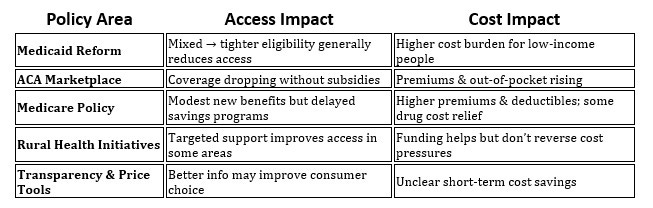
Information for your Consideration…
Impact On A Place I Know All Too Well – I recently received a notice about a story that ran on CBS News related to a small town in North Dakota – my home state, where I grew up (although some would say that I need to continue “growing up” 😊). The story relates to West River Health Services in Hettinger, ND, a town of about 1,000 residents in southwest North Dakota nestled near the northern portion of the South Dakota border. I became very familiar with the health care services at West River when I served as the Founding Director of the Center for Rural Health at the University of North Dakota in the 1980s. West River was one of the iconic rural (some would say “remote”) care programs in the nation – and continues with progressive capabilities and services in a frontier region of the state.
The CBS report related to the Trump Administration’s new H-1B visa fee requirement if a USA-based organization hires an individual from a foreign country. The issue is that “rural” or “remote” areas of the country are very underserved in terms of available healthcare professionals. As a result, many health systems are turning to foreign-based physicians and health care personnel to fill the increasingly large gap in staffing for these rural areas. Waivers are possible, but approval for these providers to join U.S.-based health care organizations increasingly takes months, despite vetting, review, and validation of their capabilities by existing local providers. In the case of West River, they had 30 applicants to review, but coming up with the fee for waiving the entry of foreign graduates was not feasible. It takes what little funds are available for side activities away from providing “care” to the rural underserved populace. For example, a $100,000 was established as part of a September proclamation by President Donald Trump, which applies to any foreign worker living outside the USA who does not already hold a visa. However, the fee is equivalent to the compensation provided to two lab technicians over the course of a year.
Prior to the new policy, the fee was $5,000. It’s obvious that the difference is not viable in virtually all rural health environments. So, in the presence of significant shortages in nursing, technical, and clinical personnel, costs escalate rapidly and surpass the resources available to rural communities. CHECK OUT the website as noted above for the details. From my perspective, it’s yet another failure of the DHHS oversight of proclamations emanating from the Trump Administration that are ill-conceived and a failure in sustaining the workforce capabilities of USA-based healthcare services – let alone the impact on many other areas as well (e.g., technology, production, farming, etc.).
The First Wave Arrives – Anthropic – an AI/ML company based in San Francisco recently announced the deployment of a new tool designed specifically for launch artificial intelligence capabilities for health care providers and payers – aka, “Claude for Healthcare” which is a first cousin derivative of “Claude for Life Sciences” (I’m not sure why it was name Claude but there’s not doubt a reason behind the name). It uses the CMS Coverage Database, PubMed, and the ICD-10 codes as part of its technical framework. The derivative capabilities are built
around Anthropic’s existing AI models but include connectivity to various medical databases and coding systems. The intent is to enhance the workflow of the organization. However, down the road, we should anticipate that offering the ability to provide “clinical augmented capability” is no doubt on the horizon. So, while it will likely be useful for fostering and supporting improved workflow and coding, we should anticipate that this represents the first wave of multiple efforts to [“move into”] the health care space.
I’m not opposed, but I’m a VERY FIRM BELIEVER that these “tools” should be viewed as sources of “clinical augmentation” rather than “clinical replacement” – which is a philosophy that may be at odds with some of the technology initiatives. Anthropic, for its part, has stated that it is committed to building a responsible and safe AI system specifically for hospitals, systems, payers, and organizations.
The company asserts that its commitment to building safe, responsible AI makes it uniquely suited to work with health systems, hospitals, payers, and other healthcare organizations. In a statement on behalf of the company, Eric Kauderer-Abrams, head of biology and life sciences at Anthropic, stated at the recent health IT conference in San Francisco that, “Anthropic is a very natural fit for the healthcare and life sciences world because our identity as an AI company is built around safety and responsibility and rigor and reproducibility, and these are all the central tenants of the healthcare and life sciences industries.” So, we shall see…and, at the same time, we should remain open but diligent as these tools are developed and deployed…
BUT – it’s obvious to me that I have been away too long since my blog has gone longer than the traditional 6 – 7 pages. I apologize!! However, there is a lot to present, and we are in the proverbial “rapids” in terms of the flow of healthcare changes. We will need to paddle harder and remain focused to make it through the rapids while continuing to provide the very best for the patients and people we care for… Stay tuned. I’ll try to stay on top of the changes…
Ideas and thoughts on how care delivery can be transformed…
Friendship: The Neglected Elixir of Health – As I was preparing to depart for our bucket list trip to Antarctica, I had the opportunity to hear a “day after the 1st” discussion on NPR related to the importance of friendship. In essence, it was stressed that “friendships” are a key factor in boosting physical health. So, how? Basically, lowering the stress level of our daily lives improves heart health (e.g., lower blood pressure, reduced heart disease risk) and strengthens the immune system by encouraging healthier behaviors (like regular exercise). It has even been shown to assist in managing chronic conditions, acting as a protective “bubble wrap” against loneliness, which is as harmful as smoking for health. Close ties with friends, indeed, seem to protect the body from stress and reduce inflammation. Furthermore, friendships are linked to longer lifespans and better overall wellness, sometimes more than diet or exercise alone.
In essence, the answer to the common medical problems can be as simple as having friends with whom one has regular and open contact. And, as I considered the research findings, it was supported by my own experience. While I have friends all over the world, I now live in Kittery, Maine – and, for the first time since grade school and high school – I have “local” friends. We have regular informal and formal contact. And, they are not only companions but confidants, colleagues, energizers, and “buddies for life”. Over the last 10 years of having these friends, it’s become apparent to me that they often serve as the “energizer bunnies” in my life for helping to keep me going. So, when I discovered the research being conducted by the UCLA Center for Friendship, I thought it was something that we need to highlight more. It’s not just the medical interventions in life that keep us going. It’s also the friends who help us with life daily that can be equally important, if not more important, at certain times in our lives. As identified by the UCLA Center, the following are the key benefits derived from friendship:
Stress Reduction: Supportive friends lower blood pressure reactivity and heart rate during stressful tasks, protecting your cardiovascular system.
Heart Health: Strong social connections are linked to lower blood pressure, healthier cholesterol, and a reduced risk of heart attack and stroke. Ah, the health reasons for my book club become more obvious…
Stronger Immunity: People with robust social ties are less likely to get sick and recover faster, as social connections help regulate immune function and inflammation. Same observation…
Longevity: Having close friends is associated with a lower risk of premature death from all causes, with some studies suggesting it’s more impactful than diet or exercise. But, this does not mean foregoing the regular exercise required for making longevity a reality!
Better Health Habits: Friends encourage physical activity, which helps maintain a healthy weight, blood pressure, and cholesterol.
Improved Illness Management: Friends help with doctor visits, meals, and overall self-care, improving control of conditions like diabetes. Especially as we get older…
Reduced Inflammation: Loneliness is linked to inflammation, which can lead to serious illnesses; friendships combat this. This is a new one for me. 😊.

Musings from a foodie…
✯Due to the plethora of eats consumed over the last couple of weeks of our trip to Antarctica, the choices are still being evaluated… Apologies in advance to those who only read The Fickenscher Files for a chance to review the tastes of the moment…
The Good, The Bad, And The Ugly
The ongoing saga…
The Great – I realize the economics are not feasible for everyone, but for those with resources that can be used for such items, I more than highly recommend a trip to Antarctica. We just returned. It not only helps one appreciate the environment, but also embrace the contemplative energies also stimulated as part of the experience. Furthermore, all of the species living on Antarctica get along with one another – a lesson we have seemingly lost among the human species in recent years…
The Good – The release of several new AI/ML products at the recent technology conference is both exciting and predictive of the changes we should anticipate in healthcare. It will be positive if we remain diligent, resulting in “good”.
The Bad – The ongoing decimation of health care policy, services, and oversight developed by the DHHS over the last 50 years under the leadership of Robert F. Kennedy, Jr.’s leadership. I predict that in a few years, “when this too shall pass”, we will look back in significant dismay at the resulting chaos and setbacks to health care, in general, initiated by the current Administration.
The Ugly – Look around…
No posts
Comments
Nothing yet. Say the first thing.
Sign in to join the conversation.