
“At least 12 of the pardoned rioters have since been charged with other serious crimes, including child molestation, assault, harassment, murder plots, and charges related to a vicious dog attack. The outcome was predictable. Critics, including this board, had warned that Mr. Trump’s pardons would embolden the rioters by signaling that crime has no consequences.”
The Editorial Board, The New York Times – Read full commentary here
“Scientists once thought illness was caused by ‘miasmas’, foul vapors that drifted through the air. For centuries, they were certain that the sun rotated around the Earth. Until the 1950s, they believed that lobotomies were the best way to treat mental illness. Why did we stop believing these things? In each case, skeptics used the scientific method to produce data that disproved the incumbent theory.”
Noubar Afeyan – a Lebanese-Armenian American entrepreneur, venture capitalist, and biotechnology innovator best known for co-founding Moderna.
“In 2026, medical AI will move from the ‘Peak of Inflated Expectations’ to the early ‘Slope of Enlightenment’ on the Gartner Hype Cycle—a sign that hype is giving way to reality.”
Hugo Aerts, Ph.D., Investigator – Mass General Brigham, from a report: Looking Ahead: Predictions for Science and Medicine in 2026.
And, so many more quotes in the last month that I had to stop…😊
Opinions and Reflections
Kudos To Sen. Angela Alsobrooks (D) Maryland – There are an increasing number of legislative leaders in the US Congress with some backbone! I have been a consistent critic of Secretary Robert F. Kennedy, Jr. for his many unfounded and unscientific views. Over the course of the last year, that perspective has solidified considerably. For my detractors, please note that I have always believed that our nation’s problems are generally solved through debate, discussion, compromise, and joint decision-making, in the final analysis, from perspectives on all sides of the table. But when ideas or perspectives are fringe at best, it is time for leadership to step up to the plate rather than step aside in deference to position. Such is the case for the U.S. Congress versus Robert F. Kennedy, Jr.
So, kudos to Sen. Angela Alsobrooks of Maryland, a fierce critic of the Senator for his unhinged, unscientific views and perspectives. At Kennedy’s confirmation hearings, she asked Kennedy to explain why the vaccine schedule for blacks should be different from that of whites. Kennedy defended himself, saying that was what a peer-reviewed study had concluded, but Alsobrooks wasn’t convinced. While I agree that understanding the basics of “nutrition” is important, I happen to believe that educating physicians (and other health care professionals) on the evolution and integration of AI/ML is more important at this point. And, it’s been my experience that getting medical and health science schools to adopt such education is difficult due to a “full” curriculum on other topics. Perhaps we should reassess those topics, BUT I digress. It’s now extended to other topics. This is not a topical issue – it’s a global issue throughout DHHS. From the placement of individuals with little or no experience into leadership roles, to advocacy for non-peer-reviewed studies, to absolute disregard for the scientific approach – which has created the “health” of modern societies – the leadership within DHHS has been stupefied. We need more than Alsobrooks to step up to the plate. While a few ideas are worth pushing, they do not outweigh the bad ideas emanating from DHHS at the moment – and leadership is responsible.
7:07 PM CST Splashdown of Artemis II – Like many people across the spectrum, both globally and politically, it was amazing to watch the Artemis II splashdown on April 10th at 7:07 PM CST. The discussion from atmospheric entry to final splashdown was quite detailed in describing the hows, whens, and whats of the re-entry process. In particular, I was struck by the comment that splashdown would occur at 7:07 PM CST. That announcement was made just a couple of minutes after re-entry in the upper atmosphere. When they splashed down, I looked at my watch and – it was 8:07 PM EST or, 7:07 PM CST. Isn’t science amazing? It would be great if Secretary Kennedy and his minions actually “listened” to science on the health care front. If that were the case, we would be improving health rather than dismantling it!!
Books and Articles worth a Review…
Let me offer a GIANT SHOUT OUT to the University of North Dakota (UND) Fighting Hawks Hockey Team (in case you did not know it, their jerseys are “green”) – because of their move to the FINAL FROZEN FOUR of intercollegiate hockey. Despite the loss to Wisconsin, the team did a great job of showing up with pure hockey fever. As both an undergraduate and medical school graduate of UND, I remember the days when hockey was played at the Ice House on campus, a large, covered hockey rink without heat. There were many a weekend night spent there yelling, whistling, and cheering on the “then” Dakota Sioux (the name changed about a decade ago from “Sioux” to “Hawks”). So, while I was disappointed in their loss to Wisconsin (my other state of residency for a long period of time), I was proud of their efforts. Perhaps next year they can go on to win the trophy and bring it home for the friends and family back at my homestead state.
When I feel I must share my thoughts and perspectives on a burning issue…
A Revised Hippocratic Oath? Over the last several years, I’ve noticed an interesting sidebar discussion that seems to be ongoing and evolving. It relates to the Hippocratic Oath, where the first order of commitment is to “…first do no harm.” The evolving discussion relates to the use of AI as part of the armamentarium of clinical providers. In recent years, there have been a number of articles by various writers and scholars related to ethical frameworks for artificial intelligence. For example, Oren Etzioni wrote “A Hippocratic Oath for Artificial Intelligence Practitioners” (2018), proposing an ethical pledge for AI developers. Others have included: Li Felländer-Tsai (AI ethics editorial), Peter Shen (STAT article on medical AI ethics), and Chinmayi Sharma (academic paper on AI oath frameworks), as well as the National Library of Medicine! My sense is that this is an increasingly important issue as AI becomes more and more an integral component of the health care delivery process. But we need to move beyond the ethicists and get the clinicians involved in the discussion and debate. Now is the time…
A Short Commentary On Religion – In recent weeks, we’ve seen Defense Secretary Pete Hegseth urging the citizenry to “take a knee…on bended knee” as they pray to Jesus for success in the Iran War. Then, just a few days later, he read out a sermon praying that “wicked souls” be “delivered to the eternal damnation” in the fight against Iran. As a kid, I attended Wednesday evening Luther League, Saturday School for learning about the Bible, and Sunday School for good measure – all followed by close attention during the sermon on Sunday. But I switched to Methodist a number of years ago because of their acceptance of all people, come what may! In all of those years as both a Lutheran and a Methodist indoctrinated person, I never experienced a call for mass killings. And, I was never encouraged to call upon Jesus as a “warrior” for saving me or the world. His calls are disturbing at best and disgusting as a representation of Christianity.
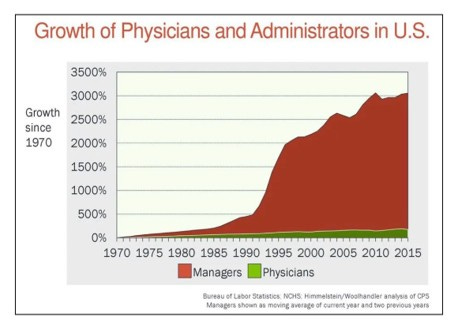
An Interesting Graph!! – I thought everyone would be interested in this graph put out by the Bureau of Labor Statistics. Even though I was trained as a physician and practiced both formally and informally for a decade plus, I’ve actually spent a major part of my career as an executive, Chief Medical Officer. Hmmm… It would be interesting to see what percent of the “administrators” are “clinicians” (i.e., physicians, nurses, etc.). I suspect it would change the graph somewhat.
Delivering care in the new virtual world…
Johns Hopkins Medicine and the American Telemedicine Association recently announced a major three-year push to develop and deploy new legislation that would reduce state licensure barriers to allow for the expansion of telehealth access. Referred to as the LIFTT Initiative (Licensure Innovation for Telehealth Transformation), it intends to educate the public on the urgent need for federal reforms to improve telehealth access nationwide.
The initiative aims to integrate proposed federal solutions with state-based licensure protocols. The rationale for the project is that it offers a potential solution for the vast majority of states that have not addressed the issue of “telehealth” and, as a result, hold restrictive telehealth licensure rules. During the COVID-19 pandemic, many states adopted more flexible rules related to telehealth visits, many of which have now been rescinded. Advocates for the change believe that certain populations are at the highest risk, including patients with cancers and rare diseases.
During the COVID-19 pandemic, temporary rules made it easier for patients to have video visits with doctors in other states. Those rules have since ended. Many states have gone back to their old, stricter rules about which doctors can treat patients, Johns Hopkins said. This means patients often can’t get care through telehealth from doctors who live in a different state, students who reside in a state that is different than the one in which they are enrolled, people residing in rural underserved or remote areas, patients enrolled in palliative care, travelers who experience problems in states where they do not live and other similar problem areas.
The LIFTT Licensure team believes that the current variety of licensure requirements at the state level is inhibiting access to effective care delivery services. It seems that many of our existing laws and regulations will be increasingly challenged as we move toward more globalization – across the board. From banks to products of all types to healthcare, the shift is occurring. We are beginning to live in a new world, and old-world solutions and requirements are clearly at the forefront of potential change in the new era of globalization.
Perspectives and realities emerging in the transformational AI space….
Technology Replacing Clinicians? Is it any surprise that the leaders of information technology have come out indicating that AI will replace doctors? We should not have been surprised that Bill Gates and Apple have joined the list of influential voices predicting AI will replace doctors. So, is the future bleak? Do we need to put away our stethoscopes and consider another profession (BTW, it’s too late for some of us)? I present what might be the most comprehensive case yet for why that future is nearer than we think. Should doctors start packing? It depends on how attached they are to stethoscopes. 😉 Bill Gates has given us a decade to prepare for the inevitable. And, for their part, Apple announced the release of their approach, referred to as the “AI Doctor” this past month.
However, I don’t believe we should look at the future through such bleak glasses. Will AI become an instrumental component of the care delivery process? YES. Will AI be able to touch someone? Hold their hand? Examine that pain for which they are seeking care? Address all of the patient’s questions? No, I doubt it. In fact, “futurists” have been making such predictions about medicine since at least the mid-part of the last century.
Now, will AI be able to “augment” our abilities as providers of care? ABSOLUTELY!!! In fact, I’ve been referring to the use of technology in the care delivery process as providing “clinically augmented intelligence”. And, the technologies will augment our capabilities in very significant ways. But, machines – at least the ones on the horizon now – will not be able to touch the patient, hold their hand, lower their voice, reassure the family, and on and on… There is something to be said for “human interaction” as a critical component of the care delivery process.
Information for your Consideration…
Health Systems And Plans Pursue Performance-Based Contracts – One of the interesting phenomena occurring across the healthcare community is the pursuit of performance-based contracts with digital health vendors. In a recent survey conducted by the Peterson Health Technology Institute, Modern Healthcare reported: “75% of health plans and 61% of health systems implemented performance-based contracts with digital health vendors.” For those organizations that have not yet adopted such an approach, it was further reported that “…the majority of the organizations that didn’t use performance-based contracts last year expressed interest in doing them.” Assuming that such a model is successful, we should anticipate further use of “performance-based contracting” in other areas of the healthcare arena.
The Increasing USA Nurse Shortages – Long story short, the nursing shortage is going from bad to worse across the country. Data from the DHHS Health Resources and Services Administration is projecting an 8% shortfall in the number of needed nursing staff for the health care community in 2028. Some of the data points include:
§ The overall combined deficit of registered and licensed practical nurses will top 355,000 by 2028.
Over the next decade the situation worsens with at least nine states will have unfilled nursing job rates in the double digits—California (22%), North Carolina (20%), Georgia (20%), Michigan (18%), Washington (17%), Maryland (16%), Oklahoma (13%), South Carolina (12%) and Louisiana (11%).
The problem is indicative of other areas in the healthcare community as well. As a rural health advocate, I should add that the rural areas of the country are in an even worse situation related to staffing shortages. Also, as I observe staffing patterns in both long-term care programs and outpatient settings, the use of temporary staff is increasing as well. The difficulty with such a staffing approach – while filling the acute shortage – too often results in gaps in actual care delivery – especially for those patients requiring longitudinal care.
Finally, it appears that the problem is only going to worsen over the coming decade if certain proposed policies of the Trump Administration are implemented. Specifically, the US Department of Education is proposing the exclusion of nursing from the “professional degree” category of education. Why is that important? It’s a factor in why individuals pursue nursing careers as Jennifer Mensik Kennedy, Ph.D., RN, President of the American Nurses Association, has clearly stated in a recent interview: “We’re going to have less staffing. We’re going to have fewer nurses throughout the continuum of [the patient] experience in healthcare, and nurses are the backbones of the healthcare system.”
Health Care Financial Stress Increasing – In its proposed budget for fiscal year 2027, the Trump Administration is proposing an across-the-board 10% cut in federal government spending, except for the support going to the military for the Iran War, where it is seeking a 44% increase. I’m wearing my peace sign from my 1960s high school and college days; you know where I stand on that one… The end result is that the health care community is on pins and needles due to rising costs. Those costs stem from high inflation (which is happening to everyone), increasingly tight operating margins, and rising pharmacy and overhead costs. Cost of care is a major issue of primary concern among administrative and clinical leaders in the healthcare industry, with 84% citing it as the “greatest threat” in a recent Becker’s Healthcare survey. As a result, operational efficiency, cost reduction (where possible), and outpatient services growth have become the watchwords among healthcare leadership. The survey also included an analysis of the challenges facing the health care community, including the following major points:
Outpatient care is a major growth sector for the healthcare delivery sector with a projected 18% increase over 2025 – 2035. Ambulatory surgery is another area of increased services in outpatient surgical units, representing a 51% increase in eligible surgeries over the period of 2024 – 2028.
Fitch Ratings – one of the world’s major credit rating agencies – recently issued a “deteriorating” outlook for the healthcare sector due to cost issues, increased uncertainty on regulatory issues, and expiration of the Accountable Care Act subsidies.
Ongoing labor and technology costs continue to increase, with cybersecurity leading the cost increase in IT budgets by 31%.
Decreased government spending with a project 7.9% reduction in Medicaid spending in 2026!
In sum, health care is facing a “cautious at best” outlook for 2026, which is forcing budget tightening. From my perspective, it suggests (strongly) that in the USA, we need to get more serious about a shift toward “value-based care delivery” reimbursement. Under such a system, the outcomes and value of service delivery would be major parameters for payments. It’s an ongoing discussion…
The Cost Of Care By Family – The Public Policy Institute recently issued a report assessing the contribution of care provided by friends, neighbors, and relatives for the aged community. It’s clear that the economic contribution of family and friends toward sustaining the aged is worth significant dollars. The Public Policy Institute used data from 2024, noting that 59 million Americans provided care for their adult relatives, neighbors, or friends. By adding up to the estimated 49.5 billion hours of care (a probable undercount), the economic contribution of labor comes to $1.01 trillion, which exceeds both Medicaid and out-of-pocket health spending. “A Place for Mom” may in fact be your living room or your friend next door that reach out to help those still living at home. Kudos to those who provide such support. BUT – as a society – we should not underestimate the cost nor the value of such services provided by neighbors, friends, and family.

Musings from a foodie…
In recent travels, I’ve had the opportunity to visit a number of places around the country. When arriving in Denver, Colorado recently, I had a hankering for some good Italian cooking and found a good place in the downtown area called Tavernetta [ ⭐⭐⭐⭐⭐⭐]. At first, I was quite taken by the menu because there were a number of “Mainer” foods on the menu (e.g. lobster, diver scallops, and the like). However, as you will see, I did succumb. However, for starters, I decided to stick with more traditional foods and was not disappointed. The Rigatoni with Lamb Ragu was exceptional as a “primi” dish. However, for the “secondi” I acquiesced to the Black Cod with white Asparagus, spinach, and hazelnut sauce. Again, it was great. It’s definitely worth a visit if you’re in the Denver area. In fact, it’s one of the best Italian restaurants I’ve experienced this year. But, standby!! I’m off to Sicily in 3 days. I’ll report back following the trip. Tavernetta – 1889 16th Street – Denver, CO 80202 – (720) 605-1889 - www.tavernettadenver.com/
The ongoing saga…
The Great – Hmmm…not sure.
The Good – Winter is over and Spring is started to blossom!
The Bad – The tit-for-tat engagement of the President with the Pontiff seemingly does little to resolve any of the issues affecting the Presidency
The Really Bad – The increasing staffing shortages evidently across the healthcare spectrum. It needs the attention of all of us…
The Ugly – The “obliterated” have already started on their “reconstruction” efforts.
No posts
Comments
Nothing yet. Say the first thing.
Sign in to join the conversation.