
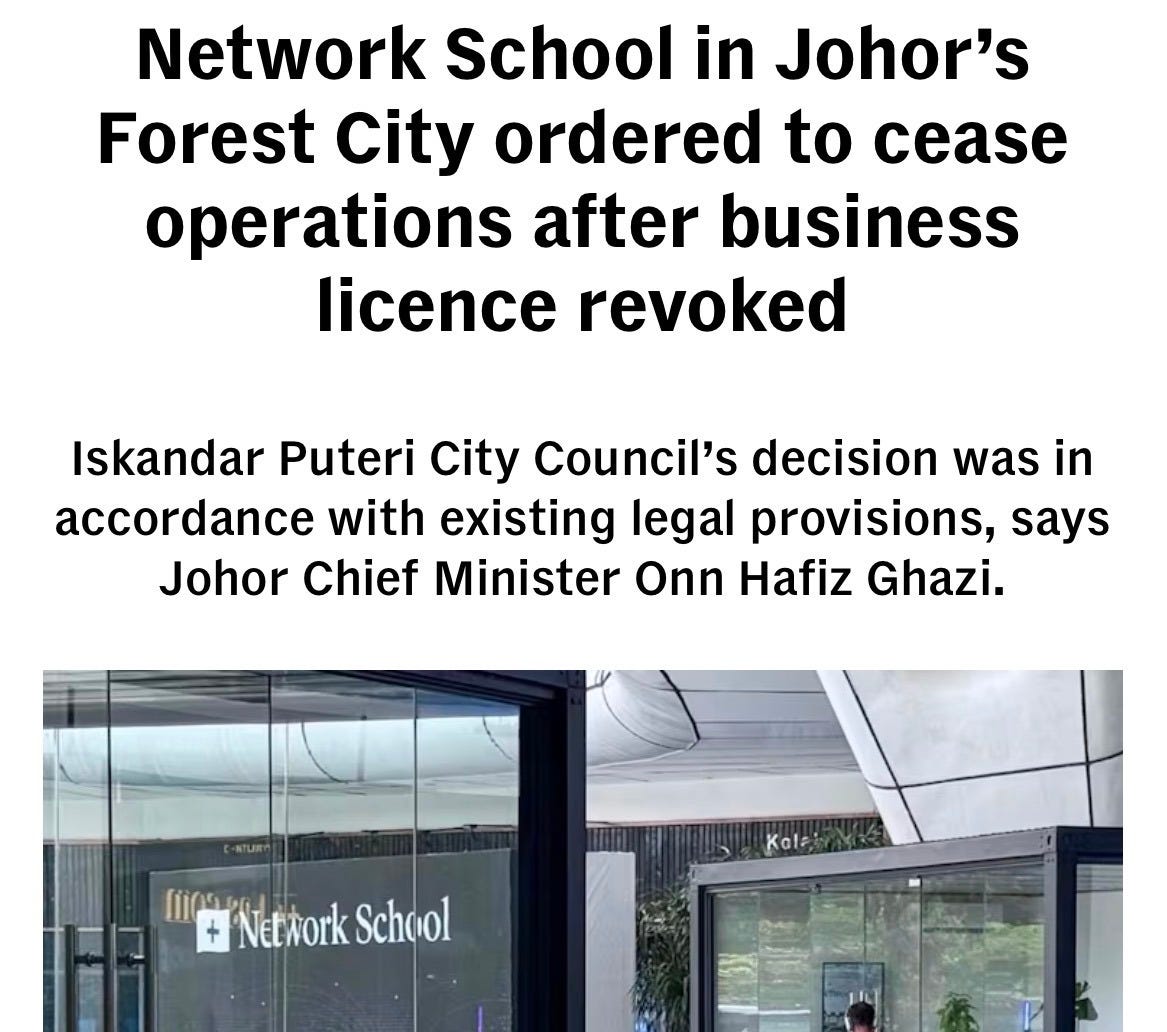
On July 21, authorities in Johor Bahru, Malaysia, sealed one of Network School’s buildings and ordered it to cease operations. Almost three hundred people were living there at the time. Over its run since 2024, the community had cycled thousands of nomads from more than seventy countries through its doors. It was one of the largest coliving communities for digital nomads in Asia, built on a reclaimed island off the coast of Johor. The space emptied out within days.
I’ve never been to NS, but I run a coliving space for the same kind of person Network School was built for, and I have nomad friends who’ve stayed there. They tell me it’s the best place they’ve found to lock in and do real work around high-agency people. So when the biggest version of the thing I do gets shut down, I pay attention. Every operator should.
The official reason is on the record related to a licensing matter. I don’t think that’s the whole truth, and I’m not going to pretend I know the rest. What I want to do here is walk through what Network School actually is, what happened over the past week, and the one part of this story that almost nobody is talking about. Because that part is the one that should keep coliving operators up at night.
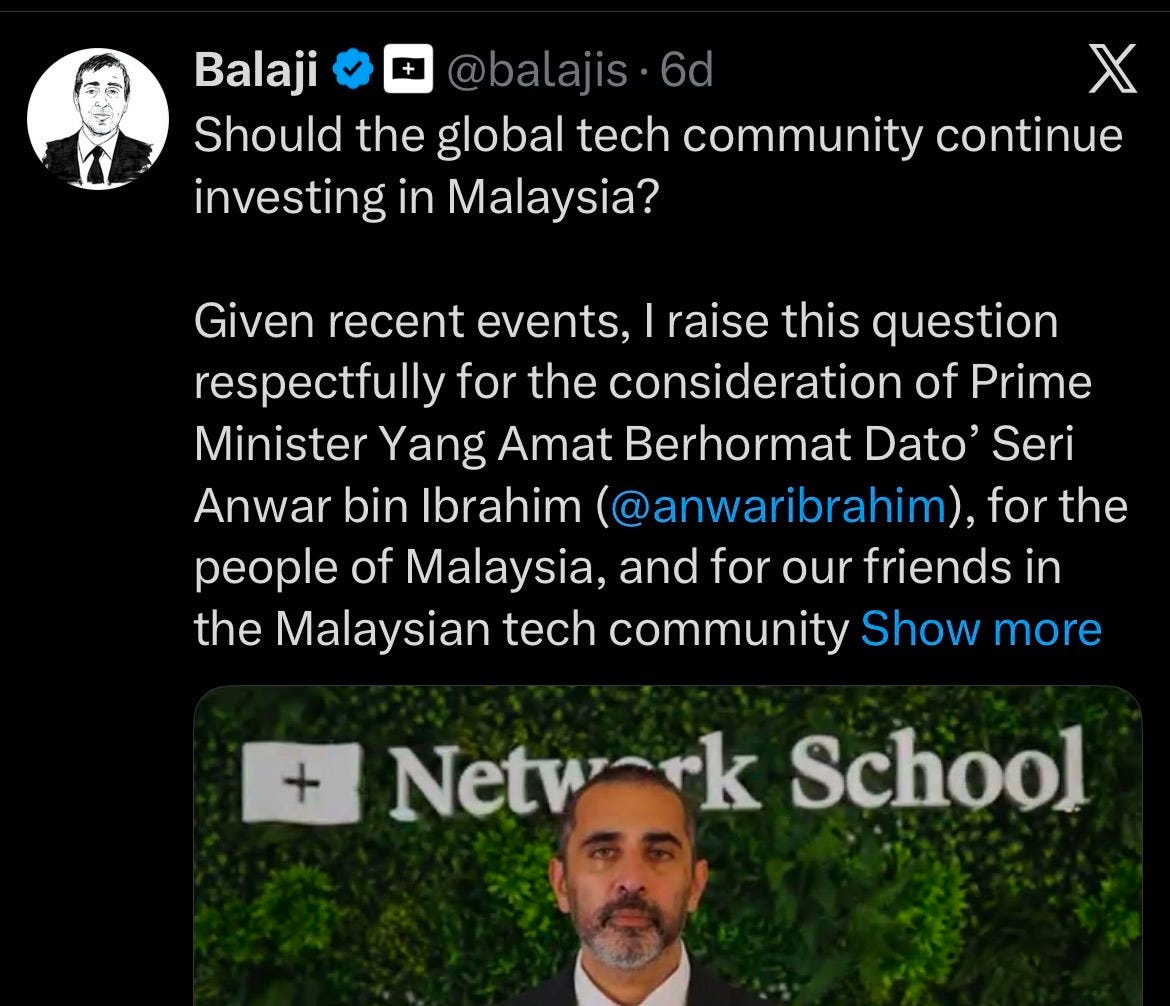
If you’re not in crypto or startup circles, the name Balaji Srinivasan might mean nothing to you. In those circles he is somewhat of a figure head.
Balaji is a former CTO of Coinbase and a former general partner at Andreessen Horowitz, one of the biggest venture firms in the world. He’s an early investor in a long list of companies people have heard of. But the thing he’s known for now is a book. In 2022 he published “The Network State: How to Start a New Country.” The core idea is that groups of people who share values can organize online first, then pool money, then buy up physical territory, and eventually earn diplomatic recognition as something like a country. A nation that starts as a group chat and ends with a flag.
You can take that idea seriously or take it with a grain of salt. A lot of people do both. But Balaji didn’t just write it down. In September 2024 he opened Network School to test a piece of it in the real world. He picked a converted hotel in Forest City, Johor, and started running monthly cohorts of founders, engineers, and creators who live and work in the same place for weeks or months at a time. The pitch was “Learn, Burn, Earn.” Get healthy, build your thing, be around people doing the same.
NS was a hit. Cohorts ran into the hundreds, and by Balaji’s own telling thousands of people passed through over the first year and a half. The names that visited gave it weight. Ethereum’s Vitalik Buterin came through. So did Bryan Johnson, the longevity guy behind Blueprint. Whatever you think of the philosophy behind it, that’s a real coliving operation at a scale most of us only talk about. For a lot of nomads, it became a destination. A place you went to get inspired.
To understand why this blew up, you have to understand where it happened. Forest City is not a normal place.
It’s a roughly hundred-billion-dollar mega-development built by one of China’s largest property developers, on four artificial islands off Johor. It was launched around 2016 with a plan to house nearly a million people. Eight years later, only a fraction of it is built and the local nickname for it is “Ghost City.” The apartments were priced mostly for foreign buyers, out of reach for most Malaysians. Then China’s property market seized up, and the Chinese developer ran into deep financial trouble. So you had gleaming empty towers and almost nobody in them.
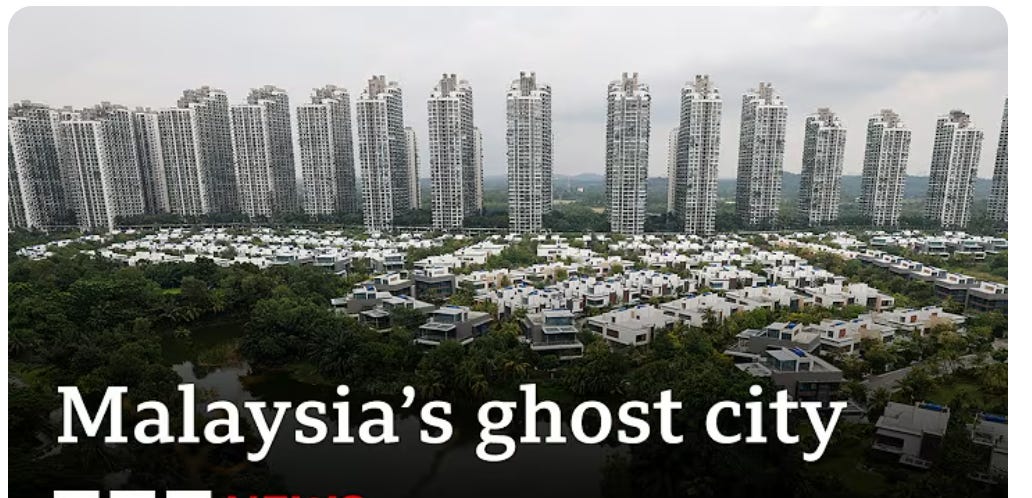
Malaysia has been trying to fix this. Forest City was designated a Special Financial Zone, and the broader area became part of the Johor-Singapore Special Economic Zone, a bet on pulling in foreign capital and talent by sitting right next to Singapore. That’s the setup. A struggling development the government badly wants to fill, in a country actively courting the digital economy.
Network School fit that story almost too well. Foreign talent, real money, global attention, filling rooms in a place that needed filling. But here’s the tension that was there from day one, and this is where I start to form my own opinion on it. Network School sold itself on being twenty minutes from Singapore. The pitch leaned on the Singapore adjacency at every turn, the tax setup, the convenience, the proximity. Malaysia was the ground it stood on, rarely the story it told.
You can call that marketing. I think it reads as a quiet disassociation from the country hosting you, and I don’t think locals or the government missed it.
This whole thing moved fast, inside of about a week. I’ll summarize it here, but the full picture is bigger than any one article can hold. If you want the detail, go read as much as you can on X. That’s where the timeline, the claims, and the reactions have played out in real time, from Balaji’s own posts to the people arguing with him.
Here’s the short version. Back in April, Malaysia’s Digital Minister had visited the campus, so this was never a project operating in the shadows. Then in July it turned. Allegations circulated on social media that Israeli nationals had joined the program on second-country passports. This is a sensitive matter in Malaysia. The country has no diplomatic relations with Israel, and as a matter of longstanding policy it does not admit Israeli passport holders. So the claim, true or not, was always going to land hard. A glossy promotional video Balaji had posted poured fuel on it.
The authorities moved. Immigration inspected the community and, by their own account, checked every participant and found valid documents. On the immigration question, the people there were in order. But local enforcement said one building was operating without a valid business license, and another was running activities different from what its license allowed.
The Prime Minister, Anwar Ibrahim, said any Israeli found to have entered through the program would be deported. On July 21, the Iskandar Puteri City Council revoked the business license, the Johor state government backed the move, and operations were ordered to cease from July 22.
The accusation that kicked this off did not hold up on the authorities’ own immigration check. I don’t believe the licensing paperwork is the full explanation for why a project with government attention in April was sealed shut in July. But I’m not going to guess at Malaysia’s real intentions.
If you want the fuller picture, don’t stop at the headlines. Read the mainstream coverage, then read the comment sections under those articles on Facebook and the replies to Balaji’s posts on X. The official statements give you one version. The comments from ordinary Malaysians give you another.
Balaji did what you’d expect someone in his position to do. He defended the project and stated the facts that helped his case.
He pointed out that immigration had cleared everyone. He framed the whole thing as a licensing dispute rather than a shutdown of the project itself. And he made the economic argument hard. By his account, Network School had put more than RM100 million into the campus with no government funding, employed Malaysians directly and indirectly, and lifted real estate values in a development that badly needed the lift. He said a further expansion worth more than RM500 million was ready to go, and that he was putting it on hold until he got assurances this wouldn’t happen again.
He has every right to all of it. If your life’s work gets sealed off, you defend it, and you lead with the facts that win. We don’t know what the authorities were really weighing. We don’t know everything Balaji knows. A news cycle and a video are not the full record.
So I’m not writing this to say Balaji was wrong. In a lot of the narrow factual disputes, he may well be right. The uncomfortable part is that being right on the facts did not keep him welcome. And that gap, between winning the argument and keeping the room, is where the actual lesson lives for the rest of us.
Here’s what I keep coming back to. In all the coverage, the accusations, the license letters, the deportation threats, there’s almost nothing about the relationship between the nomads living in Network School and the people of Johor. That absence is the story to me.
I’ve heard about it firsthand. My nomad friends who stayed there describe a community that was largely an international crowd that mostly kept to itself with very little interaction with locals or ordinary Malaysians. So when Balaji’s video makes the case about jobs and economic contribution, I don’t doubt the numbers. But the netizens don’t seem to feel any of it, and they don’t seem to buy the narrative. You can employ people and still be a stranger to the place.
Nomads move. That’s the whole identity. It’s the best thing about the life and it’s the blind spot built into it. When you’re wired to leave, you don’t sink roots. You optimize for the community you travel with and the work you’re there to do, and the actual place drops out of view. Good weather, fast wifi, cheap rent, easy visa. The land and the people who live on it slide into the background.
Most nomads I meet aren’t hostile to the places they land in. They’re just not thinking about them much. My read is that it’s more a lack of awareness than a lack of care, because awareness you can fix. But right now the default setting is a bubble. Belonging is the people you move with, not the place you’re standing in.
For a while that works fine. You show up, you do your thing, you spend some money locally, and you leave. But the moment the relationship with the place actually matters, you find out whether you built one.
Network School found out it hadn’t.
When the pressure came, there was no reservoir of local goodwill to draw on, no deep tie to the community or the officials, nothing that said “these people are one of us.” What there was instead was a year and a half of a project that told a Singapore story on Malaysian ground. A guest that never really became a neighbor.
If you think this is a one-off, look at Honduras.
Próspera is a private charter city on the island of Roatán, built under a special economic zone law and backed by many of the same Silicon Valley names. Balaji himself is an investor.
On paper it’s a similar promise. Foreign capital, new jobs, a shiny zone that lifts everything around it. On the ground, the neighboring village of Crawfish Rock says it was never really consulted, that the zone’s taxes get reinvested inside the zone rather than in the community around it, and that the whole thing feels like something happening to them rather than with them. Honduras repealed the ZEDE law, and Próspera responded with an international arbitration claim against the country. It’s now a sovereignty fight.
Different country, different specifics, same shape. A foreign-built enclave that optimizes for its own residents, keeps its benefits inside its own walls, and then acts surprised when the host turns on it.

Johor is not Roatán. But the pattern rhyming across two continents is why operators should treat this as more than gossip about one controversial founder. This is a recurring failure mode in how mobile capital and mobile people show up in places that aren’t theirs.
Here’s a distinction worth making. As a foreign owner and operator, you carry a burden a local operator simply doesn’t. A Malaysian running a guesthouse in Johor is of the place. Nobody questions whether they belong there. You, coming in from outside, are a guest, and a guest can be asked to leave in a way a local rarely can. That asymmetry is the whole job. You’re allowed to do business. Whether you build real relationships with the local government and the local people is exactly where the road divides. It’s not on any checklist and it’s the whole thing.
The version I’m trying to practice I call cosmo-localism. Global community, local roots. It’s the reason the pop-up we’re running in September is named Cosmo Local CNX, tied to Chiang Mai, the place, not just the crowd passing through it. The idea is that a nomad gathering should leave something behind in the city that hosts it, and pull the city in rather than wall it out.
That’s not just a slogan for us. At Alt_ we’ve joined forces with a local community leader and our neighbors at Anusarn Sapakoi to build something we call the Nomad Friendly District, a sandbox for this exact question that carries an endorsement from the provincial government. The premise is simple. The nomads and the locals design the district together, so the foreign crowd isn’t a bubble dropped into the neighborhood but a part of it. Local businesses have a seat at the table, not just a stake in the foot traffic.

I’ve written about what we’re building there before, and you can read that piece here . It’s slow, unglamorous work. But it’s the reservoir of local goodwill that Network School didn’t have on the day it needed one. I don’t have this fully figured out. But I know that treating the place as a stage set is how you end up sealed off, and I’ve now watched where that road ends.
Why This Is Lose-Lose, and the Conversation We Should Be Having
Step back and look at where this landed. The government moved against Network School. Local sentiment ran against it, loudly. And the nomads aren’t going to suddenly become the kind of community that puts down roots in Johor.
Balaji has already signed a memorandum of understanding with Kazakhstan, and the capital and the community will follow him to whatever the next node is. The pattern travels with them.
That mobility is real, and I understand why an investor leans on it. But I don’t read it as strength. Watching Balaji say the money can simply go elsewhere if the local government won’t play ball tells me he may have misjudged the rules of engagement in this part of the world.
RM500 million is a serious number to you and me. Against the scale of Malaysia’s economy, it isn’t the trump card it sounds like. In this region, relationship often outranks capital, and a threat to take your money and leave can read as proof you were never really committed to the place. So no, I don’t think Kazakhstan is the happy ending here. It’s an exit, not a resolution.
Because look at the scoreboard. Malaysia loses the investment and the talent it spent years trying to attract. Balaji loses the campus he built and the cleanest proof point that Network State could work in the real world. The nomads lose a place they genuinely loved. And Forest City goes back to being a ghost city with a nicer story about what it briefly was.
This is lose-lose, and that’s exactly why it’s worth studying.
I don’t think the fix is complicated, and it isn’t about crypto or network states or any of the ideology. Local participation and local involvement should be a live conversation among nomad communities and the people who lead them, and right now it barely is.
We talk endlessly about visas, tax residency, wifi, and cost of living. We almost never talk about what we owe the places that host us, or how to actually belong to them.
That silence is the gap Network School fell into, and it’s the same gap in Honduras, and it’ll be the same gap in the next place unless we start treating the local relationship as core to the model rather than an afterthought.
That’s the whole reason The Extended Stay exists, and it’s why this story matters for the operators and builders reading this. What we want to help you build is the version that doesn’t end in a sealed building.
A win for local residents, who get real participation and a seat at the table, not just the foot traffic. A win for the city or destination, which gets foreign investment that actually puts down roots instead of threatening to leave. And a win for the visitors and operators who came from somewhere else, who get to stay and build something that lasts. Win-win-win, or sooner or later nobody wins at all.
Network School is the clearest proof I’ve seen that you don’t get to skip the first two and keep the third.
We’re all guests where we operate, at least those of us who came from somewhere else. The operators who remember that, and act like it every day and not just when the inspectors show up, are the ones who get to stay.
Network School was the biggest bet anyone had placed on this kind of living. Watching it get sealed off in a week is the clearest reminder I’ve had that the thing we sell, community, has to include the community that was already there.
John Ho runs Alt_ChiangMai & Alt_PingRiver, two coliving and coworking spaces in Chiang Mai, and leads the Nomad Friendly District initiative. The Extended Stay covers emerging trends in community-powered hospitality for operators and ecosystem builders.
No posts
Comments
Nothing yet. Say the first thing.
Sign in to join the conversation.