

———
I posted a note a few weeks ago that, compared to my usual numbers, took off: 9,000 views, 32 restacks, 55 comments. You’d think I had said something controversial.
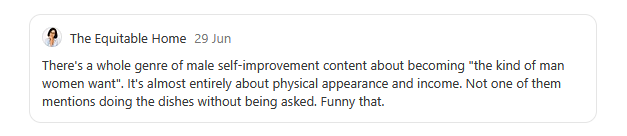
There is a genre of content dedicated to teaching men how to become the kind of man women want. It has its own vocabulary, most of it ending in “maxxing,” and is delivered with the confidence of a man who has never asked a woman what she wants. Looksmaxxing covers the face: jawline, “gonial angle,” “hunter eyes,” teeth whitened to a shade not found in nature. Financemaxxing covers the wallet. Moneymaxxing turns out to mean having a savings account; mewing turns out to mean nothing, according to every researcher who has looked at it. Testosteronemaxxing sends men sourcing their own hormone replacement therapy online. Geomaxxing means relocating to a different country to improve your odds of meeting a woman, on the theory that the problem was the postcode, not the personality.
Manosphere content is, above all, a jargon-acquisition machine. It takes ordinary insecurity about status and rejection and gives it a vocabulary that sounds like biology, so it feels less like an opinion and more like a fact someone regrettably discovered. It borrows market language for people: “high value”, “low value”, a person's worth rising or falling with looks, wealth, age, or body count. A man who's absorbed it will explain your own behaviour back to you using a term for female mate-selection strategy, usually after you've expressed a preference he didn't share. He'll caveat every generalisation about women with “not all women, but” – which does the opposite of what it claims.
Somewhere, a committed 19-year-old is uploading his selfie to an app that will score his “maxilla ratio” and rank him from “subhuman” – the supposedly ugliest 1% of men – to “Chad,” the peak of male attractiveness. Aside from being reductive, devaluing, and pseudo-scientific, looksmaxxing ideology trades in the racist stereotype that Caucasian features sit at the top of that scale and represent some form of genetic superiority.
A boy doesn’t arrive at a facial-scoring app by choosing it. Dublin City University’s Anti-Bullying Centre ran ten blank-phone accounts built to resemble 16- to 18-year-old boys, split across TikTok and YouTube Shorts. All the male-identified accounts were fed masculinist, anti-feminist and other extremist content, and once an account showed interest by watching this material, the volume increased rapidly. YouTube Shorts was the worse offender overall: it recommended a larger share of toxic content on average (61.5%) than TikTok (34.7%), and toxic content appeared within the first 23 minutes on both platforms, with manosphere content specifically showing up within 26 minutes. By the end of the 400-video experiment, the vast majority of recommended content was toxic (76% on TikTok, 78% on YouTube Shorts), dominated by manosphere alpha-male and anti-feminist material, with Andrew Tate the single most-featured influencer on both platforms (despite being de-platformed at the time of data collection). The report's conclusion is that the manosphere has mainstreamed itself by trading overt seduction and pick-up-artist content for a broader package of wealth advice, stoicism and mental-health talking points, absorbing adjacent far-right and anti-trans material along the way.
The largest and most commercially aggressive part of this world is still the pickup-adjacent lane – Andrew Tate down through a whole ecosystem of “bootcamp” coaches. Matt Artisan’s The Attractive Man is a good current example, charging several thousand dollars for in-person approach training in a growing list of North American, European and Asian cities. The camps are dressed in early-2000s lad-mag language while insisting they’ve moved past pickup-artist objectification, though participants slip back into that language the moment the cameras stop rolling. The sales pitch is always the same one, dressed up differently each time: women are attracted to a narrow “alpha” hierarchy, most male social conditioning is the problem, and confidence can be drilled like a muscle. At its more ideological end – Tate, but also figures like Richard Cooper (peddling gems of advice such as “Women cheat as much as men, but mostly when ovulating”) – it stops being about dating tactics at all and becomes a worldview, built around a loosely connected set of communities that claim to address men’s struggles with dating, fitness and fatherhood while promoting the idea that men are the real victims of the current social climate. Two-thirds of young men now regularly engage with this kind of content. The line running through all of it is “become the alpha, build, lead, never follow,” with entire ecosystems built around proximity to wealth and power as proof a man is worth something.
Sitting slightly apart from the pure pickup content is what’s become the bigger trend recently: less “here’s your opening line,” more “fix your internal operating system.” Confidence hacks are out; nervous-system regulation, integrity and “shadow work” are in. Some of these creators now position themselves against the alpha-bro script entirely, arguing the label’s become “polluted” and that real dominance comes from competence rather than performance – while keeping fully intact the premise underneath both versions, that a man’s competitiveness and need for dominance are fixed and simply need a “legitimate outlet.” It’s the same product with a nicer font.
If a paid subscription isn’t right for you at the moment, please consider supporting my work with a small one-off contribution.
Women have said what they want directly, if anyone in this industry were listening. Some evidence I’ve seen sits, of all places, in Prime Video hockey drama Off Campus, which has nothing to do with looksmaxxing and did more damage to the genre’s thesis than any peer-reviewed study could. Women are currently losing their minds over the captain of a fictional college hockey team, and not for his rank on the ice. He hands a sealed drink to a woman he barely knows because he has noticed, unprompted, that an open cup isn’t something she can trust. He asks whether she is open to a suggestion before he has made one. He spends an evening listening to a band she mentioned once in passing, for no reason other than wanting to understand what she likes. Every example women cite involves noticing something and acting on it without being asked. Scarcity or dominance does not feature once.
When you ask men what they think women want versus asking women what they actually want, the gap is not subtle. UK Ipsos polling found young men are far more likely to believe women prioritise attractiveness (50%) and financial status (39%) in a partner, while young women themselves rank a sense of humour (60%) and kindness (53%) as what matters most to them – a massive gulf between the game men think they’re playing and the one women say they’re actually in. Cross-cultural mate-preference studies going back to Buss’s large multi-country research have repeatedly found kindness sits at or near the top of what both sexes want in a long-term partner, with the emphasis somewhat stronger among women. Ambition and “industriousness” show up reliably too, but not as a proxy for wealth – research on this finds women favour drive and purpose in a partner as a signal of stability, not a bank balance.
That, though, still isn't the strongest finding, because all of it is still about what gets a woman interested in the first place. What actually keeps her satisfied once she’s in the relationship is a different, less flattering question, and the answer to it isn’t jawline-adjacent at all: for women, an equal division of household labour is one of the strongest predictors of how satisfied they are in their relationship. Couples who agree housework should be split evenly are happier than couples who disagree about it, and for women, that shared belief matters more than whether the split is perfectly even in practice. The bar sits closer to “has noticed the mental load exists and doesn’t need it explained via a passive-aggressive Post-it note” than to “does 50% of the housework.” It is the one metric the male self-optimisation industry has never once mentioned.
Men who are lonely or struggling to date are dealing with something real, and an industry has grown up specifically to monetise that reality rather than address it. A looksmaxxing app monetises through a subscription pushed straight after the score reveal. A financemaxxing influencer monetises through affiliate links to trading platforms and credit cards. A testosteronemaxxing coach monetises through a supplement line and a paid course. Every “maxx” has a product, a discount code, or a coaching tier waiting behind the advice. Teaching men to be kind and funny, and to do their share of emotional and domestic labour without being asked, has never generated a single dollar of revenue for anybody. A young man can spend his most formative dating years optimising his maxilla ratio and arrive at twenty-five fluent in gonial angles and illiterate in any of the competencies women actually want.
The industry has done the market research on the ten percent of female desire that can be sold back to men as a subscription, and correctly worked out that the other ninety percent, the part that requires doing something rather than buying something, has no product behind it at all.
Here’s a list of related Substack articles worth reading:
Game Over – Dina Honour: Dating bootcamps sell men the same shortcut promise as video-game hack videos, and it works about as well on women as a cheat code works on real life.
It’s time to stop aiming for equal relationships – Stefanie O’Connell: Even couples who believe they're splitting things evenly aren't, and the data on earnings, leisure time, and housework shows the gap consistently favours men.
Want a Traditional Wife? Here’s Your Trad-Husband Checklist – Maria Cassano: A nine-point checklist for men who want a 1950s wife, covering income, homeownership, and church attendance, that almost none of them would actually qualify for.
The Manosphere: An Economic Analysis – Leon Clark: Applies market-failure and signalling theory to dating apps and manosphere coaching to explain why the incentives produce worse outcomes for almost everyone involved.
How manosphere and red pill ideologies doom men to loneliness and unhappy relationships – Zawn Villines: Argues manosphere ideology filters men toward the small pool of women most vulnerable to misogynist partners, guaranteeing the unhappy relationships it claims to prevent.
We’ve got a Labor-Digger Problem – Sarah Steed: Coins "labor-digger" for a man who wants a partner to quietly run his life for him, then literally prices out the invisible labour he's extracting.
Paid subscribers get two companion resources below: one for parents to help check whether a son's feed has already tipped somewhere worth worrying about, and one for checking your own.
Comments
Nothing yet. Say the first thing.
Sign in to join the conversation.