
Substack has a new category checker that looks at what you’ve been publishing recently and tells you whether the categories attached to your publication still match the work you’re publishing.
I first tested the new feature on Aug. 6, while checking it with Mike Cohen, who leads AI and MLE at Substack.
The checker analyzes how your recent posts are being classified, weights newer publishing more heavily and recommends categories that better reflect what you’re publishing now.
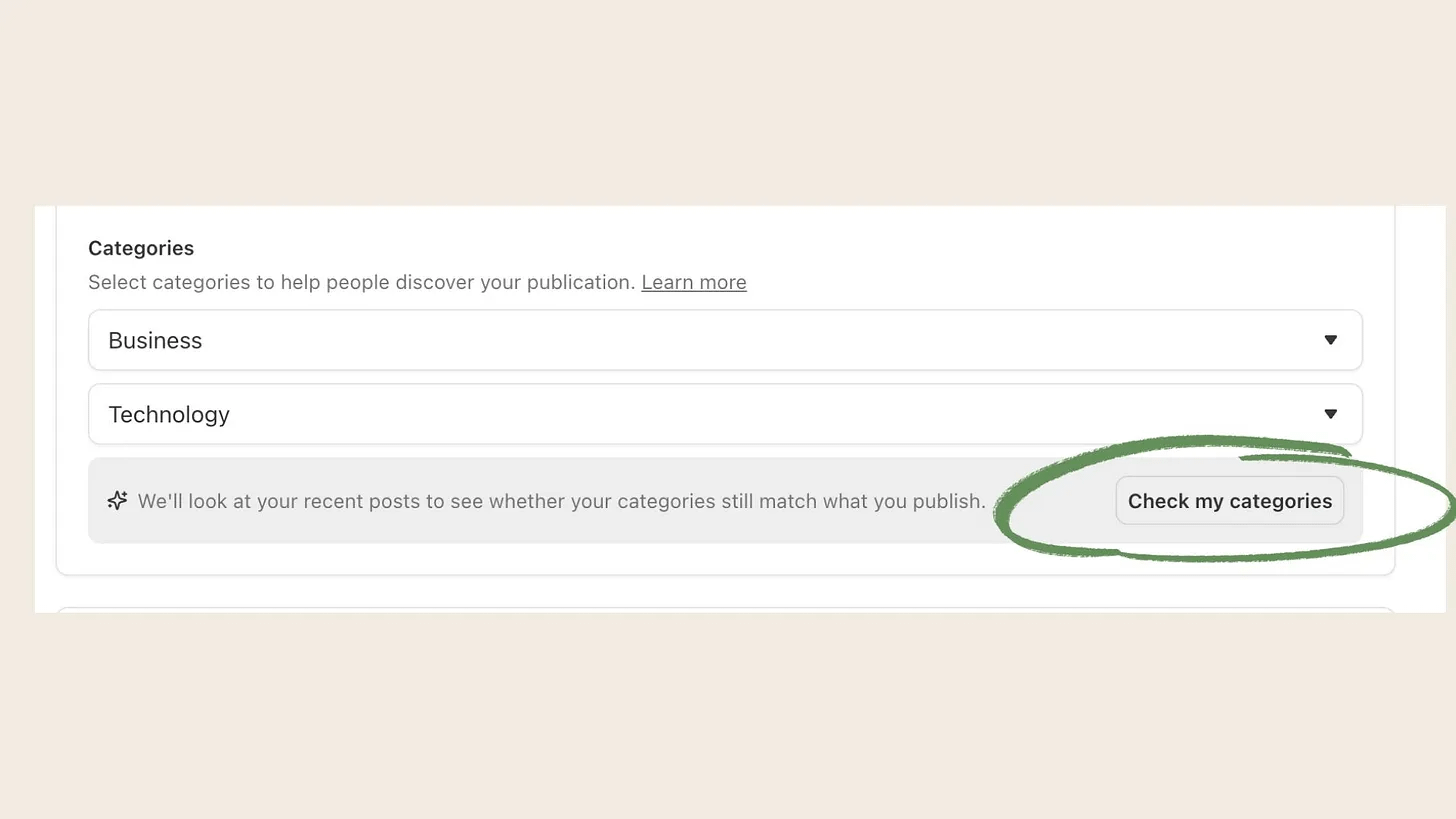
At the time, The Publishing Spectrum was categorized under Literature and Education.
The checker looked at my recent publishing and suggested something different.
It identified Business as the stronger first category — in my case, the majority of my latest posts were being classified there — and then surfaced Technology as a stronger second category. So while we were testing the feature, we changed The Publishing Spectrum from Literature + Education → Business + Technology.
The short version of today’s announcement: Substack's new category checker looks at how your recent posts are classified, weighting newer publishing more heavily, and recommends categories that better reflect what you're publishing now. Categories matter most for browse-style discovery, while personalized recommendations rely more on reader behavior and the content of individual posts.
I wrote down the date I changed my categories because I want to know what happens in the weeks and months ahead.
It’s helpful that Substack identified what I’m writing about, but what I suspect we’re all curious about is:
Does giving Substack a more accurate publication category change how new readers discover my work inside the platform?
I’ve been in touch with Mike as I’ve worked on this piece, and I asked him specifically how publishers should think about that question — what the checker is actually measuring, where category matters across Substack’s discovery network, what creators can influence and what we should watch after making a change. The answers clarified something I think is particularly important:
Your publication category matters a lot in some parts of Substack discovery. But it is not the thing deciding whether every individual post reaches the right reader.
So before you open your settings and start changing things, here’s what I think publishers should understand.
TL;DR: Publication categories have their strongest effect on category-scoped, browse-style discovery surfaces, including Explore and leaderboards.
Your publication category matters most in what Mike described as browse-style discovery. These are the parts of Substack where a reader is actively browsing by subject or category and may encounter a publication they don’t already know. Think category pages, Explore, leaderboards and other category-scoped surfaces.
Mike described category as the strongest lever in those environments.
So if the category attached to your publication no longer reflects what you’re actually publishing, correcting it gives Substack a better signal about where your publication belongs when someone is browsing for something new. There isn’t one clean metric that will tell you, your category change worked. Mike suggested starting with subscriber growth by source in your Stats dashboard and watching whether free subscribers coming from Substack-network sources change after the switch.
That’s what I’m doing with my Aug. 6 change.
Publication categories classify the publication at a broad level. And the new checker compares those categories with the subjects Substack is seeing in your recent posts. Newer work carries more weight than older work, specifically so the recommendation can remain accurate if a publication changes direction. I would not spend much energy trying to reverse-engineer an exact post count or weighting formula. Mike told me those parameters can be adjusted as Substack improves the accuracy of the feature. The useful question is much simpler:
What have I been consistently publishing about lately?
That is the input you can actually influence, which leads us to …
TL;DR: The biggest input you control is what you consistently publish — sustained editorial patterns give Substack a clearer signal than any single spike or unusually successful post.
Mostly you have control over the body of work you publish. If you are intentionally moving your publication in a new direction, consistent publishing around that subject gives the system more evidence of the shift. This is where I would want publishers distinguishing between a spike and a trend worth building around. One unexpectedly successful AI post does not necessarily mean you suddenly have a Technology publication.
But several months of increasingly technology-centered work might tell you something. The checker gives you another way to notice when the publication you are actually building has started to diverge from the publication you still think you are making.
TL;DR: It doesn’t need to be a perfect match. Choose the category that most broadly represents the publication you’re consistently building; individual posts can still be understood and distributed according to their own content.
A broad publication category does not need to describe every post you write. The better question is:
Does this broadly describe the publication I am consistently building?
And this is where understanding the rest of Substack’s discovery system matters. Publication categories influence category-scoped discovery. But personalized recommendations are driven by reader behavior and the content of individual posts.
So if you publish a business-related piece but your publication is not categorized as Business, that does not mean Substack becomes incapable of understanding that post as business content. If a reader repeatedly engages with business content, Substack can learn that interest from their behavior and use the content of individual posts when deciding what to recommend.
TL;DR: Not necessarily. Your category helps Substack place your publication, while reader behavior and the content of individual posts play a bigger role in personalized recommendations.
This may be the most useful distinction to understand:
→ Your category helps Substack place the publication.
→ Reader behavior and post content help Substack place the individual story.
So I would not choose a category by asking, “Where are all the readers I might possibly want?” I would ask, “What is the strongest broad description of the publication I am consistently making?” Then let the more personalized parts of the discovery system do the more granular matching between individual posts and individual readers.
TL;DR: Your category matters most in browse-style discovery — the category-scoped surfaces where readers who don’t already know you are actively looking for something new.
That matters because these are the places where someone who has no existing relationship with you may discover the publication for the first time. Category is not necessarily the strongest signal everywhere on Substack. But it is, according to Mike, the strongest lever in those browse-style surfaces.
That makes getting the category broadly right important without requiring it to perfectly describe everything you publish.
My recommendation is to treat a category change as a three- to six-month publishing experiment. I asked Mike whether there was any downside to publishers changing categories frequently. He didn’t identify a technical penalty. The bigger problem is measurement noise. If you keep changing the input, it becomes very difficult to tell whether anything downstream actually changed.
So if the checker identifies a meaningful mismatch:
Change the category.
Write down the date.
Keep publishing.
And leave it alone long enough to learn something.
Then watch subscriber growth by source and see whether Substack-network discovery begins behaving differently.
That’s exactly the experiment I started on Aug. 6.
If Substack is trying to understand what you publish, your readers are too.
Request a free Editorial & Audience Review and I’ll look at how clearly your publication communicates what it is, who it’s for and where your audience is already responding.
Comments
Nothing yet. Say the first thing.
Sign in to join the conversation.