
From what I can tell as an outsider doing research into historical topics, there are at least a couple of bad ways to talk about the “Dark Ages.” One bad way is the more familiar, Enlightenment-driven sneer that Rome fell, and subsequent barbarism came to rule. The previous culture being snuffed out with Europe spending centuries stumbling and bumbling around until the Renaissance. That version deserves to die a harsh death. Early medieval Europe was far from a desirable place to live, but it had monasteries, law codes, manuscripts, trade, and religions and cults, both newly forming and old alike. By Dark Ages, I mostly mean that period from about 400 to 750 CE in what had been the former western Roman world.
A more recent one is the overcorrection. Since the phrase “Dark Ages” has been used as an insult, its darkness can start to sound like a myth. The period then becomes misunderstood, unfairly maligned, or somehow more vibrant than the old caricature allowed. Much of that correction is fair and necessary. But a civilization that once produced roads, tax records, coins, public complexes, and abundant material traces left a thinner archive in much of the West. That “darkness” once meant contempt to some and a loss of visibility in the record to others. I think the word is usable only in the latter sense. The thinning record, reduced long-distance exchange, and smaller administrative footprint show that major institutions changed or receded. They do not, by themselves, tell us whether ordinary people were poorer, shorter-lived, or less secure than their grandparents. That is a real transformation, not yet a welfare statistic.
My prior here was too crude. I treated a thinning written record, reduced long-distance commerce, and weaker imperial administration as if they showed that ordinary people were less secure. They show first that a large political economy had changed shape. A household could lose access to Roman coin, imported pottery, or a nearby administrative office without necessarily being worse fed or worse off by every measure. The question is not whether “civilization ended,” but whose lives changed, how, and which consequences we can actually see.
The Dark Ages Measurement Problem
The phrase “Dark Ages” mixes cultural and evidentiary claims. The cultural claim says people became more backward, incurious, or incapable; often being a claim that reveals more about the speaker than the era. The evidentiary claim is narrower: in parts of the post-Roman West, particular records and material traces became scarcer. When a society no longer leaves paperwork or material signatures of administration at the same level, its visibility shifts for the historian. Historical epidemiologists should pay attention to that shift because it reflects changes in state legibility and administrative capacity, not a direct measure of population health.
Rome excelled at making parts of life recordable. Though not everyone was counted equally with the empire hardly constituting a rigorous data collection effort, people show up in the record because the empire wanted to tax, command, judge, pay, own, or memorialize them. It was a type of coercive visibility needed for the empire to keep its citizens in check. That kind of record production is a sign of some sort of centralized power and they become evidence of authorities creating tax registers, roads, and more. This became known as the Roman epigraphic habit, a term associated with Ramsay MacMullen’s 1982 piece The Epigraphic Habit in the Roman Empire. He gives a bit of a warning in that inscriptions were cultural acts as opposed to transparent windows into everyday life. They depended heavily on money, civic habit, and the status of the administration with their decline not mapping super neatly onto our estimates of mortality, hunger, or collapse. Their production was impacted by reasons ranging from cultural to legal to status.
I still think that huge change in record production matters. When several independent kinds of evidence all start thinning out at similar times, something likely happened to the institutions that were keeping those in place. That’s where the argument around the “Dark Ages” becomes more population health and epidemiology related. The thinning archive of records is a clue that the people behind the scenes changed, were weakened, or shifted into some less visible form with evidence less likely to survive into modern day.
Rome Made Life into Evidence
Empires coordinate life at large scales. A city or army that needed grain could draw on state and commercial networks far beyond it. Rome was brutal, extractive, and unequal; that did not make it a welfare state for ordinary people. But it created an unusually dense fiscal, military, legal, and commercial infrastructure whose loss is visible in the record. Large institutions can create hazards and protections at once. Denser cities concentrated infectious-disease risk, while trade routes moved pathogens and goods alike.
The Western collapse wasn’t one of every aspect of the empire falling into chaos simultaneously. A more useful task is to see what disappeared from the record, if any hazards seem to have changed, and which specific populations ended up harder to observe.
The Fall of Rome and the End of Civilization by archeologist Bryan Ward-Perkins is arguably the best read for the material argument surrounding the fall into the Dark Ages. He refuses the idea that the western Roman collapse was some neat transformation, making the case from the material evidence of what people used, bought, repaired, and seemingly expected to be available. A decent pot, tiled floor, or coin in circulation each implies a production and distribution system to bring it into existence and into the population. When the western empire fractured, those systems constricted in many regions, with some goods that were once seen as ordinary becoming rarer or disappearing altogether and the settlements became smaller and more local.
Chris Wickham’s Framing the Early Middle Ages is the necessary corrective for understanding the collapsing empire as a whole. The transition was uneven: Britain, Italy, and North Africa followed different trajectories, and some regions remained better connected than others. The phrase “Dark Ages” becomes misleading when it flattens those differences. It is useful only when we ask which institutions, exchange networks, or kinds of evidence became less visible, where, and when. These regional changes may invite an epidemiological analogy to unequal exposure. But fewer imported goods, inscriptions, and signs of state reach cannot be converted directly into a welfare measure for the 90 percent. They describe a different political economy; what that meant for ordinary households needs different evidence.
Uneven Falls
Historians are right to hate the old cartoon version of the Dark Ages that became cemented in the public mind. The remaining question is not whether early medieval people were intelligent or adaptive; they obviously were. It is what material simplification did, if anything, to living standards outside the elite. Neither a monastery preserving manuscripts nor a ruined forum can settle that question. Better scholarship treats the post-Roman transition as uneven changes in power structures, land ownership, taxation, and social organization, rather than a referendum on whether civilization “ended.” Each region has its own extensive literature, so this is necessarily a selective account.
Britain
Britain is the most difficult case for anyone trying to claim the western transition out of the Roman days was a gentle one because even the political ending doesn’t have a singular agreed on date. Those claiming an older end around the first decade of the fifth century use the drying up of the coin supply, imperial troops’ and Roman officials’ movements out of the area, and the famous reply from Honorius are seen as Rome telling the Britons “it’s time to defend yourselves.” Those claiming the cutoff is not so clean note that the evidence is thin and messy, with 410 not being a clear enough terminal cutoff as some Roman habits, authorities, settlements, and identities likely persisted in some different form. As opposed to choosing a date, why not ask what happened to the towns, coins, pottery, buildings, and rural production after the empire’s rule had loosened up?
The material evidence from Britain from the towns and countrysides makes it clear that the town had already stopped functioning as the kind of institution Rome had built rather early on. In his reading of the late fourth-century layers, Richard Reece notes that the roadside ditches in towns like Lincoln, Corinium, and Leicester ended up as trash heaps, the farmyard at Cirencester was left uncleared, and the final occupation layers were on floors with debris left in place indicating it wasn’t left clean. They appear as failures of maintenance, suggesting some urban spaces weren’t being kept up in the way streets, floors, yards, or buildings would have in the Roman era.
There’s also the “black soil” problem. Late Roman and post-Roman archeology mentions these mixed deposits of decayed building material, trash, manure, ash, and more with Reece describing it as an “obscure layer” which seemed to merge the last phases of the Roman British towns. Examples are given with Southwark, where he suggests the suburban area might’ve been shifted toward agricultural use, and Winchester, where black soil built up in and around buildings starting in the third century. The exact process leading to the buildup of black soil will be debated hotly for years to come in the field, but a safe read is that it shows that some of the previous urban plots of land were shifted to different uses. That’s why we should also note that settlement continuity isn’t the same thing as urban or political continuity, as people could stay within the old walls of a town without the town itself surviving in its prior form. Things like timber huts and pottery inside of the older urban sites show continuous settlement but they don’t tell us about the urban functions being performed.
Reece’s model also shifts the late Roman Britain’s economy from one based in the towns to one more oriented toward the villas, villages, and estates. That meant the role of the countryside became more important with landscape work on the continuity and discontinuity in various regions of Roman Britain complicating a simple story of abandonment. Rural organization could stick around while the Roman system shifted leading to more rural continuity. If the late Roman taxation practices leaned more heavily on goods than it did on cash, estates and farms would be much more important to the state than the markets or shops in town.
So, while there was no epic collapse in Britain during the post-Roman era, things had changed enough for it to be extremely noticeable. Coins become less useful for dating around 394 because the supply drops quickly and seems to cease altogether by 402, late pottery becomes difficult to treat as a changing chronological sequence, and the latest urban layers are often the most trash-laden levels of a site. The exact political chronology is still up for debate, but the material evidence points toward a real contraction in the Roman systems that had made exchange, administration, repair, and dating archaeologically visible. That combination shows us a world where Roman-style circulation, maintenance, dating, and urban administration had become much harder to see.
Gaul
Gaul during the same timeframe looks different from Britain, with evidence pointing more toward an elite adaptation inside of the late Roman urban changes of the time. Ausonius and Sidonius show how landowning, literate Gallo-Roman elites had adapted to the late Roman urban changes, preserving the Roman style while leaning on their position with the episcopal office to help negotiate with new rulers and keep moving in a world where formal, classical education still gave one an edge.
It feels much more continuous than Britain did, with Marseille being the best case for Southern Gaul still having true cities that mattered in the broader post-Roman European world. Its record from late antiquity gives a picture of a city that was still commercially important in the fifth and sixth centuries and even becoming more so in the late sixth. Importations of pottery and amphorae show Mediterranean exchange still linking them with Africa and the wider Med with some decreases in connection with the east seeming to have occurred on the bases of eastern amphorae declining and disappearing at Bourse by the seventh century while the African connection stayed strong. Politically, we see something similar with Merovingian kings fighting over Marseille because of its important port and accompanying revenues, customs dues, tolls, oils, and imported goods. It was also well linked with the Frankish interior making it even more well connected at a time when connections were falling by the wayside elsewhere.
Arles, an imperial city in the fourth and fifth centuries, was gateway to the Rhone and seat of the Praetorian Prefecture of the Gauls, a status that depended on the imperial state. It seems to have fared slightly worse than Marseille, at least in the eyes of this author. The city kept many things that made it look the same at some levels, with the walls not collapsing, politics staying important, the church still being present, and even a circus. But suburban elite housing was damaged and left untouched and parts of public monuments ended up reused or built into with a loosened distinction between public and private spaces. The Christian city ended up filling some of that space with more bishops, saints, churches, monasteries, and cemeteries giving it a new civic feel and political organization. Bishops were able to organize various aspects of the town into a new framework that makes the old one less recognizable.
The Gaulish countryside further complicates the story with Tamara Lewit’s work on the western villas warning us against claims that the disappearance of the classical villa automatically shows that landowners vanished with an emptying of the countryside or squatters taking over the ruins. Fifth and sixth century villas in the West show use with wooden or external structures having been added and findings of burials by Christians, while they showed less concern for things like baths, mosaics, and the old separation between a display space and a working space. It’s something that can be seen as looking more impoverished if the assumption is that elite life has to continue looking like it did in the Roman era, but Lewit argues that the better, more likely interpretation is that the rural elites simply started living a less classical lifestyle. If that’s the case, something important had changed even if those same elites had similar levels of wealth pre and post collapse.
Iberia
Iberia gives us an example of where post-Roman kings, bishops, laws, and taxes still mattered and stayed relatively stable. The Breviary of Alaric, Visigothic Code, and De fisco Barcinonensi all show how the Visigothic world absorbed, reused, and redirected parts of the Roman governmental system instead of tearing it all down and starting from naught. While that answers questions surrounding governance, it doesn’t tell us about living-standards with the better evidence for that being archeological. Rural settlement work done north of Toledo shows a dense network of farms and villages from the mid-fifth to mid-eighth centuries indicating rural reorganization after the weakening of the late Roman villa system.
Those rural sites would have depended heavily on agriculture, particularly on cereals like wheat and barley, with livestock being integrated into that system as well. They created large underground silos for grain storage with some settlements also showing olive cultivation and olive oil production means, fruit production, making animal products, doing textile work, metallurgy, pottery, salt, and trade.
Studies of the domestic plots and hearths and ovens show evidence of meals, fuel, manure, tools, repair, and storage as well. It’s a very useful correction to more lazy Dark Ages takes because basic production and exchange continued, just in smaller networks that were a bit more uneven than they were previously. The rural settlements also show materials that had to come outside of that immediate network though, including iron tools and granite hand-mills indicating the networks were more connected than they appear at first glance. Everyday life in parts of Iberia was reorganized around the households, farms, and villages during and after the Roman decline, which can’t exactly be taken as evidence of a time when Iberians were uniformly worse off.
Italy
Italy is the example where the simple western collapse story fails the fastest, but also where any celebration of total continuity is overreaching based on the evidence. A major review of the northern Italian debate, covering the Po plain and Tuscany as well as occasional looks at regions further south, starts with a note about awkward overlap in what people mean by the word civitates. Secular and ecclesiastical administrations were still based in the former Roman towns, but simultaneously the classical cityscape of monumental public fora, baths, basilicas, statues, and major elite civic displays being gone by the early Middle Ages. And while a civitas lets us know the place still mattered as a political and ecclesiastical unit, we don’t know how densely it was inhabited or just how much of that older urban lifestyle stuck around.
Those excavations are just as mixed, though they give us more concrete evidence. By the sixth century, Luni’s forum was no longer a functioning public space with the buildings demolished and stripped for their marble, while small wooden houses stood in the town square. At Brescia, the early Lombard houses were built on top of the ruins of Roman domus, even using the old walls in the construction. Verona is the necessary counter example where some of the houses in late antiquity having been occupied for centuries to come. We see similar records about the broader housing in early medieval Italian houses, finding perishable and mixed-material buildings in both the towns and countrysides, as well as a smaller number of more elaborate homes. These were generally less monumental and used more perishable materials than their Roman predecessors. That documents a reorganization of construction, not a direct measure of household welfare. The reduction in scale of elite homes shows there was a broader economic and social reorganization in the peninsula. Specialist knowledge survived at smaller scales, but with less demand and dispersed wealth, it was nowhere near as commonly seen. We’ve still got a bit of an unknown denominator problem here, but a separate catalogue of excavated wood and earthen structures from 422 urban and rural sites (postholes, earth floors, decayed walls, etc.) points in a similar direction, although north and central Italy are much more well attested to than the south or islands. We see in the documented sample that more perishable construction increases from late antiquity into the early middle ages and does so in both urban and rural settings with forms and functions varying widely.
Rome also gives us a useful look at the same problem, though a bit later. The city had retained its churches, clergy, and symbolic role in western Christianity and the imported goods were present well into the late seventh century. But a study of Roman construction from 650 to 750 shows a real break in building with monumental construction slowing in the later seventh century and resuming again in the early eighth century with less regular and less technically accomplished masonry than what had existed previously. Large masonry projects require people, money, materials, trained labor, and some sort of public authority to coordinate it all. Dey’s explanation puts the gap on a weakening Byzantine administration and a papal system that hadn’t built up the capacity to replace it.
North Africa
North Africa had historically been one of the empires greatest agricultural and urban regions, so when the Vandals captured the area, they had good reason to preserve that productive system. It’s another instance of productive land, taxes, ports, and goods being useful to whoever held the power.
The evidence from coins shows continuing political, diplomatic, and commercial connections between Vandal Africa, Italy, and the wider Mediterranean after 476 which kept the North Africa section grounded in money, Sicilian goods, trade and treaty relationships, and currency standards, with Sicily itself being a contested territory. Tributes, treaties, and coins found indicate a land where Vandal Carthage and post-Roman Italy were still very much entangled economically. It should also be noted that the Vandals didn’t strike their own gold, instead using imperial gold and local silver and bronze in a more complex monetary system that was only fully reintegrated after the Byzantine conquest in 533, although some bits of the Vandal system persisted. Further monetary signals also indicate Byzantine money production in Africa having increased, maybe because the Roman-Byzantine taxation system had been restored by then. But the coin evidence and ceramic evidence point in the same direction: African exports were slightly weakened in the late sixth and early seventh centuries compared to before, especially toward the western regions.
The Arab conquests were a second stress test, though they nearly took six decades to take North Africa. There isn’t too much evidence for a hard abandonment story beyond Carthage, as many major Byzantine African towns didn’t seemingly suffer much damage and continued on, while Kairouan and Tunis had shifted their administrative and commercial centers. Many of the existing towns like Beja, Sousse, and Gafsa were allowed to continue as district capitals while smaller towns in parts of northern Tunisia, Byzacena, and eastern Algeria look to have been more vulnerable to things like abandonment and reduction or loss of urban function altogether.
The Sixth Century Added Shocks to an Already Changing West
By the sixth century, political fragmentation and regional economic simplification in the West were already well underway. The later environmental shocks belong in this story as additional pressures, not as its original cause. Tree-ring reconstructions from the Russian Altai and European Alps indicate an unusually long cool period from 536 to roughly 660, linked to major volcanic eruptions in 536, 540, and 547. The effects would have varied sharply by place, and a temperature proxy cannot tell us directly what happened to any particular household.
The Justinianic plague needs the same restraint. It began in 541, after the western trajectories described here had already diverged. The clearest evidence for exceptionally heavy mortality comes from Constantinople, which remained a major city after the 530s. Ancient DNA now provides strong evidence that Yersinia pestis reached parts of the West, in part because western archaeology is better sampled. In Britain, a genome recovered from a burial makes the mid-sixth-century arrival of plague realistic as previous evidence was only contextual. But even that only establishes presence and not a uniform death toll, continent-wide economic collapse, or an explanation for western fragmentation that was already well under way by the sixth century. The account in this essay does not need plague to do that work.
As Documents Thinned, We Were Left Counting Bodies
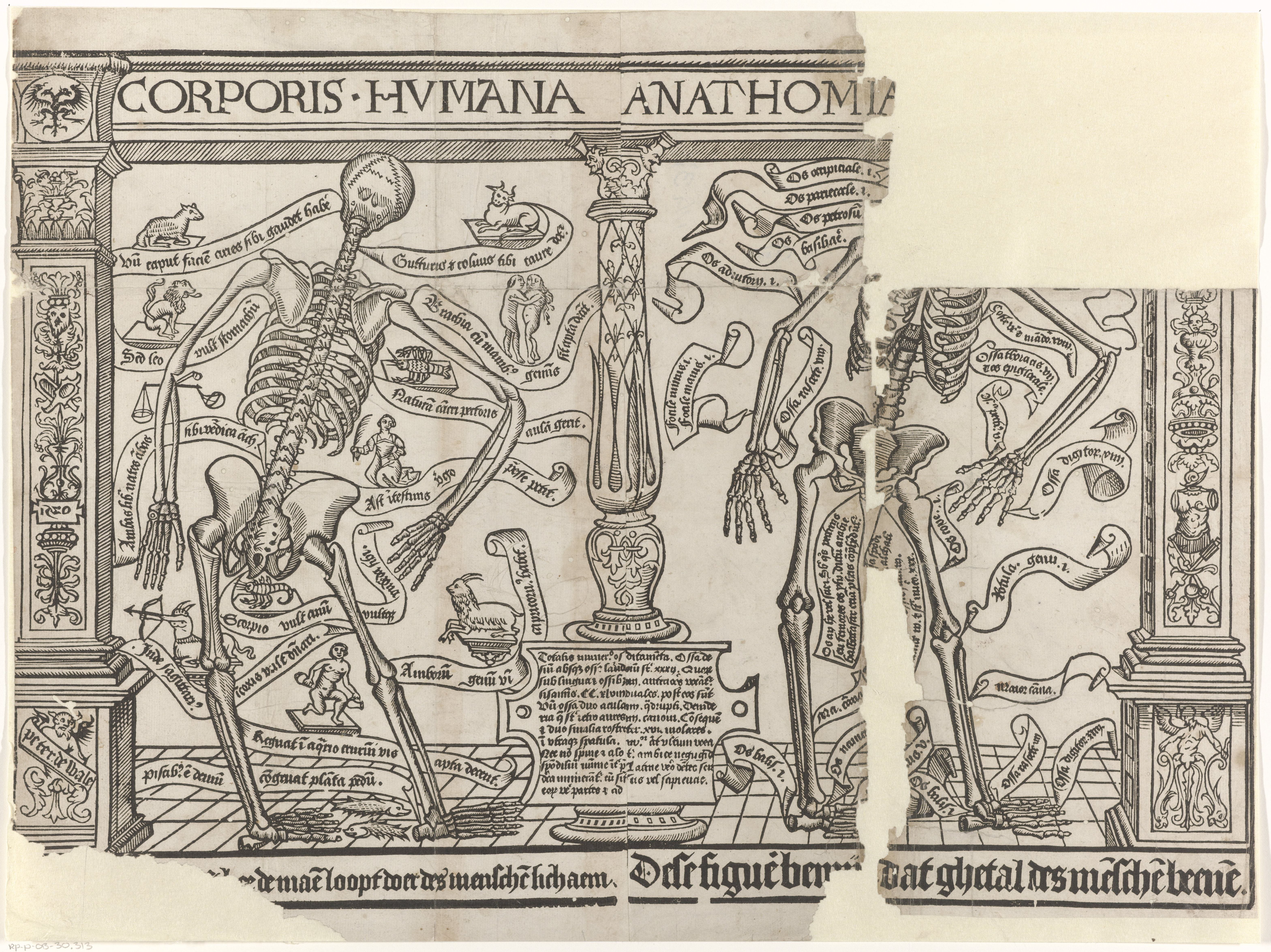
This is where my prior opinion on the matter needed quite a bit of changing. It’s nice when bodies can answer a question cleanly, and my thinking was that if the Dark Ages really were dark, bones should show something like more trauma, worse teeth, shorter statures, more signs of infection, etc, with the graves becoming the missing public health archive. But graves can’t be denominators in that way because cemeteries contain those who died, were buried in a specific way leading to preservation, who then have to be excavated, sampled, and interpreted. But burial practices change over time, and the elite are often overrepresented in burial records. Not to mention the fact that those on the margins often just disappear from the record with cremation, soil, previous excavation work in the centuries before professional archeology or anthropology, and previous bad research practices all influence what survives to today. We don’t get population registry level from the past.
There is also the problem of the osteological paradox, which I’ve discussed before in pieces on paleopathology. Lesions on a bone can mean that person was sick, but that can also mean they survived long enough for the illness or stressor to leave that trace on the bones. So, the healthy-looking skeleton without lesions may be that, healthier, but they could also have died before anything left a mark. Skeletal evidence is still useful because teeth do preserve things like childhood stress and sometimes infections while other bones preserve injuries, infections, workloads, stature, and ancient DNA when we’re lucky. We can even learn about diet, mobility, when people weaned from breast milk, and microbes through isotope analysis and dental work.
The answer, then, is not that Rome’s end left no material trace. Its fiscal, commercial, and administrative systems simplified sharply across much of the West, and that transformation is visible in many regions. But the next question is not simply whether people became poorer. It is which people, in which places, changed by which measure. This essay can show institutional and material simplification far more confidently than it can establish a blanket decline in ordinary welfare. “Dark Ages” is therefore defensible only as a description of diminished institutional visibility, not as a casual verdict on how every ordinary person lived.
Addendum, July 12, 2026
After publication, a few experts in the field generously replied to my email about the piece with two important corrections. First, the West had already fragmented along varied trajectories before the sixth-century climate and plague shocks; I had allowed those events to explain to much of what they didn’t quite explain. Second, thinner records, trade, and imperial administration do not in themselves demonstrate that ordinary people were necessarily worse off after 600. I have revised the post to distinguish institutional and economic simplification from a blanket judgment on the welfare of the 90 percent. They recommend Kim Bowes’s Surviving Rome: The Economic Lives of the Ninety Percent as essential reading on the high-imperial baseline and the lives of people outside the elite. Looking forward to reading it!
Before the Odyssey, Apollo Sent a Plague
·
Jul 26
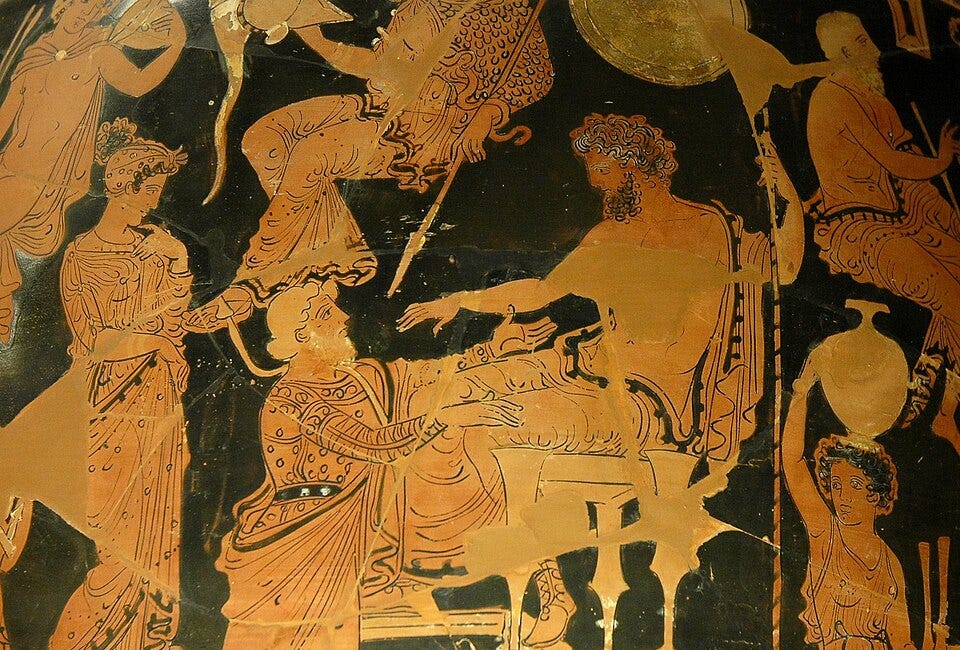
Editor’s note, July 26: After getting some feedback from a classicist who works in Homeric studies, I revised passages that could be read as implying more than the evidence allows. The Hittite and archaeological material is used here as a comparison, rather than proof of a historical Trojan War, a Bronze Age outbreak behind Book 1, or a continuous line of transmission into Homer. The revision also makes the Appaliuna/Appaluwa connection an attributed, contested proposal.
The Deaths We Can't Count
·
Jun 12
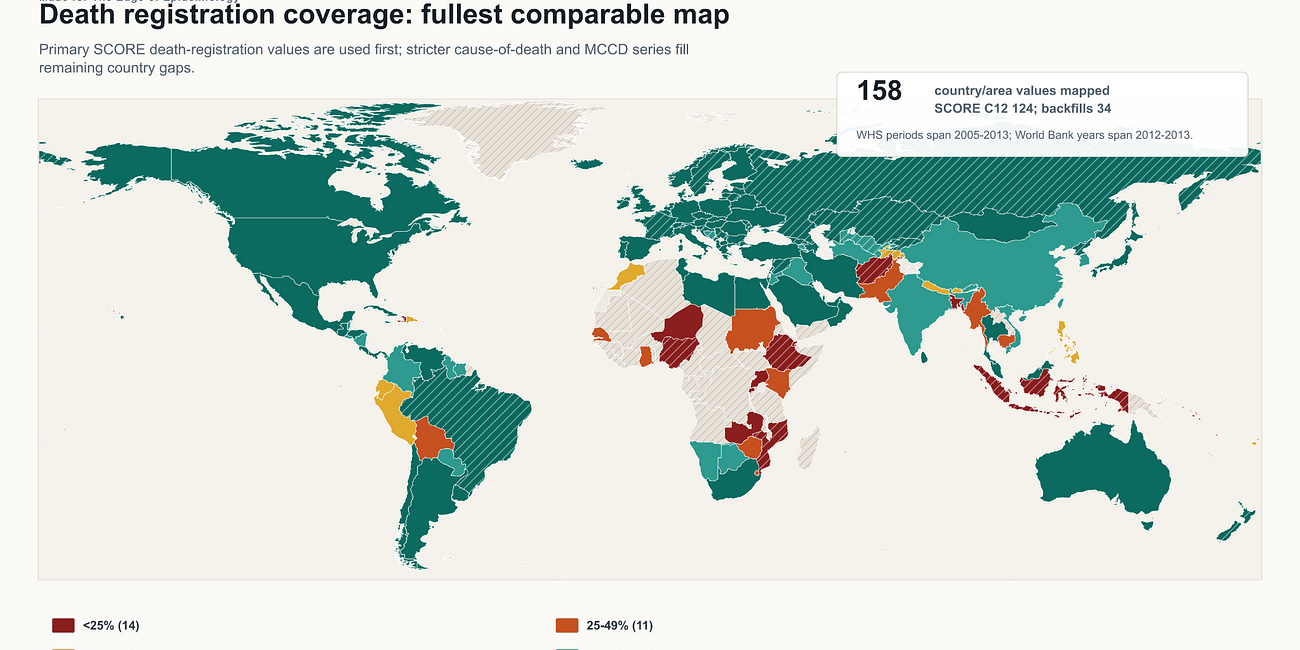
The ongoing Ebola outbreak in Central Africa had me wanting to better understand the answer to a question I hadn’t really considered beyond surface level curiosity: “how do researchers get anything resembling real-world data in the areas controlled by rebel forces?” How do they get an estimate of mortality when nobody is counting carefully?
Comments
Nothing yet. Say the first thing.
Sign in to join the conversation.