
Pressure is no longer concentrated on one front. It is converging across the battlefield, air defenses, Black Sea access and diplomacy, narrowing Kyiv’s ability to trade time for options.
Ukraine’s central problem is no longer simply whether it can hold a particular town, intercept another missile barrage or secure another tranche of Western weapons. It is whether it can continue managing all of these pressures simultaneously.
For much of the war, Kyiv could treat individual crises as discrete problems. A threatened sector could be reinforced. Air-defense shortages could be mitigated by new Western deliveries. Damage to infrastructure could be repaired. Maritime losses could be offset through alternative export routes. Political pressure could be answered with promises of another aid package.
That strategic flexibility is becoming harder to sustain.
The significance of the current phase is therefore not one Russian advance or one Ukrainian shortage. It is the convergence of battlefield pressure, depleted air defenses, vulnerable ports, industrial constraints, manpower problems and diminishing diplomatic room. Ukraine is increasingly being forced to choose which vulnerabilities it can afford to leave exposed.
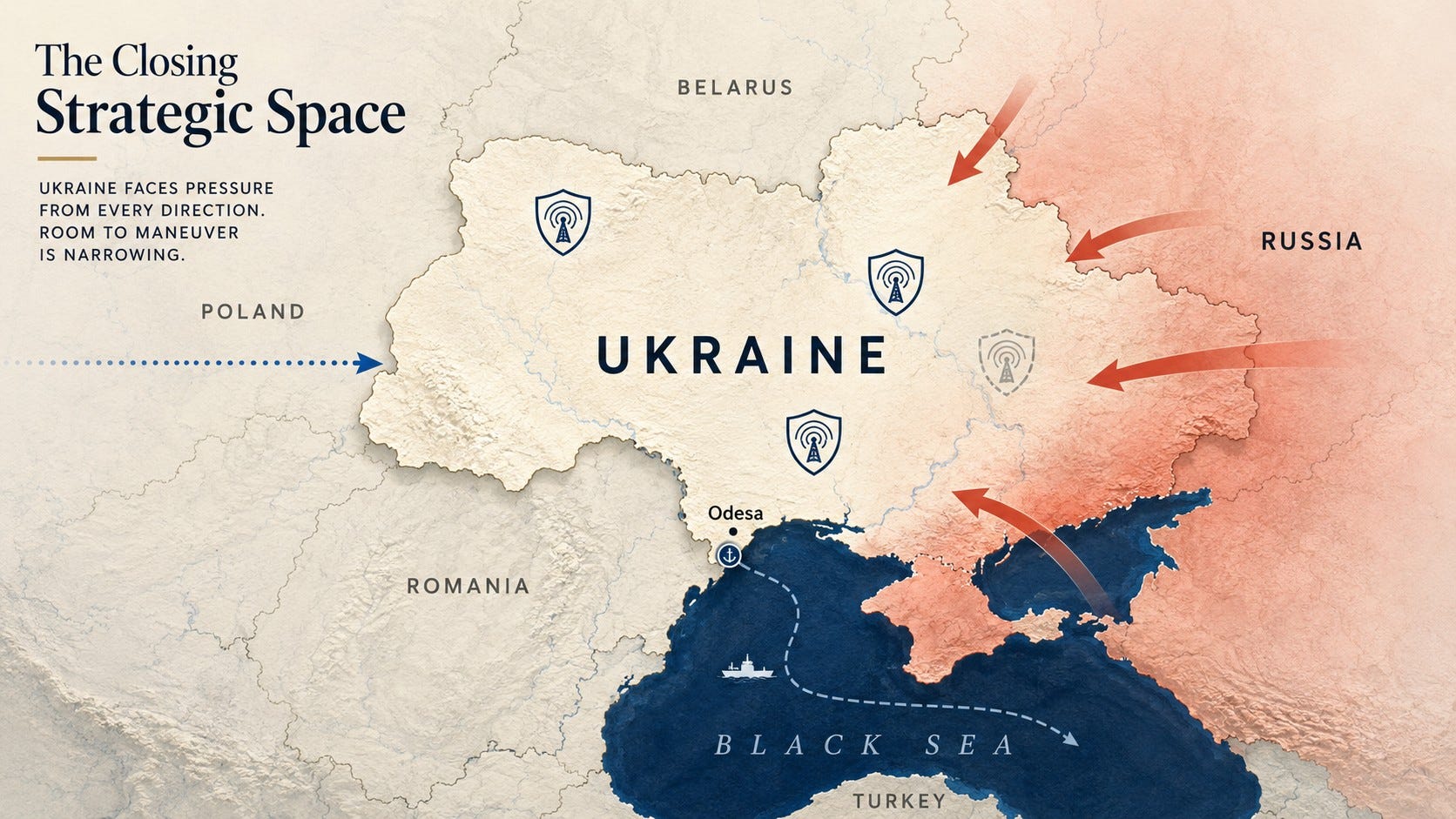
The Problem Is No Longer One Front
The reported fighting around Orekhov illustrates the problem clearly.
Russian forces have reportedly established positions inside the town after advancing through Novodanilovka. The immediate military question is whether Ukraine reinforces Orekhov or preserves the supply routes supporting the wider sector. But the strategic question is larger: how many such decisions can Ukrainian commanders make at the same time?
Pressure is also building around Dobropillya and across the Donbass defensive belt, while Slovyansk, Lyman and other positions remain under threat. None of these developments necessarily constitutes a decisive breakthrough by itself.
Together, however, they create something more difficult to manage.
Ukraine cannot concentrate reserves everywhere. Reinforcing one threatened position inevitably means accepting greater risk somewhere else. The danger is therefore less a spectacular collapse than the progressive loss of strategic elasticity: a battlefield in which increasingly scarce reserves are repeatedly moved to contain problems rather than shape events.
Orekhov carries additional significance because it served as an important base for Ukraine’s 2023 offensive toward the Sea of Azov. A position once associated with Ukrainian attempts to break Russian defenses is now itself under pressure. That reversal captures the changing military geometry of the war.
Air Defense Becomes Strategy
The same compression is visible in the air.
Ukraine continues launching drones and long-range weapons against Russian territory, but the reported interception rates raise questions about the cost of sustaining that campaign. The Flamingo missile, presented as an important new capability, is reportedly encountering Russia’s layered detection and interception network.
At the same time, Ukraine’s own air-defense position is deteriorating.
The shortage of Patriot interceptors is particularly significant because it cannot be solved merely by political declarations. Patriot missiles depend on specialized industrial capacity, supply chains and technical knowledge that Ukraine cannot rapidly reproduce domestically.
That transforms an ammunition shortage into a strategic constraint.
President Volodymyr Zelensky’s appeal for a substantially larger share of American Patriot stocks points to the scale of the problem ahead of winter. If Russia continues targeting electricity generation and other infrastructure while Ukrainian interceptor stocks remain limited, Kyiv will increasingly have to decide what deserves protection.
Cities, power infrastructure, military logistics and frontline formations compete for the same defensive resources.
The contest is therefore becoming one of allocation as much as firepower.
The Black Sea Returns to the Center
Ukraine’s southern vulnerability extends beyond the land front.
Russian strikes against Odesa and other Black Sea infrastructure, discussion of tighter maritime restrictions and attacks involving commercial shipping are returning the Black Sea to the center of the war.
For Ukraine, access to the sea is not simply a naval question. It is economic infrastructure, export capacity and strategic depth.
The reported attack on a Greek-operated tanker near Novorossiysk also illustrates the political complications surrounding Ukraine’s long-range campaign. American commercial interests are connected to energy infrastructure in the region, meaning Ukrainian operations can increasingly intersect with the interests of the governments providing Kyiv with military support.
That creates another constraint.
Ukraine needs Western assistance to sustain the war, but its operational priorities do not always coincide perfectly with those of its sponsors.
Politics Lags the Battlefield
This widening military pressure is emerging just as European governments attempt to secure a role in any future negotiations.
France, Germany and Britain reportedly want a common position capable of ensuring European participation should Washington reopen a diplomatic channel with Moscow. Yet Moscow continues to reject the political premises on which European involvement would rest.
The contradiction is difficult to avoid.
European governments want influence over the terms of a settlement while remaining committed to a war strategy whose military assumptions are becoming harder to reconcile with developments on the ground.
The political temptation will be to describe the battlefield as essentially static until diplomacy can be conducted from a stronger position. But if Ukrainian defenses are gradually becoming more difficult to sustain across several domains at once, time may not be politically neutral.
That is why the argument over whether the war has reached a “stalemate” matters.
A stalemate implies stability. The emerging picture is instead one of accumulating imbalance.
When Options Narrow
Ukraine still possesses substantial military capabilities. It can strike targets deep inside Russia, defend important sectors and impose costs. Western support remains significant.
But strategic position is measured not only by what a state can still do. It is measured by the range of choices it retains.
That range appears to be narrowing.
The battlefield demands reinforcements. The cities need air defense. The energy system needs protection. The Black Sea requires security. Long-range operations consume resources. Western governments impose political constraints even as Kyiv depends on them for weapons and finance.
Each problem can be managed individually.
The danger is that they can no longer all be managed at once.
Wars often turn not when one side suddenly loses the ability to fight, but when it loses the ability to choose where, when and under what conditions it must respond. That is the deeper significance of the pressure now building around Ukraine.
The strategic contest is increasingly about who still possesses room for maneuver—and who is being forced to spend it.
Please share with your friends, leave a comment, and subscribe!
Thank You for Supporting The Duran!
No posts
Comments
Nothing yet. Say the first thing.
Sign in to join the conversation.