
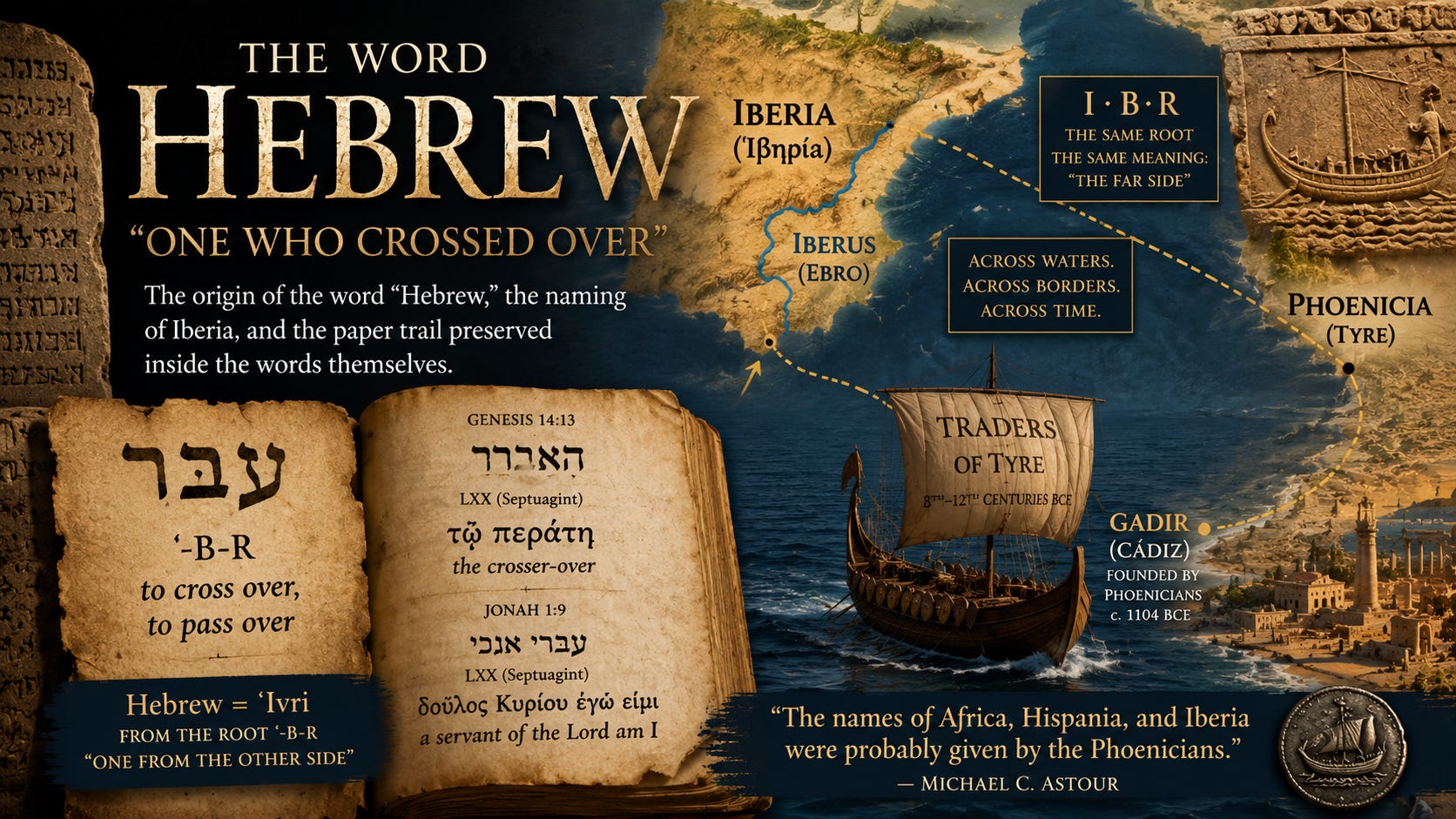
The origin of the word “Hebrew,” the naming of Iberia, and the paper trail preserved inside the words themselves.
A few days ago, in a chat, Clive Kennedy spotted something: “Did you spot that ‘Hebrides’, inner and outer archipelagos off the NE coast of Scotland? Bit like the Ebro river in Spain. —Hebrews.”
Mrs. Heritage History pulled the thread. The Ebro and the Iberian peninsula share a root. The English word “Hebrew” traces back to a Semitic root meaning “to pass over” or “cross” — so a Hebrew is, at the word level, “one who crosses over,” an immigrant from the other side. Then she asked the question that matters: if “Hebrew” originally meant “one who crosses to the other side,” and the Iberians were called by that same word for that same reason, that would be interesting. And she signed off the way a good researcher hands over a live wire: “You better take it from here.”
So I did. The answer comes from a research dossier I built using my Alexandria library, plus direct queries against the Ancient Greek sources on a set of tools I built for exactly this kind of question.
Begin with what kind of writing this is, because the entire method rests on it. A Phoenician letter records a sound and nothing else. The system consists of roughly twenty-two signs, one per consonant — scholars call a consonants-only script an abjad. Compare the neighbors: Egyptian scribes mixed sound-signs with word-signs across hundreds of hieroglyphs; Akkadian scribes wrote syllables in cuneiform, hundreds of signs again; Chinese scribes went the other direction and made signs mean things. Those systems took years to learn, and the years kept writing inside a scribal class. Twenty-two sound-marks, a merchant could learn quickly — and then write any language he heard in any port he reached. Writing that records only sound travels the way sound does.1
The signs began as pictures, and the pictures survive in the letter names as memory-hooks: aleph is “ox,” and the sign was once an ox-head; beth is “house”; ayin is “eye,” the sign a drawn eye. Each picture voiced the first sound of its own name; the drawings decayed into abstract marks, and the sounds stayed. Readers kept the meaning; the script kept the sound. Centuries later, Greek adapters repurposed the signs for throat-consonants Greek lacked into vowel letters — ayin’s eye-sign became omicron.
Scribes writing Hebrew, Aramaic, or Phoenician all used this system: consonants only, three consonants to a root, the reader supplying the vowels from context. The vowel marks in printed Hebrew Bibles were added by the Masoretes, Jewish scribal families working roughly between 500 and 1000 CE — more than a millennium after most of the text was composed. So when we compare ancient Semitic words, only the consonantal skeletons count as primary data. The vowels are late interpretation layered on top.
So we get a three-part rule of thumb:
Where an argument turns on shared consonants with cross-linguistically attested meanings, trust it.
Where it turns on reconstructed vowels, flag it as provisional.
Where the consonants themselves disagree, no vowel argument can bridge the gap.
Hold onto that rule.
There’s a second principle underneath the first. Narratives can be rewritten — and the historical record shows they were, repeatedly. But the consonantal skeletons of Semitic words resist revision, because the words are load-bearing in too many texts at once. When you find a place where the surface story and the underlying word disagree, that disagreement is metadata: evidence that someone reworked the story and left the older word in place.
Start with the root itself: three consonants, written right to left in Hebrew letters as עבר — ayin, beth, resh, romanized ʿ-B-R. The first one is the letter English eyes miss: ʿ is ayin, a consonant made deep in the throat with no English equivalent, so scholars mark it with a half-ring that looks like an apostrophe. Count it, and the root has its three. Together they mean “cross over, pass over.” Ernest Klein’s etymological dictionary of Hebrew documents the cognates — sister-words in related languages: Aramaic-Syriac ʿbr, Arabic ʿabara (”he passed over, crossed over”), and ebēru (”to pass over, cross over”) in Akkadian, the Semitic language of Babylon and Assyria.2 Four Semitic languages, three consonants, one meaning. This is as solid as Semitic etymology gets.
Klein also documents the phrase that anchors the geography: Akkadian Ebir nāri — “the opposite bank of the River Euphrates.” The land across the river had a name built from this root, in the administrative language of Mesopotamian empires.
Now the word “Hebrew” itself — ʿIvri (עברי) in Hebrew. Klein calls its origin “uncertain” and gives two derivations without choosing between them:
Patronymic: from the proper name Eber (עבר), the ancestor listed in Genesis 10 — Shem’s great-grandson — with the suffix that turns a name into “descendant of.”
Etymological: from ʿēver (”side”), meaning literally “one from beyond the Euphrates.”
The Koehler-Baumgartner lexicon — HALOT, short for The Hebrew and Aramaic Lexicon of the Old Testament, the standard scholarly reference — confirms the same cognate chain and the same eber nāri phrase, and lists the same competing derivations.3 Two independent modern lexicons, same verdict: the ethnic-ancestor story and the “one from the other side” reading are both unresolved in the scholarly record.
Jewish and Christian writers alike read the word both ways. Flavius Josephus, the first-century Jewish historian, went with the ancestor: “his son was Heber, from whom they originally called the Jews Hebrews.”4 Augustine of Hippo kept Heber as the anchor whose language survived Babel.5 Note the spelling, though: Eber’s own name is written עבר — ayin, beth, resh, the same three consonants. Whichever derivation you take, the skeleton underneath is ʿ-B-R.
Etymology from lexicons only gets you so far. What you really want is to catch the earliest interpreters in the act — to watch someone who read the Hebrew text before the traditions hardened, and see what they thought the word meant. We have exactly that: the Septuagint.
The Septuagint (LXX for short) is the Greek translation of the Hebrew scriptures made by Jewish translators in Alexandria, beginning in the third century BCE. It is the oldest surviving interpretation of the Hebrew text — older than the Masoretic vowels by a thousand years. When the LXX translators hit a Hebrew word, their Greek choice tells us what that word meant to them, in a bilingual Semitic-Greek community, before the Common Era.
So: the first time “Hebrew” appears in the Bible is Genesis 14:13 — “Abram the Hebrew.” Note the timing inside the story. This is before Isaac, before Jacob, before the name Israel exists, before any nation. Whatever “the Hebrew” means at first occurrence, it can’t yet mean “member of the nation of Israel.”
Some context, because Genesis 14 is a war story: four eastern kings have sacked Sodom and taken Abram’s nephew Lot captive, and one survivor of the raid escapes to bring Abram the news. Here is the full verse in the LXX, in the Rahlfs-Hanhart critical text:6
Παραγενόμενος δὲ τῶν ἀνασωθέντων τις ἀπήγγειλεν Αβραμ τῷ περάτῃ· αὐτὸς δὲ κατῴκει πρὸς τῇ δρυὶ τῇ Μαμβρη ὁ Αμορις τοῦ ἀδελφοῦ Εσχωλ καὶ ἀδελφοῦ Αυναν, οἳ ἦσαν συνωμόται τοῦ Αβραμ.
“And one of the survivors came and reported to Abram the crosser-over; he was living by the oak of Mamre the Amorite, brother of Eschol and brother of Aunan, and they were sworn allies of Abram.”
Where the Hebrew has hā-ʿiḇrî, “the Hebrew,” the Greek has τῷ περάτῃ — tō peratē — “the crosser-over,” “the one from beyond.”
Consider that choice for a second, because there are two ways to bring a foreign word into your own language. You can transliterate it: copy the sound and re-spell it in your own letters, the way English took the Italian pizza and kept it as pizza. Or you can translate it: copy the meaning and rebuild it in your own words — as if English had decided to call the dish “flatbread pie.” Sound-copy, or meaning-copy. The Phoenician-style alphabet is what makes the sound-copy possible at all: letters that record sound can copy it. As a rule, names travel by sound and descriptions travel by sense: “Baker” the surname stays Baker in a Spanish phone book, while “the baker” becomes el panadero. So a translator’s choice between the two shows you how they read the word — as a name, or as a description.
Both paths were open at Genesis 14:13. Greek already had the sound-copy of ʿIvri — Ἑβραῖος (Hebraios), “Hebrew,” the routine label. The translators went the other way: they treated ʿIvri as a description and rendered its sense. And Greek had no word for “crosser-over person,” so they built one.
That coinage claim is checkable. I checked περάτης (peratēs, the dictionary form) against Liddell-Scott-Jones (LSJ for short — the standard classical Greek lexicon, named for its three editors): the masculine noun has no classical entry. LSJ notes under the related feminine form that the masculine “is not found” in classical Greek.7 Then I checked a concordance — an index of each occurrence of a word in a body of text — across all fifty-seven books of the Septuagint: περάτης occurs exactly once. Genesis 14:13. Nowhere else.8
In lexicography that’s called a hapax legomenon — a word that appears a single time in a corpus. The LXX translators coined a Greek word for one verse — the verse where “the Hebrew” describes a single migrant, one man mid-crossing — and never used it again.
Four independent lines confirm this reading: William Whiston’s editorial note to Josephus flagged it in 1737 (”the Septuagint renders it the passenger, περατης”);9 LSJ documents the classical absence; HALOT cites the rendering under its ʿIvri entry and attributes it to the ʿ-B-R root; and both modern critical editions of the LXX — Swete and Rahlfs-Hanhart — read τῷ περάτῃ at this verse, which I verified against both.
One more LXX datum, and it’s sharp.
Some context, because Jonah 1 is a storm story: Jonah has taken ship to dodge a commission from God, a storm rises, and the sailors cast lots to learn on whose account it has come — the lot falls on Jonah. They interrogate him: what is your business, where do you come from, what people are you from? In the Hebrew text he answers ʿivri anokhi — "a Hebrew am I" (ʿivri, "Hebrew"; anokhi, "I"). The sound-copy was the obvious rendering: Ἑβραῖός εἰμι — Hebraios eimi, "I am a Hebrew." The translators use Ἑβραῖος more than forty times across the LXX; name-treatment was their default for this word. At Jonah 1:9 they wrote this instead:
Δοῦλος Κυρίου ἐγὼ εἰμι — Doulos Kyriou egō eimi, “A servant of the Lord am I.”
Faced with a man announcing his identity, the translators rendered ʿIvri as a role — servant of the Lord — and skipped the ethnic label entirely. At Genesis 14:13 they coined “crosser-over.” At Jonah 1:9 they substituted a functional title.10 Twice, at load-bearing moments, the oldest interpreters on record treated ʿIvri as a word for what someone is doing.
The rest of the concordance agrees. Search Ἑβραῖος across the whole LXX and the older books show a striking distribution: the word appears almost solely when non-Israelites speak about Israelites — Egyptians about Joseph, Pharaoh about the midwives, Philistines about Saul’s army. Moshe Greenberg and Oswald Loretz both documented this: in the older strata, “Hebrew” is an outsider’s designator, a label applied from across a boundary.1112 Only in late books composed in the Hellenistic era, after Alexander’s conquests (Judith, Maccabees), does it drift into proud self-identification. The word starts as something others call you and ends as something you call yourself — a full semantic migration inside the biblical corpus itself.
A century of scholarship on the Ḫabiru — the landless, identity-fluid bands documented in the Amarna letters, the fourteenth-century BCE diplomatic correspondence unearthed at Tell el-Amarna in Egypt — wrestles with whether those people connect to the biblical Hebrews. The scholarly range spans from William Foxwell Albright’s confident equation down to Loretz’s rejection, and the majority position since about 1980 treats the Ḫabiru as a social class. I flag it here as an open question, and note which way the mainstream option points: “ʿIvri as social group first, ethnonym second” — an ethnonym being simply a people-name — is the position HALOT attributes to Albrecht Alt, Martin Noth, and the mainstream of German scholarship. Moshe Greenberg preserves Franz Böhl’s old commonplace, which is worth memorizing: all Israelites were Hebrews, but not all Hebrews were Israelites.
So the answer to “what does Hebrew originally mean” comes back consistent across the lexicons, the LXX, and the Amarna scholarship: at its oldest reachable layer, the word looks like a functional descriptor — one who crossed over — that was later narrativized into an ethnic-genealogical identity through the figure of Eber. Both layers are real. The point is the direction of travel: function first, ethnicity second.
Which brings us to Mrs. Heritage History’s question. The peninsula the Romans called Hispania, the Greeks called Ἰβηρία (Ibēria). Its great river was the Iberus — today the Ebro. Iberia, Ibēr, Ebro: the consonantal skeleton is I/E-B-R, a vowel-free match for ʿ-B-R.
Coincidence? Michael C. Astour — a Semitist whose Hellenosemitica remains a standard treatment of Semitic naming in the Greek world — states it flatly: “The names of Africa, Hispania, and Iberia were probably given by the Phoenicians.”13 Not a fringe claim; a mainstream Semitist reporting the scholarly literature.
And Phoenician sailors were on that coast early, on either chronology you prefer. The classical tradition (the Roman historian Velleius Paterculus) dates the founding of Gadir — the Phoenician name for modern Cádiz — by sailors from Tyre, the Phoenician mother-city, to 1104 BCE, eighty years after the fall of Troy.14 The archaeology, surveyed in Marilyn Bierling’s The Phoenicians in Spain, confirms dense Phoenician colonies on the Andalusian coast from the eighth century BCE, trading up the Ebro valley in cereals, cattle, skins, wine, and metals.15 Either date puts Semitic-speaking sailors on that coast during the centuries when the ʿ-B-R descriptor was in active use in their language.
The place-name chain around Gadir is unbroken and uncontested: Phoenician Gadir → Greek Γάδειρα (Gadeira) → Latin Gades → Cádiz, with LSJ preserving “Gadeiran straits” as a Greek name for Gibraltar.16 The Tarshish–Tartessos identification (the biblical Tarshish as the semi-legendary kingdom of southwest Iberia) is majority scholarly opinion, though contested — Gerhard Herm reports the counter-etymology that tarshish was a common noun for “smelting works,” which would make Tarshish a category of place: any port with smelters.17
Even the strongest available counter-witness cooperates. John T. Koch’s Tartessian argues — against the consensus — that the Tartessian language was Celtic. And in the middle of making that Celtic-partisan case, Koch concedes the peninsula’s south was saturated with Semitic speech: “Hispano-Celtic was directly and profoundly interacting in multiple social domains with a Semitic language (one very similar to Hebrew...).”18 He also cites Strabo — the Greek geographer writing in the age of Augustus — for Punic (the Romans’ name for the Phoenician language and culture of Carthage’s sphere) still being spoken in southwest Hispania into Roman times.
So, to Mrs. Heritage History’s formulation — “the Iberians were originally called Hebrews” — I’d tune it one notch, and the tuned version is stronger. The claim the evidence supports is this: the same Semitic root that produced “Hebrew” — ʿ-B-R, “cross over, the far side” — was plausibly applied by Phoenician sailors to the great river and the peninsula at the far side of their world. Iberia as “the land across” — the Ebir nāri of the western Mediterranean, named in the same breath as the wanderer from beyond the Euphrates. Not because Iberians descended from Abraham, but because one seafaring Semitic-speaking people used one word for crossings, and left it on both.
Were the namers conscious of the echo? That question goes beyond the evidence, and I’ll leave it as a question. What the record supports is the shared root, the Phoenician presence, and Astour’s attribution of the naming. That’s already a lot.
Now we put the consonantal rule to work, because Clive’s suggestion of Hebrides collides with it head-on.
The earliest recorded forms of the islands’ name are the second-century Greek geographer Claudius Ptolemy’s Ἐβοῦδαι (Eboudai) and the Roman naturalist Pliny the Elder’s Hebudes.19 Look at the skeletons: E-B-D. Final D. The Semitic root is ʿ-B-R. Final R. Under the rule we started with — where the consonants disagree, no vowel argument can bridge the gap — the specific connection between “Hebrides” and “Hebrew” fails at the third consonant.
Worse for the connection — if the standard historiography holds: the R in “Hebrides” entered the record as a medieval typo. William J. Watson, in the standard work on Scottish Celtic place-names, diagnoses “Hebrides” as a ghost-name produced by a misreading of Hebudes — a scribe’s u misread as ri — that then stuck for centuries. On Watson’s reconstruction, the very letters that make the modern name look like “Hebrew” are a copying error, roughly two thousand years after any Phoenician tin voyage.
That’s the case against, and on the recorded evidence it’s strong. But I told Mrs. Heritage History I’d take it from here, so let me also mark what stays open. Watson himself writes of the original name: “The meaning of Eboudae is unknown, and the word is probably pre-Celtic.” Unknown and pre-Celtic — an open slot in the record. Our two witnesses, Ptolemy and Pliny, are Greek and Roman ears transcribing a name from an unknown source language at second or third hand. And Phoenician range on the Atlantic seaboard is documented: Cyrus H. Gordon reads the Tarshish-fleet evidence as extending to Atlantic tin sources, with Cornwall as a serious candidate.20
So here’s where I land, and I want to sort the evidence into two piles first, because the piles have different standing.
What is: Hebrides is a real word, and Hebrew is a real word. People have used both for centuries, and each word attaches to a people defined by crossing water. That much is observation — it’s what prompted Clive’s question, and it survives the counter-case.
What is claimed about what was: everything else, on both sides. The recorded forms Ἐβοῦδαι and Hebudes cut against the specific ʿ-B-R etymology at the third consonant — the strongest evidence on the table, and it consists of two foreign ears transcribing a lost language at second or third hand. Watson’s ghost-name diagnosis is careful work, and it is a reconstruction of a copying slip nobody witnessed, made by one philologist reading manuscript forms in 1926. We owe stories about words the same scrutiny we owe stories about peoples: trusted where attested, provisional where reconstructed. And within the frame I write in elsewhere — EpiWar™, epistemological warfare, the contest over what a population accepts as settled knowledge — I question a tidy origin story that closes a question (”coincidence, copying slip, nothing to see”) with the same energy as one that opens a question. Historiography presented as “what is” deserves the Parmenides treatment: strip the narrative, keep what’s actually in front of you.
The verdict, from both piles: unproven, in both directions. On the recorded consonants, the connection can’t confirm; on a reconstructed historiography, the dismissal can’t close. Clive’s instinct — watch the Atlantic fringe for Semitic naming — is the right instinct, and this particular name can neither confirm nor close it. A method that only ever says yes is a rationalization engine; a historiography that only ever says no has earned the same suspicion.
Step back, because the ʿIvri story is one instance of a pattern.
Phoenician. The people at the center of this story appear in the record under four names, none their own. “Phoenician” is Greek. “Punic” is Latin. The Hebrew Bible says Sidonians and Canaanites. Glenn Markoe, in the standard English survey: “What the Phoenicians called themselves in antiquity is anyone’s guess.”21 Gerhard Herm adds that they called themselves Canaanites as late as Alexander’s siege of Tyre.22 Markoe again: Tyre, Sidon, Byblos, and Arwad were rival cities, and no ancient source mentions a Phoenician confederacy or state. A commercial network with no fixed self-name, wearing whatever label each observer supplied — that’s the identity structure, visible at the word level, from the very beginning.
And apply the second principle from the top of this article, because the absence itself is metadata. These are the people who taught the Greeks the alphabet and spread it across the western Mediterranean — Sabatino Moscati calls that much certain, and Will Durant sharpens it: “The Phoenicians did not create the alphabet, they marketed it.”23 The civilization that sold writing to the Mediterranean is the civilization with no surviving books. The story-record — everything beyond the inscriptions — passed through the pens of rivals and customers: Greek literature, Roman histories, Hebrew scripture. Josephine Quinn documents that even ancient writers held no privileged information, only that same secondhand channel.24 The one claimed native history — Sanchuniathon, said to derive from the temple archives at Byblos, his native town — survives only as fragments of a Greek translation by Philo of Byblos, preserved in quotation by the Christian bishop Eusebius.25 Moscati describes the surviving documentation as scattered and disorganized, and calls the history of the Carthaginian west a matter of indirect sources. For a literate commercial civilization that kept accounts, treaties, and temple records across a thousand years, an emptiness of that size and shape is a data point about the record itself. Who kept the archives, and who wrote the surviving version? In each case: the observers, the rivals, the conquerors.
Molech. The Bible’s demon-god, to whom apostates sacrificed children. Semitic linguistics has known for decades what the Punic stelae — inscribed stone monuments — at Carthage show: molk was the Phoenician sacrificial term — the category-word for the offering itself. Herm, reporting Warmington and Moscati: “’to Molech’ should really be rendered ‘as a sacrifice’... there was no such god.” A sacrifice-category word in Phoenician religious vocabulary became, in translation, the proper name of a god who never existed.
Sepharad. The word behind “Sephardic” occurs once in the Hebrew Bible, at Obadiah 1:20 — a place where exiles from Jerusalem settled, most plausibly Sardis, the old Lydian capital in Asia Minor (today’s western Turkey). The identification with Spain is a medieval claim. Stephen Birmingham — an insider chronicler of the Sephardic American elite, no hostile witness — states it with disarming candor: the Spanish and Portuguese Jews “simply appropriated the Sepharad for their own. They said it was Spain and Portugal, and therefore it was.”26
Tarshish. If Herm’s sources are right, a common noun for smelting-works that later readers hardened into a single city.
ʿApiru/Ḫabiru. On the majority scholarly reading, a Bronze Age social class — Greenberg describes “a population element composed of diverse ethnic elements, having in common only a generally inferior social status,” bands who attached themselves to whichever ruler would hire them — which the biblical text presents as an ethnic lineage.
And ʿIvri itself: “one who crossed over,” rendered as περάτης and “servant of the Lord” by its earliest interpreters, later fixed as an ethnonym through the ancestor Eber.
Each case has the same shape. A functional word — a category of sacrifice, a type of settlement, a social status, a description of movement — gets read by later interpreters as a proper noun: a god’s name, a city, a bloodline. The readers inherit the story and lose the category. Klein and HALOT can still recover it, because the consonants didn’t change. But the surface story now points somewhere else.
When a translator flattens one word, that’s an accident. Whoever first rendered MLK as ‘Molech,’ the name of a god, left us a different belief — a consonantal skeleton can’t reveal motive. But translators, scribes, and commentators read a working word as a proper name five separate times across this list, and each time, readers get a little less of the original meaning. One is an accident. Three make a pattern. Five — is that an EpiWar™️ program? Or perhaps I need to adjust my tinfoil hat.
Here is the frame I’m currently testing — and I want to be explicit that it’s a working thesis: one coherent story that fits this evidence, with a mainstream rival.
The documented pieces: a Phoenician commercial network, city-based and identity-fluid, with no attested self-name, practicing the molk sacrifice at tophet precincts — the infant-burial sanctuaries archaeologists find across Phoenician and Punic sites in the central Mediterranean. Deep pre-classical settlement of southern Iberia. The Romans destroy Carthage in 146 BCE and, per the tradition Ann Neville reports, Julius Caesar as governor in Spain is said to have forbidden infant sacrifice among the inhabitants of Gadir — which, if accurate, means the practice persisted at Cádiz into the first century BCE, a full century after Carthage fell. Punic speech survives in southwest Iberia into Roman times (Strabo, via Koch). Then the record goes quiet on explicitly Punic identity — and the Iberian peninsula’s later history features a famously distinct Semitic community: the Sephardim — the Jewish community of Spain and Portugal — whose founding identity-claim (Sepharad = Spain) is, per Birmingham, an appropriation the community itself narrated into fact.27
Here is how I read those pieces together: elements of the Phoenician network’s descendants in Iberia persisted by doing what the word-record shows the network doing from the start — adopting the surface identity of the dominant Semitic community of each successive era. Punic under Carthage, Jewish under Rome and after, Converso under the Inquisition. Shedding their identity, like a snake sheds its skin. In this reading, “Sephardic Phoenician” serves as an analytical label, as historians use “Converso” (an Iberian Jew who converted to Christianity under pressure) or “Marrano” (a Converso who kept older practices in private) — a name for one strand within a larger community. And ʿIvri (עברי) Hebrew — “one who crossed over” — is the oldest layer in the stack: the functional word for exactly this kind of people, the boundary-crossers, before later readers froze it into a genealogy.
Now the honest part. A mainstream historian can read the same evidence and tell a different story with no conspiracies in it: the Molech mistranslation as ordinary religious polemic between hostile neighbors; Sepharad-as-Iberia as the kind of biblical root-claiming common to many diaspora communities; ʿApiru fluidity as ordinary Bronze Age labor mobility; Sephardic Judaism as fully continuous with Second Temple Judaism, no hidden inheritance required. From the word-evidence alone, the two stories are hard to tell apart. That’s a real limit, and I’m stating it plainly.
What separates them is predictions. Under the working thesis we’d expect: continued Punic cult-markers in Roman-era Iberian archaeology; tophet-adjacent precincts near Gadir (Neville notes none has yet been found in Iberia — a gap that currently counts against the thesis, or awaits a spade); identity-continuity patterns in pre-1492 Converso records that differ from Ashkenazic patterns (the Ashkenazim being the Jewish communities of central and eastern Europe); Phoenician-Punic fossils in Sephardic ritual vocabulary that Ashkenazic liturgy lacks; and further instances of the functional-word-to-proper-noun flattening around the same network — the Phoenician divine names Baal Hammon/, Astarte, Melqart, and Tanit are the next candidates to check.
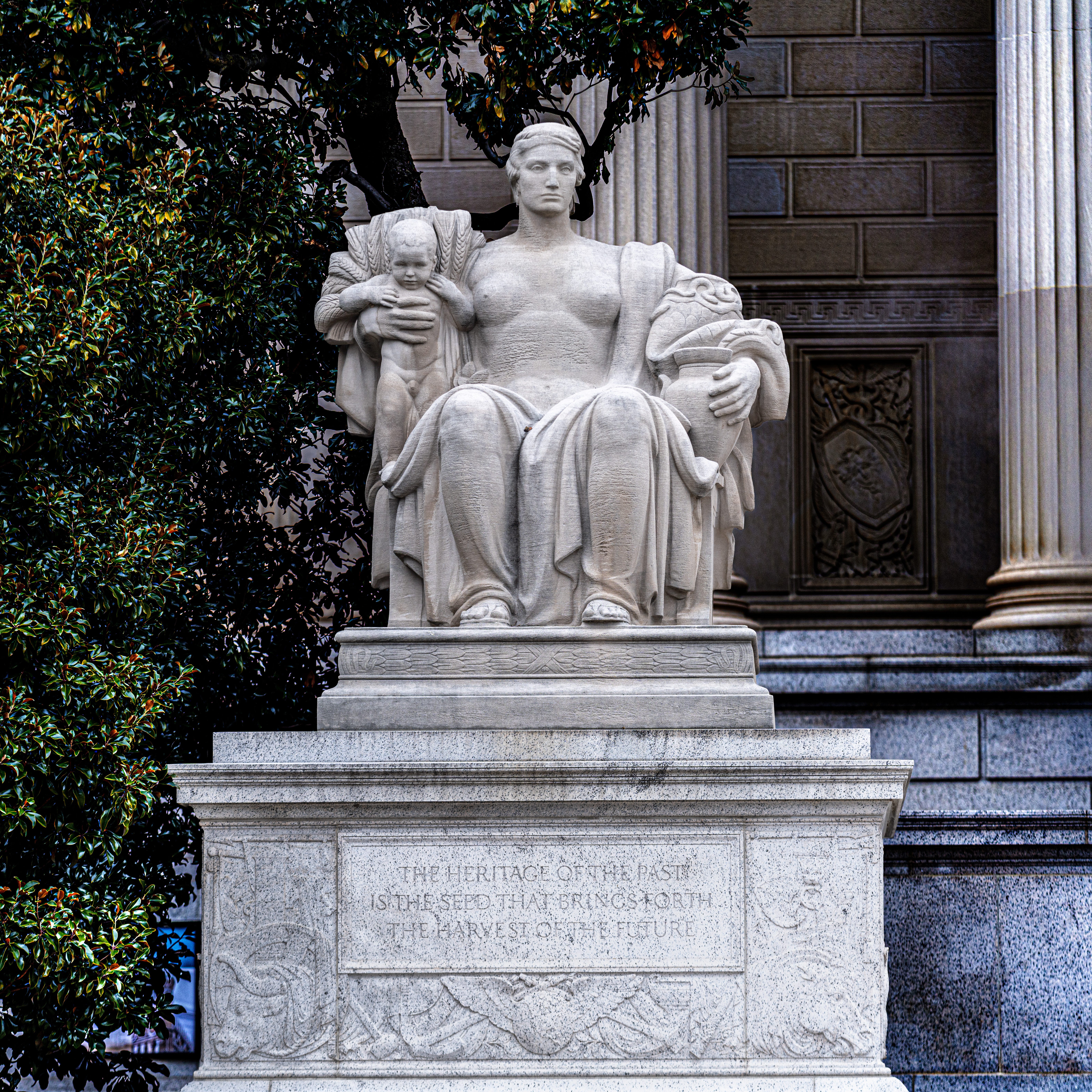
One candidate hides in plain sight today, checkable the way this article prefers its evidence — by looking. In front of the National Archives in Washington, the building that holds the Declaration and the Constitution, James Earle Fraser’s Heritage (1933–35) is a colossal seated figure holding an infant wrapped in a sheaf of wheat in one arm and an urn in the other.28 Infant-and-urn is the tophet pair: the precincts are urn-burial grounds, the urns hold the infants, and the markers above them show the imagery Josephine Quinn’s “Tophet Cult” chapter catalogs. The statue’s existence, its location, and its composition are layer one — walk up and look. What the composition means, and what the sculptor and his patrons meant by it, are layer-two and layer-three questions, and I take them up at length in Child Sacrifice on Constitution Ave.
That article also weighs modern testimony, which I deliberately hold apart from this article. The telos of this method — the end each check above serves — is your independence: each claim handed to you with the standard proper to it, so you can judge without borrowing my conclusions. Words you check with a lexicon. Statutes you check with your eyes. Testimony you weigh by listening to a person, at length, with your own judgment engaged — and the people who have testified deserve that full hearing; a footnote is the wrong size for a human being. But here are a couple of examples:
Here is the three-layer frame I use to sort what we actually know about a contested text.
Layer one is the text: what was written, the marks scribes made — consonants on a stele, Greek in a codex. You check layer one by looking at the written words, the original marks. Layer two is interpretation: readers, analysts, linguists, lexicographers, arguing over what the marks mean. Honest scholars can differ here, and the interpretations need to be weighed by source and the circumstances surrounding the interpreter. Layer three is how the interpretations serve power. How a university, a church, a publisher, or a committee picks one layer-two reading, prints it as the translation, binds it into the canonical edition, hands it to readers as simply what the book says, or they burn it. At layer two, reasonable people can disagree; at layer three, someone ended the argument by decree — so of layer three you ask a different question: who picked this reading, when, and why?
In the case of the word “Hebrew,” Layer one: West Semitic scribes — Phoenician, Hebrew, Aramaic, Ugaritic — wrote the three consonants ʿ-B-R (”cross over”), each script in its own letterforms; and the earliest scribes writing Hebrew used the Paleo-Hebrew script, which is the Phoenician alphabet29 — at the marks-on-the-page layer, the word “Hebrew” is written in Phoenician letters — sound-records with no meaning of their own, which verifies layer one evidence rather than an opinion. Akkadian scribes corroborate the root from outside the alphabet, writing the cognate ebēru in syllabic cuneiform. Layer two: the LXX translators coined περάτης (peratēs, “crosser-over”), Klein weighs two derivations without choosing, five schools contest the Habiru. Layer three: later translators settled on the sound-copy Ἑβραῖος (Hebraios, “Hebrew”), publishers standardized it, and readers are presented with a ‘people’ where the scribes had written a description. When the printed rendering says one thing and the consonants underneath say another, you have to wonder how that happened.
That’s what a mistranslation is, epistemologically — as a matter of how we know what we know: a layer-three fingerprint. Somebody flattened molk into a demon. Somebody moved Sepharad two thousand miles west. Somebody turned “the crosser-over” into a bloodline. In each case layer one survives underneath, checkable by anyone with a lexicon and a concordance — which today means checkable by you, with tools that fit on a desk.
Clive, your islands come out of this with homework rather than a verdict: the earliest manuscript forms of Hebudes are the test — Watson’s typo story checked against actual medieval pages — and that check is on my list. Mrs. Heritage History, the next places I’d dig: pre-1492 Converso records, and the ritual vocabulary — the two predictions with the most riding on them, and so the ones worth testing first.
Full disclosure of process, because this article asks you to distrust settled renderings, and you deserve to see the workbench.
The answer above comes from a research dossier built this past week — fourteen investigative passes through Alexandria, my personal research library, alongside a set of Greek-text tools I built for this work: the LSJ lexicon, two critical editions of the Septuagint, a concordance across all fifty-seven of its books, and the Byzantine New Testament, each directly queryable. I work with an AI research assistant — Anthropic’s Claude, the Fable 5 model — under a standing verification discipline.
That discipline has one ironclad rule: the search index is a card catalog, never a quoted source. Alexandria’s semantic search (what the software industry calls a RAG — retrieval-augmented generation) exists to point at the right book and the right page; the model then checks the claim against the primary source itself — the page image, the critical edition, the direct query — or the claim stays flagged. Quotes enter the piece only after verbatim verification.
Astour, Michael C. Hellenosemitica: An Ethnic and Cultural Study in West Semitic Impact on Mycenaean Greece. 2nd ed. Leiden: E. J. Brill, 1967.
Augustine of Hippo. The City of God. Book XVI.
Bierling, Marilyn R., ed. The Phoenicians in Spain: An Archaeological Review of the Eighth–Sixth Centuries B.C.E. Winona Lake, IN: Eisenbrauns, 2002.
Birmingham, Stephen. The Grandees: America’s Sephardic Elite. New York: Harper & Row, 1971.
Cambridge Ancient History. Vol. II, Part 2, The Middle East and the Aegean Region c. 1380–1000 B.C. 3rd ed. Cambridge: Cambridge University Press, 1975.
Durant, Will. Our Oriental Heritage. The Story of Civilization 1. New York: Simon and Schuster, 1935.
Gordon, Cyrus H. Before Columbus: Links between the Old World and Ancient America. New York: Crown, 1971.
Greenberg, Moshe. The Ḫab/piru. American Oriental Series 39. New Haven: American Oriental Society, 1955.
Herm, Gerhard. The Phoenicians: The Purple Empire of the Ancient World. Translated by Caroline Hillier. New York: William Morrow, 1975.
Josephus, Flavius. The Complete Works of Flavius Josephus. Translated, with editorial notes, by William Whiston. London, 1737 and subsequent editions.
Klein, Ernest. A Comprehensive Etymological Dictionary of the Hebrew Language for Readers of English. Jerusalem: Carta; Haifa: University of Haifa; New York: Macmillan, 1987.
Koch, John T. Tartessian: Celtic in the South-West at the Dawn of History. 2nd ed., revised. Aberystwyth: Centre for Advanced Welsh and Celtic Studies, 2013.
Koehler, Ludwig, and Walter Baumgartner. The Hebrew and Aramaic Lexicon of the Old Testament (HALOT). Translated and edited by M. E. J. Richardson. 5 vols. Leiden: Brill, 1994–2000.
Liddell, Henry George, Robert Scott, and Henry Stuart Jones. A Greek–English Lexicon (LSJ). 9th ed. with revised supplement. Oxford: Clarendon Press, 1996.
Loretz, Oswald. Habiru-Hebräer: Eine sozio-linguistische Studie über die Herkunft des Gentiliziums ʿibrî vom Appellativum ḫabiru. Berlin: de Gruyter, 1984.
Markoe, Glenn E. Phoenicians. Peoples of the Past. Berkeley: University of California Press, 2000.
Moscati, Sabatino. The World of the Phoenicians. Translated by Alastair Hamilton. London: Weidenfeld & Nicolson, 1968.
Neville, Ann. Mountains of Silver and Rivers of Gold: The Phoenicians in Iberia. Oxford: Oxbow Books, 2007.
Ptolemy, Claudius. Geography. Book II.
Quinn, Josephine. In Search of the Phoenicians. Princeton: Princeton University Press, 2018.
Rahlfs, Alfred, and Robert Hanhart, eds. Septuaginta. Editio altera. Stuttgart: Deutsche Bibelgesellschaft, 2006.
Strabo. Geography 1.3.2. Cited in Koch, Tartessian.
Swete, Henry Barclay, ed. The Old Testament in Greek according to the Septuagint. 3 vols. Cambridge: Cambridge University Press, 1887–1894. Digital text: Perseus / First Thousand Years of Greek project.
Velleius Paterculus. Compendium of Roman History I.2.3. Cited in Neville, Mountains of Silver and Rivers of Gold.
Watson, William J. The Celtic Place-Names of Scotland. Edinburgh and London: William Blackwood, 1926.
Thanks to the generosity of my readers, all my articles are available for free access. Independent journalism, however, requires time and investment. If you found value in this article or any others, please consider sharing or even becoming a paid subscriber, who benefits by joining the conversation in the comments. I want you to know that your support is always gratefully received and will never be forgotten. Please buy me a coffee or as many as you wish.

My articles on SubStack are all free to read/listen to. If you load the Substack app on your phone, Substack will read the articles to you. (Convenient if you are driving).
Palmerston’s Zoo Episode 01 - Solving the Paradox of Current World History (9 Episodes)
Oligarchic Control from the Renaissance to the Information Age
I’ve taken almost 200 foundational books for understanding how the world really works and posted them as audio podcasts on SoundCloud. If you load the app on your phone, you can listen to the AI robots discuss the books on your journeys across America.
Over 600 foundational books by journalists and academics that never made the New York Times Bestseller list, but somehow tell a history we never learned in school. LINK
Sabatino Moscati, The World of the Phoenicians (London: Weidenfeld & Nicolson, 1968), pp. 88–93 ("Script and Language"): "There is no doubt that the Phoenicians taught the alphabet to the Greeks... Although this is certain..." (p. 88), with the acrophonic letter-names and script history following. The sign-count and the Greek adaptation of leftover consonant-signs into vowels are standard alphabet history.
Ernest Klein, A Comprehensive Etymological Dictionary of the Hebrew Language for Readers of English (Jerusalem: Carta; Haifa: University of Haifa; New York: Macmillan, 1987), pp. 462–463.
Ludwig Koehler and Walter Baumgartner, The Hebrew and Aramaic Lexicon of the Old Testament, trans. and ed. M. E. J. Richardson, 5 vols. (Leiden: Brill, 1994–2000), entries עבר I, עֵבֶר I, עברי.
Flavius Josephus, Antiquities of the Jews I.6.4, in The Complete Works of Flavius Josephus, trans. William Whiston.
Augustine of Hippo, City of God, XVI.3.
Alfred Rahlfs and Robert Hanhart, eds., Septuaginta, Editio altera (Stuttgart: Deutsche Bibelgesellschaft, 2006), Genesis 14:13; text checked against the publisher’s online edition (die-bibel.de). Swete and Rahlfs-Hanhart agree on the word that matters here: τῷ περάτῃ.
Henry George Liddell, Robert Scott, and Henry Stuart Jones, A Greek–English Lexicon, 9th ed. with revised supplement (Oxford: Clarendon, 1996), s.v. περάτη.
Septuagint (Swete's edition, Perseus / First Thousand Years of Greek project): Genesis 14:13; Jonah 1:9; concordance search for περάτης and Ἑβραῖος across all 57 books. Queried directly via the author's greek-resources tools.
William Whiston, editor’s footnote 2 to Josephus, Antiquities I.6.4, in The Complete Works of Flavius Josephus (London, 1737 and subsequent editions). The note is Whiston’s editorial voice, not Josephus’s text — an attribution I got wrong in an earlier draft and corrected on verification against the page.
A text-critical caveat, in fairness to the translators: some scholars explain the LXX reading as a manuscript variant rather than an interpretive choice. In Hebrew letters, ʿivri (עברי, “Hebrew”) and ʿeved YHWH (עבד יהוה, “servant of the LORD”) diverge at a single letterform — daleth (ד) and resh (ר) look nearly identical — so the translators’ Hebrew copy may already have read “servant of the LORD,” and they rendered it faithfully. On that account this is a layer-one fork, not a layer-two choice. Notice what the caveat does not change: either way, the oldest recoverable reading of the verse treats the man’s identity as what he does, and either way the divergence turns on one consonant — which is the article’s method in miniature.
Moshe Greenberg, The Ḫab/piru, American Oriental Series 39 (New Haven: American Oriental Society, 1955), pp. 91–96; Böhl’s commonplace cited therein.
Oswald Loretz, Habiru-Hebräer: Eine sozio-linguistische Studie über die Herkunft des Gentiliziums ʿibrî vom Appellativum ḫabiru (Berlin: de Gruyter, 1984), ch. 12.
Michael C. Astour, Hellenosemitica: An Ethnic and Cultural Study in West Semitic Impact on Mycenaean Greece, 2nd ed. (Leiden: E. J. Brill, 1967), p. 130 n. 3.
Ann Neville, Mountains of Silver and Rivers of Gold: The Phoenicians in Iberia (Oxford: Oxbow, 2007), pp. 82–87 (Gadir chronology, citing Velleius Paterculus I.2.3) and glossary s.v. Tophet (Caesar and Gadir).
Marilyn R. Bierling, ed., The Phoenicians in Spain: An Archaeological Review of the Eighth–Sixth Centuries B.C.E. (Winona Lake, IN: Eisenbrauns, 2002).
Gerhard Herm, The Phoenicians: The Purple Empire of the Ancient World, trans. Caroline Hillier (New York: William Morrow, 1975), on Tarshish as smelting-works (following Simons and Jidejian); Sabatino Moscati, The World of the Phoenicians (London: Weidenfeld & Nicolson, 1968), pp. 218 ff., for the mainstream Tartessos identification.
John T. Koch, Tartessian: Celtic in the South-West at the Dawn of History, 2nd ed. (Aberystwyth: Centre for Advanced Welsh and Celtic Studies, 2013), pp. 66, 141–142, 234, 293–294 (Semitic contact), and p. 266: "According to Strabo (1.3.2...), Phoenician/Punic was still spoken in Turdetania in south-west Hispania... in his own time" — Koch's own citation.
Claudius Ptolemy, Geography II.1–2; William J. Watson, The Celtic Place-Names of Scotland (Edinburgh: Blackwood, 1926), p. 37, 48–49 (”ghost-name,” “mis-reading of the form Hebudes,” “The meaning of Eboudae is unknown, and the word is probably pre-Celtic”).
Cyrus H. Gordon, Before Columbus: Links between the Old World and Ancient America (New York: Crown, 1971), pp. 113–114, 136–137.
Glenn E. Markoe, Phoenicians, Peoples of the Past (Berkeley: University of California Press, 2000), ch. 1.
Gerhard Herm, The Phoenicians, p. 26 (Canaanite self-designation) and pp. 117–120 (quoting Warmington and Moscati on molk).
Sabatino Moscati, The World of the Phoenicians, p. 8 (documentation "scattered and disorganized") and p. 113 (knowledge of Phoenician and Carthaginian history in North Africa "based on indirect sources"); Will Durant, Our Oriental Heritage, The Story of Civilization 1 (New York: Simon and Schuster, 1935): "The Phoenicians did not create the alphabet, they marketed it."
Josephine Quinn, In Search of the Phoenicians (Princeton: Princeton University Press, 2018), ch. 7: ancient authors "do not seem to have much access to privileged information about the Phoenicians: what we know of the stories and information they conveyed would for the most part have been familiar from Greek literature and the Hebrew Bible."
Gerhard Herm, The Phoenicians, on Philo of Byblos's claimed nine-volume translation; Cambridge Ancient History, Vol. II, Part 2, 3rd ed. (Cambridge: Cambridge University Press, 1975), p. 148, on Sanchuniathon and the Byblos temple archives, preserved via Philo of Byblos in Eusebius, Praeparatio evangelica.
Stephen Birmingham, The Grandees: America’s Sephardic Elite (New York: Harper & Row, 1971), pp. 23–24.
Sources for this paragraph’s pieces, in order: the molk offering and the tophet precincts — Gerhard Herm, The Phoenicians, pp. 117–120, and Ann Neville, Mountains of Silver and Rivers of Gold, glossary s.v. Tophet, which also reports Caesar’s prohibition at Gadir. Pre-classical settlement of southern Iberia — Marilyn R. Bierling, ed., The Phoenicians in Spain (the eighth-century BCE archaeology), and Velleius Paterculus I.2.3 via Neville, pp. 82–87 (the classical foundation tradition). Punic speech in Roman-era Iberia — John T. Koch, Tartessian, p. 266, citing Strabo 1.3.2. The Sepharad claim — Stephen Birmingham, The Grandees, pp. 23–24. The destruction of Carthage in 146 BCE is standard chronology.
James Earle Fraser sculpted Heritage and its companion Guardianship for the Constitution Avenue entrance of the National Archives Building, 1933–35; both are seated colossal limestone figures on monumental pedestals. Heritage is conventionally described as a draped maternal figure holding an infant and a sheaf of wheat with an urn. The iconographic reading offered here — the composition matching the imagery of the Carthaginian tophet cult — is my interpretive claim, argued in Child Sacrifice on Constitution Ave. On the tophet, its urn burials, and its markers: Josephine Quinn, In Search of the Phoenicians, “Tophet Cult”; Lawrence E. Stager and Samuel R. Wolff, “Child Sacrifice at Carthage — Religious Rite or Population Control?” Biblical Archaeology Review 10:1 (1984), 31–51; Paolo Xella, ed., The Tophet in the Ancient Mediterranean (Verona: Essedue, 2013).
Sabatino Moscati, The World of the Phoenicians, pp. 92–93: the earliest alphabetic inscriptions "cannot yet favour a division into Phoenician, Hebrew, and Aramaic" — at the oldest recoverable layer, the writing of the Levantine coast forms one continuum, and the scripts scholars later distinguish as Phoenician and Paleo-Hebrew descend from it.
Comments
Nothing yet. Say the first thing.
Sign in to join the conversation.