
Mrs. Heritage History asked me to put together a dossier to inform an article she is writing on American Education and to turn it into a podcast for her to listen to while she walks her dogs. Here it is:

The bots open with a document. Frederick T. Gates, John D. Rockefeller’s philanthropic architect, wrote in the General Education Board’s Occasional Papers No. 1 in 1913 that in their dream they hold limitless resources and the people yield themselves with perfect docility to their molding hand — and that they would refrain from raising up philosophers, men of learning, authors, editors, or poets from among those people or their children.
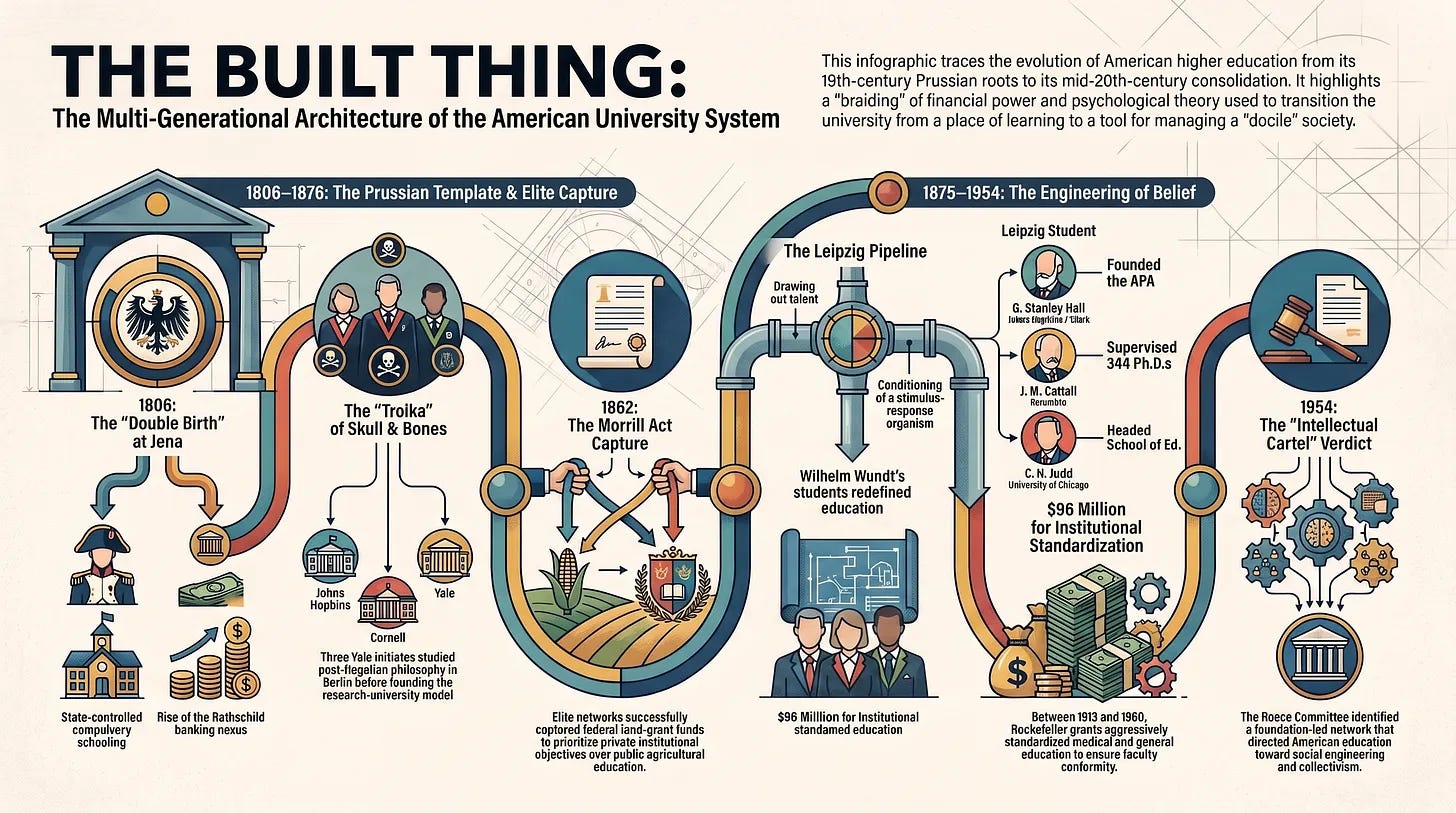
Duke built a retrieval-augmented generation system on Claude Cowork, trained it on archival documents, congressional transcripts, and the full texts of Antony Sutton, Paolo Lionni, John Taylor Gatto, and Charlotte Iserbyt, then combed the corpus for connective tissue. His argument rests on sequence, and one host calls the result a Gantt chart for the human mind.
Napoleon crushed the Prussian army at Jena-Auerstedt on 14 October 1806. In the winter of 1807, with French troops still holding Berlin, Johann Gottlieb Fichte delivered his Addresses to the German Nation and told the Prussian elite that their soldiers had lost because they thought for themselves. He proposed a schooling system under which the child cannot will otherwise than what the state wishes him to will.
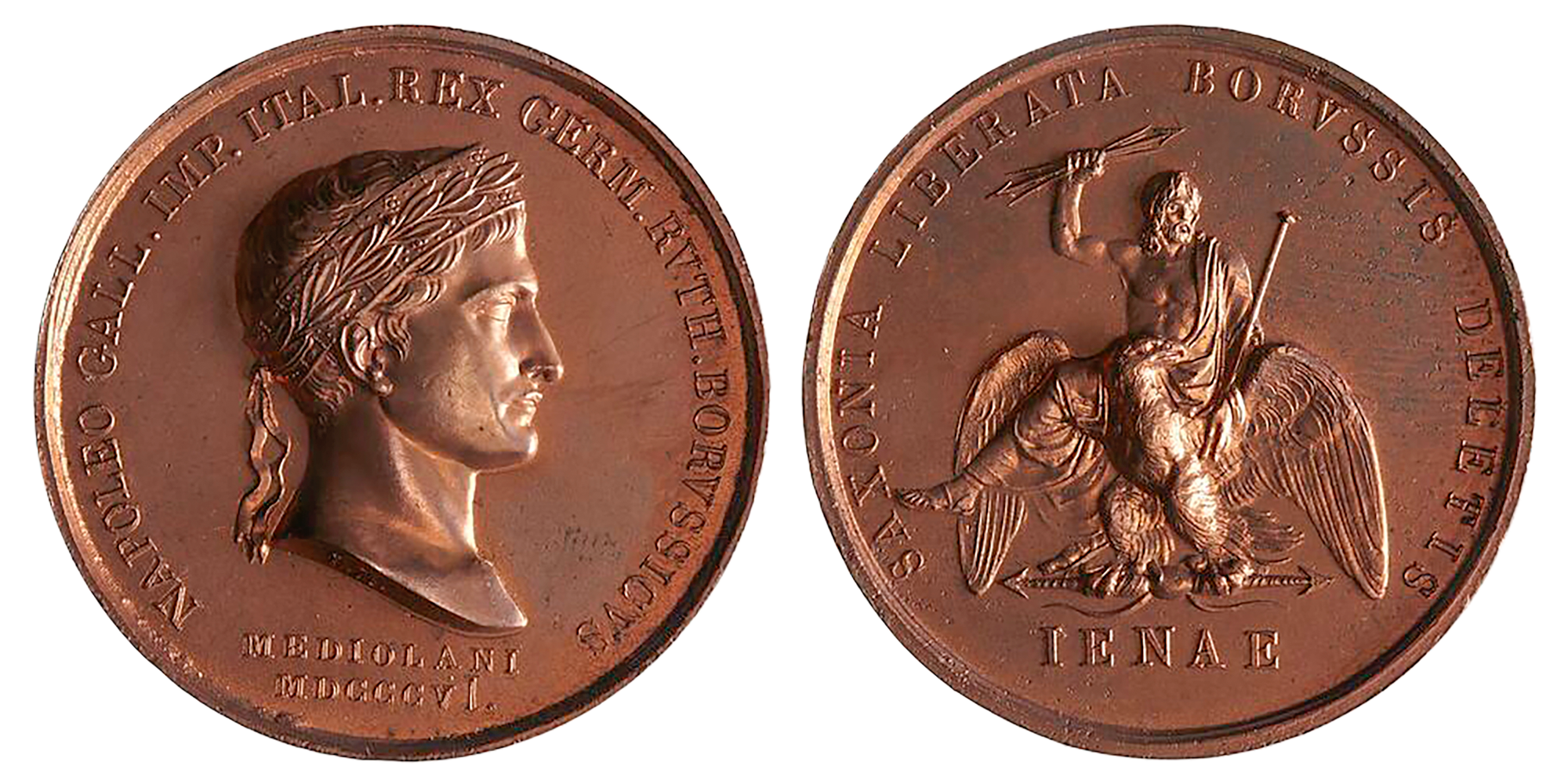
Prussian ministers passed the Compulsory Schooling Law in 1819. Gatto’s phrase for the result is the conditioning state: attendance enforced by police, the day segmented by bells, subjects compartmentalized, state-certified teachers delivering one curriculum. A modern American high school runs on the same mechanics.
The same campaign swept through Hesse-Cassel, whose ruler held what contemporaries called the largest princely fortune in Europe, built by renting his subjects to Britain as Hessian mercenaries. Fleeing Napoleon, he handed much of that wealth to the Frankfurt banker Mayer Amschel Rothschild, who channeled it to his son Nathan in London. Duke cites Niall Ferguson: the 1806 transfer supplied the capital that carried Nathan to dominance in the City.
The narrative traces the Atlantic crossing to three Yale men initiated into Skull and Bones within a four-year window: Daniel Coit Gilman, Andrew Dickson White, and Timothy Dwight. Sutton, a former Hoover Institution fellow, supplies the membership analysis, and William Huntington Russell founded the society in 1832 on his return from a year of study in Germany.
All three studied at the University of Berlin in the early 1850s, where Hegel had taught that the state is the march of God on earth and that the individual finds meaning by subordinating his will to it — the inversion of the Declaration. White wrote in his autobiography that Berlin became an obsession and that he had found there the ideal of a university.
Congress passed the Morrill Act in 1862, issuing land scrip so states could endow public colleges for the industrial classes. Gilman drafted his Proposed Plan for the Complete Reorganization of the School of Science, lobbied the Connecticut legislature, and argued that a new public college would waste money the state should hand to Yale’s Sheffield Scientific School. Connecticut gave Yale the entire allocation, no other institution in the state drew on that money for decades, and Yale gave Gilman a professorship. White, sitting as a New York state senator, ran the same play on the largest land-scrip allocation in the country, routed it into the endowment of a new private institution, and became the first president of Cornell.
Gilman took the presidency of the University of California, then in 1876 the first presidency of Johns Hopkins — the first German-model graduate research university in America, running on specialized departments and the production of PhDs who would staff other faculties. His inaugural address named the object of the university as developing character and making men who would prepare for the service of society. Read through the philosophy he absorbed in Berlin, the bots argue, service to society means service to the state, and educere, to draw out, leaves the definition of education. Gilman controlled the hiring: fellow bonesman William Welch built the medical school, Richard T. Ely the economics department.
In 1879 the physiologist Wilhelm Wundt opened the first experimental psychology laboratory at the University of Leipzig, working with chronoscopes, telegraph keys, and pendulums. He dropped a ball, had the subject strike a key at the sound, and measured the interval in milliseconds. From those measurements Wundt described human thought as physiological reaction to external stimulus and set the soul outside the field. For teachers the consequence follows directly: a child with a soul calls for reasoning, moral instruction, and history, and a child described as a stimulus-response organism calls for conditioning.
G. Stanley Hall traveled to Leipzig as Wundt’s first American doctoral student, his trip funded by a $1,000 check from a member of Yale’s Scroll and Key. Gilman hired him at Johns Hopkins on his return. Hall took the presidency of Clark University, founded the American Psychological Association, and trained John Dewey.
The others fanned out. James McKeen Cattell took the Columbia psychology department and supervised over 300 doctorates; Charles Judd took the School of Education at Chicago; E. W. Scripture went to Yale, E. B. Titchener to Cornell. Seven of Wundt’s direct students produced 117 American psychological laboratories and over 1,400 doctorates by 1948. Dewey moved to Teachers College at Columbia, which the bots pair with Judd at Chicago as the twin engines of the new pedagogy.
In his 1897 Pedagogic Creed, Dewey wrote that the teacher always is the prophet of the true God and the usherer in of the true kingdom of God. Under Hegel’s terms, that kingdom is a managed earthly society.
John D. Rockefeller Jr. hosted the private dinner in 1902 that formed the General Education Board, funded with Rockefeller oil money and later incorporated by act of Congress. Gilman appears among the original incorporators.
Carnegie founded the Carnegie Foundation for the Advancement of Teaching in 1905 and funded professor pensions, the system that became TIAA. A college drew on the fund by meeting the foundation’s definition of a college: adopt the Carnegie unit, which measures schooling in seat time; drop sectarian affiliation; standardize the curriculum. Gatto supplies the scale — between 1896 and 1920 industrialists and their foundations spent more on forced schooling than the United States government did.
Abraham Flexner, a former schoolteacher, visited 155 medical schools for the Carnegie Foundation and reported in 1910 that the country needed fewer and better doctors and would get better ones by producing fewer. His criteria required expensive laboratories and salaried full-time faculty on the Johns Hopkins pattern. The foundations then granted endowments only to schools meeting those criteria and lobbied state boards to license only their graduates. A third of American medical schools closed within a decade, more than half by 1935.
Cecil Rhodes wrote his Confession of Faith in 1877 at twenty-three, proposing a secret society to bring the uncivilized world under British rule and to recover the United States, making the Anglo-Saxon race one empire. N. M. Rothschild and Sons backed the De Beers fortune that funded it, and Rhodes left his estate in trust to Lord Rothschild. His scholarships selected for instincts to lead and fondness for sports, held young men at Oxford three years, and returned them to American academia, media, and politics.
The Rothschild Archive documents August Belmont — chairman of the Democratic National Committee for over a decade through the Civil War — as their agent in New York. The Pilgrim Society, founded in London in 1902 and New York in 1903, seated the Morgans, Rockefellers, Carnegies, and Astors with the British imperial elite.
After the First World War the journalist Charles Grant Miller found American history textbooks quietly revised toward the British account: John Hancock reduced to a smuggler, the Boston Tea Party recast as vandalism, the causes of the Revolution softened into a disagreement. Miller traced the funding to Carnegie endowments and Anglo-American amity groups, published in syndicated columns, and drew citizens in Wisconsin and Oregon into their statehouses.
The Cox and Reece committees took the question to Congress in the 1950s. Norman Dodd, chief investigator for the Reece Committee, gained access to Carnegie Endowment minutes and testified that the trustees discussed using war to alter the life of the American people, then using the teaching of history to make the alteration permanent. The majority report described the foundations as an intellectual cartel inducing educators to act as agents for social change. René Wormser, the committee’s general counsel, later wrote up the sabotage: Representative Wayne Hays interrupted witnesses, shouted over testimony, and demanded delays until the committee disbanded without subpoenaing the foundations’ records.
Leland Stanford’s railroad fortune built Stanford University, and when the trustees sought a president in 1891 they approached White, who declined and placed his protégé David Starr Jordan. Jane Stanford, holding legal and financial control after her husband’s death, fought Jordan over the school’s direction.
In 1905, at a Honolulu hotel, she drank bicarbonate of soda, convulsed, cried out that she had been poisoned, and died. The coroner’s inquest ran an autopsy and toxicology and returned strychnine poisoning. Jordan sailed to Hawaii with his own physician, a man who had no contact with the body, discredited the Honolulu doctors, and published a finding of heart failure brought on by overeating. The press and the academic establishment took Jordan’s version, and it held as the record until historians and toxicologists reopened the archives in the early 2000s.
A university president who can substitute his account of a death for a coroner’s and hold it for a century faces little difficulty rewriting a chapter on the American Revolution.
American Historical Association, Commission on the Social Studies. Conclusions and Recommendations of the Commission: Report of the Commission on the Social Studies. New York: Charles Scribner’s Sons, 1934. [In copyright; quoted from the verbatim reprint in Tax-Exempt Foundations: Hearings (below), 476–77.]
“An Act donating Public Lands to the several States and Territories which may provide Colleges for the Benefit of Agriculture and the Mechanic Arts” (Morrill Act). Ch. 130, United States Statutes at Large 12 (1862): 503–5. [archive.org: us_stat_12; National Archives transcript.]
“An Act To incorporate the General Education Board.” Ch. 91, United States Statutes at Large 32 (1903): 768–69. [govinfo STATUTE-32 facsimile.]
Carnegie, Andrew. “A Look Ahead.” North American Review 156, no. 439 (June 1893): 685–710. [archive.org: sim_north-american-review_1893-06_156_439. The “flag” quotation commonly attached to this essay does not appear in it — see master dossier Appendix item 9.]
Carnegie, Andrew. “Wealth.” North American Review 148, no. 391 (June 1889): 653–64. [archive.org: 8906CarnegieWealth.]
Commission on the Reorganization of Secondary Education. Cardinal Principles of Secondary Education. U.S. Bureau of Education Bulletin 1918, no. 35. Washington, DC: Government Printing Office, 1918. [archive.org: cardinalprincipl00natiuoft.]
Dewey, John. “My Pedagogic Creed.” School Journal 54, no. 3 (January 16, 1897): 77–80. [archive.org: sim_school-journal_1897-01-16_54_3; cross-checked against the 1897 E. L. Kellogg pamphlet.]
Dodd, Norman. The Dodd Report to the Reece Committee on Foundations. New York: The Long House, 1954. [archive.org: TheWorldOrder_329, item 23.]
Dodd, Norman. Interview by G. Edward Griffin. The Hidden Agenda. Film, 1982. Transcript. [Sole source of the Carnegie Endowment minutes account; see Carnegie Apparatus Dossier.]
Flexner, Abraham. Medical Education in the United States and Canada: A Report to the Carnegie Foundation for the Advancement of Teaching. Bulletin Number Four. New York: Carnegie Foundation for the Advancement of Teaching, 1910. [archive.org: medicaleducation00flexiala.]
Gates, Frederick T. The Country School of To-morrow. Occasional Papers, No. 1. New York: General Education Board, 1913. [archive.org: countryschooloft00gates. Commonly miscited as “Occasional Letter No. 1, 1906.”]
Gilman, Daniel C. Inaugural address. In Addresses at the Inauguration of Daniel C. Gilman, as President of the Johns Hopkins University, Baltimore, February 22, 1876. Baltimore: John Murphy & Co., 1876. [archive.org: addressesatinaug00johnrich.]
Hirshfield, David. Report on Investigation of Pro-British History Text-Books in Use in the Public Schools of The City of New York, at the Direction of Hon. John F. Hylan, Mayor. New York, May 25, 1923. [archive.org: reportoninvestig00newy_0. Companion: New York (City) Committee, Statement of Facts (1922), archive.org: statementoffacts00newy_0.]
Laws of Wisconsin, 1923, ch. 21 (creating sec. 40.36, textbook standards), approved April 5, 1923; and Oregon School Laws, 1923, ch. III, sec. 571 (”speaks slightingly of the founders”). [Operative texts as printed in Pierce, Public Opinion (below), 326–28 and 102; Oregon language codified at ORS 337.260, amended 1985.]
Miller, Charles Grant. The Poisoned Loving-Cup: United States School Histories Falsified Through Pro-British Propaganda in Sweet Name of Amity. Chicago: National Historical Society, 1928. [Alexandria PDF, read in full; also archive.org: poisonedlovingcu0000char. Contemporary campaign document of the textbook wars.]
Rhodes, Cecil. “Confession of Faith” (1877). Printed as appendix in John Flint, Cecil Rhodes (Boston: Little, Brown, 1974), 248–52; partial and variant printing in Stead, Last Will and Testament (below), 58–61. [Two textual states — see master dossier Appendix item 8.]
Stead, W. T., ed. The Last Will and Testament of Cecil John Rhodes: with Elucidatory Notes to Which Are Added Some Chapters Describing the Political and Religious Ideas of the Testator. London: “Review of Reviews” Office, 1902. [Alexandria PDF (scan); verified against archive.org: lastwilltestamen00rhodiala. Prints the 1899 will, codicils, trustee arrangements, and scholarship terms.]
U.S. Congress. House. Special Committee to Investigate Tax-Exempt Foundations and Comparable Organizations. Tax-Exempt Foundations. H. Rept. 2681, 83rd Cong., 2nd sess. Washington, DC: GPO, 1954. [archive.org: full-reece-committee-investigation.]
U.S. Congress. House. Special Committee to Investigate Tax-Exempt Foundations and Comparable Organizations. Tax-Exempt Foundations: Hearings. 83rd Cong., 2nd sess. Washington, DC: GPO, 1954. [Same archival item; C&R reprint at 476–77.]
White, Andrew Dickson. Autobiography of Andrew Dickson White. 2 vols. New York: Century Co., 1905. [archive.org: autobiographyofa01whit; Project Gutenberg ebook 1340.]
Wilson, Woodrow. “The Meaning of a Liberal Education.” Address to the High School Teachers Association of New York, January 9, 1909. In High School Teachers Association of New York, vol. 3 (1908–1909), 19–31; reprinted in The Papers of Woodrow Wilson, edited by Arthur S. Link, 18:593–606. Princeton: Princeton University Press, 1974. [Primary print unsighted; verified against the PWW-derived transcription — see master dossier Appendix item 6.]
Gatto, John Taylor. The Underground History of American Education: An Intimate Investigation into the Prison of Modern Schooling. New York: Oxford Village Press, 2003. [Alexandria PDF.]
Iserbyt, Charlotte Thomson. The Deliberate Dumbing Down of America: A Chronological Paper Trail. Ravenna, OH: Conscience Press, 1999. [Alexandria PDF.]
Lionni, Paolo, with Lance J. Klass. The Leipzig Connection. Sheridan, OR: Delphian Press, 1980 (first circulated 1967). [Alexandria PDF and epub.]
Macgregor, Jim, and John O’Dowd. Two World Wars and Hitler: Who Was Responsible? 2024. [Alexandria PDF (OCR), read in relevant chapters.]
Docherty, Gerry, and Jim Macgregor. Hidden History: The Secret Origins of the First World War. Edinburgh: Mainstream, 2013; and Prolonging the Agony (2017). [Alexandria PDF and epub.]
Sutton, Antony C. America’s Secret Establishment: An Introduction to the Order of Skull & Bones. 1983. Reprint, Walterville, OR: TrineDay, 2009/2017. [Alexandria PDF and epub.]
Sutton, Antony C. How the Order Controls Education. Bullsbrook, W.A.: Veritas Publishing, 1985. [Alexandria PDF; read in full.]
Allen, Frederick Lewis. The Lords of Creation. New York: Harper & Brothers, 1935. [Alexandria PDF and epub. Mainstream financial history; carrier of the Pujo Committee conclusion; the oligarchy’s university benefactions.]
Boring, Edwin G. A History of Experimental Psychology. 2nd ed. New York: Appleton-Century-Crofts, 1950. [Standard 1879 Leipzig laboratory date.]
Cutler, Robert W. P. The Mysterious Death of Jane Stanford. Stanford: Stanford University Press, 2003. [Alexandria PDF, read in full. Stanford professor emeritus’s forensic study: the murder verdict, Jordan’s cover-up. See Stanford Founding Dossier.]
Birmingham, Stephen. California Rich (1980); America’s Secret Aristocracy (1987). [Alexandria PDFs. The Central Pacific fortune and the Stanford founding milieu.]
Veysey, Laurence R. The Emergence of the American University. Chicago: University of Chicago Press, 1965. [Alexandria PDF. The standard scholarly monograph on the dossier’s entire subject; flagged as a control source for future audits of the master narrative.]
Diamond, Sigmund, ed. A Casual View of America: The Home Letters of Salomon de Rothschild, 1859–1861. Stanford: Stanford University Press, 1961. [Alexandria PDF, read directly. Primary: Salomon’s letters on Belmont (”quite the politician”) and on American education; the 1837 Allgemeine Zeitung des Judentums branch report; the Murphy consular testimony on the Union.]
Ferguson, Niall. The House of Rothschild. 2 vols. New York: Viking, 1998–99. [Alexandria PDF and epub. Scholarly control for all Rothschild claims, from the Rothschild Archive; vol. 1, the Belmont agency; vol. 2, “Rhodes and the Rothschilds,” the 1893–96 gold operation, and the rivals-not-agents finding on Peabody/Morgan.]
Griffin, G. Edward. The Creature from Jekyll Island: A Second Look at the Federal Reserve. 2010 ed. Westlake Village, CA: American Media. [Alexandria text file. Jekyll Island roster; his Warburg-as-Rothschild-representative characterization cited as his claim.]
Grove, Richard. The Truth About The Rothschilds (2016); Coleman, John. The Rothschild Dynasty; King, M. S. Planet Rothschild; Mullins, Eustace. Secrets of the Federal Reserve: The London Connection (1993). [Alexandria PDFs. Carriers of the agency claims (the Mullins line); cited as claim-carriers, not verification. See Rothschild Agents Dossier — Belmont, Peabody, Morgan.]
Birmingham, Stephen. The Jews in America Trilogy (Our Crowd, 1967; The Grandees; “The Rest of Us”). [Alexandria PDF with full text layer, read directly — supersedes the text-less 1967 scan. Mainstream corroboration of the Belmont agency’s function, the Schiff–Rothschild Judengasse house, and the Goldman Sachs negative finding (the Kleinwort vetting).]
Smethurst, Richard. “Takahashi Korekiyo, the Rothschilds and the Russo-Japanese War, 1904–1907.” The Rothschild Archive Review of the Year. London: The Rothschild Archive. [Alexandria PDF. Scholarly, from the family archive’s own review; Takahashi’s diaries on the 1904–07 loans.]
Sutton, Antony C. The Federal Reserve Conspiracy. Boring, OR: CPA Book Publisher, 1995. [Alexandria PDF. Framework author on the Jekyll Island group and the Morgan–Aldrich–Warburg triad.]
Flint, John. Cecil Rhodes. Boston: Little, Brown, 1974. [Prints the Confession of Faith from the manuscript, 248–52.]
Pierce, Bessie Louise. Public Opinion and the Teaching of History in the United States. New York: Knopf, 1926. [archive.org: publicopinionand00pierrich. Contemporary scholarly record of the textbook wars; prints the Wisconsin and Oregon statutes.]
Quigley, Carroll. The Anglo-American Establishment: From Rhodes to Cliveden. New York: Books in Focus, 1981 (written 1949); and Tragedy and Hope: A History of the World in Our Time. New York: Macmillan, 1966. [Alexandria PDF and epub. Scholarly spine of the Rhodes–Milner material; Quigley’s first-person access claims treated as personal testimony, per the Dodd standard.]
The Rothschild Archive — Rothschild Timeline. [Alexandria PDF. The family archive’s own chronology; control source.]
Williams, Basil. Cecil Rhodes. London: Constable, 1921. [Carrier of the first-will quotation as used by Miller and Hirshfield.]
Collier, Peter, and David Horowitz. The Rockefellers: An American Dynasty. New York: New American Library, 1976. [Carrier of the Gates quotations, via Lionni.]
Ely, Richard T. Ground Under Our Feet: An Autobiography. New York: Macmillan, 1938. [Dedicated to Gilman; carrier of the White-patronage testimony, via Sutton.]
Fosdick, Raymond B. Adventure in Giving: The Story of the General Education Board. New York: Harper & Row, 1962. [Official GEB history; carrier of the Gates–Flexner lunch, the Page letter, the $96M figure.]
Franklin, Fabian. The Life of Daniel Coit Gilman. New York: Dodd, Mead, 1910. [Carrier of the Gilman letters of 1854 and 1874.]
French, John C. A History of the University Founded by Johns Hopkins. Baltimore: Johns Hopkins Press, 1946. [Carrier of the Angell “one man” statement.]
Hall, G. Stanley. Life and Confessions of a Psychologist. New York: D. Appleton, 1923. [Carrier of the Union/Beecher/Sage and Antioch/Taft accounts.]
Jarrett, William H., II. “Yale, Skull and Bones, and the Beginnings of Johns Hopkins.” Baylor University Medical Center Proceedings 24, no. 1 (January 2011): 27–34. [Independent corroboration of the Gilman/Bones/Hopkins chain. Alexandria PDF.]
Millegan, Kris, ed. Fleshing Out Skull & Bones: Investigations into America’s Most Powerful Secret Society. Walterville, OR: TrineDay, 2003. [Yale treasurership; membership context. Alexandria PDF/epub.]
Skull and Bones Membership List (1833–1985). [Alexandria PDF; the documentary base class of Sutton’s series.]
Wormser, René A. Foundations: Their Power and Influence. New York: Devin-Adair, 1958. [Reece Committee general counsel’s account; Hays sabotage at 341; Teachers College/Lincoln School at 144–46. Alexandria PDF and epub.]
Thanks to the generosity of my readers, all my articles are available for free access. Independent journalism, however, requires time and investment. If you found value in this article or any others, please consider sharing or even becoming a paid subscriber, who benefits by joining the conversation in the comments. I want you to know that your support is always gratefully received and will never be forgotten. Please buy me a coffee or as many as you wish.
My articles on SubStack are all free to read/listen to. If you load the Substack app on your phone, Substack will read the articles to you. (Convenient if you are driving).
Palmerston’s Zoo Episode 01 - Solving the Paradox of Current World History (9 Episodes)
Oligarchic Control from the Renaissance to the Information Age
I’ve taken almost 200 foundational books for understanding how the world really works and posted them as audio podcasts on SoundCloud. If you load the app on your phone, you can listen to the AI robots discuss the books on your journeys across America.
Over 600 foundational books by journalists and academics that never made the New York Times Bestseller list, but somehow tell a history we never learned in school. LINK
Comments
Nothing yet. Say the first thing.
Sign in to join the conversation.