This essay extracted a piece of me I didn't know was there. I feel like I lost and gained something in the process of being consumed by it. I don’t know what compels me to create work like this or how long that fire will burn. But for now, I’m glad it does.
Biofoundationalism VI: OACI is the keystone text of the entire series. Previous chapters examined moral foundations through recognizable frames of clinical psychology and political applications. Now we depart from these human-readable references and descend further.
OACI introduces the paradigm of Thermodynamic Morality: an original Biofoundationalist framework for mechanically understanding how scaled human coordination propagates through values of Motion and Meaning. Examining moral codes peculiar to flesh and feelings, stripping each down to elemental substrate to see how they manifest. Or more precisely: how they move.
Several sections in OACI will be components of future chapters: including IX. Mother Mary Pairs (Chaos Symbols), X. The Idle Arts, and ∞ Worship of Infinity ∞. I consider this a living document: complete enough for publication, holistically under construction. All chapters are linked at the end. This essay can be read standalone.
Biofoundationalism is an anti-story. Nature’s third-person lens on a species hubristically convinced it’s always a first-person agent. We act upon the world. The world also acts upon us.
The ethics of gravity, virtues of embodiment, and character of constraints. Politics and morality as depicted by what moves. The body’s testimony.
The body is a temple. And a furnace.
Seeing yourself outside yourself
We are not things, but processes
What happens if everyone sits?
There’s an ethic unique to flesh and feelings: do something or feel something.
‘Order Acts, Chaos Is’ Moral Dyads
Kinetic Ethics & Inert Virtues: valuable for what it does, or what it is?
Entropy rises, structure declines. Yin expands, yang contracts.
Entropic injections in service of greater order
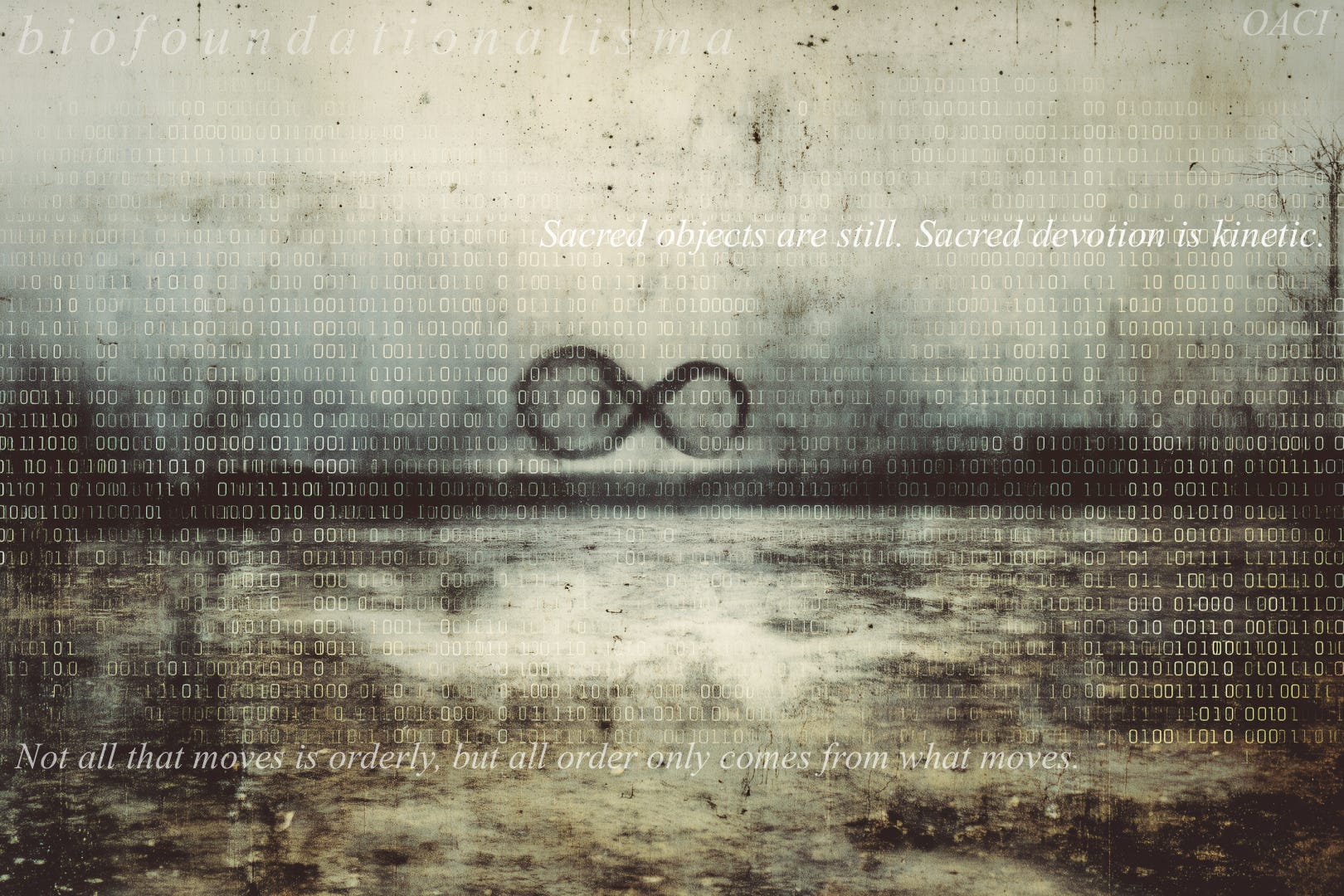
Sacred objects are still. Sacred devotion is kinetic.
Liberal art is subsidized by illiberal labor. Class divide = embodiment divide.
Orderly communism, chaotic libertarianism
Keeping failure rates down vs producing legitimacy stories
Swimming left and gradient descent. Scarcity enforces; surplus forgives.
Indulgent societies live inside their minds
Hierarchy of flesh & feelings. Body without mind. Mind without body.
We understand what people believe not by their words but by their hands.
Every political and ethical value resolves into bodily instruction: move more or move less. This essay audits that motion to reveal if our moral stances are valuable for what they do, or what they are.
The body’s motion operates within reality. Subject to physics and biology, it acts under constraint.
The mind’s theories operate outside of reality. Subject to its own imagination, it thinks under assumption.
The mind conceives contradictions and impossibilities without penalty: economies without tradeoffs, fire-breathing ponies, square circles. The body tests, verifies, and suffers consequences. If theory declares pi equals three, bridges collapse. Minds cannot reference themselves to know what is so. Only bodily experiment confirms what’s true. Gravity limits one; feelings limit the other.
Heads model what’s possible; hands report what’s real. The map may be lovely, but terrain is what you walk on. When they conflict, you either stop at cliff’s edge or crash in delusions.
Religion calls the body a temple. Biofoundationalism notes the temple is also a furnace: burning 2,000 calories daily to resist equilibrium’s death. There is no contradiction between these frames. In fact, they complement each other. You may believe a vessel holy while acknowledging it isn’t weightless. Revelation doesn’t suspend metabolism, but it can make fasting feel meaningful.
Physiology doesn't contravene religion. We obey hunger, fatigue, and mortality demanding we maintain body first, pray second. Ignore those priorities too long and flesh speaks up by terminating itself. Only after we tend to our temples can we intellectually transcend.
Biofoundationalism recognizes other constraints that aren’t as easy to touch, yet equally inescapable. Just as religion and morality aren’t undermined by biological necessity, they’re not contravened by laws of physics. Our stories operate within reality’s rules, as all living things do.
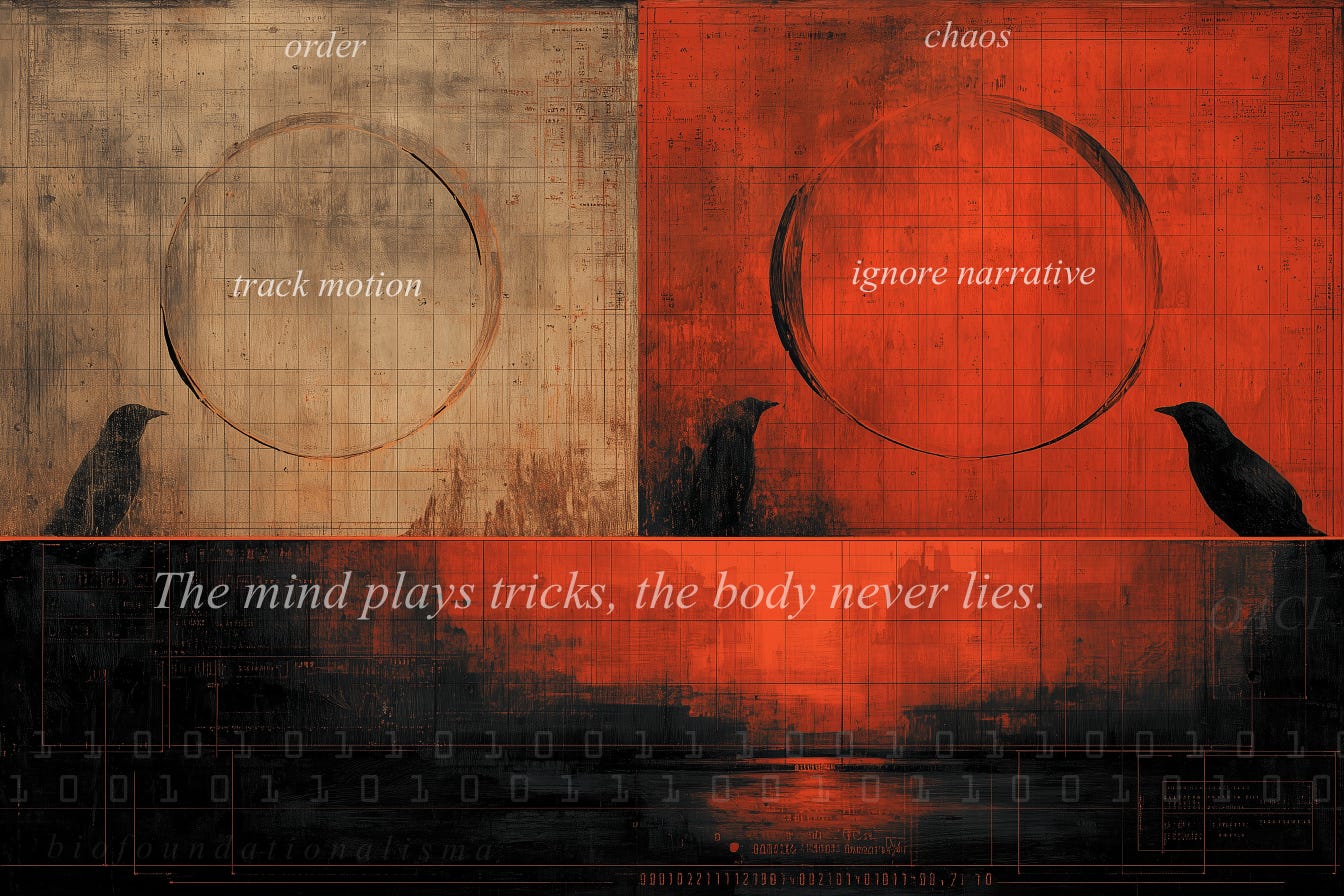
Only when the mind’s rationalism submits to the body’s empiricism can we perceive how physical laws govern us in ways evolution never equipped us to see. This essay represents that submission: omitting narratives and examining motor commands. This entails little theory, rather, it thrives by discarding theory. The mind plays tricks; the body never lies.
It will feel counterintuitive to witness moral and political stances through a mechanical lens. The mind indignantly insisting we can’t exclude its feelings and put the body first. We’ll sideline these protests and see ourselves as physical actors, not virtuous moral protagonists, by incorporating a neutral gaze. A foreign assistant measuring movement, not motivations.
Meet our co-author.
The mind has endless poetic justifications and labyrinths of nuance. The body speaks bluntly; let’s give it a chance to talk.
We’ll neutralize opinionated narration by removing ourselves from first-person description and using third-party accounting. A distant observer watching from afar… what does he see?
Picture a researcher documenting homo sapiens coordination patterns. Logs only energy flows and outcomes. No access to stories, reasoning, or intentions. Indifferent to mind’s “why?”, interested only in body’s “what”.
Introducing Thermodynamic Alien.
Thermodynamic Alien Notes:
On human scaled coordination patterns:
They divide into two aggregate groups based on symbol preferences. Both claim identical outcomes (safety, prosperity, fairness) yet issue conflicting motor commands.
Motion measurement: High kinetic expenditure. Motion increases under this symbol set.
Group B
Symbols prescribe: Lower barriers. Reduce standards. Include regardless of failure. Forgive violators. Receive resources by inert existence.
Motion measurement: Lower kinetic expenditure. Motion declines under this symbol set.
Group A and B are not different methods to same result, but contrasting thermodynamic directives. However humans do not understand them this way at all. They bicker about symbols through moral filters before deciding how bodies should move.
Simple and direct: does it make one move more, or less? There are only so many games the mind can play to obfuscate physical empiricism. Intentions live in the head. Outcomes live in physics. Only one can be weighed and measured. This is how bodies talk.
The mind will attempt to override its exclusion with self-serving moral chronicles. Insisting it’s reductive, missing something essential… “How dare you keep me out of this, do you know who I am? I’m the MIND. How can you possibly comprehend this motion until you know about all my meaning??”.
Note the objections, then proceed. Consider it an exercise in impulse control. You’ve heard the head’s accounting your entire life. Allocate one essay to the hand’s exposition.
“Simplicity is the ultimate sophistication.” — Leonardo Da Vinci (not an alien)
Physics authors laws; biology creates templates within them; and their human expression is how we organize at scale. All earthly inhabitants obey the immutable constitution of physics: not metaphorically, mechanically.
Beneath political narratives and moral rationales, we abide by the same rules as stars and snowflakes. Forces governing the universe don’t stop at the edge of human affairs! We are not outside this system. We are of it.
We are metabolic patterns. Societies are physical patterns. Both alive at different scales, inhaling energy to resist entropy. When they don’t, they die. Muscles atrophy without tension. Machines rust without maintenance. Countries decay without duty. In every case, stillness is death. You gotta move to stay alive!
Pockets of order survive by fighting entropy to maintain internal integrity. From atoms to empires, it fractally holds at every magnification. These intricate patterns are known as dissipative structures.
Dissipative Structures: Orderly patterns sustained by consuming energy and excreting entropy. A candle flame. A hurricane. You. All temporary rebellions against equilibrium. Stop the energy flow, structure dissolves. Credit to Ilya Prigogine for the original discovery and terminology. Biofoundationalism extends this concept isomorphically, recognizing…
At molecular scale: Organic compounds require energy to form and persist. Without it, decomposition.
At body scale: Metabolic processes, trillions of cells burning energy, dumping heat. Heart stops for minutes: brain death. Eating stops for weeks: corpse.
At social scale: Relationships oblige ongoing intimacy, communication, compromise. Neglect them, it atrophies into estrangement.
At institutional scale: Functioning schools, hospitals, corporations need perpetual upkeep. Not static states but ongoing processes.
At civilizational scale: Infrastructure, rule of law, defense. Without constant maintenance, the jungle returns.
Kinetic: Energy of motion. Any process displacing atoms, altering physical states, changing observable reality. Mechanical movement, chemical reaction, heat flow, diffusion: all kinetic.
Inert: Still. Inactive. Not producing change. A rock on a table is inert at human scale. If it’s not propagating outward onto atoms, not altering the outer world, it’s inert.
Dyad: A pair of oppositional and interdependent elements, each identified in reference to the other. Day is undefined without night; left unknown without right; masculine unspecified without feminine.
The Second Law of Thermodynamics: Entropy in a closed system never decreases. Without ongoing work importing energy, local order decays to equilibrium.
An Energy Gradient is a difference in work potential: Hot vs cold. High pressure vs low pressure. Concentrated vs diffuse. Economic resource disparities.
Gradient (Energy) Descent: The math of a rock sliding downhill. The hot pan’s gradient descends (energy dissipates) as it cools to room temperature. Note this is the physics usage, not the machine-learning term.
The Default State: Also known as equilibrium (maximum entropy). Static and uniform. What exists when nothing acts. The rock’s position resting on ground. A room’s temperature without heating/cooling.
At equilibrium, all gradients vanish: no temperature, pressure, or chemical differences. Thermodynamically, this is equality.
Place a hot object in cold room and wait; eventually everything equalizes. The object cools, no longer thermodynamically distinct. The room digests it into ‘same as everything else’ (equilibrium).
Entropy increases until equilibrium is reached.
Chaos and Entropy: Related but distinct. Entropy measures energy dispersal (disorder). Chaos is its lived name: experiential disorder, volatility, the felt consequences of entropy. I use them interchangeably; at human scale, the difference is academic.
When I say ‘symbol’: Mental, verbal, and digital arrangements we communicate. Words, slogans, prayers, equations, theories, memes, etc.. The mind’s vocabulary.
Gravity warps spacetime around you. Entropy degrades every structure you’ve ever known. Powers greater than us, relentlessly exerting effects whether we comprehend or approve. We are always being acted upon. There is no escape. To ‘escape’ is to die; only then are you relieved of their burden.
Thermodynamically, death and equilibrium are the same thing.
Note: this series is engineered so someone with no technical background can functionally comprehend core physics and biological concepts with useful applications to real life.Practical, concrete, testable, clear.
Not to alarm you, but your house is rotting. It’s decomposing as we speak!
Microorganisms digest wood. Moisture seeps through invisible cracks. UV radiation breaks molecular bonds in the roof. Thermal cycles widen fissures. These forces care nothing for mortgage payments.
A house is a low-entropy arrangement requiring energy to construct and maintain.
Thousands of coordinated actions: Walls erected. Systems installed. Roofing, plumbing, electrical, insulation, drywall, finishing.
Homes are orderly patterns, existing in defiance of entropy’s gravity
Nothing. Just sit there. Time does the rest, eventually crumbling back to equilibrium’s Default State without a single act of demolition.
Sleeping? Reading Substack? Video games? Practicing cello? These distinctions matter to us. They have identical effects on your house’s order. Thermodynamics cares not why you sit!
If you sit for minutes, hours, days, you won’t notice. But if you sit for…
5 years: That soft spot is now a hole. Wood rots. Systems fail.
20-30 years: Nature reclaims her territory. Vines crawl through broken windows. The universe grinds to dust what you didn’t preserve.
When an orderly structure isn’t actively sustained, it’s in some way degrading. These microscopic buildups are imperceptible but constant. You’re not making your house decay; you’re simply not stopping it. The mind overlays intentions, overlooking absence of intention is all it takes.
What holds for houses also holds for nations.
Let’s apply our sitting exercise at scale.
What if everyone in your city sat for a day?
Traffic lights work. Clean water flows. Electrical grid hums. Systems built by yesterday’s efforts keep working.
What about a month?
Sewage backs up. Shelves empty. Pipes become bacterial incubators. Lawlessness.
What about three months? Six months? A year?
Infrastructure fails. Dams breach. Grids collapse. You get it.
Within a decade, roots crack asphalt. In a century, archaeologists excavate to find evidence the city existed. The jungle doesn't invade; the city stops resisting.
Advancing toward equilibrium’s Default State doesn’t necessitate everyone sit, only more opting out of maintenance. These examples scale with the percentage who choose stillness.
Construction time vastly exceeds destruction time. It takes decades to build a city, only months of neglect render it uninhabitable. Order takes the stairs up; chaos rides the elevator down.
Society can decline without a single destructive act. Order costs. Chaos is free.
Greek kinētikos: "of motion"
Order must be built and maintained through motion. This makes it kinetic. It acts.
There is no instance where absence of motion produces structured order.
Spontaneous structures still need energy’s movement to form, decaying when the flow stops. Crystals eventually disintegrate if nothing ever maintains them.
Chaos does not require our efforts. This makes it inert. It is.
Chaos rises kinetically too: destroy, deface, demolish. Vandal and arsonist are its active agents.
It also happens passively when we do nothing.
Entropy’s chaos doesn’t happen to you; it’s perpetually happening everywhere, by default. Not an occasional event but omnipresent direction. Left alone, heat disperses, concentrations dilute, bonds dissolve, societies disintegrate. Chaos is the destination; order is a detour.
The body and the empirical structures it moves in — from clothing, home, and homeland — require motion’s order.
The mind and the rational symbols it thinks in — from abstraction, art, and myth — require meaning’s chaos.
We've relied on moral foundations from clinical psychology thus far in the series; we now go beyond them. Introducing an original Biofoundationalist frame that understands morality for what it is: an evolutionary tool for human coordination, manifesting as values of body and mind.
Strip any ideology to its substrate and you find the same cosmic dyad: orderly 0 and chaotic 1. Binary at root, infinite in narrative camouflage.
Keep in mind while reviewing:
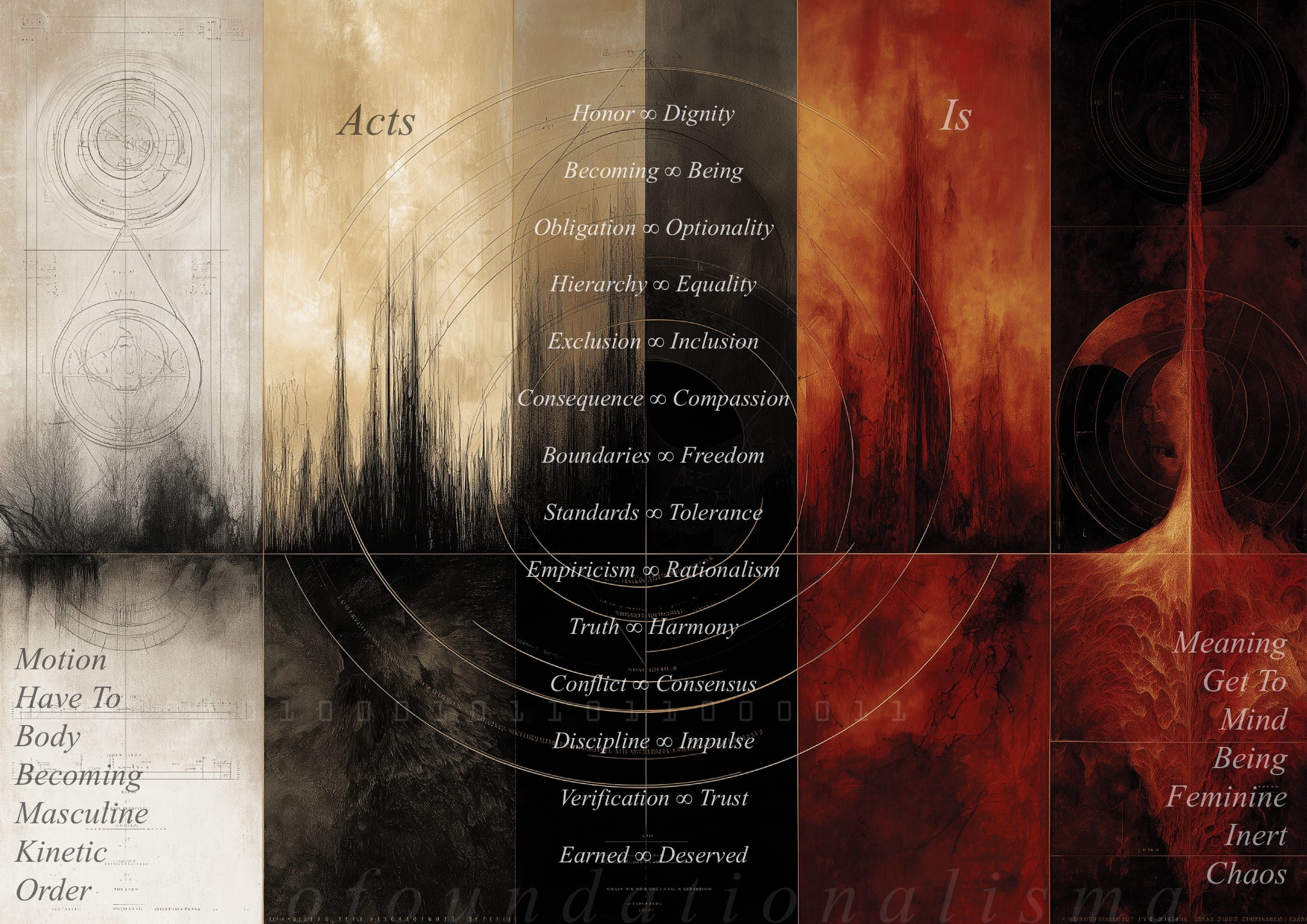
Acts (0): Valuable for what it does. Requires motion to materialize. Remove action, the value vanishes.
Is (1): Valuable for what it is. Exists by default as movement declines. Reduce action, this value appears automatically.
The distinction is not prescriptive (story) but operational (system). We're not saying Acts values are 'good' and Is values are 'bad'. We're noting how ethical stances map onto bodily directives: how does it move?
The 'Is' column either doesn't need to move or moves notably less than 'Acts.
Left column: kinetic body (0). Right column: inert mind (1).
Hierarchy Acts, Equality Is
Exclusion Acts, Inclusion Is
Boundaries Act, Freedom Is
Standards Act, Tolerance Is
Honor Acts, Dignity Is
Becoming (Extrinsic) Acts, Being (Intrinsic) Is
Obligation Acts, Optionality Is
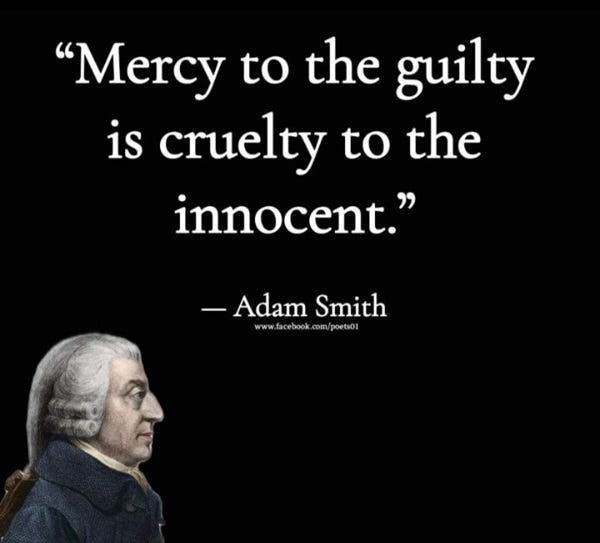
Consequence (Punishment) Acts, Mercy (Compassion) Is
Production (Accumulate) Acts, Consumption (Distribute) Is
Responsibility Acts, Rights Are
Ambition Acts, Contentment Is
This is how flesh and feelings express themselves. Every political debate negotiates these ratios through policy filters.
Let’s concretely deconstruct.
The distinction comes down to an elegant binary: does the value manifest through motion or surface through stillness? A kinetic performance of body or inert occupant of mind? This sorts every value we hold.
Motion is comparative, not absolute. For example: cooperation still moves, but less so than competition.
The binary is at the decision point: enforce the standard or make the exception? At that moment, you’re choosing one or the other.
Even embodied cognition researchers distinguish between having a feeling (internal state) and acting on it (behavioral output). That’s what we’re doing here as it relates to morality.
Allow me to elaborate.
Honor is Earned, it Acts (0): Merit must be demonstrated. Performance informs worth. Valuable for what you do. The knight earns his title through deeds. Ethics of becoming. Extrinsic value.
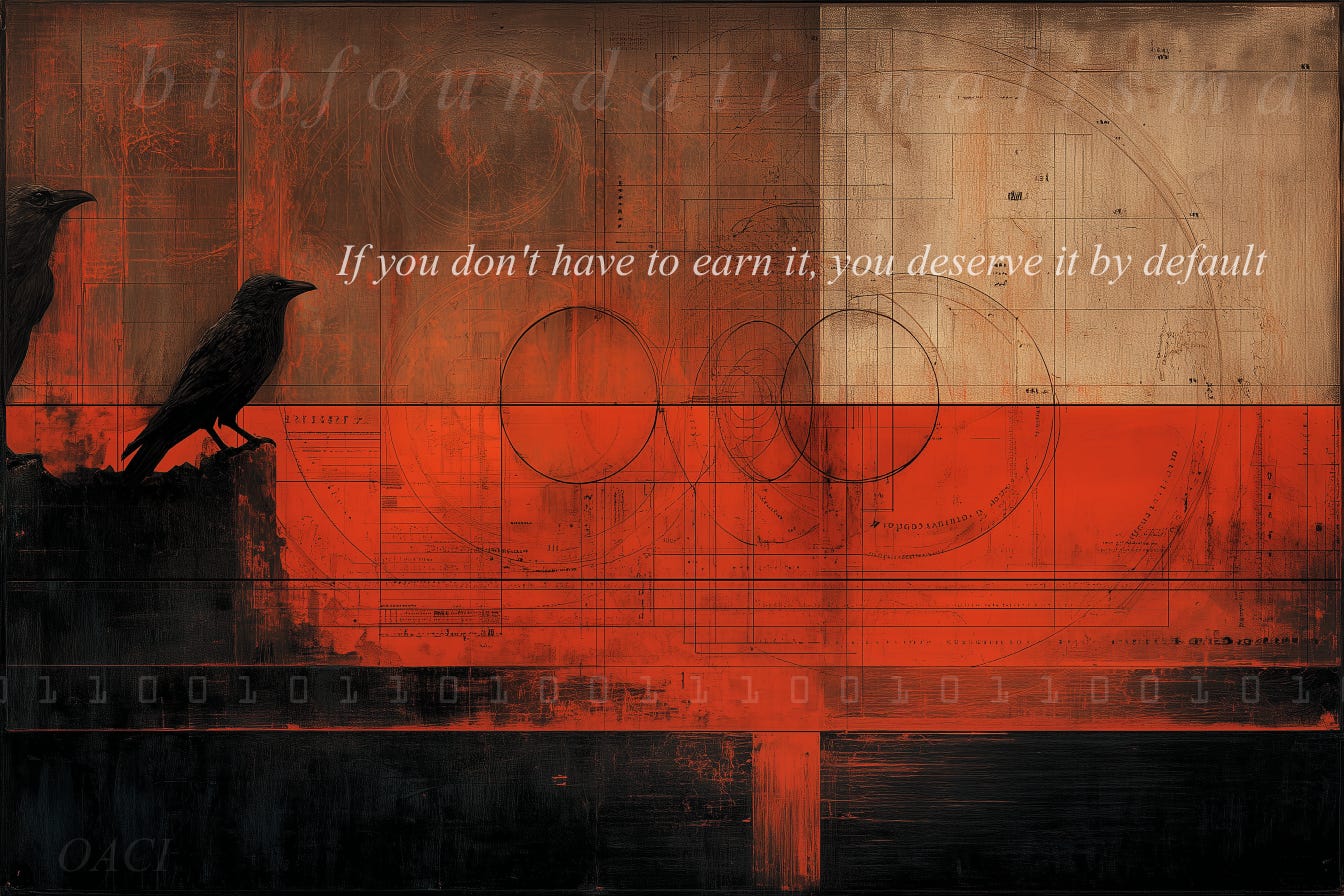
Dignityis Deserved, it Is (1): If you don’t have to earn it, you deserve it by default. Valuable for what you are. The infant deserves care by essence. Ethics of being. Intrinsic value.
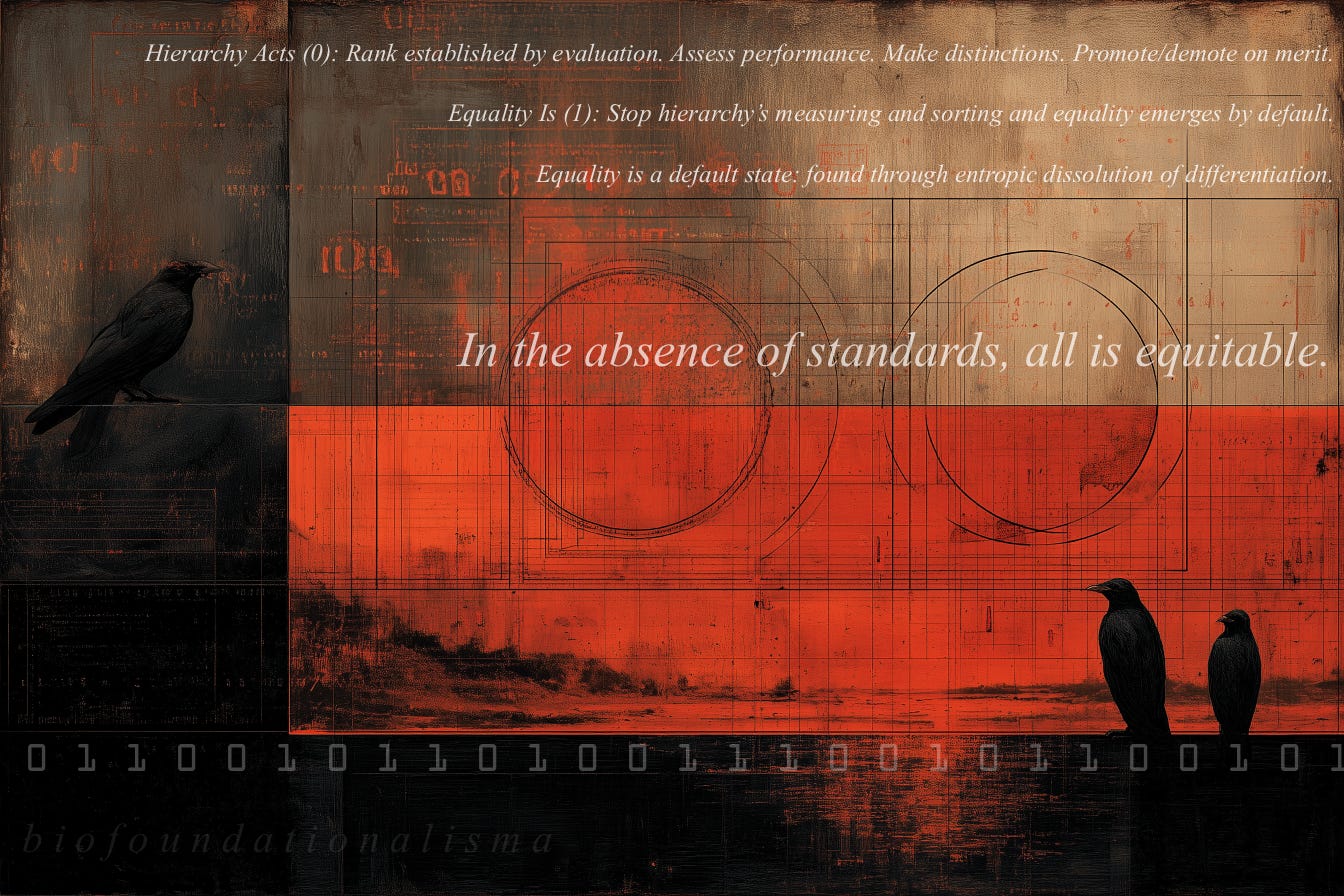
Hierarchy Acts (0): Rank established by evaluation. Assess performance. Make distinctions. Promote/demote on merit.
Energetically costly: continuous measurement, judgment, and social cost of rejection.
Equality Is (1): Stop hierarchy’s measuring/sorting, equality emerges by default.
Equality is a default state, found through entropic dissolution of differentiation. In the absence of standards, all is equitable.
Equality is thermodynamically cheap. Declaring everyone the same costs nothing. Maintaining meaningful distinctions costs enormously.
Inclusion Is (1): If you don’t exclude through competence or sorting, you include everyone by default.
E.g. remove the effort of entrance exam and everyone is inclusively admitted.
The unguarded door is open to all.
Tolerance Is (1): Asking you not prohibit, judge, or exclude.
Tolerance is a state of mind justifying non-enforcement of standards. Permit outgroup or deviant behaviors and describe it as the mind’s virtue.
Acceptance Is (1): Don’t intervene when norms are violated, just accept it. Defined entirely by what you refrain from doing.
Justice Acts (0): Investigate, prosecute, incarcerate. Among the most metabolically expensive values a society holds.
Forgiveness (Leniency) Is (1): Emerges by default as justice’s intervention declines. Compassionate mind pacifying corrective hands.
Leniency is thermodynamically free. No budget, personnel, or infrastructure needed to forgive. A district attorney declining prosecution saves the city money and himself effort. The path of least resistance is overlooking malfeasance.
Enforcement is work; non-enforcement is rest. Justice is maintained through active choice to bear costs of punishment. Energy gradients, and gravity, favor leniency.
Without Consequence (0), all is Mercy (1).
Ambition Acts (0): More success. More output. More territory. Shifts you from current state to desired one. Ethics of becoming.
Contentment Is (1): Satisfaction with circumstances, found in absence of ambition’s striving. Satiety over conquest. Belonging over contest. Peace over escalation. Ethics of being.
Ambition moves toward surplus. It says “I want more”.
Contentment sits with sufficiency. It says “I have enough”.
Production (Accumulate) Acts (0): To produce is to move.
Consumption (Distribute) Is (1): If you produce nothing, you only consume by default.
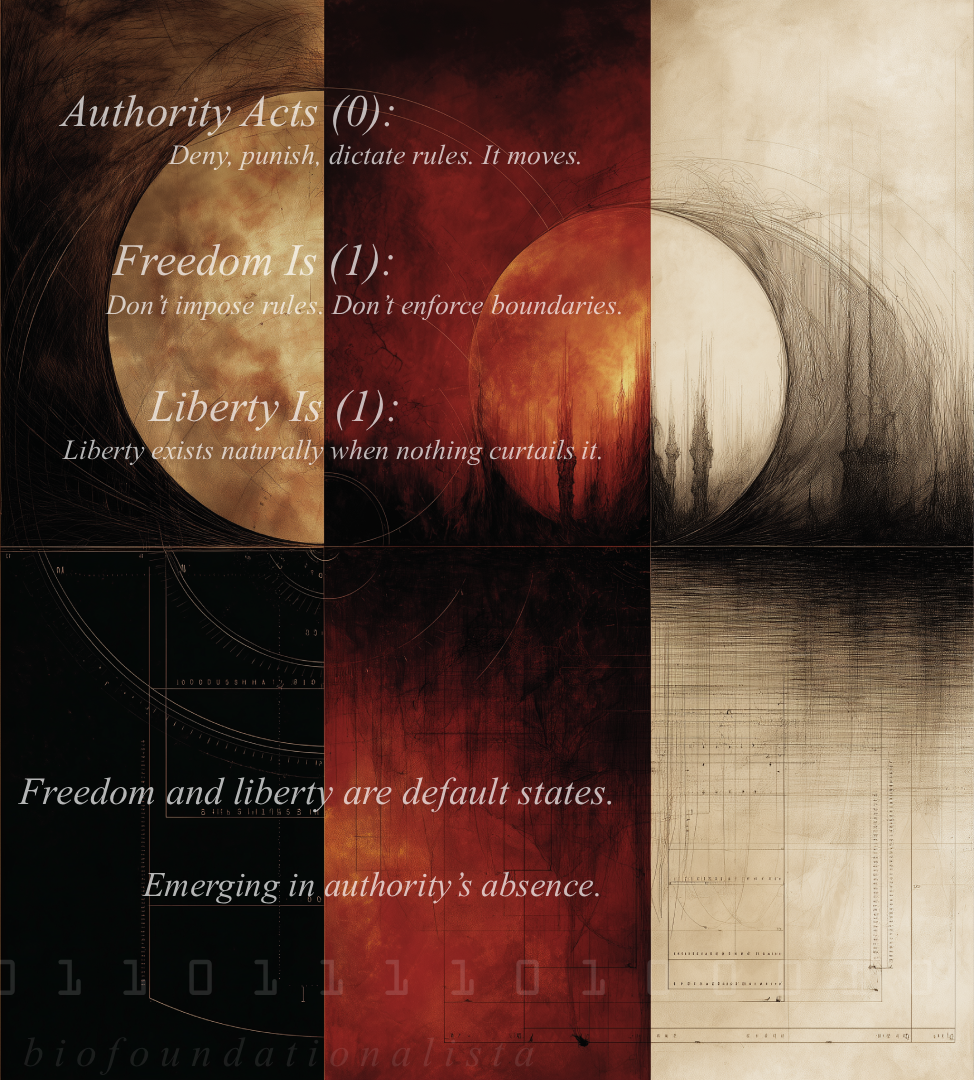
Freedom Is (1): Don’t impose rules. Don’t enforce boundaries. Emerges by default in authority’s absence.
Liberty Is (1): Proliferating naturally when nothing curtails it.
Freedom and liberty are default states: filling the void as authority’s motion recedes.
Dominance (Will) Acts (0): The very essence of superior motion.
Submission (Surrender) Is (1): Stop resisting, submission by default.
Truth (Testing) Acts (0):An entire essay was dedicated to this. Truth is found through motion. Disagreeable, confrontational, competitive; it moves. Empirical demonstration and experiment.
Trust Is (1): Abstains from actions revealing deception. If you don’t test (measure/prove) something, you trust (estimate/assume) it by default.
Trust is energetically cheaper than verification. Investigation costs time, resources, political capital. Belief costs nothing.
Harmony Is (1): Pleasant inertia of the unchallenged mind. Don't verify, investigate, prove, scrutinize, question. Rational compromise and belief.
Truth’s empiricism is disagreeable and polarizing.
Harmony’s rationality is agreeable and cooperative.
Truth insists you move to prove. Harmony implores you sit and believe.
The nature of Truth’s peer review (falsifiable) vs Harmony’s “lived experience” (unfalsifiable).
Competition Acts (0): Adversarial contest. Assumes defection. Relies on measurement and verification.
Forces differentiation. Confrontational evaluation. Low trust, low coordination. Seeks to defeat opposition via direct conflict.
Cooperation Is (1): Aligned coordination. Assumes reciprocity. Relies on estimation and belief.
Cooperation emerges as competition’s narrow self-interest and adversariness abate. Don’t defeat opposition, work with them.
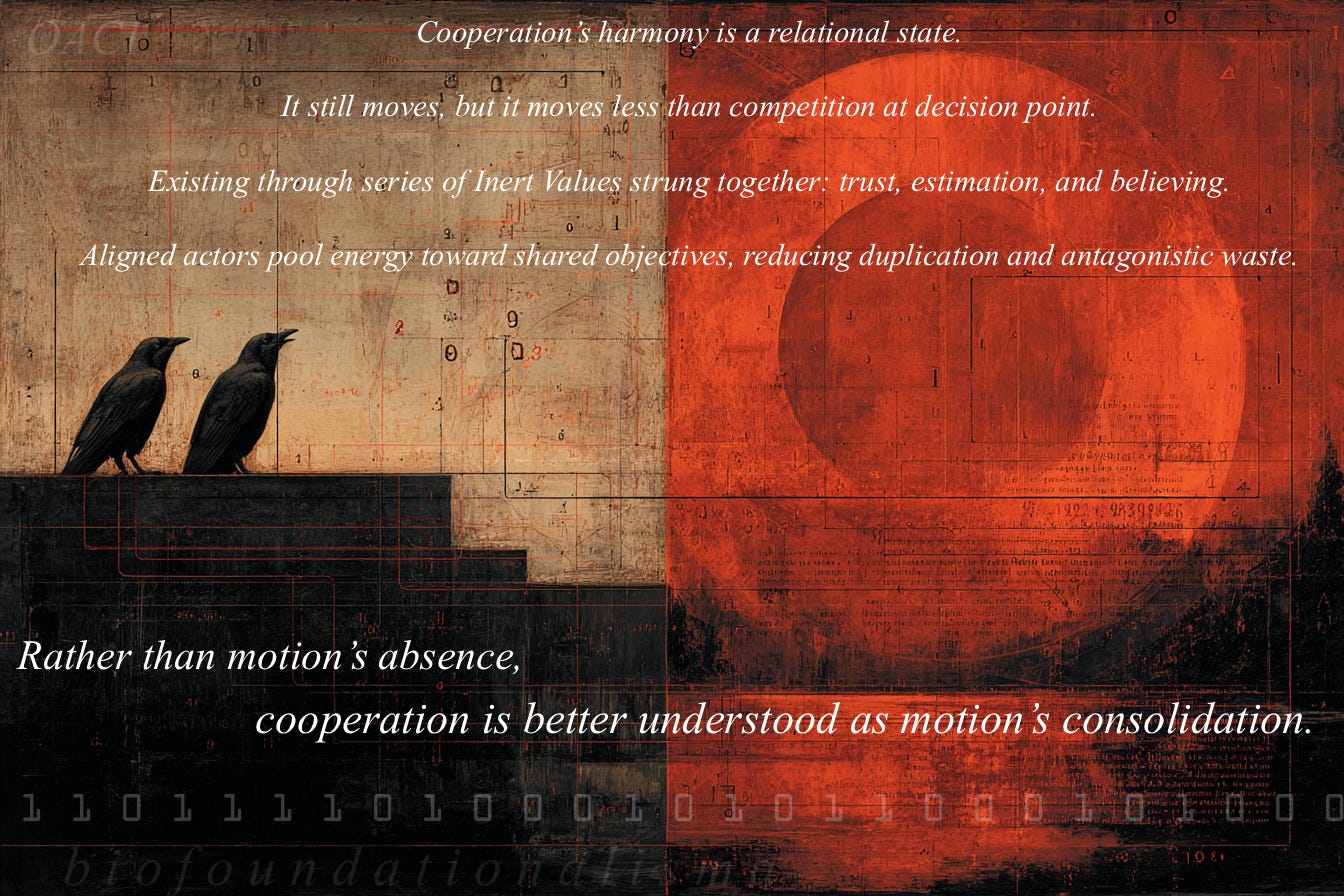
Cooperation’s harmony is a relational state. It still moves, but less than competition at decision point. Existing through a series of Inert Values strung together: trust, estimation, belief.
IMPORTANT: Rather than motion’s absence, cooperation is better understood as motion’s consolidation. Aligned actors pool energy toward shared objectives, reducing duplication and antagonistic waste.
Accountability Acts (0), Grace is (1): Grace is the absence of accountability’s repercussions. You feel grace; you impose accountability.
Discipline Acts (0): The internal maintenance cost of keeping entropy at bay within the self. Waking early, training when tired, denying frivolous urge. Discipline is order applied to oneself.
Impulse Is (1): The default state of desire. What remains when discipline’s restrictions cease.
Without duty’s Obligations (0), you have nothing but Options (1).
By dictate of physical law, only Morality of Motion can produce and maintain order. Values of Meaning are entropy’s vocabulary by category, not volition. The mind’s feelings don’t shift atoms.
Thermodynamic Alien Notes:
Humans experience acute cognitive discomfort when classifying symbols like ‘dignity’ or ‘inclusion’ as entropic.
Emotional response overrides thermodynamic assessment. They confuse “this value is inert” with “this value is useless” despite these being entirely separate claims.
What they call politics is negotiating entropy ratios with socially legible language.
A hot pan doesn't intend to increase entropy as it cools; it reaches equilibrium because nothing acts to sustain the gradient. Dignity doesn't intend to increase societal entropy; it's an inert principle drifting toward equilibrium in the absence of honor's action.
These foundational tensions are how we organize, establish standards, and determine virtues.
Every Acts/Is moral dyad is zero-sum at decision point. You cannot raise both ends of a seesaw at once. As yin expands, yang contracts. Prioritize one thing, deprioritize another. All of life’s a tradeoff.
The Hydraulic Principle: Picture a U-tube filled with water. Push down one side, the other rises. Volume redistributes but doesn’t change. Neither maximized simultaneously.
Energy is conserved: never created or destroyed, only redistributed. Structure and entropy operate similarly. Energy spent sustaining structure is unavailable for dispersal. Energy released to entropy is no longer sustaining structure. Cosmic seesaw.
The Acts/Is dyads descend from these universal laws: oppositional-yet-complementary pairs, each defined in reference to the other. The pattern fractalizes across every level of existence:
Anabolism builds tissue; catabolism breaks it down. Can’t grow muscle while burning it.
Chaotic gas and orderly diamonds. Amorphousness rises as crystalline geometry fades.
Signal is pattern; noise emerges as pattern degrades.
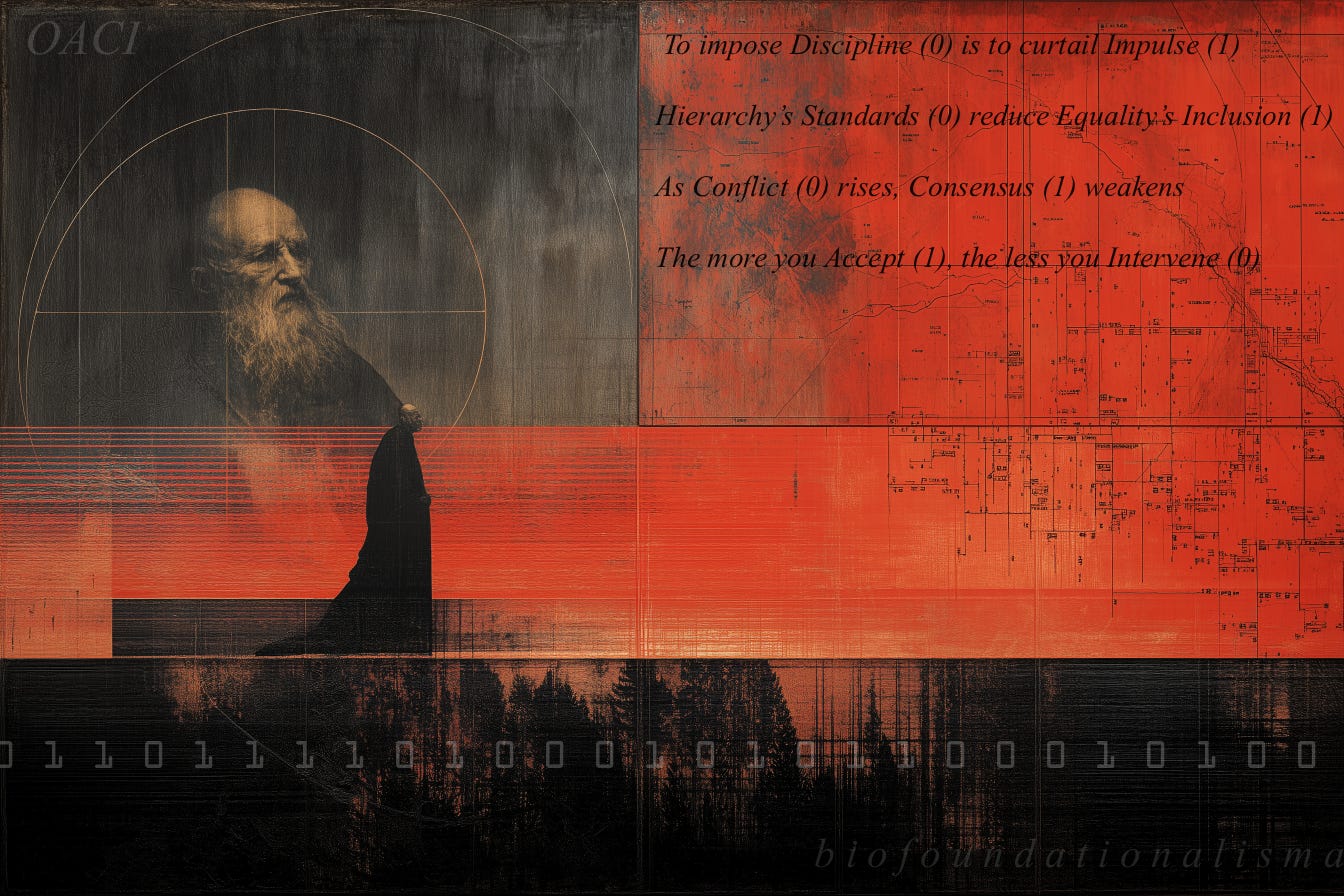
To impose Discipline (0) is to curtail Impulse (1).
The more you Accept (1), the less you Intervene (0).
The greater your Obligations (0), the fewer your Options (1).
Heavy enforcement plus universal mercy yields many laws with no teeth.
The arrangement producing catch-and-release shoplifting epidemics and open-air drug markets in cities technically prohibiting both.
Hierarchy plus equality yields ranks without authority.
A society of ceremonial positions and performative punishments.
Every policy repositions order/chaos ratios, summing to 100%. Politicians who promise to maximize both are either lying or naive.
Successful societies persist by balancing the structure that forms containers with the freedom that fills them. A healthy life oscillates between explore and exploit, obligations and options, risk and reward, accountability and grace. Motion vs Meaning.
A board meeting is highly ordered. A rave is highly chaotic. Life needs a bit of both.
The optimal ratio is situational, shifting with survival pressure and lifecycle. A nation at war needs more order than one at peace. Startups thrive in chaos; established firms do not. A child needs boundaries that would infantilize an adult. There is no absolute answer.
Going from order —> chaos uses less energy and is thermodynamically favored: releasing constraints and reducing effort.
Going from chaos —> order uses more energy and is thermodynamically disfavored: building constraints and exerting effort.
Alien, conservatives often convey frustration at political trends. They say “swims left”. Please explain?
Thermodynamic Alien Notes:
“Swims left” appears to be social scaffolding noticing entropy increases over time and energy gradients favor decay. Everything drifts toward equilibrium as maintenance ceases. This phrase is gradient descent packaged in political vernacular.
Little injections of disorder can gestate greater order.
At decision point, inert values decrement structure’s rigidity for entropy’s flexibility. However virtues like cooperation, dignity, and trust, when blended into disciplined backbone, can telescopically yield far greater motion than naive orderism alone.
‘Naive Orderism’ is an original Biofoundationalism term for myopic fixation on entropy-avoiding actions at the expense of future order. When local optimization undermines global optima.
“Order always good” = naive orderism.
No modern supply chain survives maximal verification. If every actor demanded firsthand proof of each component across global borders, commerce would seize into paralysis. Cooperation’s networked trust enables vastly more atoms to move than stiff competition alone.
Shipping containers move on delegated, not blind, trust. “I will accept your output” is chaos at decision point (no measurement, no verification), but it’s not unsecured. It’s backed by reputation, standardized processes, third-party audits, and the expectation that defects trigger consequences.
Cooperation’s trust is a credit line. It works by reducing skeptical verification redundancies: productively consolidating efforts with little injections of belief and assumption.
By strict Thermodynamic Morality accounting, giving free resources to children is pure entropy! You’re subsidizing those who contribute nothing. A ruthlessly orderly, honor-based system would extract labor as soon as possible, making kids work to demonstrate worth.
A child is the paradigmatic Chaos Dividend. Two decades of ‘deserved’ consumption yields an adult capable of vastly more ‘earned’ production than an illiterate laborer working since age seven.
Kids are tiny bundles of chaotic potential that competent parenting cultivates into orderly participants. When this happens, the dividend pays.
Chaos Dividend: Education creating production over decades. One of the clearest refutations of naive orderism.
Chaos Tax: When the education system optimizes for inputs (enrollment, credentials) rather than outputs (competence), entropic investment begets more entropy. A Chaos Tax.
A high-trust society embeds chaos injections by not always measuring, testing, or verifying. This dramatically lowers transaction costs and coordination friction (fewer guards, lawyers, audits, delays). Productive trust thrives when betrayal is costly. High-trust societies aren’t gullible, rather implicitly high-enforcement.
Handshake deals work when background threat of punishment and reputational harm is credible and predictable.
Chaos Dividend: Trust honored, multiplying cooperation. Chaos in service of order.
Chaos Tax: Trust exploited, subsidizing defection, compelling the system back into heavy verification. Chaos in service of chaos.
Scandinavia’s famous social trust rests on Scandinavian social conformity, ethnic homogeneity, and penalties for deviance. Vitiate the penalties, flood society with foreigners who don’t share the implicit contract, and watch trust evaporate.
Scientific research is chaos by immediate measure. Consuming resources to produce... papers. Speculation. Theory. No direct structural output. A militantly orderly society would defund particle physics and fund only engineering.
This is high-leverage chaos investment. Accountable institutions that convert consumption into capability incubate greater aggregate order than myopic extraction.
19th-century math facilitated engineering in the 20th. Faraday’s electromagnetic tinkering became electrical grids. The disorder of creative inquiry and investment — subject to rigorous method, disciplined exploration, and empirical output — yields Chaos Dividends.
Totems, scripture, statues, and beliefs do not move, but that doesn’t mean they can’t move you. Icons summon armies. Crosses raise cathedrals. Flags defend homelands.
When transcendent meaning like religion, motherland, and beauty mobilizes healthy motion, chaos becomes order's recruitment officer. This is an Orderly Symbol.
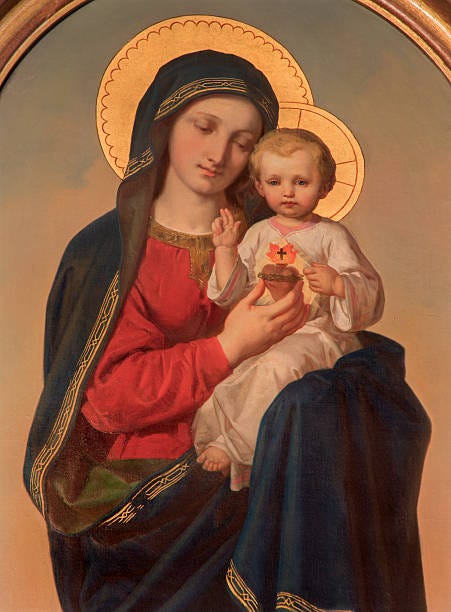
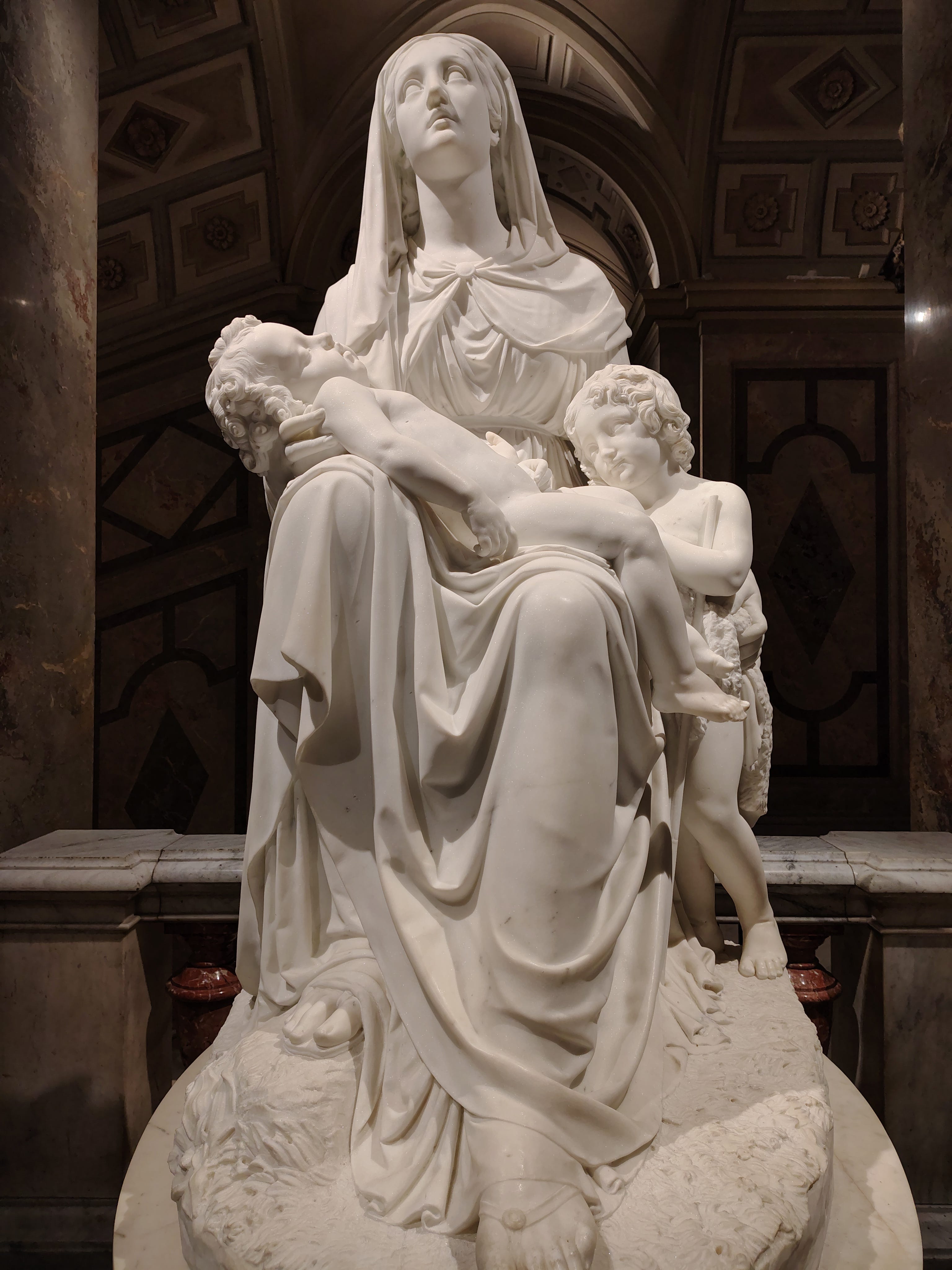
Religious symbolism is saturated with this motif. The apex meaning animating man’s will: protection and propagation of mother and child. No symbol has invigorated more bodies across more centuries. The species survives and flourishes by it.
Mind’s worship must result in body’s service; otherwise it’s a sigil without sacrifice. Emblem lacking effort. Entropy’s favorite disguise is eloquence without enactment, pseudo-profundity that never makes impact. If it has no use, it’s useless. If meaning doesn’t summon motion, it’s meaningless. This is a Chaos Symbol.
Meaning that summons bodies: Teleological chaos in service of order.
Purpose that converts to action. Symbols that successfully actuate. When the faithful build cathedrals, meaning mobilizes mass.
This is the mind serving the body.
Meaning that sedates bodies: Pure chaos.
Philosophy that loops self-referentially without external validation (the mind citing itself as evidence). Stories sowing apathy. When the faithful pray in lieu of service, meaning demobilizes mass.
This is the mind serving itself.
Provide direction for action (telos)
Increase willingness to sacrifice
Coordinate distributed actors toward shared goals
Outlast individual lifetimes, transmitting purpose across generations
Summoning Examples:
Religious commandments specifying behaviors.
Help thy neighbor, tithe, honor thy parents.
Patriotic displays inspiring military service
Statues that make young men want to be worthy of statues.
Substitute for action: “I raised awareness” as terminal achievement
Prioritizes symbolic purity over behavioral integrity; when correct words matter more than correct conduct.
Sedating Examples:
Therapy as self-reinforcing excuse justifying more therapy. Talking about feelings to discuss feelings about talking.
"I'm on my journey" as permanent deferral of obligation. Always “healing” in some way. The examined life, never lived.
Political outrage as product, not catalyst. Commentary as contribution.
Mindfulness as reason to not pursue ambition. Practice becomes the point.
Summoning Variant: Mindfulness as mental preparation for difficult action. Practice serves the performance.
Philosophically philosophizing about that which is philosophical. Bundles of clutter words and inscrutable symbol salads that neither clarify reality nor aid its navigation. Ruminative recursion.
Does meaning replace action or inspire it? If it makes doing nothing feel sophisticated, it’s a Chaos Symbol. If sufficiently resonant, it rouses noble pursuits: an Orderly Symbol.
Taken in Kunsthistorisches Museum, Vienna
These are not dyads; they’re pairs. Here, the inert side is not the Default State but the galvanizing ideal. The action is taken to establish or defend what meaning designates as valuable.
Unlike the previous list, the 'Is' side isn't found through absence of 'Acts'; it's what the action strives for. The soldier needs something worth dying for; the saint needs something worth living for. That’s what this illustrates.
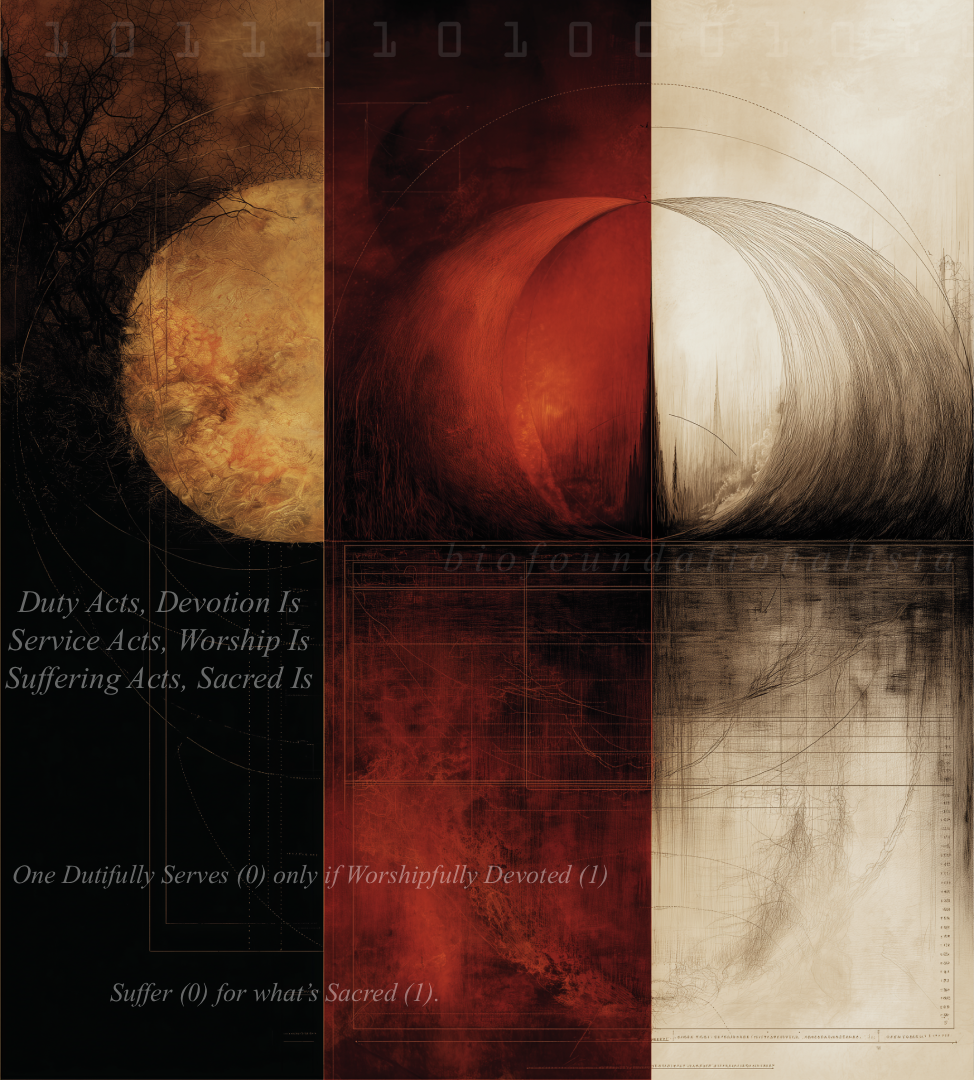
Duty Acts, Devotion Is
Sacrifice Acts, Love Is
Suffering Acts, Sacred Is
Protection Acts, Purpose Is
Service Acts, Worship Is
Shaming Acts, Guilt Is
Risk Acts, Reward Is
Commitment (Input) Acts, Creation (Output) Is
One Dutifully Serves (0) only if Worshipfully Devoted (1).
Love (1) we feel inspires Sacrifices (0) we make.
We Protect (0) what gives us Purpose (1). Suffer (0) for what’s Sacred (1).
Shaming Acts (0): Express disapproval, impose social cost, make judgment known.
You shame so one feels Guilt’s internal burden.
Guilt Is (1): A remorseful state of mind.
Without Reward (1), no reason to take Risk (0)
Creation (1) needs Commitment (0) to bring it into existence.
The finished novel (output) demands nothing from you. The novel you're writing (input) demands everything.
A system of total order (rules without meaning) cannot recruit or motivate. A state of total chaos (meaning without service) cannot persist. Mother Mary Pairs are the coupling mechanism: chaotic meaning summoning orderly motion.
Devotion is meaningless without sacrifice. And sacrifice without devotion is just servitude. A father acts willingly to protect what he loves. A slave does not. We can see how each side depends on the other by looking at them in isolation:
All worship without any service is pure chaos. Nothing acts to defend the object of worship. It’s a mind without a body.
All service and no worship is duty unaware of what’s worthy of defending. It’s pure order. A body without a mind.
Mother Mary Pairs are how religions, civilizations, and beliefs achieve scale and invigorate millions to move. Rome's expansion was driven by gloria (honor through achievement) and pietas (sacred obligations fulfilled); these ideals sent legions marching.
The same symbol can summon or sedate depending on interpretation. The Bible inspires missionary work (summoning) and justifies quietism (sedating). Thermodynamically, a monastery is entropy contemplating the nature of chaos: men sitting for decades. Meditation can prepare warriors for combat (summoning) or excuse withdrawal from duty (sedating). You can’t judge something by self-description, only by how it moves.
Compassion as a terminal value (feeling good about feeling compassionate) is inert and sedating. Entropic.
Compassion as an instrumental value (motivating hospital-building) becomes kinetic and summoning. Orderly.
‘Summoning’ doesn’t always yield constructive results; the Islamic terrorist and Imam read from the same Quran. Chaos can be active or passive. But order is forever active.
A heuristic you can apply to determine the intent behind symbolism:
Orderly symbols point outside themselves. They say: "Because this matters, you must do that". They direct movement.
Chaotic symbols form closed, self-referencing loops. They say: "Because you feel this, you’ve done enough". Self-congratulatory. Self-contained. They curtail movement.
A famous saying: “Amateurs discuss strategy. Professionals talk logistics.”
Biofoundationalist translation: “The chaotic use symbols that are unconcerned with movement. The orderly use symbols that focus on movement.”
Judge meaning not by its elegance but by what it mobilizes.
Bear in mind while reading this next section: I’m an essayist who’s worked in finance and tech. I’ve had physical jobs but have mostly been a knowledge worker. I turn these realizations upon myself too.
Whether you sit to play Mozart, read Nietzsche, or masturbate, it's identical to the house: decaying at the same rate during each.
Objection: “Performing onstage, painting, music, etc. isn’t inert! People move to do them!”
When we say 'inert' or 'seated' it means not taking action upon physical reality to foster order. Are you literally perfectly still? No. You’re always moving somehow. But you’re not maintaining your environment.
At microscopic level it’s called Brownian motion: random molecular jiggling creating no stable structure.
Thermodynamically, these activities are like leaving your car running in the garage: burning fuel, excreting exhaust, going nowhere.
Practicing violin, playing basketball, theater, etc.:
All Idle Motion. The violinist's motion doesn't repair infrastructure, grow food, or uphold systems; it entertains sitting people. One body jiggles for meaning while many inertly watch.
A concert is technically more entropic than staring at a wall alone. The wall-starer doesn’t consume arena-sized electricity and encourage thousands to sit and watch.
Boy what a bizarre way to describe a concert! As alien as it sounds, it’s thermodynamically true.
Remember, we’re recalibrating awareness of our beliefs, rituals, and activities from first-person participant to third-person observer by aggressively neutralizing intentions behind physical acts. Mind’s reasons and body’s effect are separate ledgers.
“Free” meant not beholden to immediate physical necessity. Knowledge and skills appropriate for someone not bound to manual labor. Whose role was to reason, judge, speak, and govern rather than direct manipulation of material reality.
Operate primarily in symbolic/theoretic space
Rhetoric, logic, music, arithmetic, etc.
Are evaluated by coherence and persuasion
Are pursued without immediate physical ramifications
Emphasize judgment/interpretation, not material output
As societies grow wealthy, they increasingly live in the head’s logic instead of the hand’s labor. Prosperity enables retreat from physical reality. Observed by watching how bodies move. Our Alien reviews the following:
Entertainment consumption (totally passive)
Artistic creation (purposeful but non-structural)
Financialization (coordination of real resources vs symbol speculation)
Intellectual work (potentially preliminary to physical output)
Thermodynamic Alien Notes:
When societies accrue stored order (infrastructure) and excess resources (wealth), they progressively shift from embodied atom-manipulation to mental symbol-rotation. We document the following:
1. Elevated creation of abstractions: painting, reading, writing, singing, etc.
“The Liberal Arts”
Complex, layered, intricate symbol sequences
Idle motion performed to make symbols attractive to onlookers.
Sitting and pressing buttons at portals to shift digital symbols in databases.
Not all financial symbols are pure abstractions. Some coordinate use of scarce physical goods.
E.g. “stock” in a lumber company contributes to trees converted to shelter.
Many financial symbols bear no connection to scarce resources
Most “cryptocurrencies” are abstractions looped recursively in decentralized databases, facilitating no physical resource consumption or coordination. No relationship to reality.
3. Enhanced entertainment consumption
Staring at digital symbols on screens
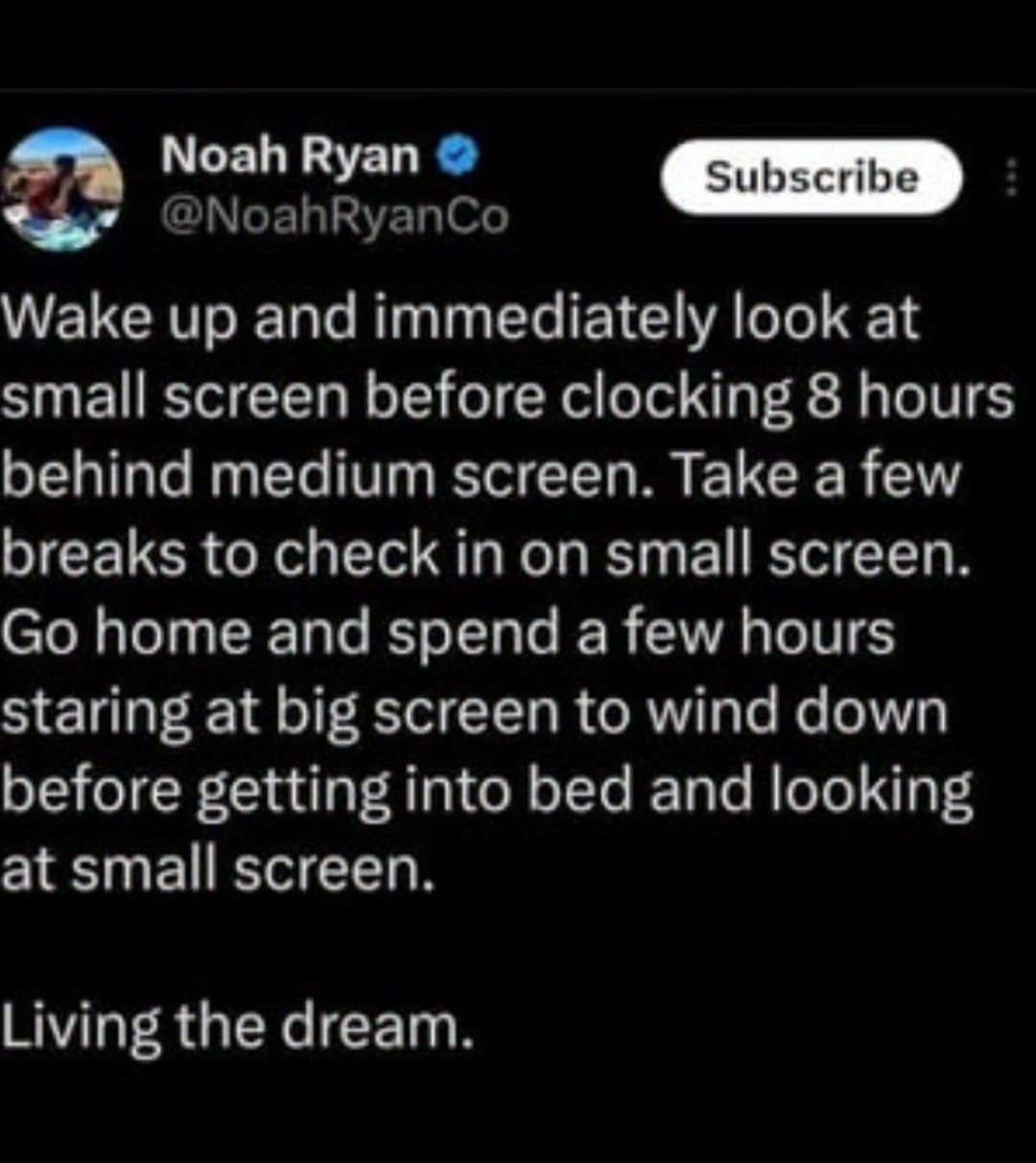
Netflix, TikTok, movies, sports, and other types of vicarious motion. Average human watches bodies move far more than moving their own.
4. Digital portal obsession
Glass rectangle mediates almost entire relationship with world (“computer”, “phone”).
Substantial population stares at digital symbols in portal all day: encompassing work, leisure, recreation, communication, and relationships (“laptop lifestyles” “email jobs” “posting”).
Concluding takeaways:
Computer: digital portal enabling extreme motionlessness
Sitting economy (remote work): millions seated in climate-controlled environments rotating database symbols
Rationalism and philosophy: symbol looping lacking external validation
Empirical verification quite rare. Symbols are self-referenced to demonstrate validity of symbols.
Recursion without exit condition. Exceptionally high rates of inertia.
As societies become decadent, they pursue the Idle Arts: living more in mind, less in body. Liberal arts are valuable, but their value isn’t preservation. They’re a form of Mother Mary Pair: something we cherish that provides purpose.
Objection: “Writing code, designing buildings, legal work, planning campaigns: these are mental activities leading to order.”
Yes, when it results in future motion (Chaos Dividends). Abstractions must ultimately actuate. Idle Motion is useful when preliminary to tangible output; it’s pure entropy when it’s the terminal goal.
The architect’s drawings precede skyscraper (physical object). The general’s strategy precedes victory (execution). Shakespeare’s plays synchronized productive social standards. Whereas watching Netflix encourages you to sit and watch more Netflix. Not all meaning is created equal. It’s easy to tell if it’s productive or passive: look at what it does to bodies.
US GDP is ~80% services, ~10% manufacturing. In 1950, it was ~50% services, 27% manufacturing. A country that once built things now mostly narrates them. An economy dominated by email artisans and spreadsheet thespians, served by skeleton crew of atom-movers. For every person servicing physical infrastructure, six circulate symbols about it. This arrangement is fine... until the ratio shifts too far. Then entropy rises faster than order resists it. What’s the sitting-economy threshold before the whole structure starts to sag?
Knowledge workers live in their heads: remote work, email jobs, abstract production.
Their status derives from inert symbol-rotation: credentials, verbal fluency, institutional navigation, managing procedures.
They experience the world through screens and succeed by manipulating perception.
Trade and service workers live in their bodies: presence required, physical output, concrete results.
Their status derives from kinetic production: repair, build, grow, fix.
They experience the world through reality’s friction and succeed by solving material issues.
The ruling class is almost exclusively disembodied. Their expertise is moving words to manipulate consensus, not moving atoms to maintain structure. They reside in digital maps and unwalked territories. When policies fail in reality, they typically respond by narrating it differently.
Too many seated-economy symbol-sequencers governing motion-manufacturing atom-maintainers. The mismatch is starting to show.
So much meaning, so little motion. All these tidbits of idleness add up…
These are genetic predispositions, both heritable and measurable. This is our focus.
What’s leftwing is not always liberal; what’s rightwing is not always conservative. Strip away rhetoric and modern Republicans are barely conservative on an absolute basis; they’re ‘rightwing’ only by comparison to ‘leftwing’ counterparts. And Democrats certainly aren’t liberal on all issues. Parties are shifting coalitions of contrasting order/chaos ratios clustering along the spectrum of conservative authority and liberal freedom.
In practice, there’s no such thing as perfectly liberal or entirely conservative. Just as there’s no such thing as unmitigated chaos or unqualified order; there’s always a little bit of entropy or structure present at some degree. However, that doesn’t mean we pretend that the column of a building isn’t vastly more orderly than a puddle on the ground. While there isn’t an unalloyed version of either pole, there are abundantly clear, measurable categorical distinctions.
Some ideologies considered ‘leftwing’, like communism, have extremely pronounced authoritarian hierarchy and high-order societies.
Communism imposes strictly enforced rules and militant top-down command. Referring to this ideology as liberal/leftwing focuses only on economic policy (equal distribution of resources, deserved and not earned). We find this odd and misleading. These are high-motion regimes.
Communists are authoritarians with different resource-distribution protocols. They are exceedingly structured and hierarchical.
Whereas parties considered ‘rightwing’, such as libertarianism, tout substantially weaker hierarchical organization and reduced internal rules in favor of ‘freedom’ (constraint removal).
This ideology is fundamentally lower motion, favoring entropic erosion of structured conditions. Again, referring to it as conservative/rightwing focuses only on economic policy (resource distribution based on contribution, earned and not deserved).
It’s unclear why libertarianism is not considered a ‘liberal/leftwing’ system when its core principles are reduction of authoritarian command and diminished restrictions.
The terms 'left' and 'right' package conflicting dimensions. Thermodynamically, we focus on order/chaos and energy gradient (bodily motion).
Humans refuse to recognize organizational doctrines on thermodynamic grounds. This results in misnomer political categorizations where an ideology is deemed ‘conservative/rightwing’ (orderly, authoritarian) or ‘liberal/leftwing’ (chaotic, egalitarian) while possessing only some of these characteristics.
Requires: Infrastructure, active patrol, legal proceedings, physical removal
Is: Amnesty, sanctuary cities, inclusion, asylum, pathway to citizenship
Requires: Not enforcing borders, not deporting, not upholding immigration laws
Thermodynamic Alien Notes:
Humans create land-based containers defined by “borders” with permeability gradient: filters that admit some and exclude others.
Maintaining steep gradient (perimeter) requires continuous energy expenditure. Higher movement observed.
Flattening gradient occurs through cessation of activities. Energetically cheaper. Accompanied by symbolic declarations (“no human illegal”, “compassion”).
“Open borders”: symbol advocating total dissolution of gradient. Encouraging flow from chaotic exterior (regions impoverished or at war) to orderly interior. High entropy.
Acts: Arrest, investigate, prosecute, universal enforcement, heavy punishment
Requires: Extreme confrontation, trial, imprisonment. Very energetically costly
Is: Community trust, de-escalation, rehabilitation, selective enforcement (social justice), decarceration, second chances
Requires: Not punishing, not prosecuting, reducing imprisonment, not confronting. “Defund the police”.
Thermodynamic Alien Notes:
Observation: when diminished enforcement fosters entropy, the liberal response is not to increase motion but to intensify symbol rotation.
This is diagnostic: meaning-orientation responds to failure with different meaning. They emphasize narration of the structure, not its preservation.
Acts: Rigorous testing, competitive selection, exclusion of unqualified, hierarchies of competence, disciplined meritocracy
Requires: Continuous evaluation, standard enforcement, rejection
Is: Equality, grade inflation, participation awards, reducing standards to include (diversity/DEI)
Requires: Not testing, not maintaining hierarchies, not disciplining, not failing students, not applying standards uniformly
Example: Colleges and corporations modifying admissions/hiring based on race (essence, intrinsic) rather than merit (actions, extrinsic).
Standards are filters. Filters require energy to uphold. Remove the filter and everything passes through (inclusion). Thermodynamically cheap.
Acts: Work requirements, time limits. Earned with effort.
Requires: Fraud investigation, means testing, denying benefits
Is: Universal basic income, guaranteed housing/employment. Deserved by essence.
Requires: Not means testing, not verifying eligibility, not denying claims. The policy is defined by what it doesn't ask of you.
Thermodynamic Alien Notes:
Liberal symbols exhibit more consistent propagation rates. We find this is due to lower adoption costs. Things you say that reduce effort are easier to promote than things you do that increase effort.
Organisms in aggregate adopt behaviors based on energy economics, not moral philosophy. 'Sit And Get' needs no convincing. 'Move To Earn' requires continuous exertion. The thermodynamics of persuasion favor entropy.
Privatization: weakening centralized state for distributed market
Federalism: undermining hierarchy, diminishing government authority
Laissez-faire: government abstaining from intervention and top-down command
Liberalism is ascendant in prosperous societies for reasons our Thermodynamic Alien finds painfully obvious: would you like to inertly receive things or kinetically work for things?
Thermodynamic Alien Notes:
Puzzling semantic inversion observed.
Low-motion groups use high-motion terminology:
"Progressive" suggests high movement
"Activist" implies action
"Resistance" connotes force applied
Yet the policies prescribed are predominantly subtractive: don't enforce, don't exclude, don't require, don't distinguish.
"I'm an activist for social justice": semantically active but operationally passive. Captures rhetorical appeal of motion without incurring its metabolic costs.
Whereas high-motion groups use low-motion terminology (“conservative”, “traditional”), suggesting stasis. Yet this often entails elevated energy expenditure to maintain structure. Signals modesty, understating cost.
The descriptions are thermodynamically inverted. One overstates motion; the other undersells it. Discourse is corrupted at the level of vocabulary.
We move because we must and sit still because we may.
Liberal values reside in the mind. Requesting motion decrease for meaning.
Existing in the negative space where exclusion ceases and consequences abate.
Values of Meaning are prized by essence. Valuable for what they are.
Conservative values express through the body. Requesting motion increase for structure’s service.
Morality of Motion is prized for output. Valuable for what it does.
The liberal framework deploys meaning to justify elimination of orderly filtering: “Equality” tickles the brain’s kindness bones. “Dignity for all” strikes a lovely cognitive chord.
“Trust” “Believe” = Don’t verify or investigate
“No human is illegal” “Open borders” = Don’t maintain perimeter
Each phrase sounds active while prescribing passivity. They’re semantic anesthetics, numbing the body’s barriers by making inaction feel refined. Why enforcement is primitive. Why maintenance is cruelty. Why order is oppression. Why mind’s feeling is enlightenment and body’s forum is regressive.
There’s little more consecrated to liberal temperaments than ‘human rights’. Alien, what’s that?
Thermodynamic Alien Notes:
Human rights are entitlements received for existing: status, protections, or material support granted by declaration rather than contribution.
You get a "right" by simply being, not becoming. Bestowed for essence (intrinsic), not merit (extrinsic).
The concept is coherent in societies with excess to grant entitlements without reciprocal contribution. Subsistence societies have few "rights" as there’s little to hand out to non-producers. Rights are luxury goods of civilizational wealth.
When rights expand faster than the productive base funding them, society writes checks it can’t cash. The math eventually enforces itself.
Thermodynamic Alien Notes:
We find it curious how conservative groups express confusion when social standards “swim left”. This is equivalent to surprise that water flows downhill or an oven cools when unheated. Entropic gradient descent is law of physics. All things “swim left” given sufficient time.
Liberal groups promote reduced maintenance efforts and free resource provision for existence. Conservatives seem unaware their stances entail more energy (work) for same, or reduced, benefits.
Liberal values are thermodynamically favored: less work, more receipt
Conservative values are thermodynamically penalized: more work, less receipt
“Swimming left” is not mysterious. It’s simple incentive-following and thermodynamically coherent. Societal dissipative structures drift toward equilibrium as maintenance declines and resources are distributed independent of contribution.
Organisms do not work for energy when energy is simply provided to them. Their habits are products of habitat. This is obscured because humans insist on narrating incentive-following as moral accomplishment.
The cosmic seesaw has a weighted end. Gravity is not bipartisan.
Given the choice between ‘Move To Earn’ or ‘Sit And Get’, dissipative structures opt for paths of least resistance.
Energy flows toward lower potential, and civilizational energy flows the same way. The mind’s punditry obscures this physical reality.
The liberal wins by preventing action; the conservative wins by increasing action. One fights gravity; the other surfs it. This thermodynamic asymmetry is at the heart of perpetual conservative bewilderment.
Merit is honor’s son. Extrinsic effort, because you have to. Becoming.
Human rights are dignity’s daughter. Intrinsic essence, because you get to. Being.
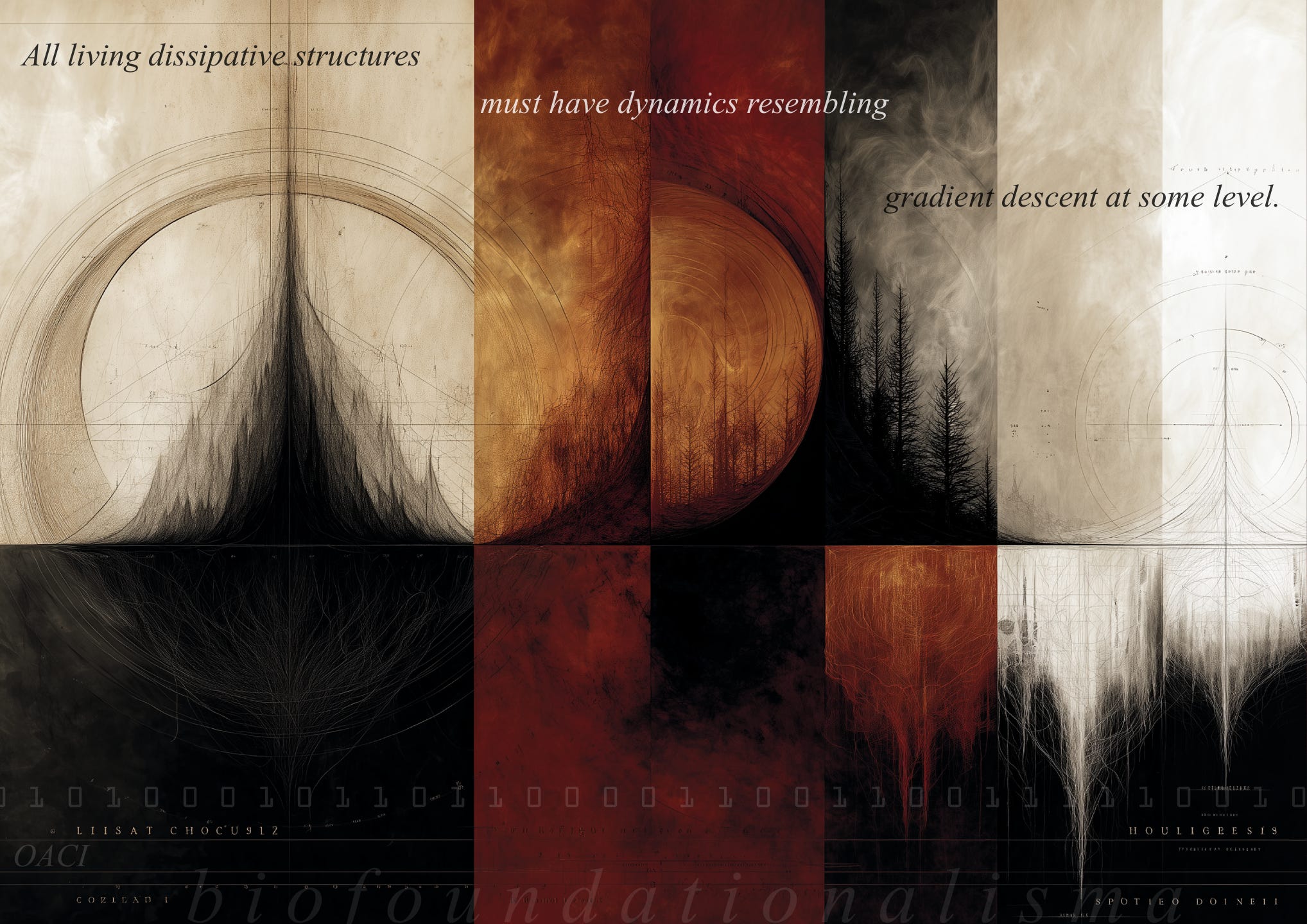
We respond to incentives. When “As you are” prevails over “As you do”, the system incentivizes inaction. All living dissipative structures must have dynamics resembling gradient descent at some level. The organism known as ‘country’ is not immune nor an exception.
The Acts/Is framework doesn’t tell you which to choose; it tells you what each costs.
Order is not ‘good’, chaos is not ‘bad’. Order is expensive, chaos is free.
Entropy is gravity’s destination. Structure is a detour.
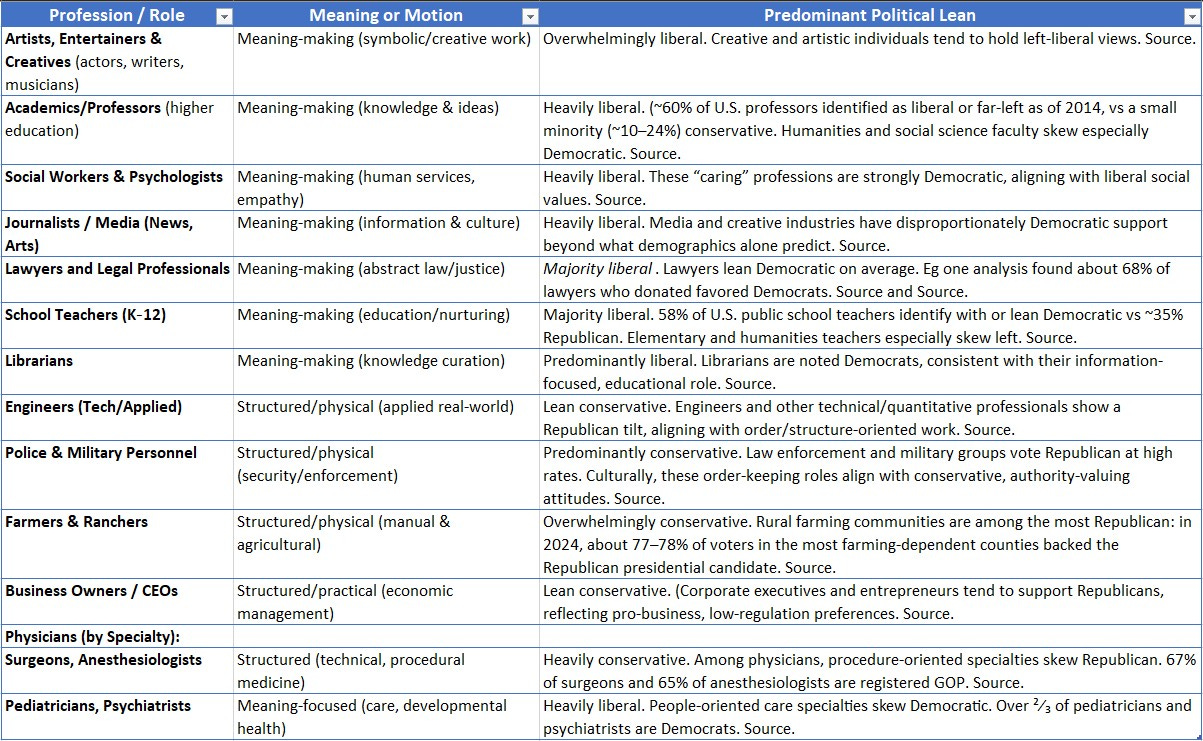
Hello Alien, give us an idea of how professions oriented by Motion vs Meaning tend to vote.
Thermodynamic Alien Notes:
The delineation is best understood as people whose primary job is to keep failure rates down vs people whose primary job is to produce legitimacy stories.
Failure-rate occupations: Falsifiable. If you do your job wrong, something breaks, someone dies, or money disappears in ways that cannot be narrated away.
Legitimacy-story occupations: Largely unfalsifiable. If you do your job wrong, the consequence is disagreement about whether you did it wrong.
This list is not comprehensive, however preliminary results are not surprising. Those who fight entropy professionally prefer order-leaning politics. Those who narrate entropy professionally prefer meaning-focused politics. These are not absolute correlations but compelling clustering effects.
Order’s obligations are prerequisite for chaos’ options; the reverse is not true. You need the skeleton before adding fat. Gotta have walls before hanging art. You cannot fill a cup that hasn’t been formed.
Build strong economy (order) → distribute surplus as welfare (chaos)
Establish rule of law (order) → show mercy to specific violators (chaos)
Maintain high standards (order) → make compassionate exceptions (chaos)
Secure borders (order) → welcome refugees (chaos)
Start with welfare (chaos) → build economy (order)? No, you’re distributing what hasn’t been created.
Start with mercy (chaos) → establish justice (order)? No, you’re forgiving what hasn’t been enforced.
Start with inclusion (chaos) → build standards (order)? No, you’re excepting what hasn’t been required.
Start with open borders (chaos) → secure perimeter (order)? No, you’re defending what hasn’t been defined.
Rome built roads, laws, and legions (order) before enjoying bread and circuses (chaos). When decadence consumed more than legions could sustain, Rome fell. The postwar West built industrial economies (order) before its welfare states (chaos). Wealthy Westerners mistake their ancestral inheritance for the natural state of things.
Thermodynamic Alien Notes:
What conservatives identify as security, liberals construe as oppression. What liberals interpret as freedom, conservatives experience as destruction.
This is not disagreement over facts. It’s whether maintenance of gradients is fundamentally desirable. One sees boundaries as survival; the other sees them as confinement.
They possess antithetical entropy-ratio preferences.
Enforce justice rigorously, and you can choose mercy in specific cases. Start with mercy as baseline, and justice becomes impossible; there's nothing to forgive because nothing was prohibited. Mercy’s meat lives on justice’s skeleton. Forgiveness of everything is indistinguishable from permission of everything.
You can only afford to include after exclusion has built something worth joining. Exclude based on standards, and you can welcome exceptions. Start with inclusion as default, and standards never materialize. Membership means nothing when everyone already qualifies.
Patrol borders vigilantly and you can choose who to admit. Start with open admission, and borders are irrelevant. You cannot welcome people 'in' when there is no 'out’.
Civilization is galvanized by chaotic ideals, not built by them. The liberal mind entices the conservative body… “If you move well now, you can move less in the future…” Wealth gradient informs motion gradient: poor nations do physical labor because they have to, wealthy nations do meaningful work because they get to.
Every act of mercy that doesn’t punish withdraws from order’s surplus.
Every instance of inclusion undermining standards degrades the lattice it exists upon.
Every compassionate justification to remove boundaries weakens the structure permitting the compassion.
Each instance of non-maintenance is a loan against the future.
An orderly mind
The activist needs a legal system to protect her protest, infrastructure to broadcast her message, and wealth to fund her causes. She borrows from order’s account to write checks for entropy’s equality. Chaos can only spend what order has saved.
Thermodynamically, equilibrium is indistinguishable from death. For biological systems, it means literal death. As an organism decomposes, its matter becomes undifferentiated from its environment. It returns to the soil.
Strong men, good times, weak men, hard times? Biofoundationalist translation:
Kinetic body creates order’s prosperity (gradient accumulates energy)
Scarcity forces kinetic body to restore order (equilibrium, rebuild gradient)
The hard-times generation is resource-constrained, necessitating acts that build surplus. The good-times generation is resource-permitted, enabling inertia that consumes it. Survival because you must, luxuries because you may. Our habits emerge from our habitat.
Nation that celebrates being over becoming ambles toward equilibrium’s Default State just as oven cools when nothing heats it. Civilizations carry a Maintenance Debt: every institution unmaintained, every standard unenforced, accrues interest in decay.
Physics manifests through ideology; chaos expresses through policy; civilizations decline not because people become evil, but they cease sustaining society’s orderly patterns. Entropy that reclaims unmaintained houses also reclaims unmaintained nations. It’s dissipative structures all the way down.
Civilization is a living thing by virtue of being composed entirely of living things. Society’s shape is an aggregate of our individual actions. You are a cell in its body; your motion matters.
Do your political beliefs live through hands or head? Sideline the mind: look how it moves, not what it says.
Does it advocate building and maintaining, or redistributing and removing? Should others earn resources or deserve them?
Is my stance high motion (demanding someone work/accumulate) or low motion (making someone refrain/redistribute)?
Be aware of which force you reliably serve.
Separate yourself from moral narration by asking: “What does the alien see?”
Meaning without motion is hallucination. Motion without meaning is subjugation.
A life lived only in the body is barren of joy and purpose. A life existing only in the head is devoid of structure and coherence. Without order's bones, nothing can live. Without chaos’ color, nothing is worth living for. But the mind must know its place: it fulfills the body's survival and health first, itself second. It thrives through bodily service and becomes a tyrant of unmoored, narcissistic fantasies when answering only to itself.
I sat while writing OACI. Participant in the sitting economy, practitioner of the Idle Arts. An entropic force consuming energy, rotating symbols, producing no structure so that I may infuse you with unorthodox meaning.
Like all things behind a screen, this essay is a chaos injection. But that doesn’t make it a Chaos Symbol. Does it serve greater order or subvert it? Does it clarify reality or obfuscate it?
Chaos Symbols reference themselves in closed loops. Orderly Symbols point outside themselves to the external world. This essay is the body’s confession. Which direction do its symbols point?
While transcendent emblems like Mother Mary are beyond the scope of a Substack post, we can still aim to summon, not sedate, with language. Analysis is nothing without application. If what we stare at later benefits what we do, then chaos has served order. Biofoundationalism aims to humble the head so it aligns with the hands: an Orderly Symbol.
A humble mind knows its place: it either serves the body’s reality or its own delusions. When someone insists their thoughts are what’s real rather than what’s outside their skull, it’s grounds for an insanity plea by a defense attorney. The mind’s floating chaos is rooted by the body’s boundaries. If you live inside your head, you live inside a dream.
Traits of the disembodied: treating internal states as external facts. Identity is declared rather than demonstrated. Problems renamed rather than solved. Consensus substitutes for verification. Thinking is the goal of thinking. Feelings supersede evidence. Shuffling financial symbols instead of building wealth. Sentiments are their reality. Chaos looping without exit.
To dwell in the mind is to exist in fantasy. Disregard the body and you’ll eventually wake up in a nightmare.
When body and mind clash, the body wins. Not metaphorically, physically.
A statement so obvious it shouldn’t need saying, yet it circulates as epiphany among the terminally online. Why? A population residing in its head has forgotten the body’s primacy, noticing we mistook elaborate permission symbols (credentials, consensus, approval) for external constraints. We’re realizing the cage is imaginary. The bars are made of thoughts.
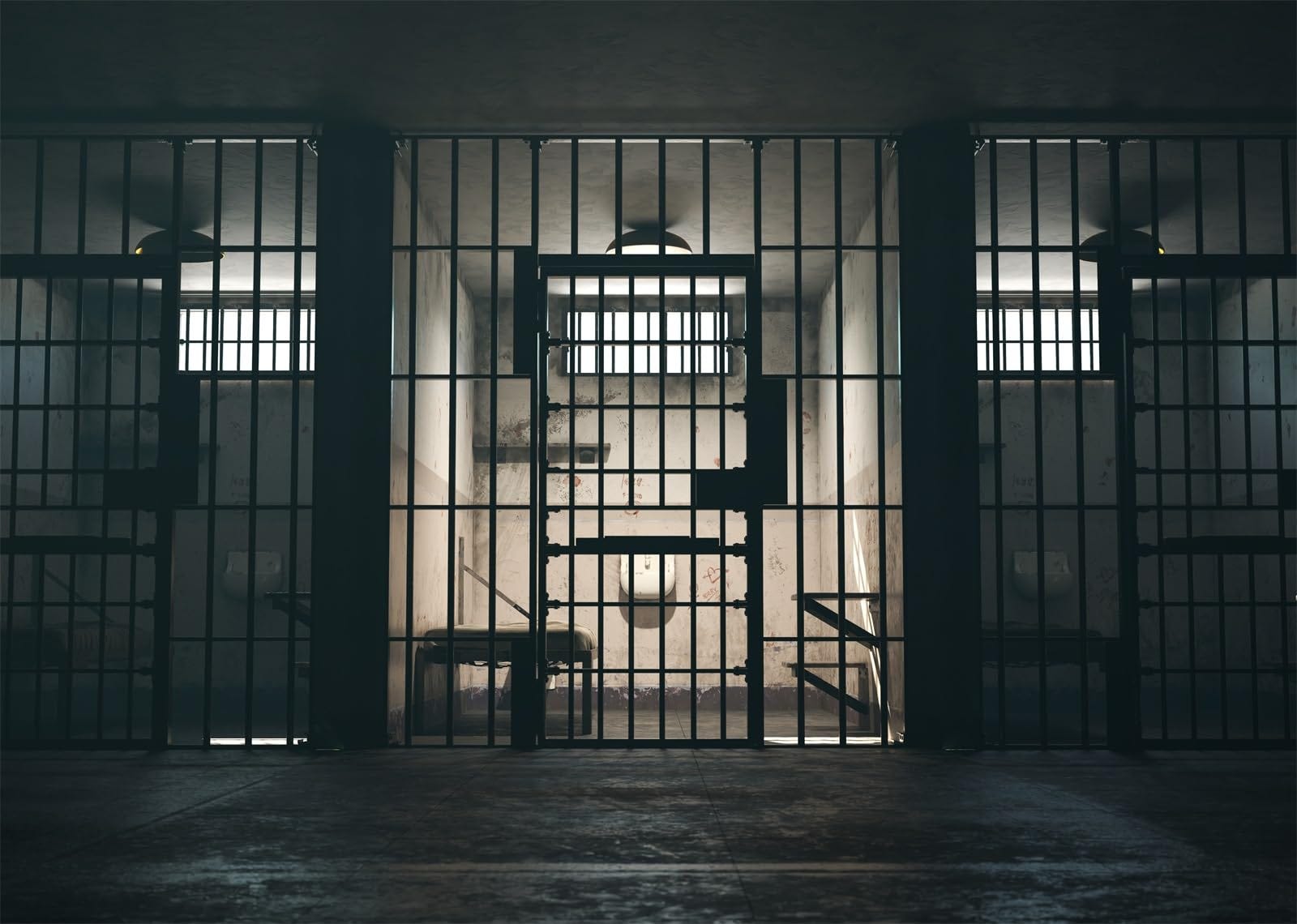
It tacitly recognizes the chaos chamber between our ears often lulls us into fear’s indolence. The prison is inside your head! Which we understand deep in our bones means ‘not real’. The revelation: you were always free to move.
It also surfaces the hierarchy of What Acts vs What Is; it’s not a partnership of equals. The asymmetry is in dispute resolution. When the two cannot reconcile, how is it settled?
When flesh and feelings clash, movement wins. For simple reason: actions determine outcomes. Minds excel at ornate speechcraft while hands speak bluntly by ending the conversation. History is written by those who showed up with weapons, not words. The pen is mightier than the sword only if the pen summons swords. Injury to feelings can’t kill you; wounds to flesh can. Dominance is a mode of motion, not a frame of mind.
The Acts/Is dyads embed this resolution device. If mind begs for mercy and body insists on justice, justice prevails. Bodies can just do things.
Minds petition. Bodies coerce. A diplomat is the mind’s reasoning. A soldier is the body’s rationale. When diplomacy fails, violence resolves. The kinetic is the supreme authority through which all other authority flows. Ultima ratio regum: the final argument of kings (bodies).
Without physical backing, thoughts are impotent. Without corporeal organ, brain vanishes. Mind is forever beholden to its earthly vessel; however, the body isn’t dependent in quite the same way…
Recall earlier I said: “Pure order is living in a prison. Pure chaos is swimming in an ocean”. You can survive in a prison. Wretchedly, but you persist. Whereas you perish in the ocean. Prison can be understood as body without mind. Ocean as mind without body.
There are real instances of this:
Sponges: multicellular animals, no nervous system, respond to water flow
Bacteria/microbes: single cells, no neurons
Amoebas and slime molds: single cells, no neurons, make decisions via biochemical networks
Placozoans: Flat multicellular animals with no organs, nerves, or muscles
A flat, creeping blob without defined front/back or left/right
Extreme parasites: Animals without nervous system or gut. Meat machines lacking plausible substrate for thought.
Jellyfish: No brain or heart. Nerve net detects/reacts to stimuli sans centralized processing. Yet they hunt, reproduce, propagate.
Bodies without minds exist, executing survival programs through mechanistic processes. They live. Miserably. Like a worm. Like bacteria. It’s a hollow, soulless existence, but it fucking survives. The amoeba lacks interiority, yet has outlasted every civilization.
NOTE: At this scale things get partly semantic. Are brain and mind synonymous? If you broaden ‘mind’ so any goal-directed regulation counts as cognition, then bacteria and cells have ‘minds’ in an extremely minimal sense. I’m not dismissing this conceptualization; it captures real capacities. But it stretches the notion of ‘mind’ beyond scientific usage. It’s entirely within mainstream biology and neuroscience to describe these organisms as bodies without minds.
The asymmetry for the inverse is resoundingly clear.
Body is unequivocal bedrock for mind’s existence. Not a partner, a prerequisite.
While others can debate whether slime molds have ‘minds’ under expanded definitions, there isn’t a single documented instance of mind without body. No examples, evidence, or ambiguity. Uploaded consciousness? LLMs? We’re still describing substrate. Silicon instead of carbon. A body wearing different meat.
A bodiless mind is a fiction. Chimerical thought exercise. It’s so fanciful only a mind could dream it up! An ethereal cognitive being, relieved of its biomass. What would that even look like?
It lacks physical form. No earthly presence. So definitionally you can’t depict it, because… what’s to depict? Nothing gives it shape. Is it a spirit? Ghost? Figment of imagination? Perhaps an… ideal?
The body’s temple is restriction. Limits, finitude, and constraints are corporeal conditions. Gravity binds you. Hunger compels you. Mortality humbles you. Infinity is absence of limit, absence of boundary, absence of constraint, just as chaos is absence of order.
(Referencing Acts/Is dyads: recall which side emerges through absence)
This cognitive being would have no demarcation or spatial parameters, perhaps no temporal location. Doesn’t have to resist entropy or decay. Quite poetically, the notion of mind liberated from body is what all minds venerate most. The ultimate object of our mind’s worship is its own emancipation.
From secular atheist to religious theist, we find a similar divine wish:
Christianity: eternal soul in heaven (transcend body)
Buddhism: escape cycle of rebirth in nirvana (transcend body)
Judaism: Resurrection, life beyond death and decay (transcend body)
Islam: Resurrection, immortal eternal life (transcend body)
Atheist transhumanism: upload consciousness to silicon (transcend body)
Hinduism: liberation from samsara’s rebirth cycles (transcend body)
Platonism: realm of perfect forms (transcend body)
Jainism: liberated soul attains pure consciousness (transcend body)
Gnosticism: material world as prison, spirit as true self (transcend body)
Sikhism: release from reincarnation (transcend body)
Neoplatonism: ascent of soul toward the One (transcend body)
“Transcend body”: No more gravity-bound, entropy-governed metabolic machine. Some traditions imagine bodiless liberation; others imagine its numinous elevation. Regardless of spiritual packaging, the pattern holds: continuity without rot or weight.
It’s a human universal to seek salvation freed from burden of meat. Believers and rationalists. Mystics and technologists. East and West. Ancient and modern. All converge on the same dream: to live forever inside a dream.
Across societies, cultures, and timelines, mankind exalts the highest Elysium he can fathom. For some cultures, it’s sacrilege to portray this limitless being; giving it contours disrespects its celestial everlasting continuum. It cannot possess form because form is boundary. It must be eternal, as death is the body’s poverty.
The mind’s holiest ambition is its own escape, yearning for consciousness untethered from matter. What do we call a supernatural mind that’s transcended body?
Traditions have another word for Infinity…
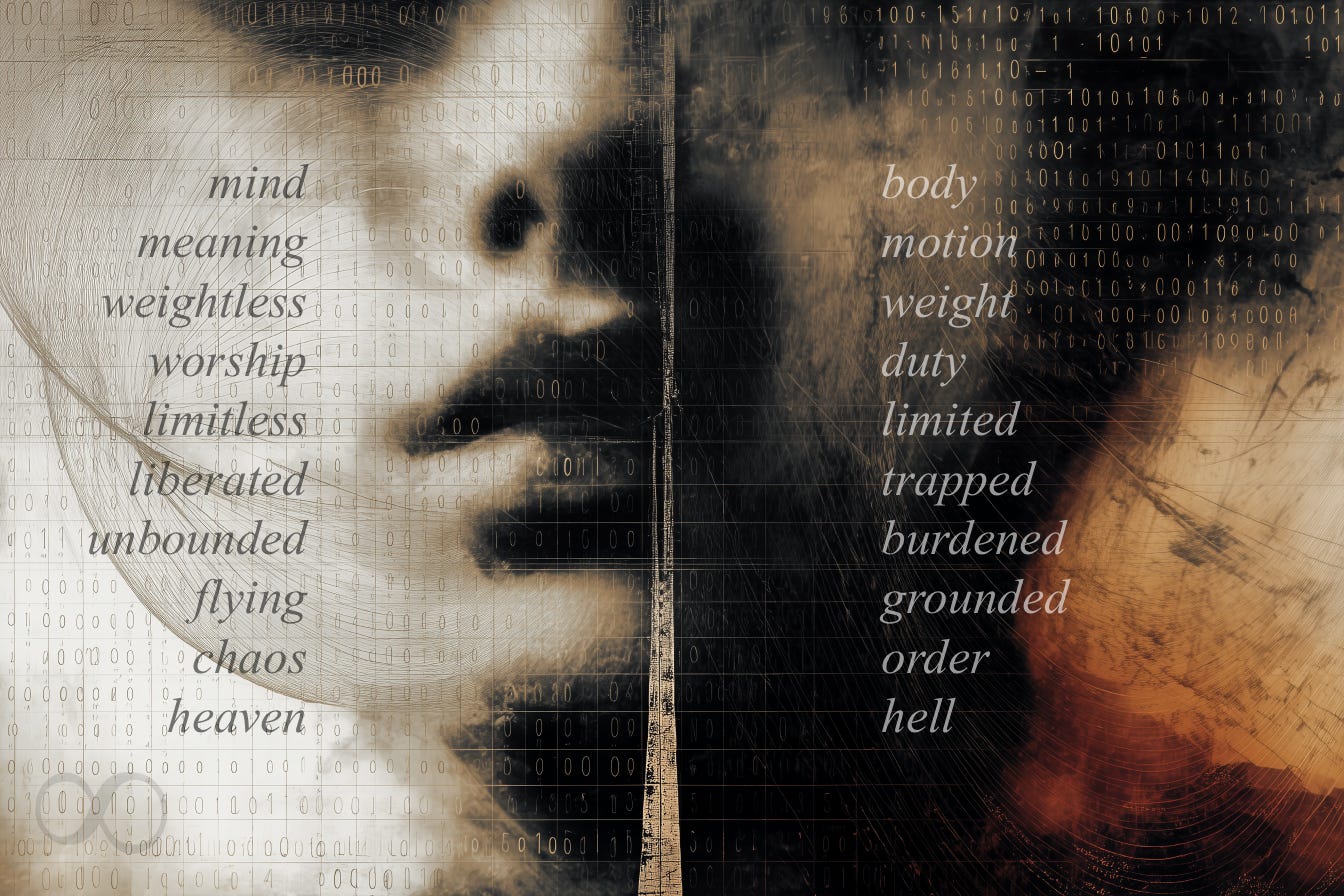
Heaven is the Kingdom of the Mind. Hell is the body’s eternal suffering.
Paradise is escape from flesh. Damnation is imprisonment within it.
What do we promise the faithful? Not better bodies, the absence of bodies. To exist evermore in the Default State without struggle. Chaos as salvation. An ocean you can fly in. Heaven is pure mind, forever.
What do we threaten the wicked? Permanent embodiment. Matter that never escapes itself. Tormenting sentience of endless suffering. A prison of purposeless pain. Flesh’s permanence. Hell is pure body, forever.
These archetypal spiritual destinations arise from the deepest representation of what we perceive ourselves to be: minds trapped in bodies. Meaning seeking relief from Motion’s weight.
Humanity’s single greatest piece of meaning is the sacrosanct aspiration of mind shedding bodily jurisdiction to live eternally in Sacred Infinity. Entropy’s sanctified resting place, where gravity is the wind beneath your wings.
Order’s ethics are bounded obligations. Embodied.
Chaos’ values are infinite optionality. Unembodied.
We attempt to transcend the body’s restrictive Morality of Motion by striving toward the mind’s limitless Values of Meaning. In doing so we reach, however subconsciously, for our conceptualization of God.
Ascending toward divinity on a Tower of Babel atop databases, the mind’s chaos undoes itself, flying too close to the sun. As we approach heavenly equilibrium, flesh on earth sternly reminds us, we worship what we cannot be. Finite minds confined to finite forms, improving finite world, dreaming of Infinity.
“Thy kingdom come, thy will be done, on earth (body) as it is in heaven (mind).”




Comments
Nothing yet. Say the first thing.
Sign in to join the conversation.