
Not too long ago, great white sharks remained largely absent from the East Coast imagination. Spotting one along the Mid-Atlantic felt like something that was supposed to happen somewhere else—in places like California, South Africa and Australia. The Atlantic seemed little more than open water en route to someplace more familiar.
This June, a sport fishing crew off Virginia Beach encountered a nearly 15-foot great white that surfaced alongside their 30-foot center console, circling the vessel roughly 26 miles offshore near a Dominion Energy wind turbine. The interaction was captured on video, reported by news outlets, and shared widely online.
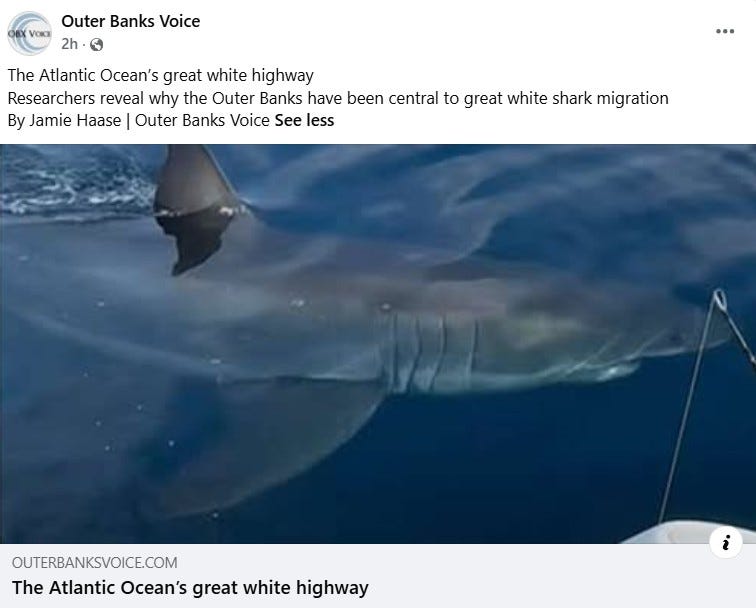
A little over 100 miles south along the coast, the waters around Cape Hatteras and Ocracoke are among the Atlantic’s most biologically productive, influenced by the continental shelf and the surrounding ocean currents. It is there that OCEARCH has tracked numerous great whites, including Contender, one of the largest ever tagged. Together, these and countless other observations have reshaped our understanding of great white movements along the East Coast.
Two developments help explain why these sharks have become so much more visible along the East Coast. The first is ecological. As seal populations rebounded following federal protection under the Marine Mammal Protection Act of 1972, great whites likewise followed their prey closer to shore. The second is technological. Aerial drones, acoustic tagging, satellite tracking, and other advances in marine science have transformed our ability to monitor sharks that were always present but observed less frequently.
Advances in long-term tagging technology and expanding research programs beginning in 2012—reinforced by multiple studies published between 2022 and 2026—have shown not just where Atlantic great whites travel, but that individual sharks return to the same places season after season, a behavior known as site fidelity. The Atlantic was never just a migratory corridor. It was always a home range.
Juvenile great whites have drawn increasing attention off the Outer Banks, where shallow inshore waters support their development throughout their earliest years. A 2022 study by UNC Wilmington researcher Rebekah James and colleagues monitored white sharks less than a year old through their first winter, finding that they consistently occupied continental shelf waters off North and South Carolina, including areas off the Outer Banks.
As great whites mature, their range expands. Large adults are routinely studied off North Carolina’s barrier islands before continuing south toward the Gulf of Mexico. This route is now recognized as a critical part of the North Atlantic population’s life cycle. A 2026 study by OCEARCH and NOAA found that a majority of tagged great whites entered these waters during the colder months, arriving between late fall and spring before returning north. The Gulf, once regarded as a biological outlier rather than an integral part of great white range, has emerged as the southern anchor of the Atlantic migratory cycle.
Today, that annual circuit—from Canada to New England, through the Mid-Atlantic, along the southeastern coast, into the Gulf of Mexico and back north again—is one of the best-documented great white corridors known to science.
Recent genomic research provides another important piece of the puzzle. A 2024 study published in Current Biology revealed that great whites are divided into three largely distinct populations: the North Atlantic/Mediterranean, the North Pacific, and the Indo-Pacific. These groups rarely mix. Each has evolved independently, meaning what happens to one population does not necessarily apply to the others. The same study documented only a single known hybrid between these lineages, associated with the Bermuda region, highlighting just how rarely they interbreed.
That genetic distinction becomes especially important when comparing great whites around the world. Although they remain among the ocean’s apex predators, sharks in some regions are facing pressures that the North Atlantic population has thus far largely avoided.
Off the coasts of California, South Africa, and Australia, specialized groups of killer whales have developed highly effective hunting strategies targeting great whites. Tagged great whites have been observed abandoning established waters following killer whale encounters, with prolonged absences documented in places such as California’s Farallon Islands and South Africa’s Gansbaai.
More recently, a 2025 study led by marine biologist Erick Higuera-Rivas used drone footage off Mexico’s Baja Peninsula in the Gulf of California to document orcas targeting great whites at an even earlier life stage—juveniles in and around known nursery areas. Not all killer whale populations hunt sharks. The Gibraltar orcas of the eastern North Atlantic feed almost exclusively on Atlantic bluefin tuna, while certain ecotypes elsewhere specialize in hunting sharks.
The displacement documented off South Africa and parts of the Pacific has not, so far, emerged here. Instead, great whites along the East Coast have followed a different ecological course, shaped more by expanding seal populations than orca predation. As long as Atlantic orca populations continue to favor bluefin tuna over sharks—and seals continue to congregate near barrier islands, inlets, and coastal shallows—the conditions that have made the North Atlantic a stronghold for great whites are likely to continue.
As tagging initiatives continue to evolve, the data they generate are making shark movements easier to anticipate. The Atlantic White Shark Conservancy (AWSC) and OCEARCH have made their tracking information accessible online, allowing the public to follow individual sharks throughout the year using tools like AWSC’s Sharktivity app and OCEARCH’s Shark Tracker.
These platforms have made monitoring annual movements simpler than ever, with peak great white activity off the Outer Banks typically occurring in September and October. Thanks to decades of advances in marine research, our imagination is catching up to reality.
These sharks have not suddenly arrived along the Eastern Seaboard. They were always here, moving through, returning, and following the same long-established routes in pursuit of the same prey they always have. What once appeared random is now understood as part of a predictable pattern—one that coastal communities from Nova Scotia to Florida are likely to keep observing for years to come, with the Outer Banks remaining a defining waypoint along this great white migration corridor.
(Jamie Haase is a Virginia-based freelance journalist who writes about science, wildlife, public policy, and emerging technology.)
No posts
Comments
Nothing yet. Say the first thing.
Sign in to join the conversation.