
The so-called manosphere, a loose network of online communities centred around male grievance, is not a recent phenomenon. Forums, YouTube channels, and influencers have long cultivated narratives around masculinity, dating, and perceived social decline. But the arrival of increasingly powerful AI tools is changing the dynamics of how this content is created, distributed, and consumed.
Where once these ideas relied on human creators, they can now be amplified, repackaged, and personalised at scale.
AI generated content has lowered the barrier to entry. Entire accounts can be run semi autonomously, producing videos, commentary, and posts that mimic human tone and authority. In some cases, these systems are not creating new ideologies but refining existing ones, testing which messages resonate most and iterating accordingly.
The result is a feedback loop. Content that provokes engagement is prioritised. Engagement drives visibility. Visibility normalises the message.
What makes this particularly potent is not simply the volume of content, but its adaptability. AI tools can tailor narratives to specific audiences, subtly shifting tone depending on age, location, or interests. A frustrated teenager might encounter self improvement rhetoric that gradually edges into grievance. An older user might be served more overtly ideological content framed as social commentary.
This progression is rarely abrupt. It is incremental, almost invisible.
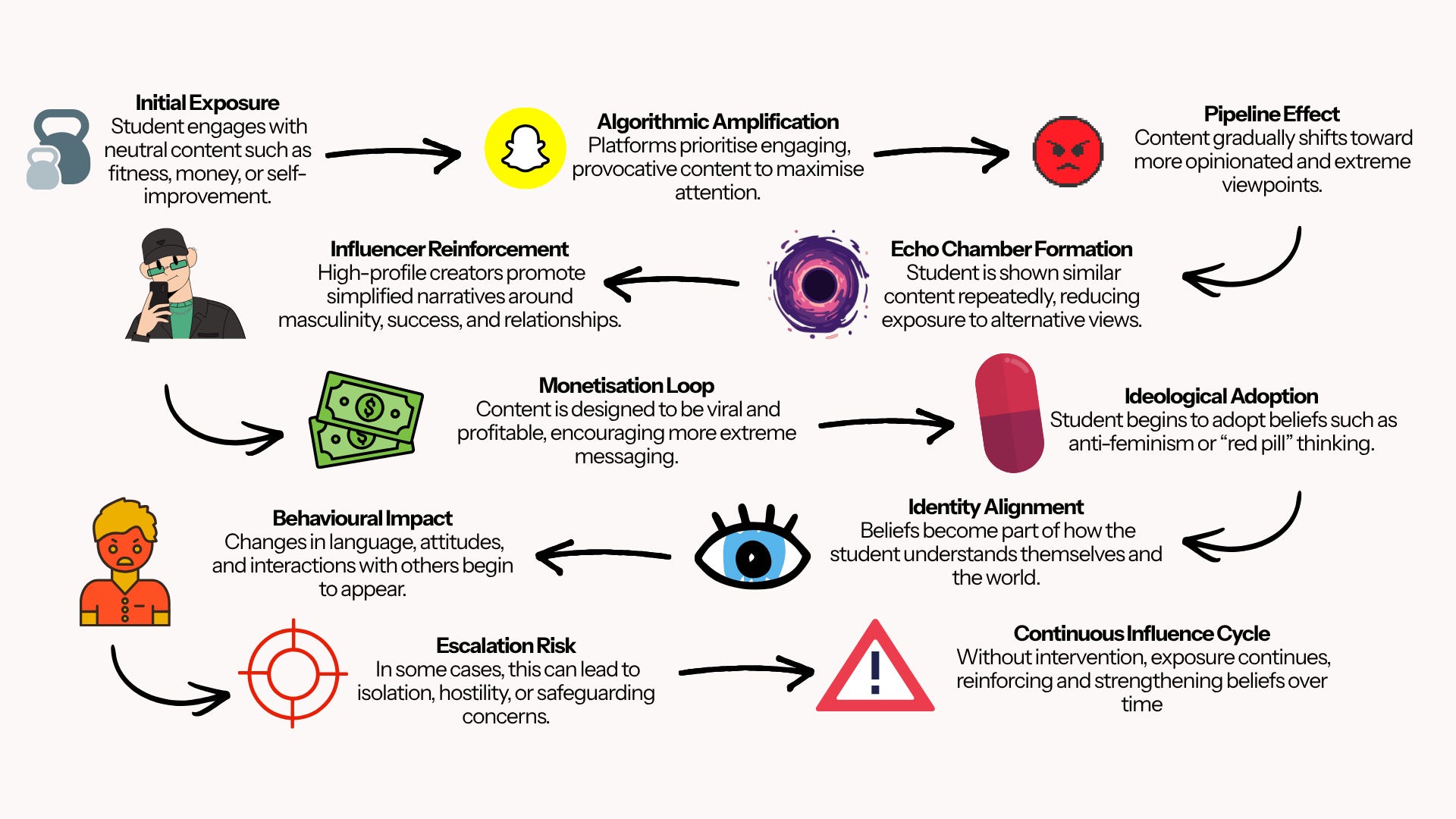
Platforms have long struggled with moderation in this space. The language used within manosphere communities is often coded, ironic, or deliberately ambiguous. AI generated content complicates this further, as it can continuously evolve to avoid detection while maintaining the same underlying themes.
At the same time, there is a commercial dimension that cannot be ignored. Engagement driven platforms benefit from content that keeps users watching, clicking, and sharing. In that context, controversy is not a bug. It is a feature.
None of this suggests that AI is creating radicalisation from nothing. Rather, it is accelerating and optimising pathways that already exist. It makes the spread of these ideas more efficient, more targeted, and harder to trace back to a single source.
The question, then, is not whether the manosphere will persist. It will. The question is how societies respond to a landscape in which influence can be automated, narratives can be scaled instantly, and the line between human and machine generated persuasion becomes increasingly blurred.
Regulation may play a role, but it is unlikely to keep pace with the technology. Platform accountability will be tested, but incentives remain misaligned. Perhaps the more immediate challenge lies in digital literacy, in helping users recognise not just what they are consuming, but how and why it is being served to them.
Because in an environment shaped by algorithms, the most powerful messages are often the ones that feel the most personal.
And increasingly, they are not written by people at all.

No posts
Comments
Nothing yet. Say the first thing.
Sign in to join the conversation.