
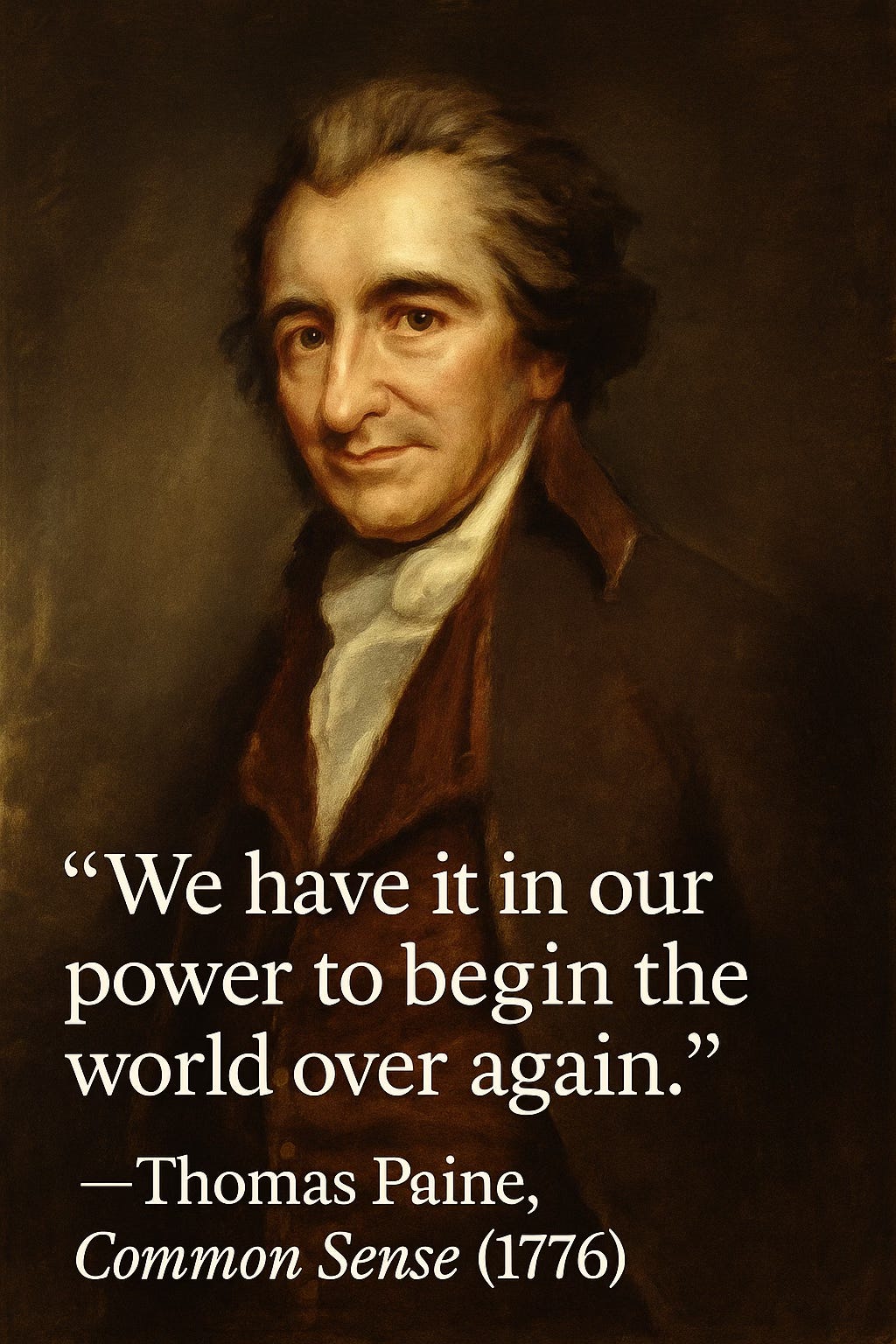
“We have it in our power to begin the world again” — Thomas Paine, Common Sense
This July 4th, we mark 250 years since our founding fathers made their biggest bet, and it paid off.
In January 1776, a small pamphlet hit the streets of Philadelphia. It was only about 47 pages long. It was printed cheaply, sold for next to nothing, and written in plain, direct language.
And it played an important part in changing the course of history.
That pamphlet was Common Sense, written by an English-born immigrant named Thomas Paine. He had been in America barely a year, but he saw something clearly that many leaders and citizens did not: the time for compromise with Britain was over.
The thirteen colonies were at a fork in the road. One path led to clinging to the old system, accepting minor reforms, and slowly suffocating under imperial control. The other led to taking great risks, declaring independence, and creating a new form of government.
Paine’s genius wasn’t just in his argument—it was in how he made it impossible to ignore. He wrote not for scholars or politicians, but for shopkeepers, farmers, and artisans. His sentences were sharp, his metaphors memorable, and his reasoning relentless. He stripped away the default assumption that staying the course was the only option. He pointed to a unknown identity, the American identity, and a future of self-determination, shared purpose, and the freedom to shape a destiny no longer bound by traditions.
Business leaders today face their own “Common Sense” moment. At the end of this newsletter, you’ll find my complimentary guide—The Pig, the Lipstick & The Playbook of Champions—built to help you shatter mediocrity and win the future.
In late 1775, the colonies were already fighting skirmishes with British troops, but most still hoped for reconciliation. The Continental Congress had sent the “Olive Branch Petition” to King George III, asking for a peaceful resolution. The King refused even to read it. Instead, he declared the colonies to be in open rebellion.
Still, prominent colonial leaders hesitated. Breaking from Britain was extreme. The colonies relied on British trade, military protection, and currency. Most viewed themselves as “loyal British subjects”. Britain was the known quantity—powerful, experienced, and established. Starting fresh was terrifying.
Paine’s Common Sense called out that fallacy. He dismantled the idea that Britain, the King, was a benevolent protector. He mocked the logic of hereditary kingship. He showed that the “benefits” of the relationship were an illusion—and that the costs of staying tethered were rising fast.
Most importantly, he gave his readers a way to see themselves not as subjects, but as shapers of their own destiny. Independence wasn’t just possible—it was necessary, urgent, and inevitable.
This week, we celebrate the 250th anniversary of the Declaration of Independence. But in corporate America, we’re seeing the same pattern play out—just with balance sheets instead of battlefields.
Most companies today operate under the illusion of safety. They have systems that worked in the past. They’re proud of their “heritage,” their “brand,” and their “best practices.” They talk about innovation and “reinvention with AI” but spend most of their time defending their king —> the status quo, this quarter’s results and short-term optimization.
This is the corporate version of the colonies sending the Olive Branch Petition: making small, polite adjustments to a system that is fundamentally failing them.
The enemy we are battling isn’t a monarch in London. It’s the acceptance of mediocrity as the new standard—the silent, slow erosion of once high-standards, urgency, accountability and boldness. It’s the belief that staying comfortable and optimizing for the next quarter is safer than reinventing for the next decade.
If you’ve been inside an organization of any size, you’ve likely seen these on display:
The Innovator’s Dilemma—where success in the past blinds leadership to disruptive threats in the present.
Culture Hijacking—where consensus, low expectations, and “not rocking the boat” quietly replace urgency, ownership, truth seeking and customer obsession.
Lipstick on the Pig—cosmetic changes and announcements that disguise, but don’t fix, the deeper problems. These often take the form of an “AI committee” or “innovation lab”.
Just like the colonies in 1775, many companies know something is wrong, but avoid facing it head-on. They tinker at the edges. They hope the old formula will magically start working again. They allow tomorrow’s management team, future employees and investors to deal with the lack of clear-eyed diagnosis and stewardship.
Paine’s America was at a moment of reckoning. Britain appeared unassailable, commanding the most powerful navy the world had ever known and a professional army. Most colonists still saw themselves as loyal subjects of the King. Breaking away promised chaos, uncertainty, and danger. Yet, as their ambitions shifted, these once loyal British subjects began to shed their state-based identities of “Virginians” or “New Yorkers” and started to see themselves as something new—and far more powerful: Americans.
Many successful companies today face a similar inflection point. Many still define themselves by their past wins, legacy markets, or long-standing structures. But the leaders who thrive are the ones willing to reorient their ambition—abandoning the comfort of old labels and outdated playbooks to embrace a bold, unified identity built for the action today and investment in the future.
In corporate terms: every quarter you delay breaking free from mediocrity, competitors move faster, customer expectations rise, and disruption gets harder to counter. The costs go up. The options narrow.
Paine’s solution wasn’t to negotiate for slightly better terms with Britain. It was to start over entirely—with a new system built for freedom, adaptability, and self-determination.
For business leaders, the equivalent is this: stop applying incremental fixes to a system that’s past its prime. Build a new operating model, culture, and strategy designed for today’s reality and tomorrow’s opportunities.
Here is Howard Schultz on his clear-eyed clinical diagnosis of Starbucks:
They lose the ability to be on offense. And the worst thing that a company can do, like a sports team, is start playing defense because you're afraid to fail. That is a disease. Not unlike another disease which has happened in Starbucks, which is hubris.
— Howard Schultz, 2024
If you’re a leader—whether of a company, a division, or even a small team—this might be your Common Sense moment.
You can:
- Keep making minor improvements, chasing quarterly numbers, and defending what you’ve always done.
- Or decide that good enough is no longer acceptable—that the enemy is mediocrity, and that defeating it requires bold, structural change.
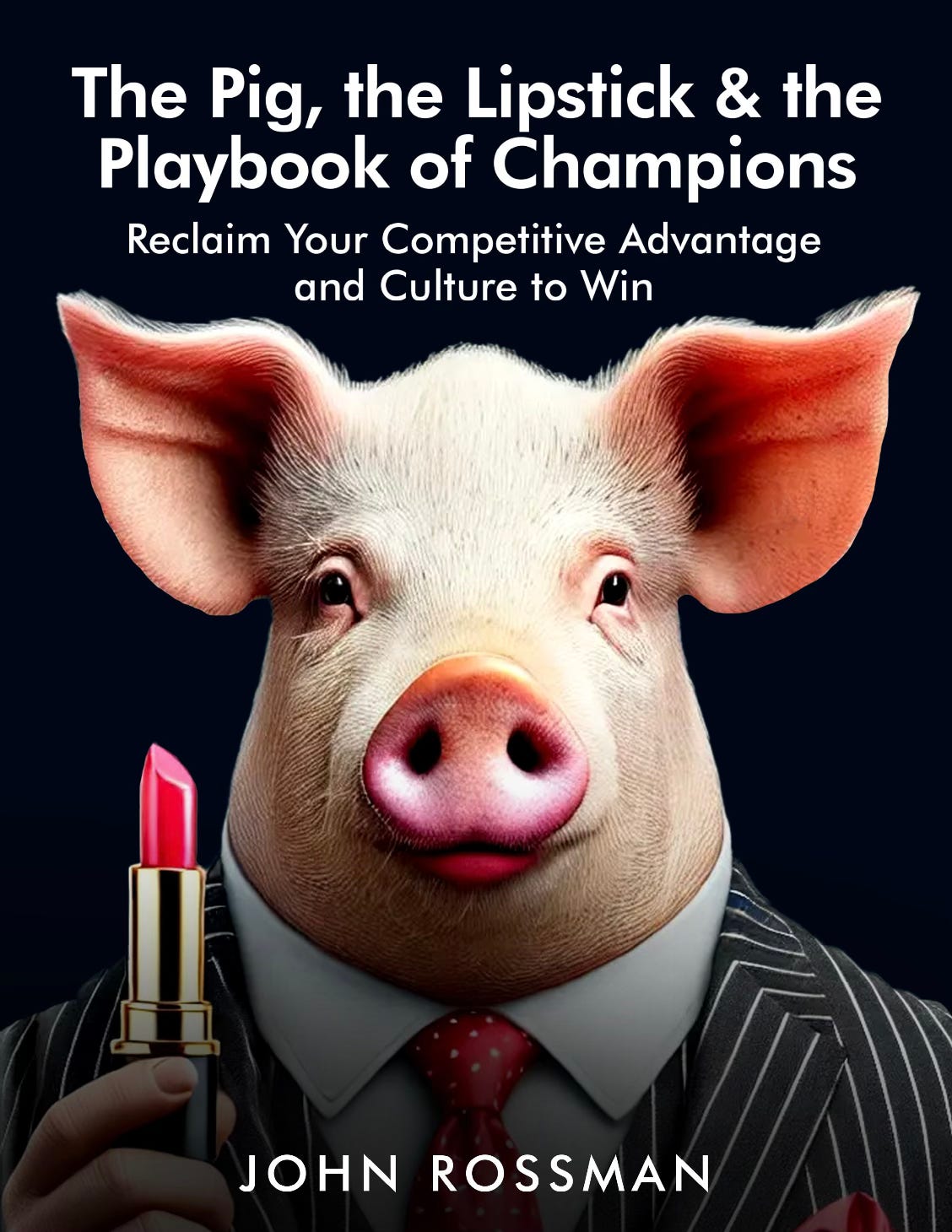
This is exactly why I wrote The Pig, The Lipstick & The Playbook of Champions.
It’s a business manifesto for leaders who are tired of defending the old castle and ready to start building for the team, the culture and the future their customers, employees and investors deserve.
Reclaim your competitive advantage instead of watching it erode.
Rebuild a championship culture that demands excellence.
Make Big Bets to position for long-term advantage instead of short-term survival.
Avoid the success trap, where past wins lull you into complacency.
Like Common Sense, it’s short, direct, and meant to be acted on. And like Paine’s pamphlet, it’s not for everyone—only for those ready to take the harder, bolder path.
Paine wrote later in 1776, in The American Crisis:
The harder the conflict, the more glorious the triumph.
He understood that transformation is uncomfortable, messy, and risky. But he also knew that the cost of staying in a broken system is always higher.
The colonies had to fight for independence. You may not have to fight a war, but you do have to fight entrenched habits, outdated systems, incremental thinking, perverse incentive systems and the gravitational pull of “good enough.”
The only way to win is to act—boldly, decisively, and now.
In 1776, Paine’s Common Sense was passed from hand to hand, read aloud in taverns, and shared in homes across the colonies. It gave people the language, clarity, and urgency to make a choice that changed everything.
I’m offering you something similar. Download your complementary copy of this business manifesto — The Pig, The Lipstick & The Playbook of Champions. Please pass it around your organization and network.
Inside, you’ll find:
- The Playbook of Champions framework.
- The real causes of culture hijacking and innovation paralysis.
- How to take Big Bets that matter—and win.
It’s time for your own Common Sense moment.
250 years ago, the founders didn't optimize for the next quarter. They built for the next century. So can you.
Onward,
John
John Rossman
Author, Big Bet Leadership, The Amazon Way, Think Like Amazon Your guide to making winning high-stakes decisions in the AI era.
www.johnrossman.com
Please help me grow The Digital Leader Newsletter by sharing it with your network. Thanks!
Thanks for reading The Digital Leader Newsletter -- By John Rossman! This post is public so feel free to share it.
Comments
Nothing yet. Say the first thing.
Sign in to join the conversation.