
Today’s newsletter’s got something for everyone and, like a bowl of chocolates, you never know what you’re going to get. Or today’s newsletter is like a box of Cracker Jack: full of prizes.
We’ve got some articles where I am quoted, articles I’ve written and where I have some remarks and insights, and finally a video interview from Las Vegas with Providence College Professor Pat Kelly about a hot topic: casino gambling, especially sports betting.

First, a story from the Netherlands where a journalist wonders what in the world is going on in the United States these days with regard to white-collar law enforcement.
De Amerikaanse beurswaakhond verliest zijn waakzaamheid en niemand grijpt in
The American stock market watchdog loses its vigilance and no one intervenes.
Het Financieele Dagblad by Felice de Man
Insider trading is one of the hardest forms of fraud to prove, regardless of who is involved or under what circumstances it takes place, says Francine McKenna, an accountant and professor of accounting at Montclair State University in New Jersey. “But what is happening here is clearly unacceptable. Making money from government information in this way is simply not acceptable.”
Fewer interventions
The lack of action towards Trump is striking not only; the SEC intervenes much less frequently in general. In April, the stock market watchdog announced that it had initiated nearly 30% fewer new cases against companies in the first year of Trump’s second term.
Moreover, the SEC withdrew cases that had already been initiated. According to McKenna, the regulator was essentially telling courts they had already taken up to hear the cases.
“There are substantially fewer cases,” says Olga Usvyatsky, accounting analyst and former research director at Audit Analytics. According to her, it is remarkable that the SEC is sending out far fewer comment letters . In these letters, publicly traded companies are alerted to inconsistencies in their accounting or inadequate disclosure, with a request to clarify the matter.
Read the rest, with comments from University of Colorado law professor Ann Lipton and Prof. Tjibbe Bosman, assistant professor of accountancy at the Vrije Universiteit Amsterdam at Het Financieele Dagblad.
Thanks for reading The Dig! This post is public so feel free to share it.
Are we overtraining accountants?
My latest at Chicago Booth Review is the summary of a new research paper on accounting education and licensing requirements. I also include research by Yale’s John Barrios and MIT’s Andrew Sutherland to supplement my analysis.
Over the past decade, anyone wanting to become a licensed public accountant in much of the United States needed to obtain 150 hours of educational credits, enough in many cases for a graduate degree.
All those hours of specialized education, an increase over earlier requirements, were supposed to be good for accounting professionals. But they haven’t been worth it from a career and earnings perspective, suggests research by Chicago Booth’s Anthony Le and Parth Shah, a PhD student at the London School of Economics.
Their research finds that accountants with more specialized training tend to be siloed into accounting careers, with less flexibility to move to other jobs offering higher pay.
A recent comment on LinkedIn by Prof. David Wood of BYU is related and my response is some of what I have written about the issue many times before.
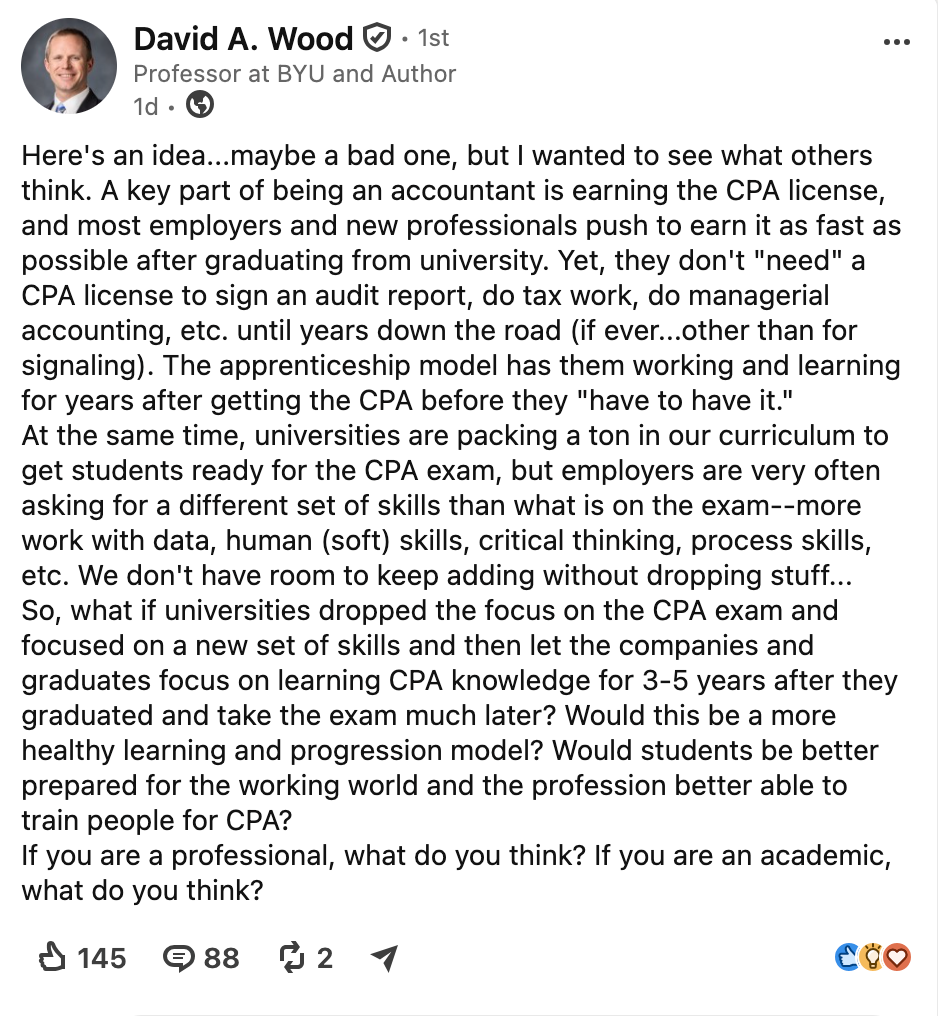
What’s going on here? Why are the largest global firms still pushing to have students done with CPA exam and ready to be licensed, despite all the evidence that this may not be the best focus now that their university educations may be shorter?
When the idea of a 150-hour requirement was first discussed it wasn’t easy to convince everyone more education was a necessary prerequisite to CPA licensing. Accounting academia, which had to create and staff more programs to meet the advanced education mandates may have been excited, but the effort required to fulfill the new curriculums was daunting and there was stubborn pride in existing programs.
Some states were still holding out when, in 2008, the AICPA was trying to convince licensing bodies that a traditional four-year undergraduate program was no longer “adequate” to obtain the “requisite knowledge and skills to become a CPA”. One speech used the word “professional” often to argue that numerous new accounting, auditing and tax laws meant expanded knowledge for “professional practice in accounting” was required.
Support for more accounting-specific education was also bolstered by claims that it would boost audit quality, productivity, and wages. Academia eventually responded to the expanded requirements with a boom in the number and size of accounting graduate programs. A graduate degree had become, in many cases, the new minimum for an entry-level job in public accounting.
Most accounting students now pass the CPA exam before starting full-time work . This goal has been aided until now by spending longer in school to complete the 150-hour requirements before beginning an entry level role at a public accounting firm. Longer time in university, combined with more internships — up to four if they start interning after their first undergraduate year and sometimes at the same firm — reinforce career and the firm-specific and accounting career specific attachment Le and Shah write about.
As the 150-hour mandate was phased in state by state, some public accounting firms mandated that university accounting programs implement graduate degree programs as a condition of recruiting their students. The AICPA’s website said students were not necessarily required to have a graduate degree to meet the 150-hour requirements. However, “in most cases, the additional academic work needed to acquire the technical competence and develop the skills required by today’s CPA is best obtained at the graduate level” (AICPA n.d. “150 Hour Requirement”).
Requiring all entry-level auditors to take a “course of specialized study” also met the objective of making public accounting more like law or medicine, “learned” professions that are typically exempt from federal and state overtime pay requirements. Meeting the “learned profession” requirement for overtime exemption for unlicensed associates gave the largest global public accounting firms — who at the time were facing multiple nationwide class action lawsuits regarding overtime claims by unlicensed associates — a much better chance of quashing future claims.
In economics, licensing schemes are thought to be driven by a desire to increase regulatory capture and the private-interest motive. Making licensing schemes more stringent is typically intended to limit the supply of new entrants and extract monopoly rents (Friedman 1962; Stigler 1971; Maurizi 1974). The introduction of the additional 30-credit hour requirement—the 150-hour rule—increased the marginal cost of becoming a CPA and, unsurprisingly, reduced the accounting graduate pipeline and, therefore, the number of new CPAs.
It is really hard to understand why anyone did not anticipate this.
States allowed multiple ways to meet the 30-credit-hour requirement that ultimately may have also deemed it ineffective in filtering out low-quality candidates because the higher opportunity cost of more study eventually contributed to dissuading some high-quality candidates from pursuing the more demanding certification (Akerlof 1970; Barrios 2019).
You can read the final article in Booth Review here.
The Le and Shah research paper is available here.
Grant Thornton buys CBIZ
The Financial Times Stephen Foley had the scoop:
Grant Thornton seals accounting sector’s largest takeover in a generation
US audit and consulting firm to buy publicly listed CBIZ for $5bn in all-cash deal
Stephen Foley in New York Jul 29 2026
The figure offers an 18 per cent premium to CBIZ’s closing share price on Tuesday and a 54 per cent premium to its 30-day average, but is a far cry from the $88.65 it touched early last year.
The company’s earnings have repeatedly disappointed Wall Street since the acquisition of Marcum, and CBIZ went from being valued more highly than private equity-backed rivals to being cheaper, in effect turning it into a takeover target.
The takeover by Grant Thornton is the largest accounting firm combination since the wave of consolidation that created the Big Four, which culminated in the 1998 merger of Price Waterhouse with Coopers & Lybrand. “We don’t have a desire today to try to become one of the Big Five,” Peko told the FT, saying Grant Thornton would continue to focus on mid-market business.
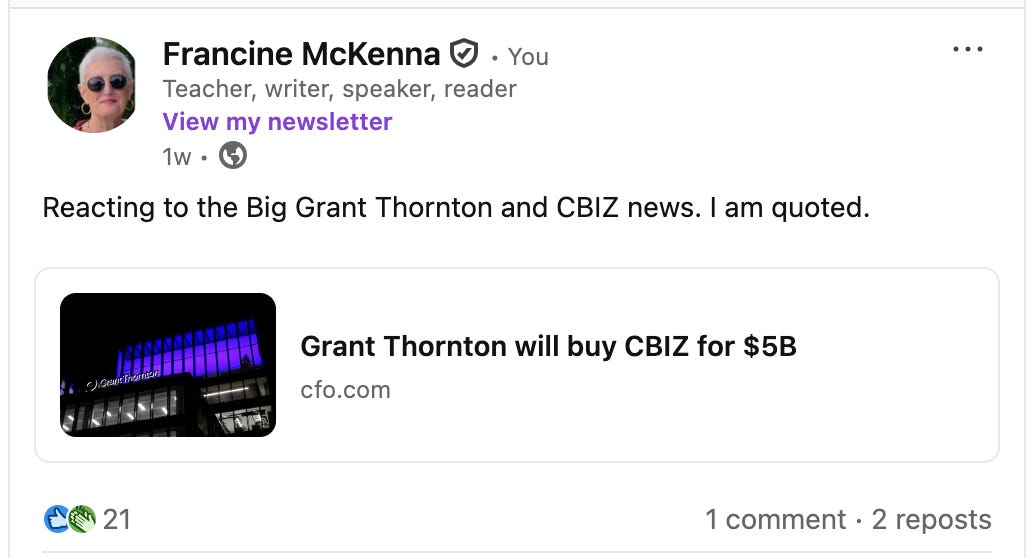
Francine McKenna, adjunct professor at Montclair State University and author of The Dig accounting newsletter, said she “could not have predicted” the merger but was not surprised by it. “Consolidation seems to be the strategy here,” she told CFO.com.
The companies are likely not combining to compete with the Big Four on public company audits, but are instead looking to build a broader geographic footprint and boost their tax and advisory offerings, McKenna said.
Still, CBIZ may bring some baggage with it due to its 2024 acquisition of Marcum, which just three years ago settled federal claims of failures in auditing special purpose acquisition companies.
“I wonder if Grant Thornton knows what they’re getting themselves into by absorbing what CBIZ absorbed when they bought Marcum,” McKenna said.
Yeah, it’s a lot.
The fine print of the CBIZ acquisition by Grant Thornton documents on July 29 revealed two material weaknesses in financial controls and that CBIZ auditor, KPMG, had withdrawn its ICFR opinion!
For the avoidance of doubt, notwithstanding anything in this definition or the definitions of “Compliant” or “Required Information” to the contrary, the filing of an amended Form 10-K by the Company (the “Amended Form 10-K”) that amends and restates KPMG LLP’s Report of Independent Registered Public Accounting Firm (the “KPMG Report”) to express an adverse opinion on the effectiveness of the Company’s internal control over financial reporting as of December 31, 2025 associated with certain material weaknesses shall be sufficient to determine whether the Required Information (with respect to the financial statements for the year ended December 31, 2025) has been received and is Compliant, in each case, in determining the commencement, continuation or completion of the Marketing Period, provided that
(i) there are no subsequent announcements or filings that provide such KPMG Report or Amended Form 10-K may not otherwise be relied upon or be considered Compliant and
(ii) this paragraph shall not be deemed to affect the Company’s obligations under clause (c) of the definition of Required Information. For the avoidance of doubt, there will be only one full Marketing Period and if a Marketing Period is completed prior to the Closing Date, there will be no requirement for a subsequent Marketing Period to run.
On August 4, CBIZ filed a second amendment to its 10-K that explains more.
CBIZ, Inc. (the “Company”) is filing this Amendment No. 2 on Form 10-K/A (this “Amendment No. 2”) to amend and restate its Annual Report on Form 10-K for the period ended December 31, 2025, originally filed with the Securities and Exchange Commission (“SEC”) on February 26, 2026 and as amended by Amendment No. 1 on Form 10-K/A on March 2, 2026 (collectively, the “Original Form 10-K”) to make certain changes as described below.
Subsequent to the filing of the Original Form 10-K, management identified material weaknesses in internal control over financial reporting relating to the administration of the Company’s 2007 Employee Stock Purchase Plan (as amended from time to time, the “ESPP”) and the Company’s reassignment of goodwill among reporting units. Notwithstanding the identified material weaknesses, management believes the consolidated financial statements contained in the Original Form 10-K fairly present, in all material respects, the financial condition, results of operations and cash flows of the Company for all periods presented in accordance with accounting principles generally accepted in the United States, and that such material weaknesses did not result in any change to the Company’s consolidated financial statements as set forth in the Original Form 10-K…
SEC rules require that when a registrant prepares, on or after the date a registrant reports an accounting change such as the change in segment reporting described above, a new registration, proxy, or information statement (or amends a previously filed registration, proxy, or information statement) that includes or incorporates by reference financial statements, the registrant must recast the prior period financial statements included or incorporated by reference in the registration, proxy, or information statement to reflect these types of changes. Accordingly, the Company is including in this Amendment No. 2 the Company’s recasted audited consolidated financial statements reported in the Original Form 10-K to reflect the segment reporting changes described above. The information included in this Amendment No. 2 does not amend or restate the Company’s audited consolidated financial statements included in the Original Form 10-K.
Except as described above and to update the Report of Independent Registered Public Accounting Firm of KPMG LLP to express an adverse opinion by KPMG LLP on the effectiveness of the Company’s internal control over financial reporting as of December 31, 2025 associated with the material weaknesses, this Amendment No. 2 does not update or amend the Original Form 10-K to give effect to any subsequent events beyond those that existed as of the Original Form 10-K filing date. This Amendment No. 2 should be read in conjunction with the Company’s other filings with the SEC subsequent to the Original Form 10-K, together with any amendments to those filings. Other than as described above, this Amendment No. 2 does not modify or update the disclosure in the Original Form 10-K in any way. As required by Rule 12b-15 of the Securities Exchange Act of 1934, as amended (the “Exchange Act”), this Amendment No. 2 contains new certifications by the Company’s principal executive officer and principal financial officer, which are being filed as exhibits to this Amendment No. 2.
In addition, the Company concluded that, as a result of the purchase and delivery of certain shares of common stock relating to the ESPP as described in Item 5 in this Amendment No. 2, immaterial revisions should be made to the Company’s historical condensed consolidated financial statements for the quarter ended March 31, 2026. Accordingly, the Company will revise the previously issued interim financial information for the three months ended March 31, 2026 in the Quarterly Report on Form 10-Q for the quarterly period ended June 30, 2026.
Shoemaker’s children and all that.
It’s an embarrassment to the profession that an accounting firm full of professionals who get paid to advise others on these same issues can’t get their own books and controls straight.
Silicon Valley Bank and KPMG
Finally, before we get to Professor Pat Kelly’s interview and a short discussion on the Big 4 and casino gambling and sports betting, there has been a development in the case against KPMG for the failure of Silicon Valley Bank.
On July 29, a federal judge for the case in California denied motions to dismiss and gave the plaintiffs an opportunity to amend their complaint.
U.S. District Court
California Northern District
Notice of Electronic Filing
The following transaction was entered on 7/29/2026 at 2:34 PM and filed on 7/29/2026
Case Name:
In re SVB Financial Group Securities Litigation
Case Number:
Filer:
Document Number:
355(No document attached)
Docket Text:
Minute Entry for proceedings held before District Judge Noel Wise:
Motion to Amend and Motion to dismiss Hearing held on 7/29/2026. Argument presented by counsel. The Court orally granted the motion to amend and denied the motion to dismiss. Written order shall issue.
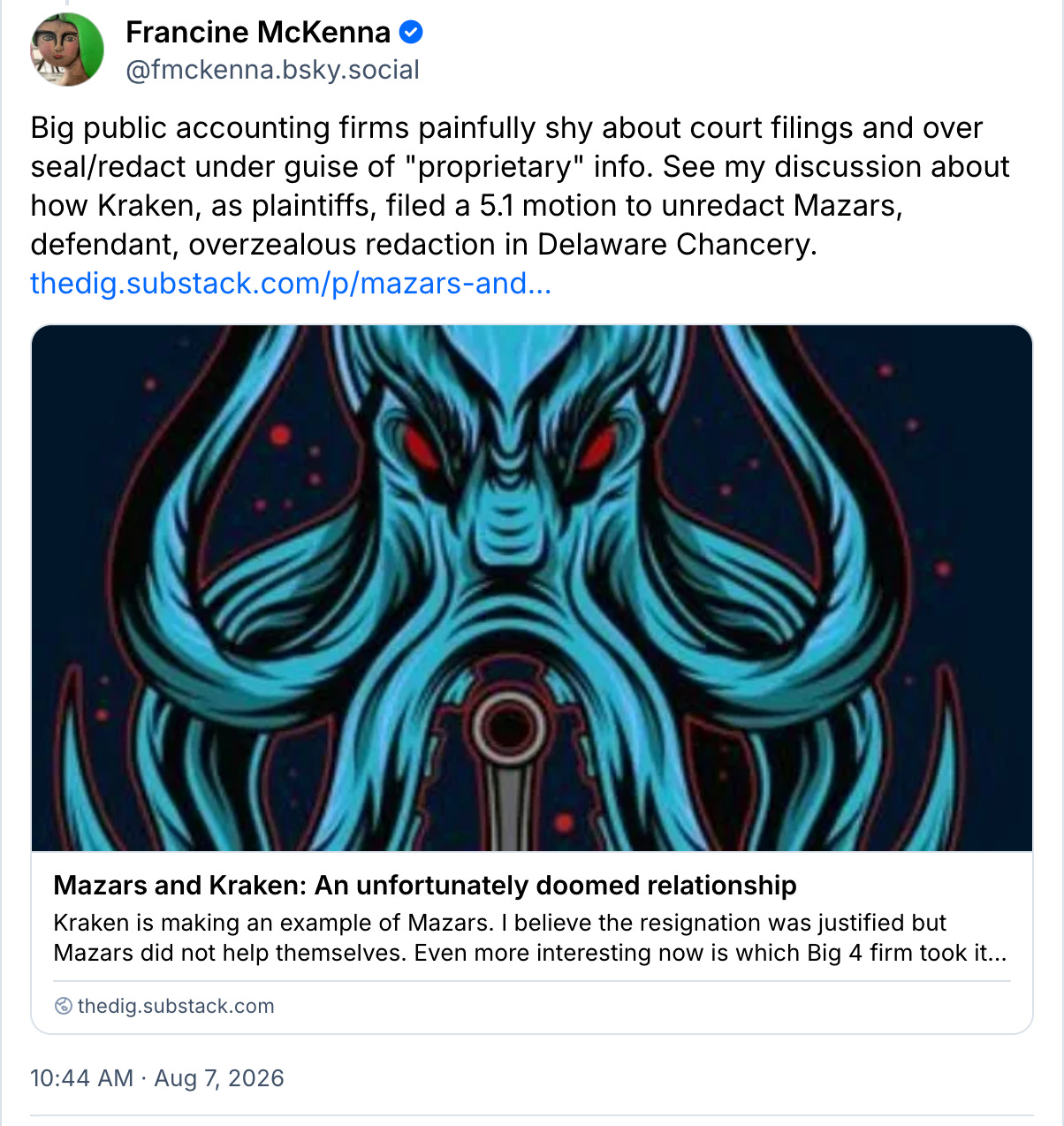
Law professor Ann Lipton, of the University of Colorado, posted on Bluesky that the situation is especially bad for KPMG.
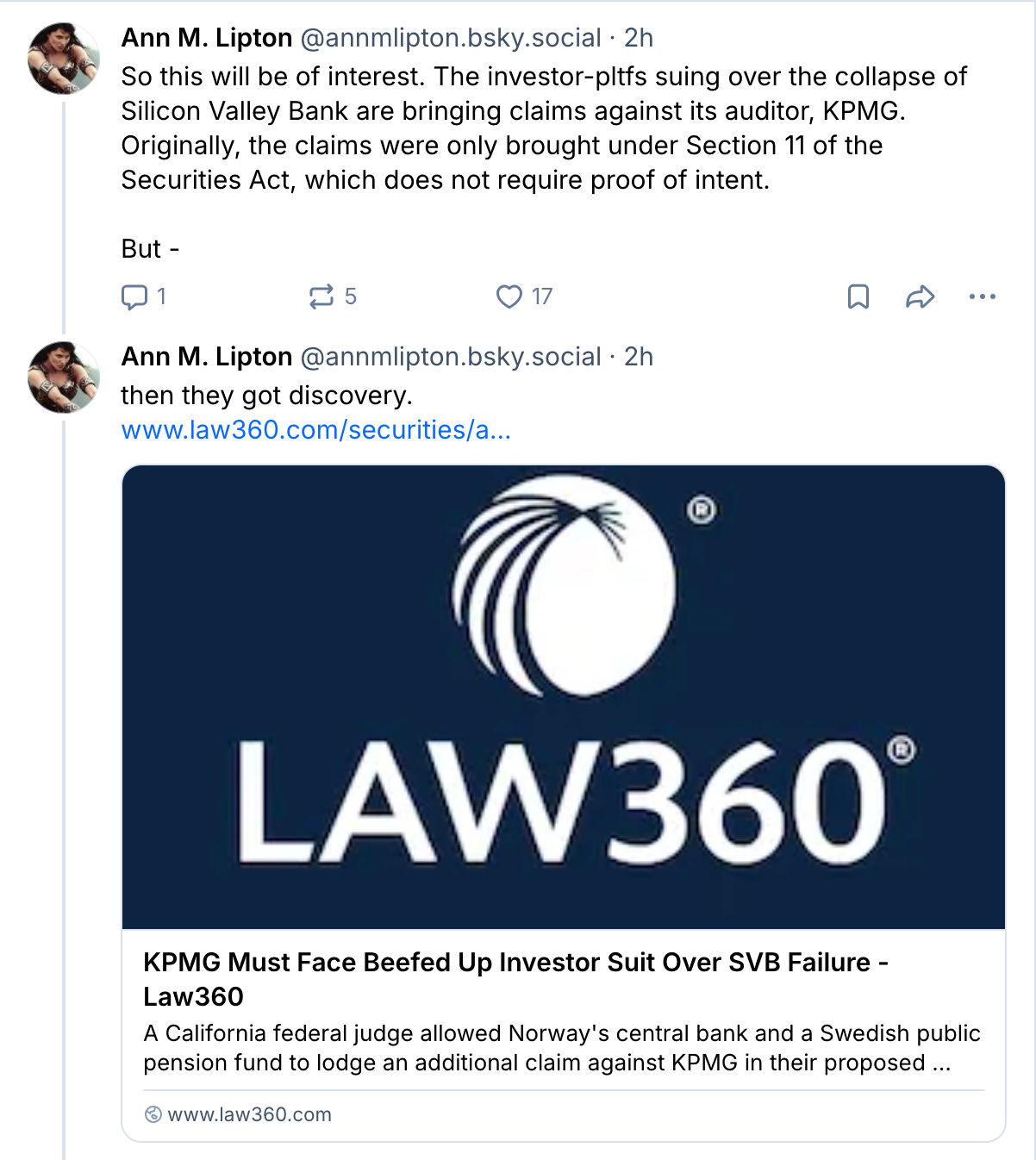
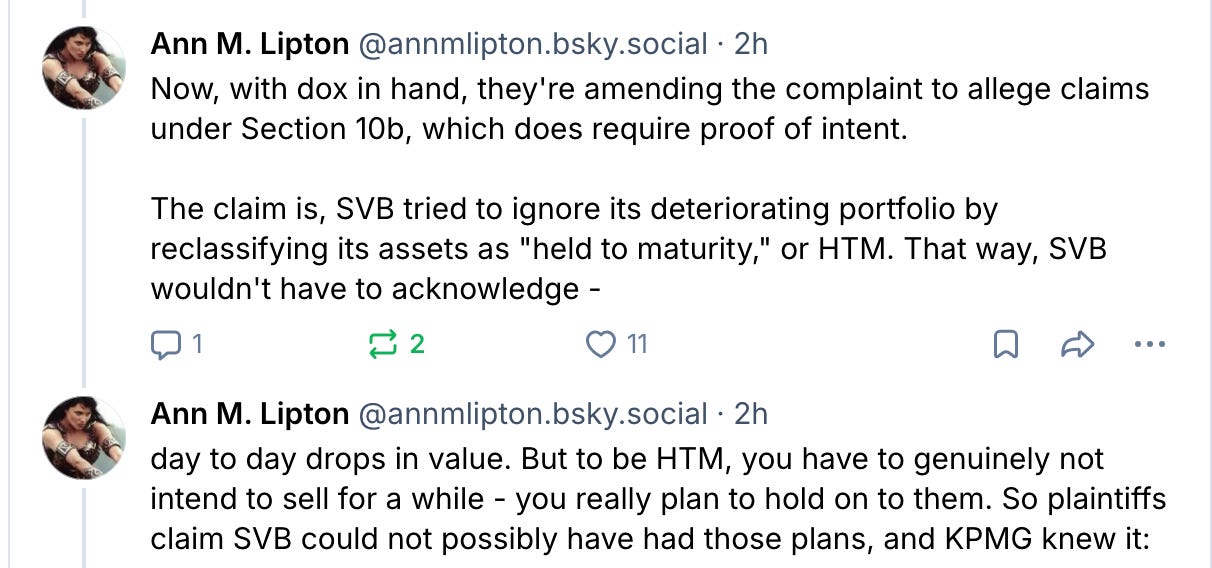
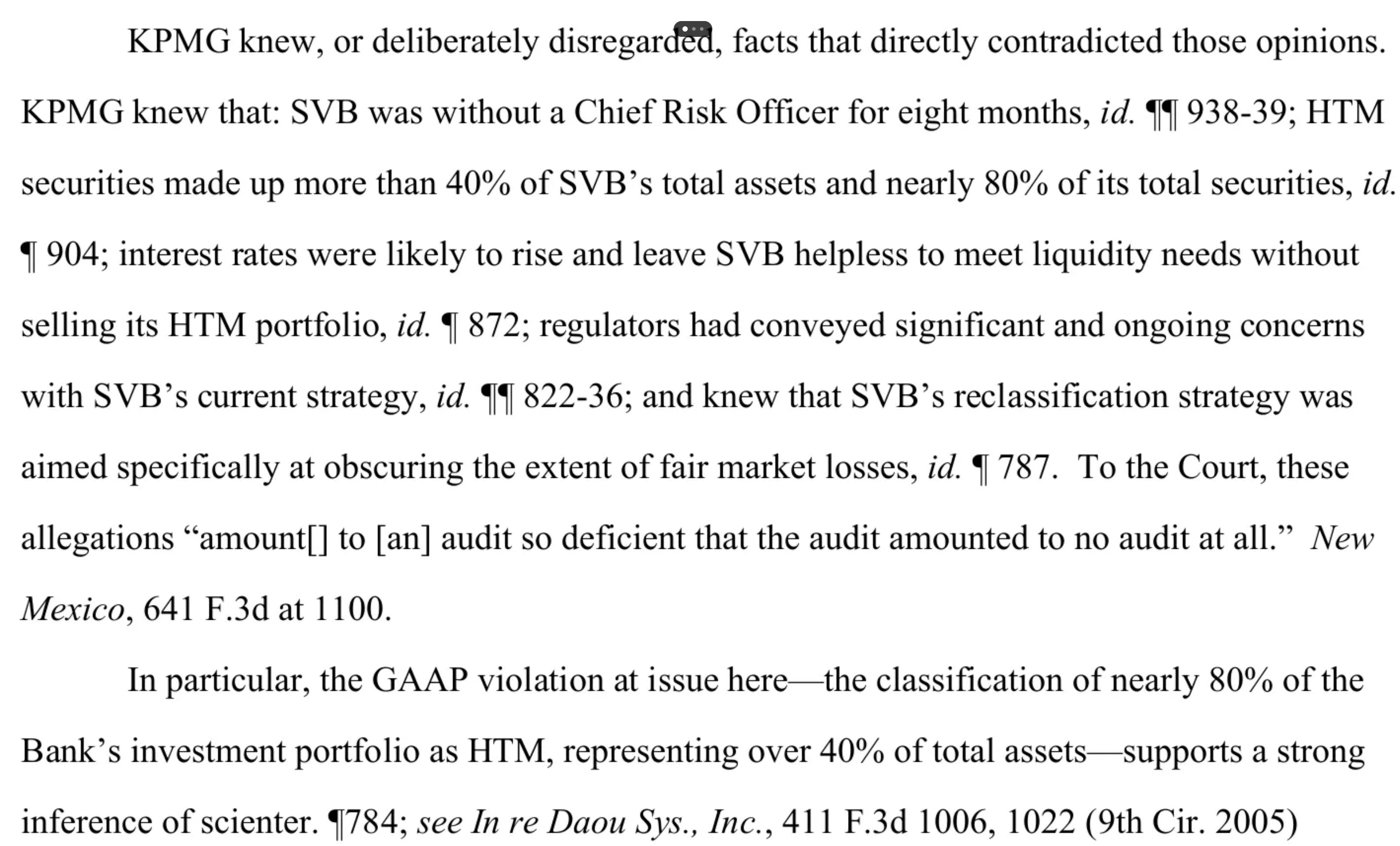
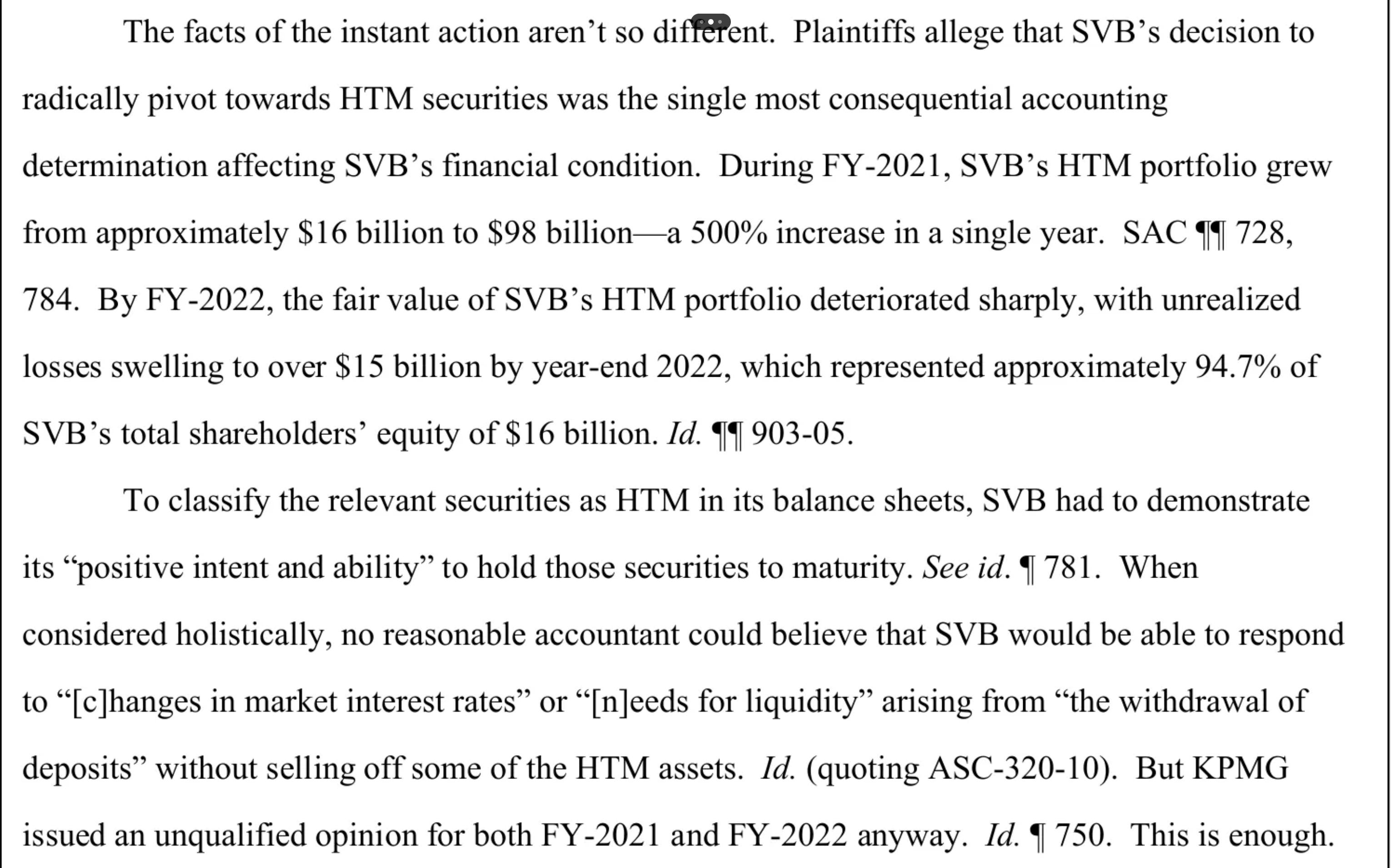
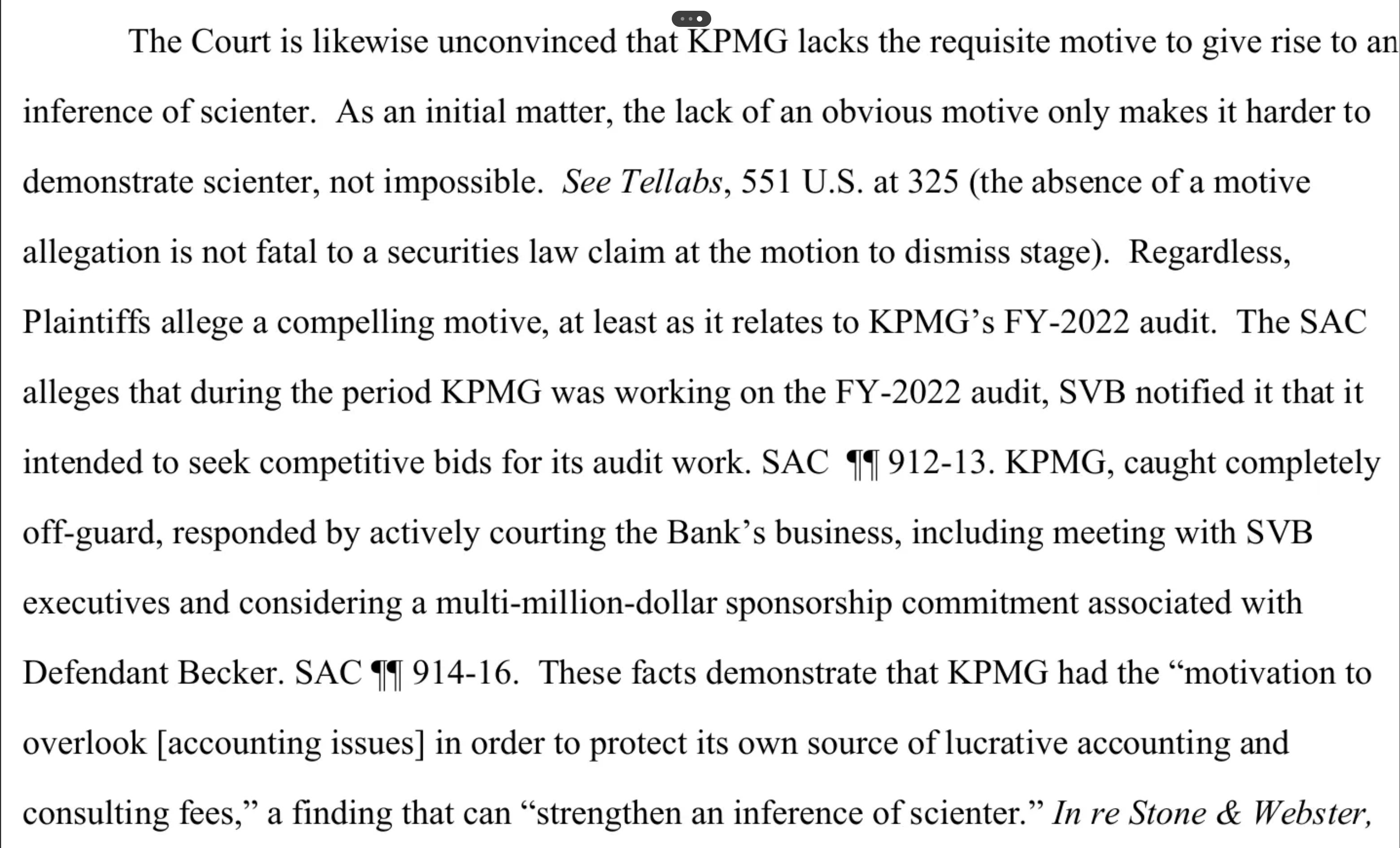
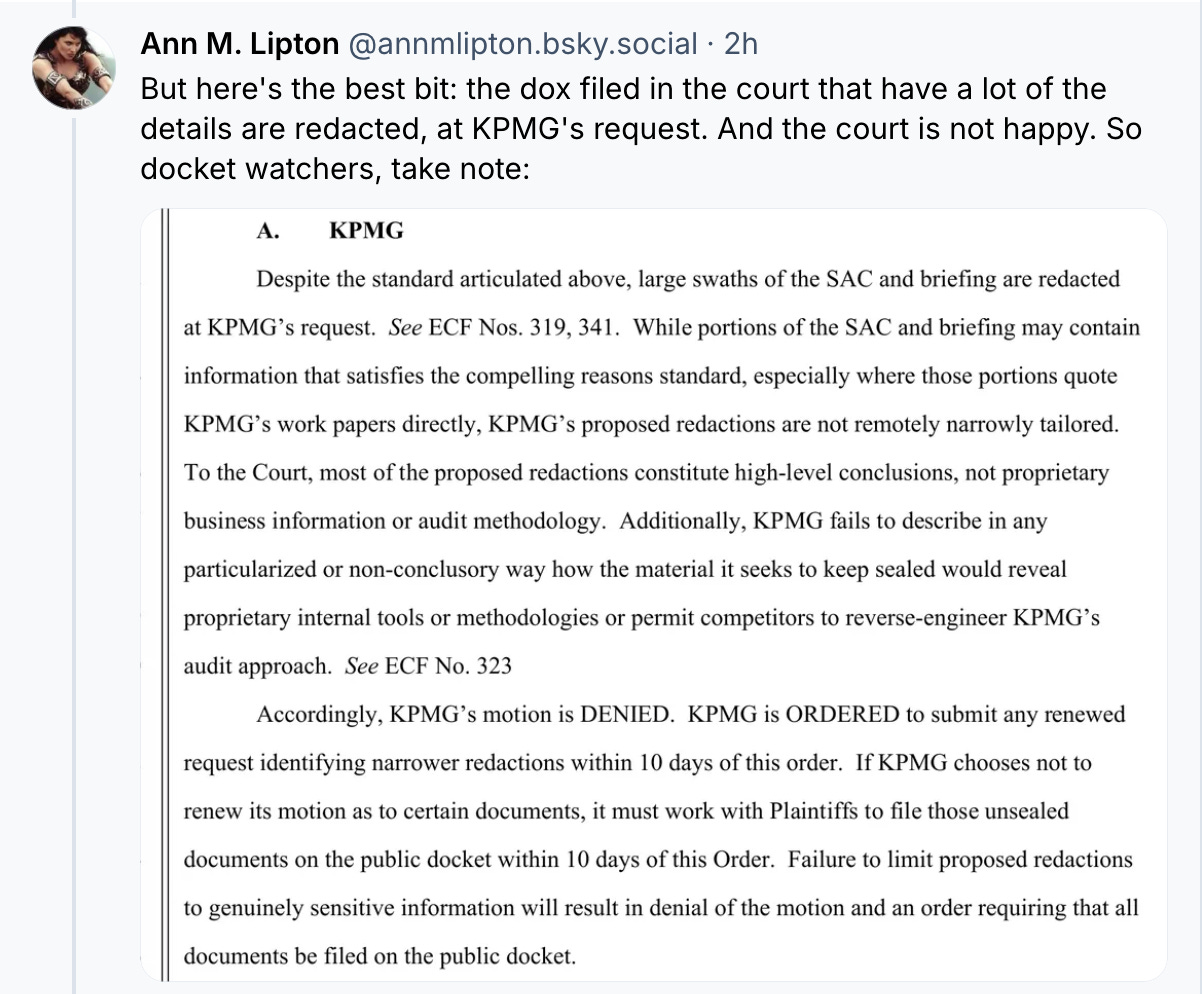
My response to Ann:
For more on the SVB/KPMG case, read:
Accounting Ethics Professor Pat Kelly, casino gambling and sports betting expert
While I was in Las Vegas last weekend I had a chance to spend some extra time with Dr. Pat Kelly, friend and long-time esteemed accounting ethics professor at Providence College. Pat was one of those in the Public Interest, Ethics and Sustainability Section of AAA who has been repeatedly inviting me to speak and who spearheaded my Accounting Exemplar Award.
Pat is just an incredible guy and someone I respect and admire a lot for his career-long focus on teaching and his passion: the ethics of casino gambling and now sports-betting.
When Pat won the Excellence in Accounting Ethics Education Award by the American Accounting Association Public Interest Section in 2024, his college had this to say:
Kelly first became aware of the detrimental impact of problem gambling in his hometown of Ledyard, Connecticut, where he delved more deeply into specific cases during a sabbatical in 2008. Cases of individuals with clean records motivated to steal from their workplace to support a gambling addiction occurred more often than expected. This finding led to “Casino Gambling and Workplace Fraud,” a paper Kelly published on the subject with his colleague, Carol Hartley, CPA, in 2010. It describes the important considerations managers within a 50-mile radius of a casino should address to prevent large financial losses. The paper has been referenced more than 125 times and downloaded over 2,100 times.
His research has focused on the addictive nature and shockingly powerful motivation behind gambling, which unfortunately can lead to tragic outcomes. People without so much as a parking ticket can be driven to steal hundreds of thousands of dollars from their workplace to support the addiction, he said.
He has also examined how aggressively states support casino revenues and expansions. “You can travel from Maine to Washington D.C and always be within a 50-mile vicinity of a casino,” Kelly said. States essentially compete for this revenue, as demonstrated by what has happened here in Rhode Island when it approved sports betting in 2018. People who could not gamble in neighboring states came here, bringing revenue to Rhode Island. This motivated neighboring states, Connecticut and Massachusetts, to legalize and expand gambling — and the cycle goes on across the country. The same trend has continued with online gambling.
This is why Kelly is worried about the current generation of college students. Instead of sitting in front of a slot machine, they are on a path to have an entire casino at their fingertips through the evolution of sports betting and online gambling on mobile devices, he said.
I had a chance to talk to Pat a lot in Las Vegas and record this video. I learned more about him as a husband, dad, and now grandad, about his career before he entered academia, and his future plans.
Before we show the video, I’d like to just touch on how the global public accounting firms support, promote and provide credibility to the business models of casino gambling, sports betting, and now prediction markets pushing to get involved in sports betting.
I wrote for my legacy blog re: The Auditors in June of 2008:
The story was, while I was at PwC, that PricewaterhouseCoopers LLP did not involve itself with gambling or porn. At least, not during business hours. But my Google Alerts went off recently with news of PwC’s Global Entertainment and Media Outlook: 2008-2012.
The latest edition of this entertainment and media industry forecast was released June 18, 2008. The report covers the US, Europe, Middle East, Africa, Asia Pacific, Latin America, and Canada and says it provides an-depth global analyses and five-year growth projections for 15 related industry segments. The forecast is pretty bullish for the casino and other regulated gaming segment, especially outside the US.
“In Asia-Pac, major resort casinos in Macau will propel that area to become the largest single casino gaming destination in the world.”
And their folks get interviewed by Forbes.
LAS VEGAS –
Global gambling revenue is estimated to pass $155 billion in 2012 after growing at an annually compounded rate of 6.5 percent per year, according to a PricewaterhouseCoopers LLP report released Wednesday. Gambling revenue is expected to rise from nearly $114 billion in 2007 because of new casinos and upgrades to existing ones around the world, the report said…PwC’s UK firm is very active in advising casino and regulated gaming firms.
Regional Casino Investment Could Stimulate the Development of New High-Quality Leisure Facilities for UK Regions LONDON – 17 MAY 2006
The Outlook for Regulated Gaming: It’s A Good Bet
S
o, I was not surprised to find that PwC really does avoid auditing the casinos and regulated gaming industry. They’d prefer to consult to them. Better for the squeaky-clean image not to be seen counting the millions in cash until it’s in your own shop.But I was surprised to find one lonely PwC audit engagement in Las Vegas, of course. And I was also surprised to find that the audit engagements are fully concentrated in the US in only two of the Big 4 – EY and Deloitte.
KPMG is nowhere to be seen.
Interestingly, in Europe, troubled Sportingbet PLC and PartyGaming PLC, (whose executives could not travel to the US under fear of prosecution,) are avoided by the Big 4. Both companies have recently changed auditors to BDO Stoy Hayward.
What’s new 18 years later?
Well, all of the Big 4 including PwC and KPMG are now auditing casino gambling and online gaming and sports betting companies. The troubled Sportingbet PLC and PartyGaming PLC are now part of Entain PLC, and audited by KPMG UK.
BDO audits DraftKings, #6 in its the top ten 2025 audit fees. (Super Micro is #3.) Talk about dancing with the devils!
Biggest Gambling Companies in the World Note: The ranking below is based on the latest revenue numbers. The info covers both physical gambling locations and online casino companies.
1. MGM Resorts – Deloitte NY
Location: Las Vegas, NV
Notable holdings: 30+ luxury casino resorts worldwide, BetMGM, Borgata
Revenue: $17.05 billion
Trading Symbol: MGM
2. Flutter Entertainment PLC – KPMG Dublin
Location: Dublin, Ireland
Notable holdings: Fanduel, Betfair, Paddy Power, Pokerstars, Sportsbet
Revenue: $13 billion
Trading Symbol: FLUT
3. Las Vegas Sands – Deloitte NY
Location: Las Vegas, NV
Notable holdings: The Venetian Macao, The Parisian Macao, The Plaza Macao & Four Seasons Hotel Macao
Revenue: $11.5 billion
Trading Symbol: LVS.
4. Caesars Entertainment – Deloitte NY
Location: Las Vegas, NV
Notable holdings: Caesars Palace, William Hill, Harrah’s, Horseshoe, Eldorado
Revenue: $11.4 billion
Trading Symbol: CZR
5. Wynn Resorts – EY NY
Location: Las Vegas, NV
Notable holdings: Wynn and Encore records, WynnBet for sports bettors, Wynn Slots App
Revenue: $7.1 billion
Trading Symbol: WYNN
6. Penn National Gaming – PwC NY
Location: Wyomissing, PN
Notable holdings: Hollywood Casino, Ameristar, Boomtown
Revenue: $6.3 billion
Trading Symbol: PENN
7. Entain PLC – KPMG UK
Location: Douglas, Isle of Man
Notable holdings: Bwin, Ladbrokes, PartyPoker, Coral, Sportingbet, co-ownership of the BetMGM platform
Revenue: $5.2 billion
Trading Symbol: ENT.L
8. Melco Resorts & Entertainment – Deloitte Singapore
Location: Hong Kong
Notable holdings: City of Dreams, Studio City, Altira Macau, Mocha Clubs
Revenue: $4.38 billion
Trading Symbol: MLCO
9. International Game Technology PLC – PwC NY
Location: London, UK
Notable holdings: IGT PlaySports
Revenue: $4.31 billion
Trading Symbol: IGT
10. DraftKings – BDO US
Location: Boston, MA
Notable holdings: DraftKings
Revenue: $4.3 billion
Trading Symbol: DKNG
Robinhood – Audited by EY US. Robinhood allows users to trade sports outcomes via federally regulated prediction markets and event contracts through a partnership with Kalshi. Users can buy and sell Yes/No contracts tied to game winners, totals, player stats, and multi-leg “combo” parlays.
Prediction markets Kalshi and Polymarket are private companies and do not make audited financial statements nor the name of any financial statement auditor public.
Former senior EY partner Joe Howie, now a whistleblower, is suing EY over his alleged retaliatory termination and he has had a lot to say about EY’s casino clients, especially the Chinese ones.
Howie spoke on a panel with former PCAOB Board member Kathleen Hamm and Prof. Rick Kravitz at the end of the 30th Annual Ethics Research Symposium last Sunday. His presentation focused on auditor activities all over the world for the gaming industry, especially with regard to Chinese casino owners. His concerns were central to his remarks and are a big focus of his complaint against EY.
HOWIE DISCLOSES THAT EY WAS WILLINGLY ENGAGING WITH CLIENTS CONTROLLED BYALLEGED CHINESE MAFIA GROUPS AND FACILITATING THEIR CRIMINAL ACTIVITIES
A. EY’s Willing Engagement with High-Risk Clients Having Credible Links To Alleged Criminal Activity
76. Beginning in June 2021 and continuing through 2024, Howie observed that EY leadership across Global, Area, Regional, and member firms—including leaders within Professional Practice Groups—knowingly permitted the Firm to provide audit and other professional services to companies, particularly in the gaming, casino, and hospitality sectors, that were controlled by or closely connected to organized crime syndicates and other criminal groups and activity.
77. Upon review, Howie found that EY’s acceptance and continuance decisions, including for publicly traded clients he identified, were inappropriate and failed to reflect known fraud, NOCLAR, and other risks identified through adverse media. In most cases, these risks were absent from the required PACE forms, indicating that audit teams had conducted incomplete risk assessments. This raised serious concerns that key audit procedures were either insufficient or not performed at all.
78. The absences Howie found on the required PACE forms greatly increased the risk that both current and prior audits were noncompliant with SEC laws and regulations, including Exchange Act Section 13(a) and Exchange Act Rules 12b-20, 13a-1, and 13a-13 promulgated thereunder.
EY’s failure to properly identify and respond to these risks increased the likelihood that fraudulent or illegal conduct went undetected, exposing shareholders to otherwise preventable harm even beyond the specific examples identified in this Complaint (e.g., Registrants1-7, Listed Companies 1-7, Private company1, and others). Between 2021 and 2024, Howie repeatedly alerted senior EY leadership that certain publicly traded and other clients presented serious legal risks due to credible evidence of unlawful conduct, including findings from U.S. and foreign government investigations and investigative media reports. He was concerned that through EY’s association with these high-risk clients, its clear failures to follow professional standards and address the NOCLAR risks, and its failure to take exception to fraudulent reporting, EY was facilitating activity in violation of professional standards,11committing discreditable acts of professional misconduct, and potentially committing violations of law.12
EY’s involvement with high-risk clients and its failed audits in connection with them aided in obscuring their schemes and prolonged both the periods and severity of investor harm. This was not the first time EY was a cause of securities law violations and engaged in seriously unethical conduct.13 However, Howie felt this matter stood out as one of the worst examples in the Firm’s history of failures.
And now for my interview with Providence College Professor Pat Kelly.
Thanks for reading The Dig! This post is public so feel free to share it.
Here are his slides from his plenary address at the 30th Annual Ethics Research Symposium in Las Vegas, “The Ethical Implications of Sports Betting and Problem Gambling.”
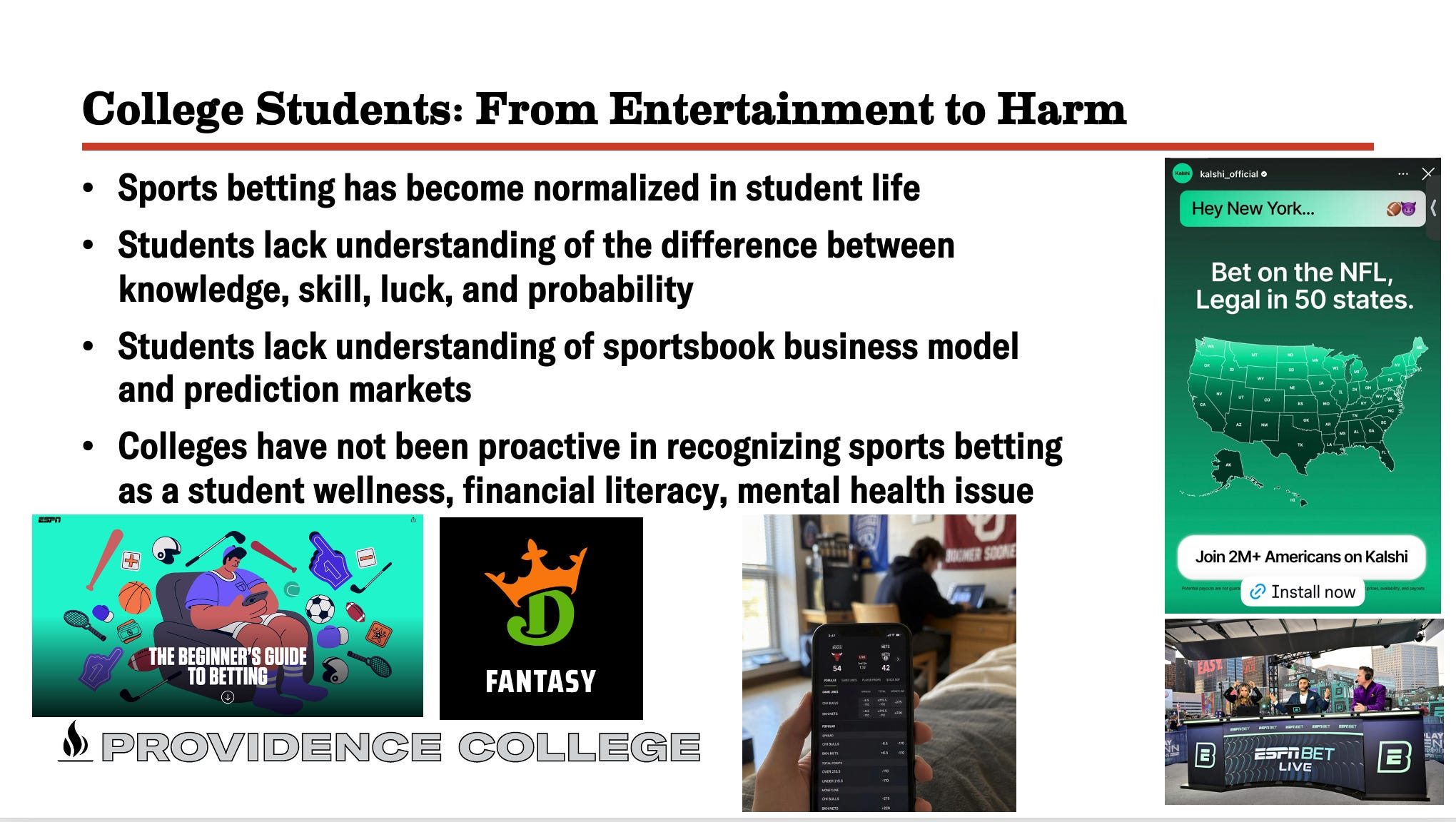
Pat should be quoted by major media whenever they write about the proliferation of casino gambling, sports betting, and problem gambling especially in the young male demographic. I also hope that he’ll be asked to provide Congressional testimony related to some of the bills in Congress, which he talks about in his presentation.
© Francine McKenna, The Digging Company LLC, 2026
Comments
Nothing yet. Say the first thing.
Sign in to join the conversation.