
Well, here we are and summer has virtually arrived. Our sustainable energy set-up has completed its first full heating season. It’s been a period of observation and learning, all within the framework of living a Directionally Good Life. As you know from Episode 6, I have also presented this to Kingston’s Efficient Homes Show earlier this month. But in summary, despite not having the perfect house for a heat pump, it has worked brilliantly. Despite anxieties, the technology has all worked!
A quick reminder, rewinding to last year.
Our 12kW Samsung heat pump was installed in July. We made the decision not to replace any of our old radiators. We were warned that some rooms were very marginal and that was before we chose to not go ahead with external wall insulation, which had been assumed in the heat loss calculations! Instead, the existing radiators and pipework underwent a thorough flush to remove sludge. Each radiator received a new TRV, which we then set to maximum in every room. We then wanted to see how it would perform and replace radiators if required after the first winter.
Later in 2024, our setup was further enhanced: 26kWh of battery storage was added in September, followed by 21 solar panels (8.4kW maximum array size) in November. This truly transformed our home's energy infrastructure and our gas supply was removed.
Our heating season commenced at the end of September and finishing exactly seven months later, at the end of April. We experienced a winter that was slightly drier and marginally colder than average, with temperatures dipping to -7°C on a few nights. This presented a reasonable test, especially as the heat pump design calculation assumed a minimum of -2°C.
Aside from a minor instance of user-error, the system has operated remarkably well. We did encounter a few days where things felt amiss, only to discover we had inadvertently reduced the radiator flow pump to less than 50%. Once rectified, the heat pump performed as intended and the heat supplied was sufficient even on those coldest days.
Our Homely controller proved highly effective, consistently maintaining the target temperature within +/- 0.3°C. We opted for a set temperature of 19.2°C, monitored by a sensor on the landing. This generally resulted in a comfortable 19.0°C downstairs, slightly warmer than our old gas thermostat setting.
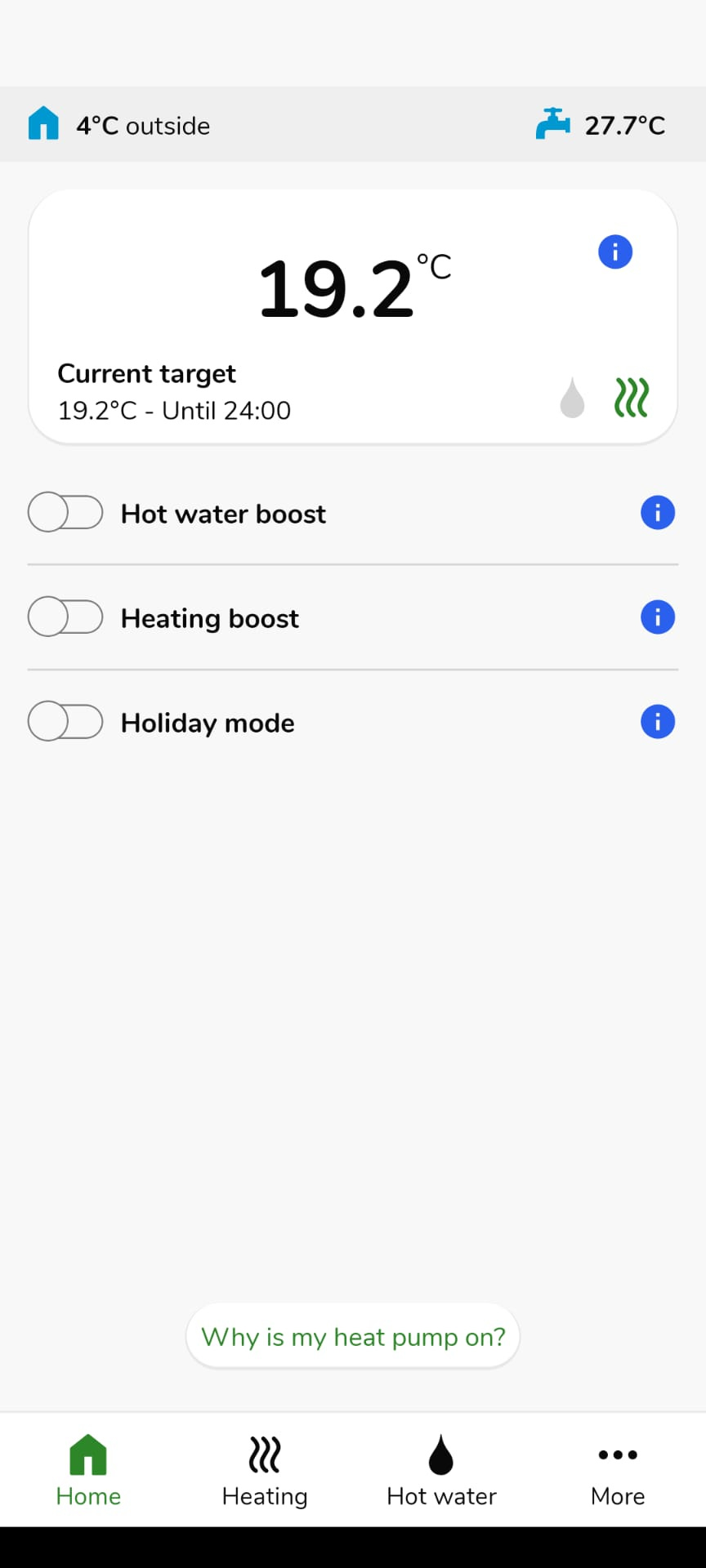
We learnt a good deal about sensor placement. Initially in the hall, like our previous thermostat, we found that opening the front door would register a false dip in temperature, and kitchen heat during cooking would cause it to sense the house was warmer than it really was. This led us to reposition the sensor to the most stable location we could identify i.e. the landing.
Following the advice of our installers (YEYW), we operated a single zone and maintained a consistent target temperature 24 hours a day, 7 days a week. This represents a considerable shift from our conventional gas heating practices, with heating in the morning and evening only.
This leads to perhaps the most significant observation: it’s just a nicer heat with a heat pump!
Gas central heating, which we operated like most people for limited hours, used to create much greater temperature fluctuations. Boilers tend to be oversized, and water temperatures are set too high, leading to larger deviations from the set point and thermostat overshooting. Moreover, when the gas heating was off, the house could become noticeably cold, prompting those familiar discussions about when to put the heating on again. (Remember that over half our house is 1930-built, with solid brick walls and no cavity insulation i.e. the heat loss can be quite rapid).
The heat pump offered a markedly different experience: constant, consistent warmth. It never felt excessively hot or cold. On the chilliest days, the heat pump operated at full capacity for much of the time, but the key difference lay in the flow temperature through the radiators. While a gas boiler might circulate water at 55-60c, the heat pump maintained a range of 35-45c, only reaching the higher end during the coldest periods.
My mother, who often remarks on cold hands indoors at her own home, stayed with us and noted that her hands remained warm throughout.
It was also interesting in how we managed heating in unused rooms. With gas, we would have adjusted the radiator TRVs to a frost setting and closed doors. With the heat pump, our approach was the reverse: unused rooms had radiators on maximum with doors open. The aim was to ensure a consistent temperature across the entire house, maximising the thermal mass, and minimising temperature gradients. Initially, there was some apprehension about bedrooms becoming too warm, but the outcomes were fine - we found ourselves using a summer-weight 4.5 tog duvet all winter!
Regarding hot water, our relatively large system comfortably met the needs of the two of us. With visitors, it required a little more planning but was still entirely manageable. The crucial thing was to heat the water ahead of requirements and not just react as you might with gas or an immersion heater.
And as for noise – a frequent query with heat pumps: when operating at a 35c flow temperature, the heat pump is virtually silent, though subtle air movement can be discerned if one is listening intently. At full capacity, the sound of air moving is certainly more noticeable, but it's important to clarify that it's not a mechanical whine, as might be associated with some electric cars. Being an outdoor unit helps, particularly when considering that internal boilers can also generate considerable noise on cold days.
The Homely controller, accessed via its app, has proved excellent. It was more straightforward to use than a standard physical boiler controller, offering the convenience of adjusting settings even when away from the house. This remote capability has certainly been beneficial. Indeed, I would argue Homely has been the most crucial element of the whole set-up. As nerdy as I may be, I have no desire to be managing “weather compensation curves” and other detailed parameters deep in the heat pump menu system. Many people experience real issues with managing their heat pump through the native controls. Homely managed all this, leaving us with the simplest of settings while it managed everything in the background. As it was all app-based this is easier and simpler than the old boiler.
For those of you interested in the financial aspects, I understand the running costs are a significant point of discussion. I will cover this next time as well as getting into the performance of the solar panels and batteries.
Spoiler Alert - it has been substantially cheaper and yes, the sun does still shine in the winter sometimes!
No posts
Comments
Nothing yet. Say the first thing.
Sign in to join the conversation.