
In my last post, I shared the results of our Net Zero Power Quartet (heat pump, solar panels, battery storage and EV) from October 2024. I revealed that our total annual household energy bill had dropped from an estimated £3,000 down to just £22. It was a massive win, but I ended that update with a bold ambition: to hit literal free power over a year.
I now have the full figures for the calendar year of 2025. This is cleaner than my previous review, which was slightly skewed by the installation timeline (our solar didn’t even go live until November 2024) and an early “user error” after I accidentally knocked the central heating pump dial down to 50%!
So, did we hit the holy grail?
I am thrilled to report that for the full calendar year of 2025, the total cost to run our home—including all heating, hot water, cooking and lighting—was -£43.
Yes, you read that correctly. After excluding the costs of charging our EVs, Octopus Energy credited us £43 to run our house for a year.
Episode 13 was a “rolling year” that included the messy setup phase. By looking at the 2025 calendar year, we see the system in full operation across all 12 months:
Full Solar Coverage: We had the benefit of the panels for the entire duration, including the months we missed in late 2024.
Arbitrage Mastery: By the end of December I had got the hang of how to use the Tesla battery app. We spent the full 12 months maximising the gap between 8.9p imports and 15p exports.
Efficiency in Action: The heat pump continued to perform at high efficiency, proving that not replacing radiators and not adding external wall insulation isn’t a barrier to heat pump performance.
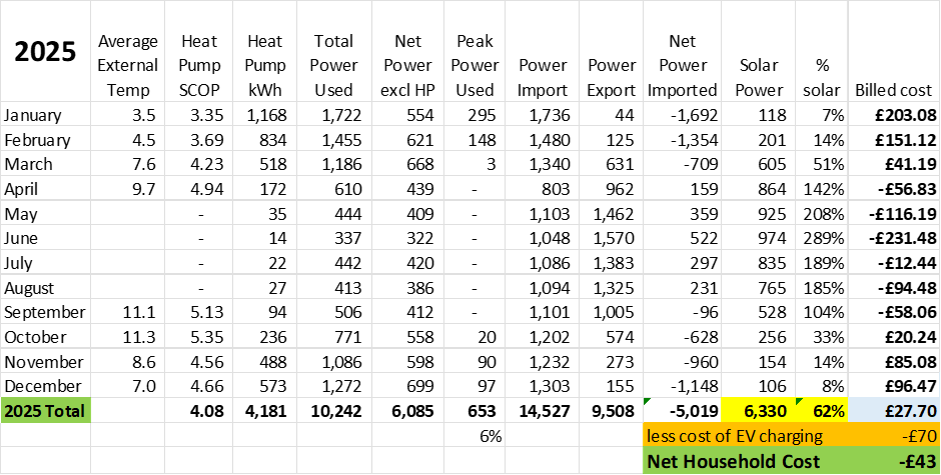
(Note: kWh except temperature and £ bills)
The 6 months with negative bills and solar power generating more than was used, more than covered the 3 months of proper winter. The batteries enabled £1,426 of power to be exported back to the grid.
You might think that hitting a negative bill is the end of the journey, but I’m already finding ways to further optimise. For 2026, I’ve made a significant technical tweak to the heat pump settings that should push our efficiency even higher and hopefully bills lower still.
I have reduced our minimum flow temperature to 25c down from the 35c floor set by the installers (Your Energy Your Way). They were worried about our long pipe runs. However, my experience is that on milder days, it is far more efficient for the heat pump to run for longer periods at 25c rather than “cycling” (turning on and off) at 35c. And, yes, this really does mean the radiators at times have water flowing through them at just 25c!
The early signs are incredibly promising:
Breaking Records: I’ve already recorded a 7.1 COP day (remember: the Coefficient of Performance gives the heat output for 1kWh of electrical input). For context, last year my highest was 6.4, and I only saw a COP over 6 on eight days in total. A modern gas boiler will achieve 0.9 COP at best.
The Tipping Point: This change in minimum flow temperature matters most when the external temperature is 8c or above—which accounted for 97 out of 212 days in the last heating season. Below that external temperature the flow temperature was broadly running at 35c anyway so the change makes no difference.
The Potential Saving: On those 97 milder days, I’m seeing an average improvement of 0.9 COP due to the lower flow temperatures. I estimate this will save roughly £156 over the year.
Of course, it isn’t all one-way traffic. While I am making the house more efficient, Octopus increased the daily standing charge and peak-hour electricity prices in January. So much for the government’s statements that bills should be falling!
However, because our Net Zero Power Quartet is designed to virtually eliminate peak-rate usage (just 6% of peak power consumed in 2025) through battery storage and solar, we are effectively insulated from the worst of these price hikes. By squeezing more heat out of every kilowatt during the off-peak window, we’re making sure that even if the standing charges go up, our “profit” from Octopus should stay firmly in the black.
We’ve moved past the question of “Does it work?” and into the much more exciting territory of “How far can we take it?” and 2026 is looking like we can really confirm that the investment in green technology does payoff.
No posts
Comments
Nothing yet. Say the first thing.
Sign in to join the conversation.