
One hour, five days a week, I message strangers online.
That’s around 260 hours a year I don’t spend writing, working with clients, or spending time with my family.
I spend it talking with people who sometimes block me, say ugly things, or just reject me. But that wasn’t what was eating at me recently.
It was that this was on my calendar, renewing every Monday, from now until infinity. And the only exit seemed to be admitting that my business would die.
This is why an experimental mindset matters, and it’s not about success at all.
Experiments end.
You’ve probably seen this, one way or another.
Someone stays in a bad job (or relationship) for three more years.
Someone survives a toxic team and calls it resilience.
Someone spends the entire education budget every single year on another certification, because that’s the official path, and the official path is supposed to lead somewhere.
None of those people are dumb. They’re stuck in the same trap I was in recently, where stopping feels like losing.
When most people say “Cold outreach is just part of running a business”, they’re partially right.
I can’t pay my bills unless I talk to people.
But there’s more stuff under my control than I realize, when I started adopting experimentation:
I control the action, and how long I run it. That’s the whole lever.
Anne-Laure Le Cunff, author of Tiny Experiments, doesn’t like to actually call these things experiments. She calls it a pact.
A pact has two parts. A duration and an action.
For twelve weeks, once a week, I will write up the agenda for our team meeting and send it out.
That’s the whole thing. No hypothesis. No success metric.
She calls it a pact because experiments get designers tangled up. Bring up experiments at work, and people think of p-values, sample size, minimum detectable effect, sampling bias.
That’s the organizational version, and it matters enormously when you’re running research that affects other people, users, or the entire business.
A personal pact is a different animal. It measures whether you did the thing. Nothing else.
Which sounds like a nice-to-have, until you notice what it buys you.
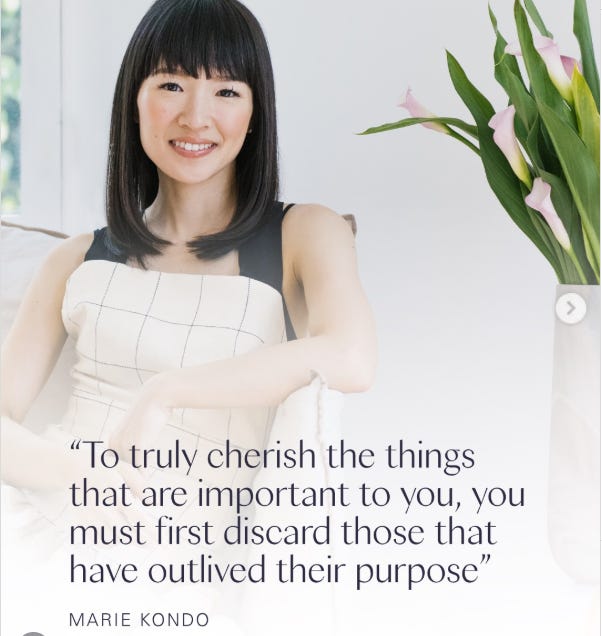
Back when Marie Kondo took the world by storm, one central insight stood out: how to declutter.
We keep stuff we never use because letting go is hard.
The guitar is still in the closet after three lessons. The microbrewing kit is in the garage, used twice.
There’s a ball of tangled yarn and a bin of crochet supplies somewhere.
You’re going to get back to it when work calms down. When it gets easier. One day.
At work, it’s the same thing. The old design library nobody wants to scrap.
The workshop software still on the invoice, so you schedule a workshop to justify keeping it.
The critique ritual you keep restarting, even though it has collapsed twice already.
And we treat it all as binary. Either we make the thing work, or we fail. That framing leaves no third option, and it ignores context completely.
Maybe the critique is impossible to maintain because your design team got cut in half. That isn’t a failure. That’s a different situation.
But the wording is marketing genius.
Wording does a lot of work here, and companies know it.
Go cancel a subscription sometime and actually read the buttons.
Are you sure you want to quit? You’ll lose your progress. Your streak ends today. Cancel my membership and give up my discount.
Those are high-impact words, chosen on purpose. Quit. Lose. Give up. They’re built to make leaving feel like a small personal failure. And it works.
I have absolutely backed out of a cancellation flow because I didn’t want to be the guy who gave up on Japanese.
Then we turn around and use those same words on ourselves. On projects nobody is charging us for. And we end up trapped by things we never agreed to in the first place.
Le Cunff suggests a better alternative. Once a pact has run its course, she says it’s the perfect time to reflect and take one of 3 moves:
Persist. Your once-a-week meeting notes are working, so keep going. Turn the twelve-week run into six months.
Pivot. Something’s off, but the idea is sound. You’ve got five meetings a week and once a week isn’t enough, so you go daily. Or you drop the general notes and only do it for strategy meetings.
Pause. You stop.
Look at that third one closely, because it’s doing something sneaky. Pausing and quitting are essentially the same action. The difference lives entirely in the word.
Quitting means you failed at it. Pausing means maybe in five years, maybe in two months, you might pick it up. Or you might never pick it up.
That’s the trick. It’s psychologically easier to pause something than to quit it, and pause gets you to the same place.
Less junk, first of all. You’re not hauling a habit around because stopping would be an admission.
And you get honest about tradeoffs. Say the meeting agendas cost you two extra hours a week. That’s real. But the PMs loved it, the meetings got shorter, people showed up prepared.
So you stick with it for another three months and decide again later. Or the two hours were wrecking your week, and nobody noticed either way, so you pause and move on.
Either answer is fine. That’s the point. You set the duration up front, so the end of the pact becomes a scheduled decision instead of a crisis.
If you’re a UX team of one, which is how I spent a good chunk of my career, or you’re stuck on how to reach the next level, or you’re just not sure what your next move is, run a pact.
Pick an action. Pick a duration. Twelve weeks, once a week.
Then give yourself permission to pause it.
I’m doing this with the outreach. Eight more weeks at an hour a day, five days a week, and then I sit down and look at what actually happened.
Do I persist, because it’s working better than I think?
Do I pivot and change how I’m doing it?
Or have I found a different way of getting clients, so I can pause this one?
I don’t know which yet, and that’s sort of the point. But having a date written down changes the mornings. Rejection is a lot easier to walk into when it isn’t forever.
That outreach hour is really about this.
I get designers onto the shortlist for Senior, Lead, and Principal roles. Not just the first interview: the final one, where it comes down to you or another person.
You tell me your story on a call. I write the portfolio, presentation slides, and interview scripts that get you there.
If you’d rather not wait for me to turn up in your DMs, learn more here: https://theshortlistedportfolio.com/
No posts
Comments
Nothing yet. Say the first thing.
Sign in to join the conversation.