
An article on the Middle East Monitor
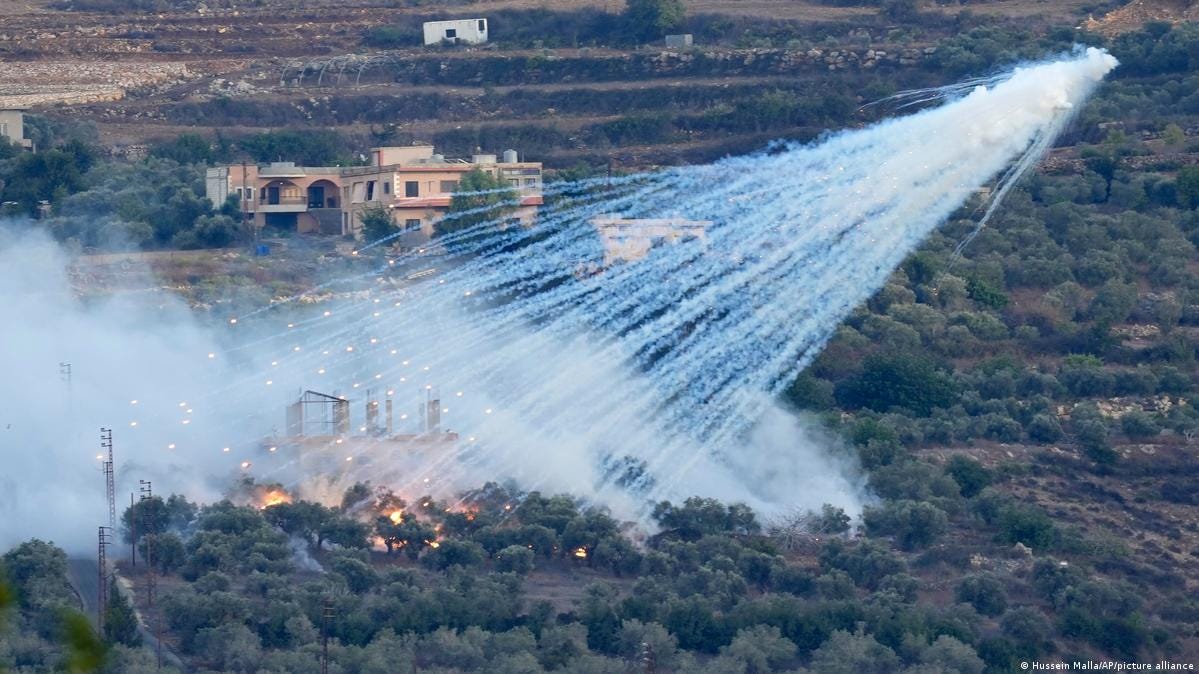
A Palestinian took the invaders’ weapon, turning it against them to defend his homeland. Immediately hordes of settlers attacked Palestinian towns throughout the occupied West Bank. This is a common pattern in Palestine and Lebanon, especially after the launch of the Al-Aqsa Flood. And it is a calculated one. The occupation imposes as much domination as it can without provoking a massive uprising: apartheid within the occupied territories, a blockade in Gaza, displacement and Judaization in the West Bank, and near-daily killings in Lebanon and Syria. And this is what they want us to consider “routine violence.”
As long as the people of the land do not resist, the occupation keeps up this basic violence, gradually escalating it, until we mentally come to terms with its presence. Then, whenever the people of the land resist, the occupation inflicts “additional violence” which it presents as a reaction to the act of resistance. The message is clear: “Do not resist, or else.” This additional violence is designed to make the people of the land wary of resistance and to make them cry out against their oppression: “Enough violence!”—meaning: “The routine violence is enough; why bring additional violence upon ourselves?”
Thus, the occupation seeks to make acts of resistance costly, just as the resistance seeks to make the occupation costly. It shifts the question from how to confront the occupation to whether it is even worth confronting it. It instills a spirit of defeatism and creates a rift within the colonized society. Perhaps these two tools—defeatism and societal fragmentation—are the most dangerous weapons in the enemy’s arsenal. We have seen the success of this endeavor in the rhetoric that blames the resistance for the colony’s violence—sometimes out of ill will, and at other times out of despair and oppression. Therefore, the resistance must be as diligent in confronting this breach in our societies as it is in confronting the enemy’s breaches on the battlefield. So how do we do so?
First, we must provide a clear, non-sectarian justification for our resistance. One may decide to confront the enemy because one finds meaning in refusing injustice, or based on Islamic, nationalist, or leftist ideologies. But these motivations are not shared by everyone in our communities. Justifying the resistance on this basis suggests that our motives are the cause of “additional violence,” and therefore that abandoning them would bring about peace. In contrast, highlighting the reality of the Zionist project as one of subjugation and explaining how it employs violence draws attention to the cost of non-resistance and shows that the solution lies not in accepting violence but in eliminating its source.
Second, acts of resistance must be viewed with a critical eye. Not all acts of legitimate resistance are effective. We recall here the PFLP’s review of the feasibility of operations outside Palestine, the resistance factions’ review of the option of martyrdom operations, and the evolution of Hamas’s rhetoric leading up to the “Our Narrative” document regarding the targeting of non-combatant settlers. Therefore, rather than hiding behind the reality that “there is no escape from the occupation’s additional violence” to justify any acts of resistance, resistance options must undergo a feasibility study before being implemented and a critical review afterward. In this way, we do not merely seek retaliation but refine it, as the martyr Basil al-Araj put it.
Comments
Nothing yet. Say the first thing.
Sign in to join the conversation.