

Meta-Thinking transforms marketing by aligning deep customer insights with personalized content and context. It's not just about delivering the right message—it's about creating the right experience for every individual, at every touchpoint.
In today’s marketing landscape, consumers expect personalized experiences that speak directly to their unique needs and desires. However, delivering these tailored experiences requires more than just basic segmentation. Brands must adopt a Meta-Thinking approach, which transcends traditional archetypes and allows for a deep integration of customer insights, content strategies, and workflow execution. This approach fuses content and context, enabling businesses to create powerful campaigns that resonate with a wide range of nuanced audiences.
In this article, we’ll explore Meta-Thinking as a content and context framework that leverages micro-archetypes, personalized workflows, and adaptive strategies to deliver hyper-targeted and relevant marketing campaigns. This method empowers brands to engage modern consumers, particularly in high-value markets such as luxury goods, where personal identity, aspirations, and values play an essential role in decision-making.
Meta-Thinking is the process of combining multiple layers of customer insights, marketing strategies, and workflows into a cohesive framework. This holistic approach ensures that content is not only tailored to a target audience but also deeply contextualized within each consumer’s unique journey, preferences, and behaviors.
At the core of Meta-Thinking is the idea of moving beyond traditional personas and engaging with micro-archetypes—small, specific customer segments that represent distinct variations within broader audience groups. By identifying and understanding these micro-archetypes, marketers can craft campaigns that speak directly to the personal, emotional, and practical needs of each group, resulting in more meaningful and effective engagement.
To build a successful Meta-Thinking strategy, brands must integrate several key components that drive both content creation and contextual understanding. These components include:
Micro-Archetypes: Detailed, sub-segmented personas that reveal the deeper motivations and behaviors of customers.
Content Personalization: Creating tailored content that resonates with each micro-archetype based on their unique needs.
Contextual Relevance: Understanding where, when, and how to deliver content to align with the customer’s journey.
Optimized Workflows: Streamlining content production and campaign execution to respond quickly to consumer feedback and market shifts.
Traditional marketing personas paint broad strokes about a target audience, identifying basic demographics, goals, and behaviors. Micro-archetypes take this further by focusing on the specific characteristics, values, and motivations within these larger segments. In a Meta-Thinking framework, micro-archetypes enable marketers to deliver hyper-personalized experiences by breaking down personas into their most granular elements.
Let’s revisit the luxury car market example:
Primary Archetype: The Innovator
Broadly speaking, The Innovator is someone who values cutting-edge technology and is an early adopter of new trends.
Micro-Archetypes Within The Innovator:
The Eco-Tech Enthusiast: Values sustainability and seeks the latest green technology in luxury cars, like electric vehicles (EVs) and eco-friendly materials.
The Gadget Aficionado: Thrilled by advanced features like autonomous driving, augmented reality dashboards, and integrated smart technology.
By understanding these micro-archetypes, a luxury car brand can craft tailored messaging and content that resonates with each sub-group. The Eco-Tech Enthusiast might engage more with content about the car’s carbon footprint reduction, while the Gadget Aficionado will respond to videos highlighting futuristic in-car technology.
Imagine running a marketing campaign targeting both micro-archetypes:
For The Eco-Tech Enthusiast, the campaign might include blog posts and videos focused on the brand’s commitment to sustainability, the eco-friendly features of the vehicle, and its reduced environmental impact.
For The Gadget Aficionado, the content might focus on the high-tech features of the car, including its autonomous driving capabilities, virtual dashboard, and real-time navigation system.
By recognizing the distinct desires of each micro-archetype, the brand can optimize content for relevance and engagement, ultimately improving conversion rates and driving deeper connections.
Once the micro-archetypes are established, the next step in Meta-Thinking is to design content that speaks directly to the specific needs, preferences, and motivations of each group.
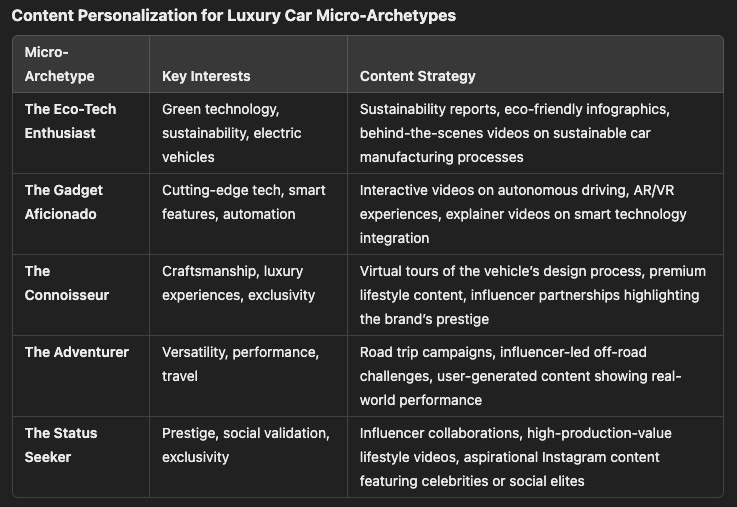
By tailoring content specifically to each micro-archetype, brands can deliver messages that feel personalized, fostering a stronger connection with their audience.
Content without context is like a car without fuel—it lacks the power to move forward. Contextual relevance in Meta-Thinking means delivering the right content, to the right person, at the right time. This involves mapping the customer journey for each micro-archetype and identifying the ideal moments to engage with them.
For example, within the luxury car market, different micro-archetypes will interact with the brand at various stages of their journey. Here’s how brands can map the journey for two distinct micro-archetypes:
The Eco-Tech Enthusiast Journey:
Awareness: Reads sustainability articles on LinkedIn or green tech blogs.
Consideration: Watches in-depth videos about electric vehicle features and green manufacturing on YouTube.
Conversion: Engages with virtual test drives and online configurators that showcase eco-friendly options.
The Status Seeker Journey:
Awareness: Follows luxury influencers on Instagram or TikTok.
Consideration: Views influencer collaborations or attends virtual luxury events showcasing the car.
Conversion: Engages with personalized, invitation-only test drive events or high-end car shows.
By understanding these contextual touchpoints, brands can deliver content that aligns perfectly with the moment of engagement, increasing the likelihood of conversion and brand loyalty.
Implementing a Meta-Thinking strategy requires more than just great content—it also demands efficient workflows. Streamlining content production, distribution, and campaign execution is crucial to responding quickly to customer insights and market changes.
To optimize workflows for micro-archetype campaigns, brands can:
Segment Content Creation Teams: Assign specific creative teams to focus on each micro-archetype, ensuring deep understanding and faster content turnaround for their niche audience.
Automate Campaign Execution: Use marketing automation tools to segment audiences and distribute personalized content at scale.
Use Data-Driven Feedback Loops: Continuously gather data on content performance and customer engagement, using it to refine messaging and optimize future campaigns.
By implementing agile workflows, brands can rapidly adapt their strategies to emerging consumer preferences, ensuring that they remain relevant in a fast-changing market.
In the era of precision marketing, brands that adopt the Meta-Thinking framework are better positioned to connect with their audience on a deeper, more meaningful level. By focusing on micro-archetypes, personalized content, contextual relevance, and optimized workflows, marketers can create campaigns that speak directly to individual consumer needs while driving engagement, loyalty, and conversion.
The power of Meta-Thinking lies in its ability to merge content with context—not only delivering the right message, but ensuring that message resonates with the right person at the right time. For industries like luxury goods, where brand loyalty and prestige are paramount, this level of personalized marketing is not just advantageous—it’s essential.
Conclusion: A New Era of Marketing
As brands embrace Meta-Thinking, they unlock the ability to create deeply personalized and contextually relevant marketing campaigns that foster stronger relationships with their audience. This approach represents the next frontier in content strategy, one that moves beyond generalizations to truly understand the motivations and behaviors of every customer, no matter how niche their preferences may be. For marketers, the future is clear: those who master the art of Meta-Thinking will not only stand out—they’ll thrive.
Meta-Persona Architect
Metadata Persona Architect Demo
·
October 8, 2024

The purpose of the Metadata Persona Architect is to help companies develop a nuanced and strategic approach to content creation and marketing by creating Meta-Personas. Unlike traditional personas that focus on individual consumer profiles, Meta-Personas represent a
Comments
Nothing yet. Say the first thing.
Sign in to join the conversation.