
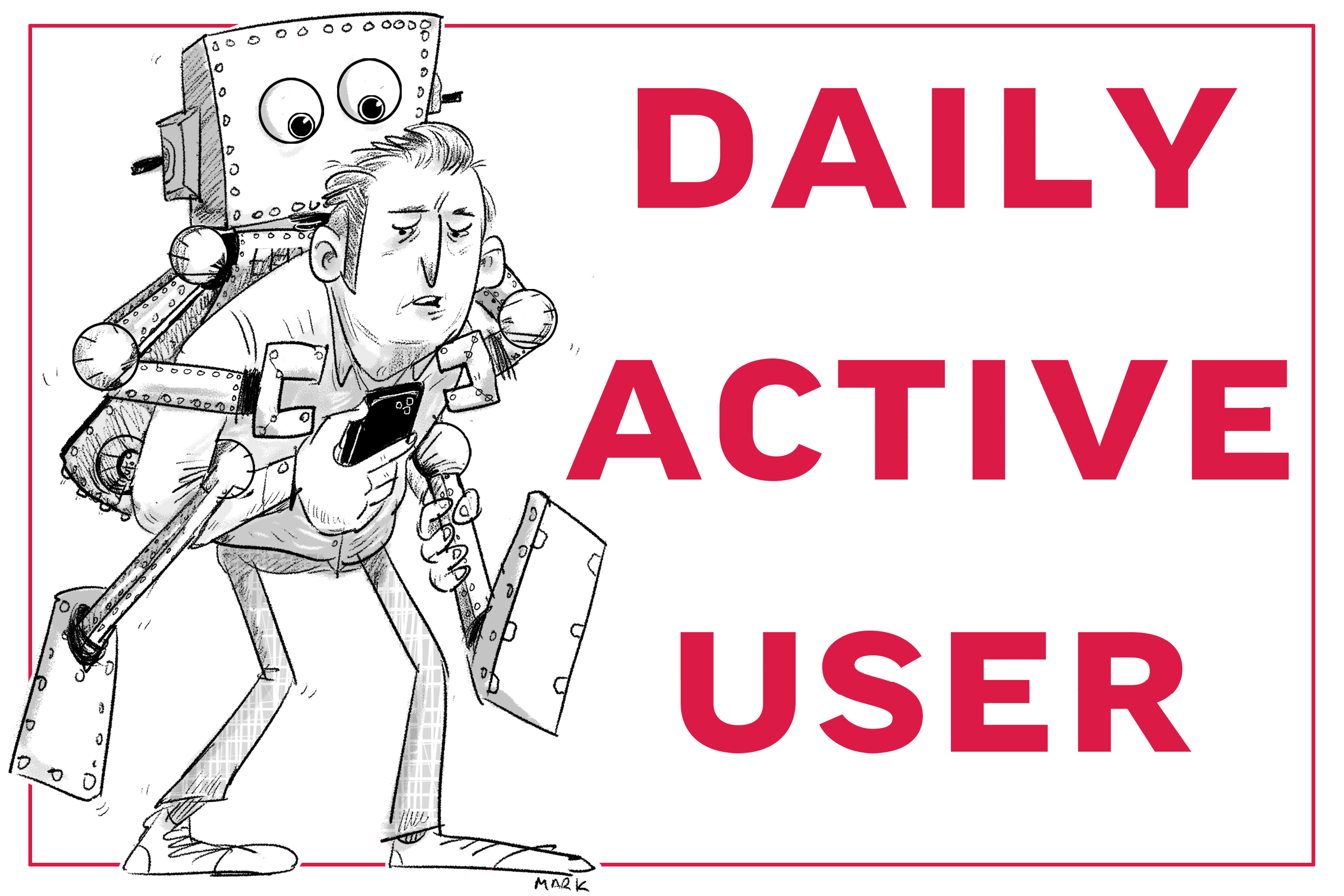
The pen-to-paper outline for this post makes for some interesting reading on its own. As the work for this newsletter (typed up on a Daylight computer) has continued, and the data has become more revealing, there is much to be optimistic about. Sadly, this does not outweigh the challenges we face ahead, yet I feel vindicated that a lot of what I’ve discussed has been borne out in lawsuits (won and in discovery), reporting, and data. It feels good to be right about the positive things, but there is no comfort in being right about the terrible things.
Those who take pleasure, or some distorted version of it, in further enriching themselves by addicting children and vulnerable individuals to social media platforms, have had time in court and been found liable for what they were accused of. The social media executives and their teams knew they were targeting and addicting children, and juries found this to be true. The cases were won, and their feeble free speech arguments were sunk using the companies’ own words. Internally, they knew they were addicting and harming kids, while externally they offered, nothing to see here, we are doing all we can with the best technology. No one was buying it.
The harm was deliberate. Attempts were made to lobby and obfuscate, lies were told, and money was made along the way. Vulnerable children were exploited for profit. In her brilliant book of the same name, Sarah Wynn Williams called these purveyors of addiction Careless People, in reference to F. Scott Fitzgerald’s Daisy and Tom from The Great Gatsby. While “careless people” is an appropriate term, the CEOs of these companies are something else entirely, and we must not let them get away with being merely careless.
There is a deep ideology at work when you cross the lines they have crossed. Those who have so much wealth, and would still knowingly harm children, are more than careless, they are cruel. A desire to realize the value of every child’s well-being at around $270, when you are amongst the ten wealthiest humans on the planet, and doing all you can to extract their happiness for what, to you, is a pittance, speaks to a cruelty that is hard to fathom.
This case is even more damning when you consider that these companies and their CEOs pride themselves on being “data-driven companies,” which they truly are. This means that from the C-suite down, everyone within the decision chain knows, with precision, the harms they inflict. And knowing they are causing harm, each would (and does) keep going for that $270 a head for each kid. Bleak, I know, but as Charlie Munger famously said, “Show me the incentive, and I will show you the outcome.”
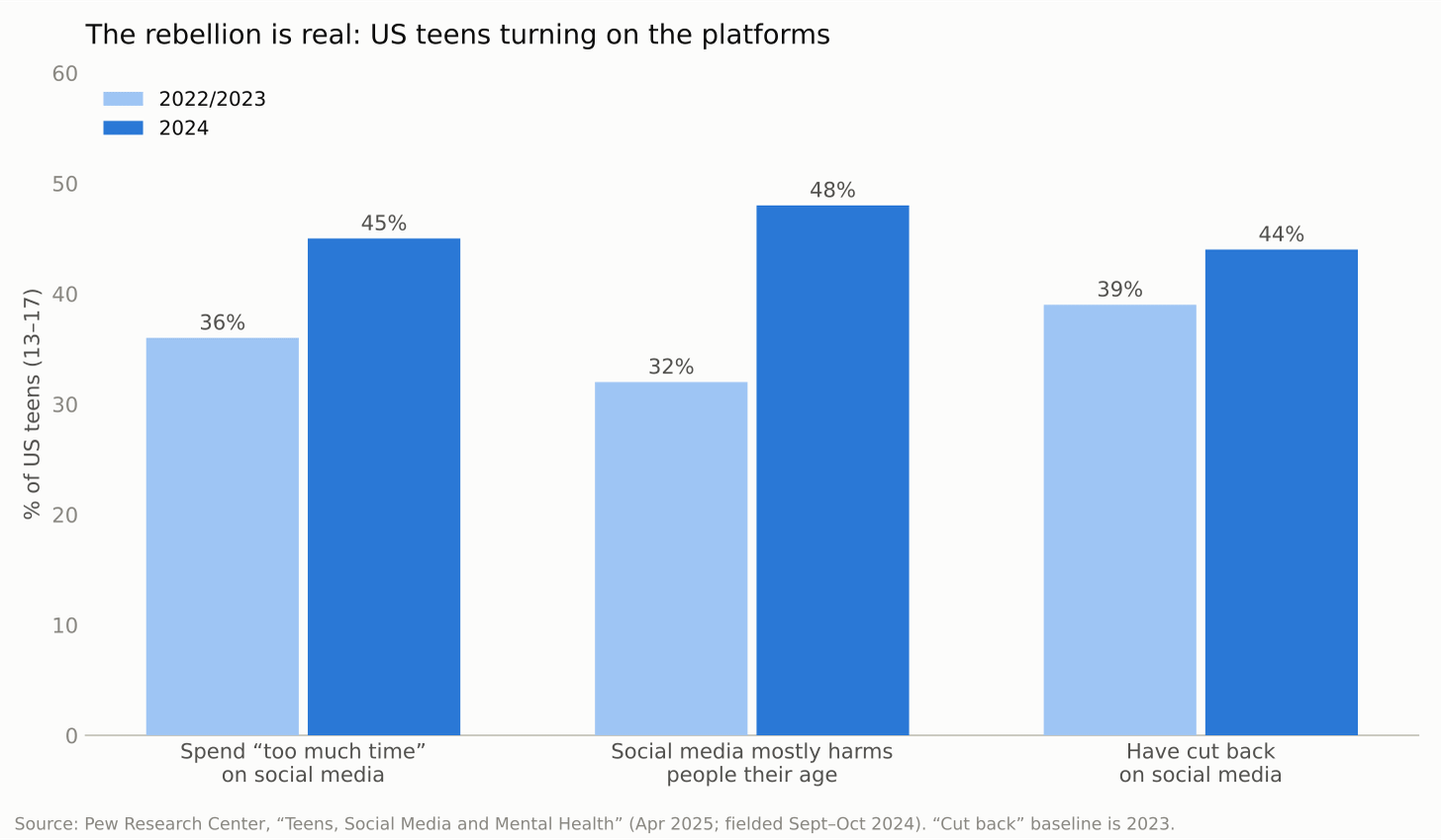
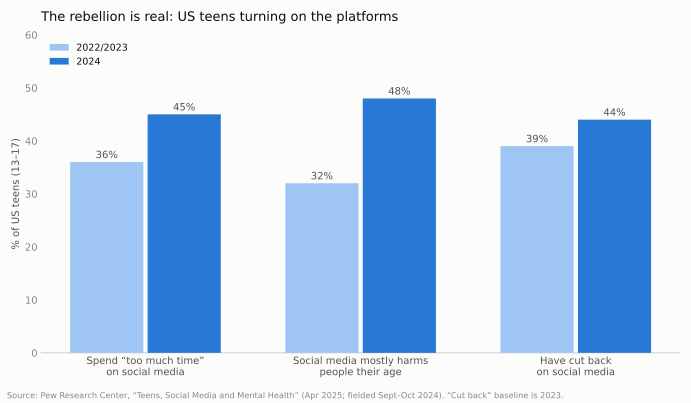
The trending good news is that our most anxious generation seems to be showing the first signs of stirring against the abuses, working to get social media out of their bloodstream. They are starting to rebel, as they should. We are seeing this in the heartening growth of offline clubs and in-person gatherings, a return to live music without devices, and an increase in time spent reading. There is a decline in platform usage among youth throughout the world, though sadly not in the United States. Also, it now seems to be the parents who are trending upwards when it comes to overuse. A tragic irony indeed.
The rise of purposeful (as opposed to smart) devices is climbing, while the capabilities of these technologies, supercharged by AI, are becoming harder to ignore. Though many kids are breaking the spell cast by the devices, the most vulnerable young are severely struggling, while tech platforms and AI companies squarely target them for further invasive exploitation, aided by (I hate to have to write this) their schools.
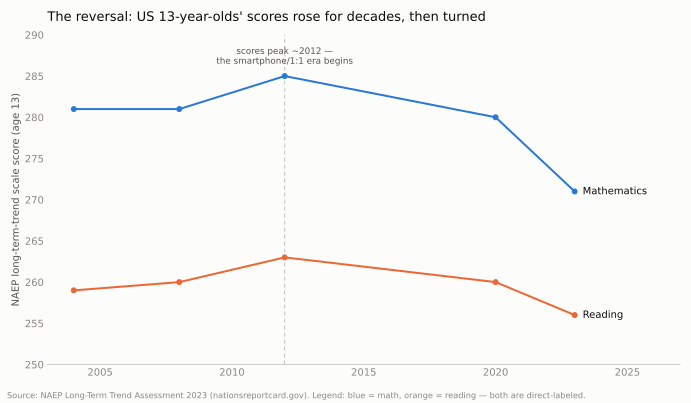
The first thing I didn’t see coming was that once the data confirmed that 1:1 devices in schools were leading to a catastrophic drop in learning, most schools would not change course. As literacy and math scores plummeted, we saw that these devices made learning the hardest for the most educationally and economically vulnerable. What was intended to bring equality has exacerbated inequality, while the wealthy, particularly those who build and invest in these technologies, are able to buy themselves out of the scourge of devices in the classroom. To state it plainly, a digital device in the classroom makes it more difficult to learn for all but the most gifted and neurodivergent students, leaving everyone else to suffer through an impoverished learning environment whose benefits are indefensible. If you are a parent and your school is giving your child a laptop or tablet, they are handing them a tool that was not designed for kids. A tool that doesn’t (apart from rare cases) advantage them academically, but that is more likely to make learning harder. On their classroom desk sits a device that has now been shown, as with social media from the company’s own internal communications, to be little more than a way to get loyalty and attention from children. Loyalty that is hoped will follow these kids into adulthood.
The data is devastating here. It is shocking to me that, even as this data hits the headlines, and as AI accelerates it, schools still appear to be doing nothing about it, and in some cases, to even be doubling down. This is madness. But then again, we Daily Active Users are good at never letting facts, data, or mental health get in the way of a good fix or simply following the crowd. Here’s a thought: If the people who make the devices and software don’t let their kids use them, and often send their kids to schools that ban these products, what more do we need to know?
The second thing I missed was the data on how devices are demolishing birth rates. This was quite a surprise to read, and the data seems solid and well researched. In short, where smartphones have been introduced, birth rates have dropped soon after. Our digital devices are so antithetical to human flourishing that they are causing a population decline of unprecedented scale. The data is fascinating as it tracks, at times by network and locality in detail, the tech drops, and then country by country the decline. Not in the number of births per person, which has remained relatively stable, but simply in the number of humans interested in or able to create more of themselves, more of us. And we wanted these things in schools?
Some argue that fewer humans is a good thing, and that cellphones and laptops as birth control are a good thing, as they will help us heal the earth and mitigate climate change. I have found that population science is, oddly enough, counterintuitive. But what it comes down to is fewer people able to take care of us as we age, so the economics of supporting us becomes increasingly brutal as the competition for diminishing resources grows more acute. Essentially, the utopian end state will be a bumpy ride we are ill-equipped to navigate, as there is little precedent for a country’s population to drop to the size of a major city in a generation or two. One demographer made the point that you have to abuse a mammal in order to interfere with its desire to reproduce, and yet we have managed to addict and amuse ourselves into a state of no longer wanting to make love to one another. Derek Thompson said, “everything is TV.” Neal Postman said, regarding TV, that we are, “amusing ourselves to death.” I think both are true.
Climate has changed, and we are going to need technology to help us manage it, alongside the very big population decline. Like the Luddites, I have never been anti-technology, or anti-technology that charts toward human flourishing. We are going to need the best and brightest to help us make this turn, and it will come from the kids who are pushing back on this technology. We must help free them from this capitalistic hold. They don’t need laptops in schools, second screens at home, or social media platforms that degrade their every waking moment. It is us, the parents and teachers, who give them these devices in the first place. We must learn quickly from this mistake, as it’s these kids we’ll rely on as we age.
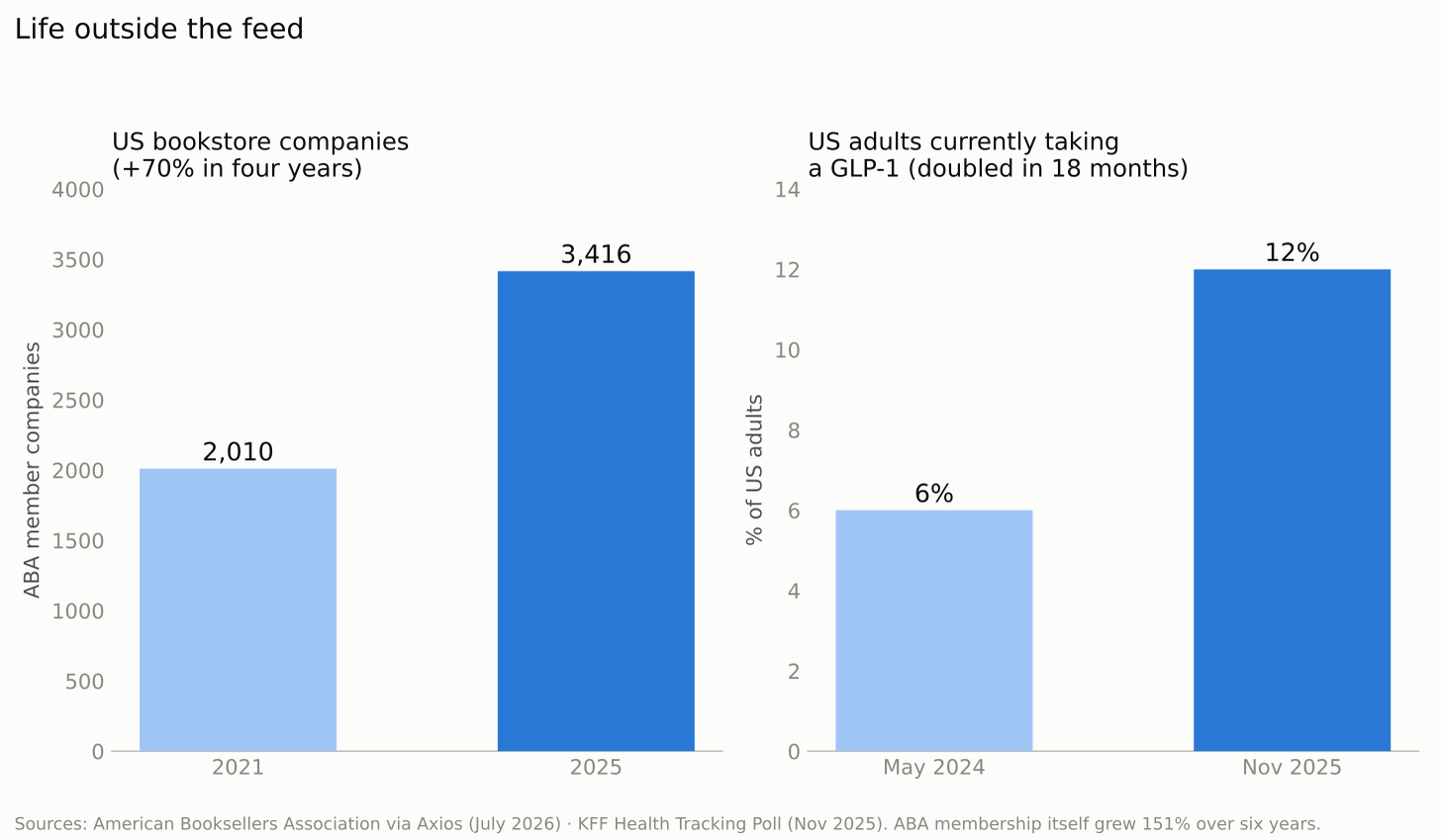
Spiritually, and it turns out also scientifically, we are going to need fiction to keep our minds healthy as we age. The good news is that bookshops are back and people are reading again. I’m not too worried about the AI slop apocalypse when it comes to reading. But as we’ve seen from current literary prizes being awarded and then retracted, going forward there will be no way to tell whether AI was employed, and its use will be too tempting for many of us. I can foresee a premium being placed on the value of older works versus new ones, and people trusting less and less in ebooks that big tech companies can alter or retract at will.
And with the consumption of books comes the wonders of GLP-1s and the explosion of fitness and health. From full bookstores to the decline of Spotify and Netflix stock prices as analysts wake up to the enshitification of their platforms, and as we come to realize more and more that abusing our customers is good for the short term (giving the execs plenty of time to cash out) but terrible for the long term, I think we, who can free ourselves from this dystopian internet-device-infected world, will have a lot to be optimistic about and celebrate with each other in person.
The data is clear, and we know what to do. We need to admit, as I have, that we are Daily Active Users. And that our future happiness will often derive from what we are able to draw from within our lives, not from what we can add. That every hour reclaimed from a corporate feed will be a better hour than one spent staring slack-jawed at a smartphone or laptop. There is hope in the human, outside of the machine, and the brave kids who are organizing and pointing us in the right direction are onto something; we just have to find the self-control, or recovery, needed to leave the phone at home, and to head out into what is left of the world that this technology hasn’t yet ruined.
The CEOs and workers at the tech companies who knowingly harm us and our children are not going to change unless we make them. They are OK with the harm; they give it monetary value, count it as it flows in. And if they won’t draw a line at hurting children, then where is the line for them at all? As Paul Weller from the Jam said, in the 1980 song “Going Underground,” “The public gets what the public wants” and “The public wants what the public gets.”
In this blog’s inaugural post, I started from the springboard of Jaron Lanier’s Ten Arguments for Deleting Your Social Media Accounts Right Now in which he wrote, “Social media is making politics impossible.” I pushed this point to its logical conclusion: if it makes politics impossible, then it will make democracy impossible. I stand by this point, but there is another one I failed to unpack in my initial piece: ubiquitous internet connectivity and algorithmic feeds have made us, as a population, ungovernable. I found this particularly striking, since watching yet another politician fail in the UK to serve out their term, and seeing images of a UFC cage match on the White House lawn for the U.S. president’s birthday. As I see it, no politician stands a chance while we are glued to our screens, and the good we see is happening in spite of, not aided by, our always-on, always-looked-at internet-connected devices. So my initial opinion stands. We are still choosing smartphones over democracy. What we have now is only going to get worse. We cannot have both. It will not work. You can have your cat videos along with tattered politics, or you can have some peace and more fun out in the real world—and democracy. You can’t have both.
I loved the class I taught for the last 11 years. I didn’t do it for the money, but for the joy of it. I was able to help my students. But a few experiences, one of which was in a classroom of a prestigious university, convinced me that this way of leading students through a course was not going to work for them—or me. I realized that AI- and device-led learning hindered my ability to serve my students in a way that I could not, in good conscience, continue.
This sense hardened when I was honored to be asked to speak at a prestigious university. As I waited my turn, I sat at the back of the classroom, with an inadvertent view of all of the students’ laptops. What I saw was shocking and made me feel sick to my stomach. Every kid had an AI chatbot open, a social- or phone-based messaging app, and some other kind of shopping or feed in front of them as their lecture proceeded. All were recording the lecture using transcription software so it could be summarized, and as the person before me was speaking, every kid I could see was engaged in pretty much anything but listening to what they were saying. One enterprising student who had been shopping in one tab went to their AI note-taker and prompted it to draft a question that would make them sound smart to the speaker they had just recorded.
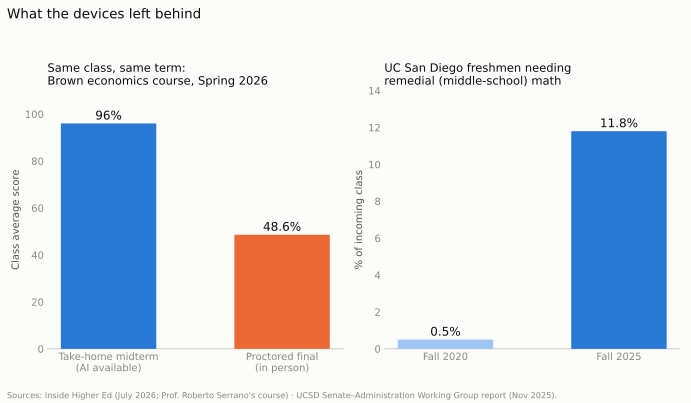
When it was my turn to speak, I was devastated. I didn’t ask for them to put their laptops down; what would be the point? They had phones and could just continue it all there; then, would it be fair to remove their means of note-taking? Whether you wanted to hear me or not, and the subject was quite important for their course, the point was they weren’t with me. It was gutting. My most powerful feeling in the moment and for hours after was this deep and sinking feeling that this simply wasn’t going to work. That we had broken something. That, up until the advent of internet-connected portable devices, education (and the data show this) had been improving. Our steady climb toward a better education for our kids was sideswiped (no pun intended) and sharply reversed—along with our birth rates. Our children’s reading and maths, it now seems, have declined to the point where some universities are having to teach college maths majors middle-school basics, and where classes include kids who can’t handle reading a 20-page article, let alone a whole book.
So let’s keep it simple. It’s the internet-connected phones, laptops, and tablets that are, when combined with algorithmic feeds, toxic to our flourishing. Is it all bad? No. Is it mostly bad? Yes. Is it getting better? Somewhat, but not fast enough.
Leave the phone at home and go be with other humans who have done the same. Demand that, until they can show you data to the contrary, our children’s schools be internet- and device-free, with the exception of neurodivergent/special-needs use cases and advanced sciences, including computer science where needed.
Invest in a featureless device. I am devoted to mine and the time it gives me back. The device I have typed this on is black-and-white only, has all the apps available, and yet I have installed the fewest possible so as not to be armed with anything I don’t need, limiting my distractions. As the saying goes, you are the sum of what you are paying attention to. And if that’s your phone or your Instagram feed, well, you can follow my meaning as you choose.
The future is grim if we get this wrong—and we are getting it wrong in a big way. You know, somewhere inside you, you know that what I am saying is right, not because I’m persuasive or clever, or because the data says I am, but because, as a human, this way of living is demeaning, abusive, and cruel. This extractive way of living seeks only to further serve the billionaires and their despicable commerce, of which our children are the driving force.
We might have to smash a few machines along the way, but we won’t be alone in doing so. And although the Luddites offer us a tragic lesson in what happens when you lose this battle, I doubt that any one of those executed or imprisoned or impoverished for breaking a machine ever saw a nobler cause than the one they were engaged in. A cause that we are now engaged in. Though unlike the Luddites, we don’t even have to fight; we just have to refuse to upgrade, like, and subscribe, and merely ask our schools, who are forcing these devices onto our children, to go back to what we know works, to simply follow the data.
The cause for less is righteous and liberating.
And if putting the device down is a bit too hard, then it might be time to pick up that hammer and remove from your attention, with all the force you can muster, that which was built to make you serve itself. Because these machines no longer serve you. You know what has to be done.
Hammers up!
This one dropped between the writing and the editing of this post, and it says a great deal of what I’ve tried to say above, only better and from inside the room. Sophie Winkleman’s speech at ARC 2026, “Why Tech in Schools is a Disaster for Children” — brought to my attention by Jared Cooney Horvath’s excellent piece, “Sophie Winkleman Does It Again (And New Data Backs Her Up)” (The Digital Delusion, July 10, 2026). Horvath pairs the speech with a fresh data point that belongs in the 1:1 devices section above: a Brown University economist gave the same class a take-home midterm (AI available: class average 96%) and a proctored, in-person final (average 48.6%, the lowest in the course’s history). Watch the speech. Then look at the device your school just handed your kid.
Some sources:
NPR — Jury finds Meta and YouTube negligent, first social-media addiction bellwether (2026) — https://www.npr.org/2026/03/25/nx-s1-5746125/meta-youtube-social-media-trial-verdict
ABC News — $6M verdict, 70/30 fault split (2026) — https://abcnews.go.com/GMA/News/jury-returns-verdict-meta-youtube-landmark-social-media/story?id=131121474
NPR — TikTok settles; Judge Kuhl’s Section 230 ruling sends design claims to the jury (2026) — https://www.npr.org/2026/01/27/nx-s1-5684196/social-media-kids-addiction-mental-health-trial
Bloomberg Law — Judge Gonzalez Rogers narrows Meta’s 230/First Amendment defenses; state AGs’ trial Aug 2026 — https://news.bloomberglaw.com/litigation/metas-defenses-show-cracks-ahead-of-states-addiction-trial
Bloomberg — Meta settles first school-district case before trial (2026) — https://www.bloomberg.com/news/articles/2026-05-21/meta-settles-school-suit-over-social-media-averting-first-trial
State AGs v. Meta, unredacted complaint ¶84 — “lifetime value of a 13 y/o teen is roughly $270” (2023) — https://www.azag.gov/sites/default/files/2025-05/Doc 73-2 Complaint (limited redactions) -11.22.2023.pdf
Forbes — world’s 10 richest, July 2026 — https://www.forbes.com.au/news/billionaires/the-top-10-richest-people-in-the-world-july-2026/
Sarah Wynn-Williams — Careless People (Flatiron, 2025) — https://us.macmillan.com/books/9781250391230/carelesspeople/
Lawrence Lessig — “Let’s create the ‘Wynn-Williams Effect’” (2026) —
Henry Farrell — The Rich Are Not Like You and Me (2025) —
Henry Farrell — The political economy of billionaire derangement (2026) —
The Verge — ex-Meta VP Brian Boland’s trial testimony (2026) — https://www.theverge.com/policy/881706/meta-executive-brian-boland-testimony-social-media-addiction-trial
Reuters — Meta tolerates rampant ad fraud to safeguard billions (2025) — https://www.reuters.com/investigations/meta-tolerates-rampant-ad-fraud-china-safeguard-billions-revenue-2025-12-15/
Farnam Street — Munger, “The Psychology of Human Misjudgment” (1995) — https://fs.blog/great-talks/psychology-human-misjudgment/
Eventbrite — phone-free events +567% globally 2024→2025 (2026) — https://www.eventbrite.com/blog/press/newsroom/the-rise-of-phone-free-experiences/
Forbes — why phone-free events are trending (2026) — https://www.forbes.com/sites/brucelee/2026/06/08/phone-free-events-are-trending-here-are-big-reasons-behind-this/
Billboard/Yondr — 20 million phone-free moments (2025) — https://www.overyondr.com/blog/billboard-article-1025
Kerrang — Ghost’s phone-free 2025 world tour — https://www.kerrang.com/ghost-announce-that-their-2025-world-tour-will-be-a-phone-free-experience
NEA — Federal data on reading for pleasure: all signs show a slump (2024) — https://www.arts.gov/stories/blog/2024/federal-data-reading-pleasure-all-signs-show-slump
iScience via CNN — reading for pleasure down ~40% in 20 years (2025) — https://www.cnn.com/2025/08/20/health/reading-for-pleasure-decline-wellness
ALA — Gen Z and Millennials’ library use and print preference — https://www.ala.org/sites/default/files/advocacy/content/tools/Gen-Z-and-Millennials-Report (1).pdf
Circana BookScan — romance/romantasy-led print growth (2025) — https://www.circana.com/post/another-year-of-romance-with-a-dark-twist-circana-bookscan-reports
American Booksellers Association — 2025 Annual Report: +19% members, 605 new stores, +151% in six years (2026) — https://www.bookweb.org/news/aba-ceo-allison-hills-letter-2025-annual-report-1632880
Axios — bookstores are making a comeback (2026) — https://www.axios.com/2026/07/03/bookstores-barnes-noble-james-daunt
Pew Research Center — Teens, Social Media and Mental Health (2025) — https://www.pewresearch.org/internet/2025/04/22/teens-social-media-and-mental-health/
GWI — how older consumers came of age on social media — https://www.gwi.com/blog/social-media-older-consumers
Pew Research Center — Americans’ Social Media Use 2025 — https://www.pewresearch.org/internet/2025/11/20/americans-social-media-use-2025/
FT (John Burn-Murdoch) — Have we passed peak social media? (2025) — https://www.ft.com/content/a0724dd9-0346-4df3-80f5-d6572c93a863
Counterpoint Research — US feature-phone comeback, Gen Z digital detox (2023) — https://counterpointresearch.com/en/insights/us-feature-phone-market
CNBC — dumb phones on the rise as Gen Z limits screen time (2023) — https://www.cnbc.com/2023/03/29/dumb-phones-are-on-the-rise-in-the-us-as-gen-z-limits-screen-time.html
NYT Magazine — Is There Life After Smartphones? (2026) — https://www.nytimes.com/interactive/2026/03/31/magazine/quit-smartphone-addiction-social-media.html
Light Reading — Light plots expansion with its minimalist phone — https://www.lightreading.com/broadband/light-plots-expansion-with-minimalist-phone
OECD — Students, digital devices and success (PISA 2022 analysis, 2024) — https://www.oecd.org/content/dam/oecd/en/publications/reports/2024/05/students-digital-devices-and-success_621829ff/9e4c0624-en.pdf
Reboot Foundation via Hechinger Report — tablets in class, lower NAEP scores (2019) — https://hechingerreport.org/research-shows-lower-test-scores-for-fourth-graders-who-use-tablets-in-schools/
AP/VOA — Sweden brings back books and handwriting; Karolinska statement (2023) — https://www.voanews.com/a/sweden-brings-more-books-handwriting-practice-back-to-its-tech-heavy-schools/7262263.html
After Babel — Sweden Went All in on Screens in Childhood. Now It’s Pulling the Plug. (2025) —
After Babel (Jared Cooney Horvath) — The EdTech Revolution Has Failed (2024) —
Gallup/Walton — 60% of teachers used AI in 2024-25 (2025) — https://news.gallup.com/poll/691967/three-teachers-weekly-saving-six-weeks-year.aspx
NYT — Chromebook Remorse: tech backlash at schools extends beyond phones (2026) — https://www.nytimes.com/2026/03/29/technology/chromebook-remorse-kansas-school-laptops.html
WSJ — Screens have taken over classrooms; even students have had enough (2025) — https://www.wsj.com/us-news/education/schools-phone-screens-technology-research-c268bda5
NYT Opinion (Jean Twenge) — the laptop that ate your child’s classroom (2025) — https://www.nytimes.com/2025/11/16/opinion/laptop-classroom-test-scores.html
NAGB — 10 takeaways from the 2024 NAEP results (2025) — https://www.nagb.gov/powered-by-naep/the-2024-nations-report-card/10-takeaways-from-2024-naep-results.html
NAGB — 12th-grade NAEP 2024: lowest math and reading scores ever recorded (2025) — https://www.nagb.gov/powered-by-naep/the-2024-nations-report-card/top-5-takeaways-from-12-grade-naep-math-reading-results.html
FT (John Burn-Murdoch) — Have humans passed peak brain power? (2025) — https://www.ft.com/content/a8016c64-63b7-458b-a371-e0e1c54a13fc
NAEP Long-Term Trend, age 13 (2023) — https://www.nationsreportcard.gov/highlights/ltt/2023/
NYT — “Teachers Are Going to Hate It”: how social media apps hooked teens at school — incl. Google’s 2020 “onboard kids into Google’s ecosystem” deck and 2015 YouTube schools memo (2026) — https://www.nytimes.com/2026/06/04/us/social-media-schools.html
WSJ — How YouTube took over the American classroom (2026) — https://www.wsj.com/us-news/education/youtube-chromebooks-schools-children-brain-f151dfbb
NYT — A Silicon Valley school that doesn’t compute (2011) — https://www.nytimes.com/2011/10/23/technology/at-waldorf-school-in-silicon-valley-technology-can-wait.html
CBS News — Silicon Valley parents raising their kids tech-free (2018) — https://www.cbsnews.com/news/silicon-valley-parents-are-raising-their-kids-tech-free/
UCSD Senate-Administration Working Group report — remedial math 0.5%→11.8% in five years (2025) — https://senate.ucsd.edu/media/740347/sawg-report-on-admissions-review-docs.pdf
Inside Higher Ed — UC San Diego sees students’ math skills plummet (2025) — https://www.insidehighered.com/news/quick-takes/2025/11/12/uc-san-diego-sees-students-math-skills-plummet
The Atlantic (Rose Horowitch) — The Elite College Students Who Can’t Read Books (2024) — https://www.theatlantic.com/magazine/archive/2024/11/the-elite-college-students-who-cant-read-books/679945/
PBS NewsHour — the post-literate age (2026) — https://www.pbs.org/newshour/show/post-literate-age-why-fewer-americans-are-reading-for-pleasure
Sana, Weston & Cepeda — laptop multitasking hinders learning for users and nearby peers (2013) — https://www.sciencedirect.com/science/article/pii/S0360131512002254
New York Magazine — Everyone Is Cheating Their Way Through College (2025) — https://nymag.com/intelligencer/article/openai-chatgpt-ai-cheating-education-college-students-school.html
Inside Higher Ed — Brown professor’s class: 96% on AI-open take-home, 48.6% in person (2026) — https://www.insidehighered.com/news/faculty/learning-assessment/2026/07/08/brown-professor-suspects-most-his-class-used-ai-cheat
NBER (Myers & Hooper) — Is the iPhone Birth Control? (w35310, 2026) — https://www.nber.org/papers/w35310
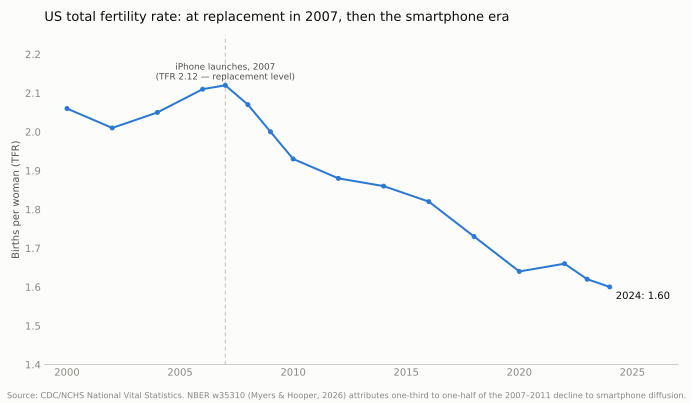
CNN — smartphones arrived just before the US fertility plunge (2026) — https://kvia.com/health/cnn-health/2026/06/12/smartphones-arrived-just-before-the-us-fertility-rate-plunged-one-study-says-its-a-direct-cause/
FT (John Burn-Murdoch) — Why birth rates are falling everywhere all at once (2026) — https://www.ft.com/content/fba35eca-df3a-4ad6-b42d-eb08eb7c9ad3
Noah Smith — Are you finally ready to admit it’s the phones? (2026) —
Derek Thompson — Why the Whole World Stopped Having Babies (2026) —
Institute for Family Studies (Lyman Stone) — ~75% of the US fertility decline is declining coupling (2025) — https://ifstudies.org/blog/yes-marriage-still-matters-for-fertility-new-evidence
Korea Times — Statistics Korea: population to shrink to 36M by 2072 (2023) — https://www.koreatimes.co.kr/economy/20231214/koreas-population-projected-to-shrink-to-36-mil-by-2072-statistics-korea
Our World in Data — South Korea’s population is set to shrink (UN WPP 2024) — https://ourworldindata.org/south-koreas-population-is-set-to-shrink-what-would-it-take-to-stop-the-decline
Derek Thompson — Everything Is Television (2025) —
Derek Thompson — The Monks in the Casino (2025) —
Neil Postman — Amusing Ourselves to Death (Viking, 1985)
American Gaming Association — commercial gaming revenue hits $78.7B in 2025 (2026) — https://www.americangaming.org/commercial-gaming-revenue-hits-78-7-billion-in-2025-driving-record-18-1-billion-in-gaming-taxes-nationwide/
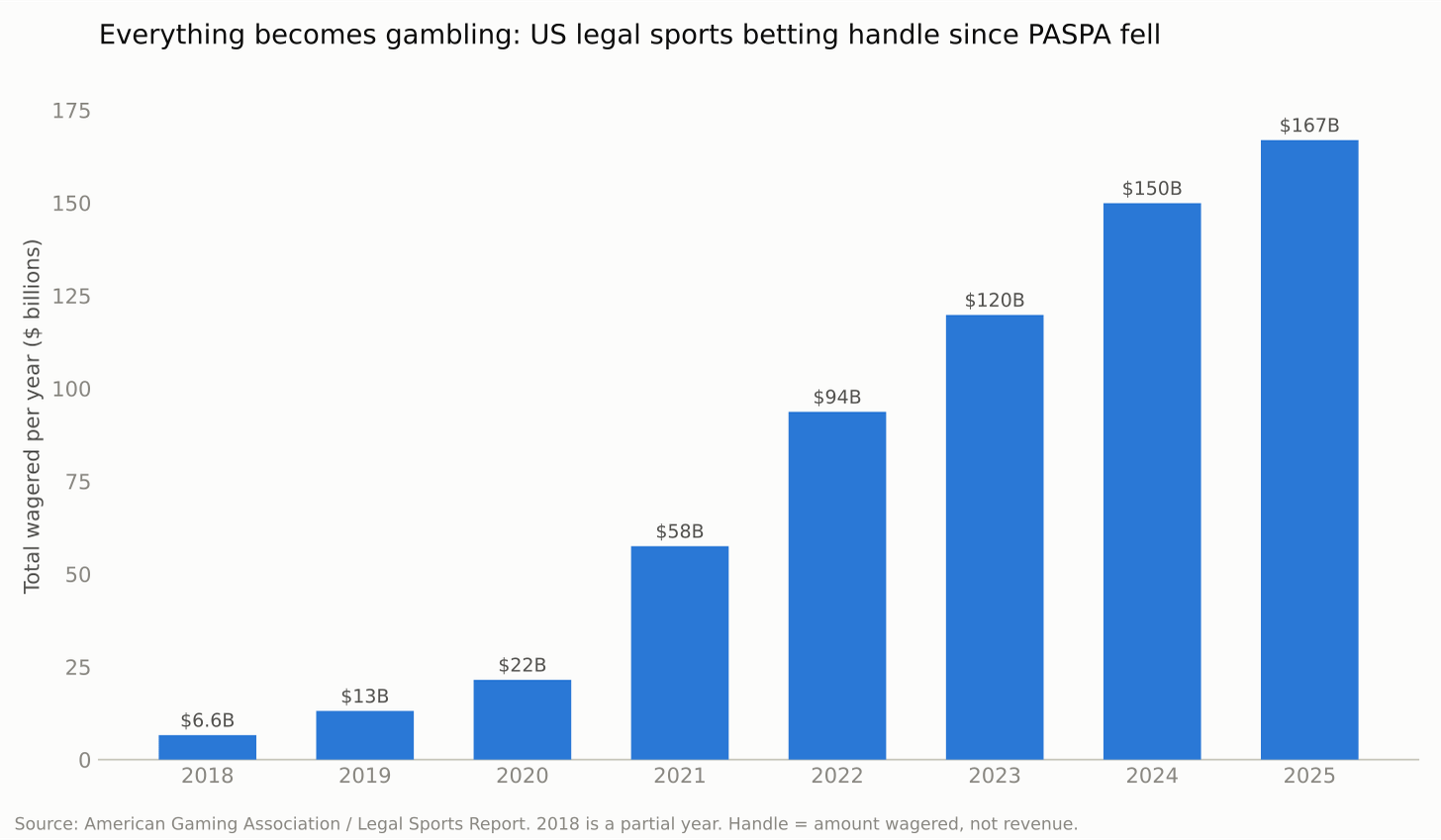
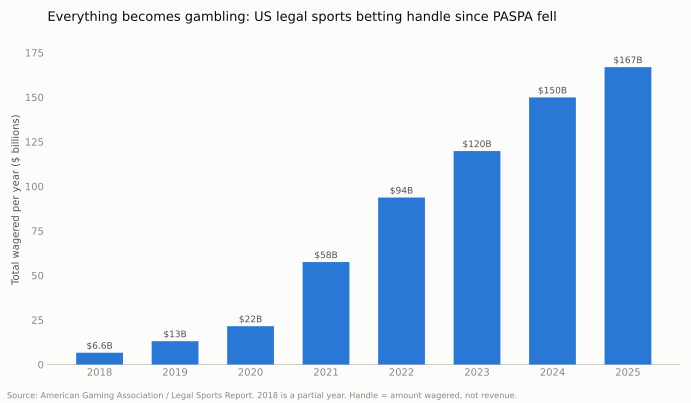
Pew Research Center — prediction-market volume has soared (2026) — https://www.pewresearch.org/short-reads/2026/05/27/trading-volume-on-prediction-markets-has-soared-in-recent-months/
Kyla Scanlon — Everyone is Gambling and No One is Happy (2025) —
Scott Galloway — The Next Opioid Crisis (2025) — https://www.profgalloway.com/the-next-opioid-crisis/
After Babel (David Courtwright) — Limbic Capitalism Has Been Driving Addiction for Hundreds of Years (2026) —
The Walrus — the real scandal isn’t that AI wrote a prize-winning story, it’s the response (2026) — https://thewalrus.ca/the-real-scandal-isnt-that-ai-wrote-a-prize-winning-story-its-the-response/
Euronews — NZ book awards disqualify two authors over AI artwork (2025) — https://www.euronews.com/2025/11/18/new-zealand-book-award-disqualifies-two-authors-for-ai-artwork
Bloomberg — Netflix faces earnings risk after $257B wipeout (2026) — https://www.bloomberg.com/news/articles/2026-07-16/netflix-faces-earnings-risk-after-stock-s-260-billion-wipeout
Forbes — Spotify shares tank as outlook misses (2026) — https://www.forbes.com/sites/conormurray/2026/04/28/spotify-shares-tank-as-earnings-outlook-misses-expectations/
Cory Doctorow — the canonical enshittification essay (2023) — https://pluralistic.net/2023/01/21/potemkin-ai/#hey-guys
FT — review of Doctorow’s Enshittification (2025) — https://www.ft.com/content/5efa975d-9994-42e3-a718-5924e71e0938
Wilson et al., Neurology — cognitive activity delays Alzheimer’s onset ~5 years (2021) — https://www.medicalnewstoday.com/articles/do-reading-puzzles-and-similar-activities-really-stave-off-dementia
Wu et al., JAMA Network Open — literacy activities and ~11% lower dementia risk (2023) — https://pmc.ncbi.nlm.nih.gov/articles/PMC10349343/
KFF — 1 in 8 US adults currently taking a GLP-1 (2025) — https://www.kff.org/public-opinion/poll-1-in-8-adults-say-they-are-currently-taking-a-glp-1-drug-for-weight-loss-diabetes-or-another-condition-even-as-half-say-the-drugs-are-difficult-to-afford/
Health & Fitness Association — record 81M US gym members in 2025 (2026) — https://www.healthandfitness.org/81-million-americans-were-members-of-a-fitness-facility-in-2025-new-hfa-report-finds/
Jaron Lanier — Ten Arguments for Deleting Your Social Media Accounts Right Now (Holt, 2018), Argument Nine
NPR — Andy Burnham becomes prime minister (2026) — https://www.npr.org/2026/07/19/nx-s1-5895993/andy-burnham-prime-minister-keir-starmer
CBS News — Starmer resigns; who is Andy Burnham (2026) — https://www.cbsnews.com/news/keir-starmer-resigns-who-is-andy-burnham-likely-next-uk-prime-minister/
TIME — UFC Freedom 250 at the White House, in photos (2026) — https://time.com/article/2026/06/15/ufc-fight-white-house-freedom-250-photos/
UFC — Freedom 250 results (2026) — https://www.ufc.com/news/ufc-freedom-250-results-highlights-interviews
Jessica Winter, The New Yorker — What Will It Take to Get A.I. Out of Schools? (2026) — https://www.newyorker.com/culture/progress-report/what-will-it-take-to-get-ai-out-of-schools
Noah Smith — America’s political economy is pretty bleak right now (2026) —
Copernicus Climate Change Service — hottest June on record in western Europe (2026) — https://climate.copernicus.eu/copernicus-record-heatwave-brings-hottest-june-western-europe-during-second-warmest-june-globally
WMO — record-breaking heat spreads through Europe (2026) — https://wmo.int/media/news/record-breaking-heat-spreads-through-europe
UK National Archives — the proclamation of Ned Ludd; York executions (1813) — https://www.nationalarchives.gov.uk/explore-the-collection/stories/the-proclamation-of-ned-ludd/
JSTOR Daily — Luddites on trial — https://daily.jstor.org/luddites-on-trial
Brian Merchant — Blood in the Machine (Little, Brown, 2023) — https://www.hachettebookgroup.com/titles/brian-merchant/blood-in-the-machine/9780316487740/
The Jam — “Going Underground“ (Polydor, 1980)
Jonathan Haidt — The Anxious Generation (Penguin Press, 2024) — https://www.penguinrandomhouse.com/books/729231/the-anxious-generation-by-jonathan-haidt/
No posts
Comments
Nothing yet. Say the first thing.
Sign in to join the conversation.