
After I sent Prof Wang Gungwu my last essay, he wrote back that I should take care of myself and not get too angry.
It was kind advice. I have been trying.
The essay asked who gets to be Chinese after the rise. It began with an Australian who wanted to close the category. Chinese meant China; China meant the People’s Republic; therefore someone like me, whose family had lived in Southeast Asia for generations, could not really be Chinese. The modern state was allowed to swallow the civilisation.
The harder figures wanted to do the opposite. They wanted to open the category and turn it into an operating space. The old fox I met in Shanghai imagined free Chinese formations beyond the full reach of Beijing: settlements, commercial zones, institutional membranes, places where Chinese capital, intelligence and organisational ambition could acquire more room. He was not trying to deny that I was Chinese. He was trying to decide what my Chineseness might be useful for.
Professor Wang supplied the correction.
Artificial intelligence was not the deepest technology in the room. Nation-state, sovereignty, border, citizenship, race, minzu, constitution, law, Party, propaganda and history were also technologies. Older ones. More deeply installed. They organised what people considered legitimate before the model arrived. The machine would not simply dissolve them. They would recruit the machine.
I thought that was the end of the argument.
It was only the end of the identity argument.
Since then, I have been watching another China leave China.
Not its civilisation in the old sense. Not migrants carrying dialect, gods, recipes, clan names and family obligations into new settlements. Not the familiar diaspora.
Its operating body.
The category is growing batteries, ports, machine tools, models, laboratories, ships and hands.
The first sign is easy to mistake for ordinary industrial relocation.
Phone assembly moves to India and Vietnam. Some tablet production follows. Factories close in China and reopen elsewhere. Tariffs rise. Local-content rules bite. Governments announce that they have captured manufacturing from China. The product receives a new country of origin.
Then one looks underneath.
宁南山 Ning Nanshan’s comparison of Chinese exports in the first halves of 2018 and 2026 reports falling phone exports and stagnant tablet exports, while automobiles, integrated circuits, lithium batteries, ships, engineering machinery, display modules, printed circuits, power semiconductors, cables and medical equipment rose sharply. He notes that as electronics assembly moved to India and Vietnam, China exported more of the batteries, display modules and other components required by the new assembly sites. His intended conclusion is that Chinese industrial upgrading has succeeded. The stranger conclusion is that final assembly can leave while the reproductive organs of the industrial system remain Chinese.
The phone has left China.
The battery has not. The display has not. The production machinery has not. The supplier qualification system has not. The engineering knowledge has not. The ability to redesign the next generation has not.
The object is no longer merely made in China. It may not even be made by a Chinese-owned company. But it is increasingly made through Chinese industrial capacity.
施展 Shi Zhan calls the public-facing version “Made with China.” Host countries receive factories, jobs and portions of the value chain. Yao Yang speaks of “building China abroad.” Chinese firms should not fear joint ventures, local-content obligations or outward technology transfer. They should use them to enter markets permanently.
But Shi is candid about the asymmetry. The front end moves. The deeper platform remains.
翟东升 Di Dongsheng imagines the political form. A factory sits in a jointly constructed industrial zone in Southeast Asia, around the Indian Ocean or in Latin America. Sovereignty formally belongs to the host. China annexes nothing. Local labour works the lines. Taxation and regulation are negotiated. Yet the factory remains attached to Chinese capital, machinery, software, logistics, standards, components and strategic direction.
The factory has left Chinese territory.
The industrial system has not.
This is more than offshoring. Offshoring usually means that production has migrated into another national ecology. China Outside China means that production disperses across territories while remaining connected to a Chinese reproductive centre.
The relevant question is not who owns today’s plant.
It is who can build tomorrow’s plant.
Who can change the production process? Who qualifies a new supplier? Who repairs the machine? Who updates the software? Who finances expansion? Who owns the experimental data? Who can replace the failed component? Who trains the engineers? Who determines which technical standard becomes normal?
The country printed on the box may be local.
The industrial metabolism may still be Chinese.
A battery must cross a border. A machine tool needs a ship. A factory requires land.
A model is less obedient to geography.
It can be downloaded, hosted, fine-tuned, translated, compressed, embedded behind a local interface and made to appear indigenous. A user may never see the Chinese company that trained it. A developer may care only that it is cheap, capable and open enough to modify. The model enters as cognition without a flag.
For a while, that remains a software story. Chinese models answer questions, write code, translate documents, generate images and perform office work around the world.
Then the model acquires hands.
It enters the vehicle. The robot. The drone. The port. The warehouse. The factory-control system. The electricity grid. The hospital. The mine. The laboratory. The city’s traffic system. The autonomous vessel. The satellite constellation.
At that point China Outside China is no longer merely a supply chain.
It becomes a sensorimotor field.
A Chinese model in a chatbot is a product. A Chinese model coordinating a locally manufactured vehicle, using Chinese batteries and power electronics, learning from roads in Indonesia or Brazil, receiving updates through a Chinese software ecology and returning operating data into the next generation of the system is something else.
The vehicle may be assembled locally.
The intelligence may speak the local language.
The roads belong to the host country.
Yet perception, prediction, control, maintenance and improvement begin to share a Chinese operational grammar.
The same pattern can extend from orbit to seabed.
A satellite detects a change in an ocean current. A model identifies an emerging ecological risk. Autonomous vessels collect samples. A deep-sea laboratory analyses them. A scientific foundry generates hypotheses, designs experiments and directs robotic execution. A biotechnology platform produces a response. Port systems reroute vessels. City authorities adjust water or food systems. Insurers reprice exposure. The resulting data returns to the models that select the next experiment.
Space sees. The ocean reports. The laboratory interprets. The city responds. The model learns.
No single transaction is sovereign. No Chinese flag needs to be raised above the laboratory. Yet the loop can become structurally Chinese if the sensors, models, batteries, robots, experimental machinery, data standards, financing and maintenance all depend upon a Chinese-centred system.
This is where 范阳 Fan Yang’s intuition becomes larger than “AI for science.”
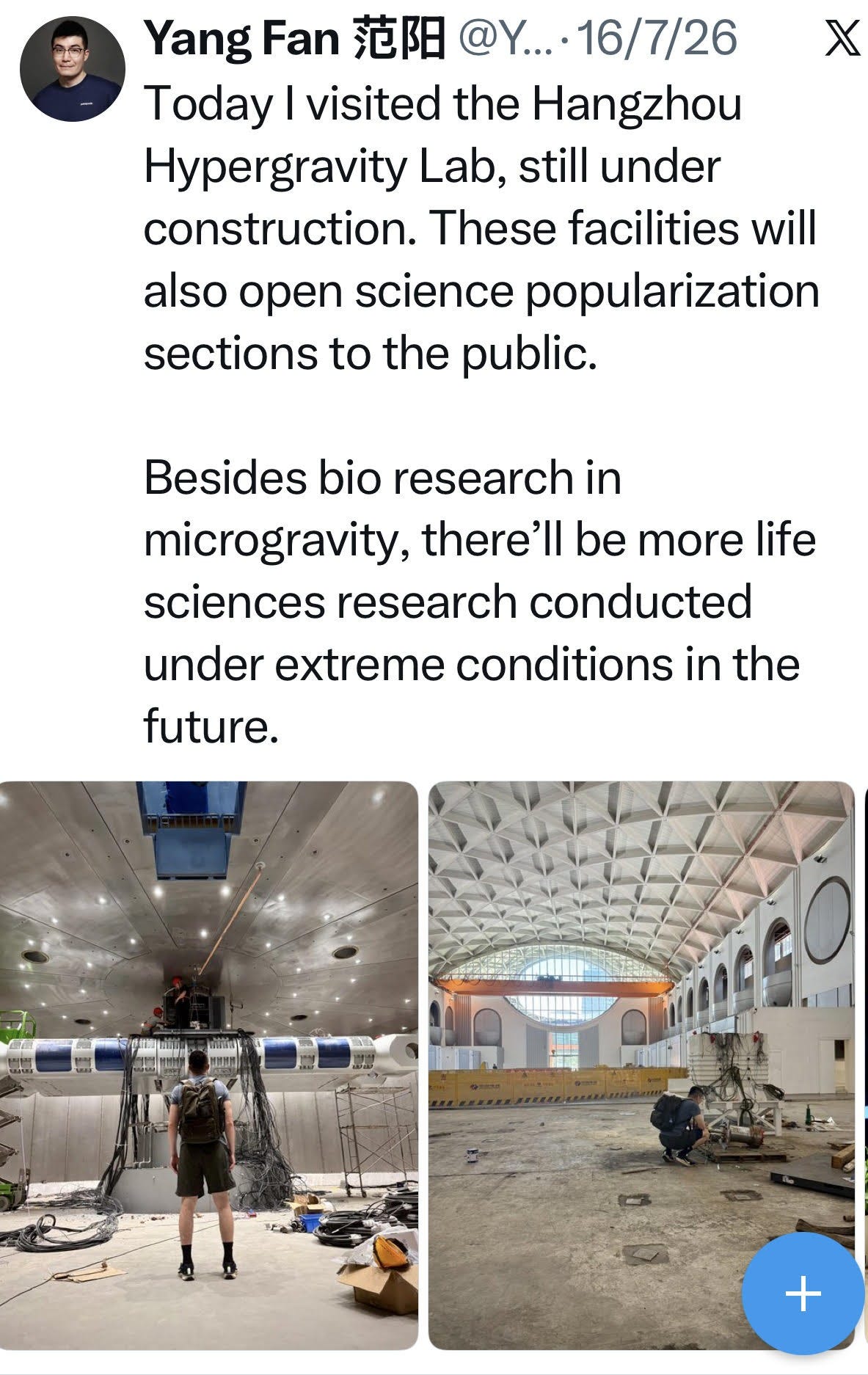
He was not describing a better university institute with more GPUs. He was describing a new organisational animal: young, multidisciplinary, AI-native, impatient with budgeting hierarchies, able to work with agents more easily than with committees, hungry for compute and direct contact with reality.
The form we arrived at was a scientific OODA loop with legal personality.
It owns the whole cycle: hypothesis generation, literature synthesis, model construction, experimental design, robotic or standardised laboratory execution, data capture, validation, regulatory translation and deployment. Its advantage is not that it employs more brilliant scientists. It is that it learns from reality faster than the old institution can convene a committee.
The laboratory is therefore not merely a place where intelligence is applied.
It is an organ through which intelligence touches the world and changes itself.
Deep ocean, outer space, disease, climate, cities and biotechnology are not simply new sectors for China to enter. They are interfaces with reality. They supply the feedback without which machine intelligence remains trapped inside inherited data.
The countries that matter will not merely be those with the best models.
They will be those able to house the machine’s contact with reality.
Wet laboratories. Ports. Grids. Tropical cities. Farms. Deep-sea platforms. Orbital sensors. Hospitals. Factories. Populations. Regulatory regimes willing to let new institutional forms act before every category is settled.
Machine civilisation needs habitats, not merely stacks.
China Outside China may become one of those habitats at planetary scale: not a single centrally designed super-system, but millions of industrial, urban, scientific and logistical loops sharing enough components, standards and accumulated knowledge to learn from one another.
This would not necessarily be Party China advancing according to a master plan.
It may be Hayekian China creating facts before Party China has decided what they mean.
Firms move because margins have collapsed at home. Scientists move because institutions are too slow. Models diffuse because developers choose cost and capability. Industrial parks form because host governments want jobs. Logistics systems expand because trade requires them. Chinese engineers solve the next problem because they already solved the previous one.
Only afterwards does Beijing have to decide which external facts have become Chinese interests.
The empire appears after the invoice.
A few weeks ago, while arguing with 兆 Kazu about Singapore’s minimum viable population, I found myself writing a forbidden sentence:
Singapore is too small, so Singapore must cease to be merely a place.
The first Singapore took a colonial port and manufactured an operating territory. It reorganised land, housing, labour, ethnicity, language, education, capital, family formation, transport and public conduct. Once that machine worked, Singapore began projecting fragments of it outward: industrial parks, ports, airports, utilities, planned cities, commercial law, technical assistance, trained officials, logistics systems and state-linked capital.
We called this regionalisation.
Stated plainly, it was external state formation.
A small country was trying to acquire an operating body larger than its territory.
The unfinished version is a Singapore “empire” whose territory is contracts, whose provinces are platforms, and whose garrisons are standards, capital, law, insurance, data and technical dependence.
No annexation. No governors. No imperial anthem.
A port concession. An arbitration clause. A project-finance structure. A city operating system. A payments corridor. A laboratory network. A health-security platform. An undersea cable. A cloud region. A standards body. An engineering school. A Singapore entity through which other people’s land, labour, capital and technical ambition become organised.
China Outside China would be the great opening.
Chinese firms going outward need financing, insurance, dispute resolution, trusted corporate structures, sanctions navigation, data governance, standards translation, political interpretation and people able to cross Chinese, Anglo-American and regional operating systems. Host countries need Chinese industrial capacity without becoming helplessly dependent upon it. Western firms need interfaces through which they can engage Chinese production without surrendering every legal and technical boundary.
Singapore should not merely host these flows.
It could organise them.
A Singapore-controlled mesh of finance, shipping, insurance, arbitration, standards, data and technical services around Chinese outward movement would be imperial in function while remaining non-territorial in form.
The citizen body would acquire not merely rents, but command over circulation.
That was the heresy.
Who has the balls to do it?
Probably no existing state in pure form.
Singapore possesses many of the instruments and almost none of the official vocabulary for the appetite. Its island mind is domestically commanding and externally polite. It will regulate every square metre at home, compose the population, discipline institutions and impose long-term national plans. Abroad it suddenly becomes modest. It facilitates. Connects. Orchestrates. Respects local ownership. Avoids picking winners. Waits for consensus. Rotates its officers every three years just as they begin to understand the theatre.
It will call empire a “Global Singapore partnership strategy” until nothing imperial remains.
The Gulf has more visible appetite, risk capital and willingness to create exceptions. But appetite is not the same as accumulated operating grammar. Capital can buy ports, laboratories and companies. It cannot instantly manufacture Singapore’s density of commercial law, multiracial civic credibility, logistics practice, administrative memory and ability to translate between systems.
Chinese firms possess the industrial metabolism. But they cannot by themselves supply neutral jurisdiction. Their very strength creates suspicion. A Chinese company can build the infrastructure. It may be unable to persuade the host that the infrastructure will remain politically agnostic in a crisis.
Host countries possess land, labour, legitimacy and the right to say no. But many do not possess the integrative institutions required to prevent foreign capacity from becoming domestic dependency.
The animal may therefore be composite.
Chinese industrial depth.
Gulf capital and appetite.
Singaporean law, finance, insurance and standards.
Host-country territory, labour and political authorship.
AI-native organisations moving between them.
It may not bear any one flag. It may appear as a consortium, a city network, a portfolio of zones or a set of interoperable institutions. The empire may form before any state admits that an empire exists.
The state—or coalition—that sees the opportunity will stop asking how to attract Chinese investment.
It will ask how to organise Chinese overflow.
It will acquire minority stakes, recurring operating contracts, arbitration rights, insurance positions, data access, training institutions, standards authority, payment corridors and the ability to redesign the system when the first bargain fails.
It will make China Outside China more useful to host societies and more difficult to operate without itself.
This can be predatory. It can also be constitutional.
The moral test is whether the organiser merely extracts a toll from Chinese expansion or creates real reproductive capability in the host: engineers who can modify the system, suppliers that can survive without one foreign purchaser, public institutions that understand the technology, local firms that can eventually build the next generation.
Empire as permanent dependency is merely a larger trap.
The better proposition is an empire that accumulates options without extinguishing the options of others.
The empire must remain a treasury of options, not a destiny.
Now suppose there are ten more years of Xi Jinping. Not because I know that there will be. The thought experiment clarifies the mechanism.
A strong centre continues to integrate the Party, state, market, technology system and national story. Security reaches further into institutional life. Political experimentation narrows. Private actors remain capable and ambitious, but the forms in which they may organise become more tightly defined.
At the same time, China Outside China grows.
Firms acquire foreign assets. Scientists form institutes elsewhere. Engineers learn to work across jurisdictions. Chinese capital gains experience with unfamiliar legal systems. Models diffuse beyond the national information environment. Industrial groups build supply chains that Beijing can influence but does not entirely administer. Families, founders and technical teams acquire second homes, external accounts, foreign partners and new political intuitions.
The centre becomes harder.
The perimeter learns to move.
This is where the wolves appear.
A wolf is not necessarily evil. It is a style of attention.
The wolf looks at an institution and asks where the hinge is. Who owns the account? Who can revoke access? Who controls the compute? Who clears the payment? Who writes the standard? Who carries liability? Who possesses the data? Who can appoint the board? Who cannot leave without collapse?
Brothers ask what can be born. Elders ask what should be governed. Wolves ask what can be owned, routed, priced, licensed, scaled, trapped or turned off.
Another decade of centralisation could produce a peculiar ecology. The mainland retains extraordinary industrial capacity, infrastructure, talent formation and national coherence. The external Chinese world accumulates room, legal plurality, capital flexibility, organisational mutation and experience operating between rival systems.
The wolves will not wait abroad as a community of noble exiles reading liberal constitutions and dreaming of return.
They will be running laboratories, funds, ports, family offices, factories, model stacks, logistics systems, arbitration practices, media networks and city platforms. Some will be cosmopolitan. Some nationalist. Some liberal. Some oligarchic. Some harsher than the officials they left behind.
The outside does not purify.
It trains.
Then succession comes.
Perhaps smoothly. Perhaps not. There need not be regime collapse. There need only be enough uncertainty for the inherited arrangements to become negotiable.
A province needs capital. A ministry needs a technical system it does not possess. A political faction needs allies. A national champion needs foreign markets. A new leader needs a coalition. A city needs to restore confidence. An industrial group needs to reconnect with external finance, research and supply chains.
China Outside China begins to rush back in.
Not necessarily as people crossing the airport.
Capital returns. Code returns. Corporate structures return. Models return. Standards return. Scientific organisations return. Foreign-trained Chinese teams return with external partners attached. Political narratives incubated in Nanyang, California, Dubai or Singapore return through Shanghai and Shenzhen. Legal and financial forms developed to survive outside Party China become tools in the contest to reorganise Party China.
The outside returns as an operating grammar.
This may produce reform. It may produce oligarchic capture. It may produce a new Party settlement in which external Chinese capital and technical networks are reintegrated without receiving political autonomy. It may produce a more distributed China, with cities and industrial groups regaining room. It may produce a harsher recentralisation after the wolves frighten the next sovereign.
The wolves are not saviours. They are claimants.
The post-Xi struggle may therefore occur not only inside Zhongnanhai, the Central Committee or the security apparatus. It may be fought across the external body that China spent the preceding decades creating.
Who controls the payment corridors? Who can restore investor confidence? Who can reconnect advanced laboratories? Who possesses the industrial networks in Southeast Asia and the Gulf? Who can speak to Washington, Singapore, Brussels, Riyadh, Jakarta and Shenzhen without translation? Who can keep the machines running while the political centre renegotiates itself?
The external Chinese operating system could become treasury, sanctuary, archive, supply line and kingmaker.
Xi Jinping may spend two decades strengthening the Chinese state and inadvertently help create the most formidable Chinese world ever assembled outside it.
The harder the centre holds, the more valuable the perimeter may become. And the small powers that organise the perimeter may discover that their greatest imperial asset is not command over China Outside China.
It is leverage over the return.
I can already hear Professor Wang clearing his throat.
He would object first to my verbs.
China leaves.
Civilisation expands.
The wolves return.
Who exactly is acting here?
Firms are not the state. Models do not possess national loyalty. Overseas Chinese communities do not form one political body. A factory in Vietnam, a scientist in Singapore, a fund in Dubai, a Cantonese family in Malaysia and a Party strategist in Beijing cannot be compressed into a single China moving through history.
He would be right.
He would remind me that I am again defining technology too narrowly. A model can cross a border easily. A person cannot so easily escape citizenship, race, law, suspicion, family, national education and historical narrative. Nation-state, minzu, Party and sovereignty remain more powerful technologies than the AI-native organisation.
The Party is not simply a cage from which Chinese capacity escapes. It is a historically resonant governing form: selector, protector, learning organisation, paternal sovereign and bearer of the claim that political unity precedes private liberty. It may metabolise the external system more effectively than my wolves expect.
He would also ask why I assume that Chinese outside China are waiting to return.
Most are not.
Nanyang Chinese did not spend centuries as an offshore reserve population for a future Chinese state. They settled. Became local. Formed new loyalties. Lost dialects. Created families with other peoples. Survived through ambiguity. Became Malaysian, Singaporean, Thai, Filipino, Indonesian, Vietnamese and much else, often after painful struggles to be accepted as such.
Their history is not a waiting room. My history is not a waiting room.
This is the distinction this essay must preserve:
China Outside China is not Chinese Outside China.
China Outside China is the new industrial and cognitive field: firms, models, machines, capital, standards, laboratories and logistical systems whose reproductive centre remains connected to China.
Chinese Outside China is the much older human story: migration, settlement, adaptation, hybridity, memory, suspicion, loyalty and the production of plural Chinese lives beyond the political centre.
The first may seek to use the second.
They must not be collapsed.
A Singaporean Chinese person is not a latent distribution node for the PRC. A Malaysian Chinese school is not an offshore cultural asset awaiting activation. A Nanyang family’s language, memory and civilisational attachment do not grant Beijing, a Chinese company, or an external Chinese wolf a claim upon its political loyalty.
We are not China’s overseas population. We are Chinese civilisation after settlement.
That sentence becomes more important, not less, as China Outside China thickens around us. The Australian wanted to deny the civilisation and leave only the passport. The fox wanted to mobilise the civilisation and thin out citizenship.
China Outside China could do both simultaneously. It can make Chinese inheritance more visible and prestigious while making settled Chinese communities more politically suspect. It can offer cultural abundance while narrowing the distinction between cultural affiliation and strategic alignment.
A strong China once again supplies language, confidence, media, products, schools, myths and ambition.
It also produces pressure.
Prof Wang’s hardest question remains unanswered:
Can thick Chinese life coexist with thin political identification when the centre is powerful?
Singapore’s answer, if it has one, lies in the membrane.
Professor Wang’s point about Singapore was not that it was more authentically Chinese or less Chinese. It was that Western-derived law sits above the governing party in a way law does not sit above the Party in 党天下 Dang Tianxia. That distinction permits a Chinese-majority society to remain Chinese without allowing one political organisation to possess the final meaning of Chineseness.
The membrane is not decoration.
It is the condition of plurality.
A Singapore “empire” riding China Outside China would therefore have to export more than arbitration, insurance and clean incorporation. It would have to extend the membrane: appeal, legal personality, divided authority, credible exit, local political authorship and the right of a participant to remain Chinese without becoming subject to a single Chinese sovereign interpretation.
Otherwise Singapore does not organise Chinese overflow. It launders it. Otherwise the empire’s law merely makes someone else’s power more bankable.
For two centuries China struggled to fit a civilisation into a modern territorial state.
The state had to be made strong enough to resist dismemberment, organise development, abolish rival sovereignties, create a national people, discipline capital, absorb technology and return China to power.
It worked.
Perhaps too well for the old container.
The same success now produces industrial capacity that cannot all be consumed at home, firms that cannot all grow inside the domestic market, scientists whose organisational forms do not fit inherited institutions, models that diffuse more quickly than sovereignty, and capital that seeks habitats beyond the territorial state.
The civilisation begins acquiring external organs. A continental political centre. A maritime industrial body. Orbital eyes. Oceanic sensors. Urban nervous systems. Robotic hands. Biological laboratories. Financial membranes. Diasporic memories that do not belong to the state.
It may become the first great civilisation of the modern period whose political centre remains intensely territorial while its operating body becomes planetary.
Its language need not become universal. Its systems may.
Its people need not become subjects of Beijing. Their cities, factories and institutions may nevertheless depend upon Chinese loops.
Its firms may behave autonomously until crisis turns their assets into national interests. Its external Chinese communities may resist political absorption while living inside an increasingly Chinese material world.
Its centre may insist upon unity even as its power depends upon dispersion. That contradiction is the story. This is not simply the rise of China. It is the multiplication of the places from which something Chinese can act.
Beijing acts.
Shenzhen acts.
A Chinese model hosted in Jakarta acts.
A scientific foundry in Singapore acts.
A battery and vehicle system assembled in Mexico acts.
A port, payment corridor or industrial zone acts.
An old Nanyang family acts by refusing the claim that any of these institutions possesses its identity.
After Xi, the accumulated outside may act upon the centre.
None has the final word.
That is why I want to bring this back to Prof Wang Gungwu.
He will probably tell me I have mistaken a conjuncture for a civilisation. That I have made technology too sovereign, overflow too purposeful and “China” too coherent. That I am rediscovering old maritime Chinese worlds while flattering myself that AI made them new. That the Party, nation and border will prove more durable than my planetary systems. That settled Chinese societies have their own histories and no obligation to complete a mainland story.
Good.
I want the demolition.
I am not Prof Wang Gungwu. I do not possess his command of the long history. I have only the strategist’s vice: I see a new form while it is still wet and want to know what happens if it survives.
The previous essay asked:
Who gets to be Chinese after the rise?
The next question is larger:
Who gets to build the Chinese world after China no longer contains it?
The Party?
The firms?
The wolves?
The small empires that organise the overflow?
The settled Chinese who refuse to be conscripted?
The models and machines that make the distinctions operational before any philosopher has settled them?
A civilisation leaves its territory. Its intelligence acquires bodies. Its external organs learn to survive. Its wolves begin to face home.
Who gets to inherit it?
And do the Chinese outside China still get to say no?

No posts
Comments
Nothing yet. Say the first thing.
Sign in to join the conversation.