
Researchers have spent YEARS scratching their heads trying to figure out why fewer babies are being born.
They looked at housing costs, childcare expenses, women’s careers, and economic instability. All of those things are undoubtedly influences directly correlating to the shrinking population, but they’re definitely not the full story.
Elon Musk refers to it as ‘the biggest threat to humanity’. Dramatic? A little. But it is a genuinely scary problem for the economy and we unpacked why in this week’s Curve Weekly podcast.


Basically - none of the reasons that have been reported seems to explain what’s going on. Recent studies overlaid the data on smartphone adoption, and what was discovered is kind of mind blowing.
This week the FT published a graph that is impossible to dismiss. It tracks the percentage change in fertility rates across multiple countries, plotted against years before and after smartphones took off.
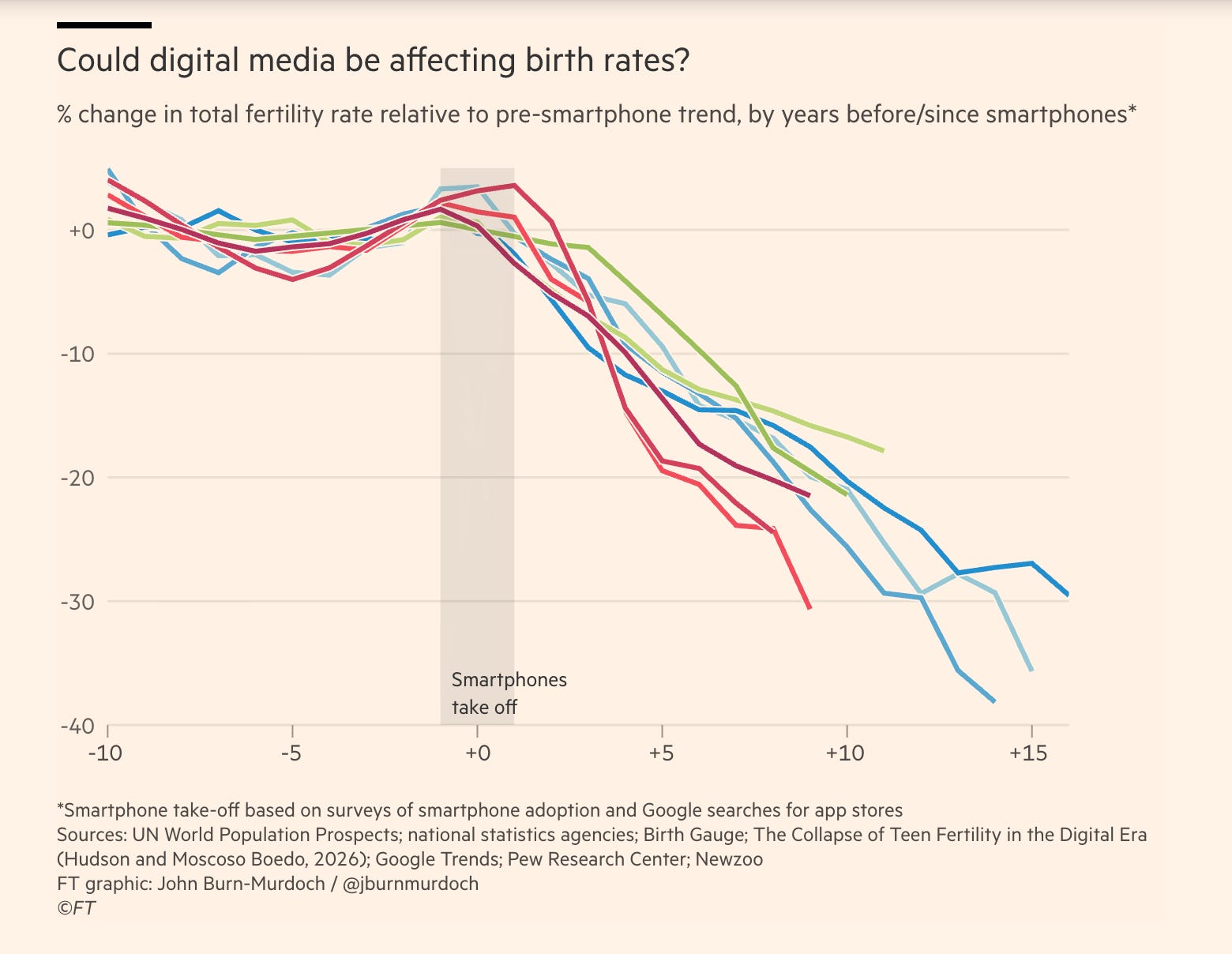
For the ten years before smartphones, the lines were flat. Stable. Unremarkable. The moment smartphones hit, every single line drops. Steeply, consistently, across countries with completely different economies, cultures, and policies. By fifteen years after smartphone adoption, most are down 20 to 30%. Some countries even further. A coincidence? We think not!
In country after country, birth rates started falling almost exactly when 4G was widely rolled out. Not before. Not after. Right when the internet went everywhere - into every pocket in every part of the world.
The biggest thing worth mentioning is that this isn’t just a rich-country problem. Mexico, Brazil, Iran, Sri Lanka all now have lower birth rates than the United States. More than 60% of countries are currently below the level needed to keep their populations stable. In 66 of them, the average woman is having closer to one child than two. In some, the most common number is zero!
The invention of the smart phone has meant less time socialising in person. In South Korea, in-person socialising among young adults has literally halved in twenty years. When you zoom out, what this data is telling us is so simple - fewer couples are forming (because we simply aren’t spending enough time with each other) resulting in fewer babies. Not only that, but those who are in relationships are using their phones so much that they’re acting as its own form of contraception. Think about it - scrolling in bed isn’t exactly an aphrodisiac!
FT chief data reporter John Burn-Murdoch points out that researchers found the same effect with television decades ago. Couples who had TVs had fewer children than those who didn’t… draw your own conclusions. Entire countries with more televisions per person had lower birth rates than their economic development alone would predict. The smartphone has simply accelerated something already in motion, and made it global almost overnight.
There’s a second layer worth paying attention to. Think about how much of your screen time is seeing other people’s relationships. The proposal videos, the anniversary posts - the love you see performed for social media is now being used as peoples reference points. In the same way when you compare the mundanity of your everyday life, with someone else’s social media highlight reel - most of us feel pretty deflated. That same phenomenon is now playing out in the way we view and experience relationships… because we’re comparing them to the performativity we’re digesting.
When someone’s real relationship isn’t measuring up to what they’re seeing online, people are bailing early. Terrifying. Researchers are finding this effect is most pronounced in more traditional cultures, where women’s expectations are shifting faster than their male counterparts are keeping up with.
The part we found most interesting is that most young people still say they want around two children. The gap isn’t in desire, it’s between what people want and what’s actually happening. People want babies, they want to start families - it’s just the reality that isn’t happening for a lot of us.
Whether you want to have kids, you can’t have them (financial or fertility reasons) - or perhaps you’ve decided having kids isn’t for you at all, this is hugely impactful for all of us and we want to explain why.
An ageing population is not just a social issue. It’s an economic one, and history has a very clear example of what it looks like at scale. What it’s looking like we are going to see play out, is a little scary and while we’re not sharing this to frighten anyone, the impacts on the economy are real and understanding why is important.
As an example, if we look at Japan in the 1980s, it was the envy of the world. They had the second largest economy. Property prices were booming and there were serious conversations about whether it might overtake the United States. Then the birth rate collapsed. Today Japan sells more adult nappies than baby ones. Its working-age population has been shrinking for thirty years which means three lost decades of near-zero economic growth.
The logic is straightforward. Fewer young people means a shrinking workforce, less tax revenue, and more pressure on government spending for pensions and healthcare as people get older. In Japan, pensions now consume over 50% of the entire government budget. Read that again - 50% of the entire government’s budget is being spent on supporting elderly people. The global average is around 20%. That’s money not going into schools, infrastructure, technology, or innovation. The really cruel irony is that it’s a vicious cycle that is really hard to get out of. The harder it becomes to fund an ageing population, the less you can invest in the future that might actually grow you out of it. And Japan isn’t alone in this - parts of Asia and Latin America are heading in that same direction.
For investors, this is one of the most significant long-term shifts playing out across global markets. We have talked about it quite a lot on the podcast - but in case you missed it - demographic change reshapes entire industries. Healthcare, property, consumer spending, government bonds - everything is being impacted. It changes which economies are worth watching and which are quietly stalling.
The story of falling birth rates gets told as a social crisis, a relationship crisis, a technology crisis. And while it is all of those things - it is also an economic signal. It’s quietly reshaping the economic trajectory of entire countries.
Of course, with a 90% female audience, we know there are SO many factors why people either choose (or don’t choose) to not have kids. It’s nuanced, it’s sensitive and we totally understand that this is a really complex issue but the reality is that the economy does need more people to be born. If you have any thoughts, ideas, or feelings you want to share about this we would love to hear from you please comment below!
Also if you prefer to get notifications as opposed to emails, we highly recommend downloading the app and turning on notifications!

Available for iOS and Android
The Curve team x
No posts
Comments
Nothing yet. Say the first thing.
Sign in to join the conversation.