
When T.S. Eliot wrote that April is the cruelest month, he really meant March through May. But that didn’t fit the meter. I’ve experienced a bit of that cruelty this spring (I mean, who hasn’t, right?), which is why it’s been a minute since my last post. But out my window I see lilacs coming into bloom out of the dead land, and I am back too.
In fact, this will be the first of two posts addressing some recent Line 5 news that you might have missed. I don’t mean the appearance of Enbridge’s disturbing geo-technical report on the tunnel, so helpfully explained here by my friend David Holtz last month. I also don’t mean the good news of the U.S. Supreme Court’s unanimous affirmation that Enbridge isn’t exempt from basic procedural requirements. Enbridge’s argument was so laughably bad in that case that they couldn’t even convince corporate toadies like Alito and Thomas to vote in their favor. I also don’t mean the bad news that EGLE plans to issue Enbridge its water discharge permit for the tunnel project, an appalling, if unsurprising, decision. Instead, I want to discuss two stories that I suspect passed by largely unnoticed.
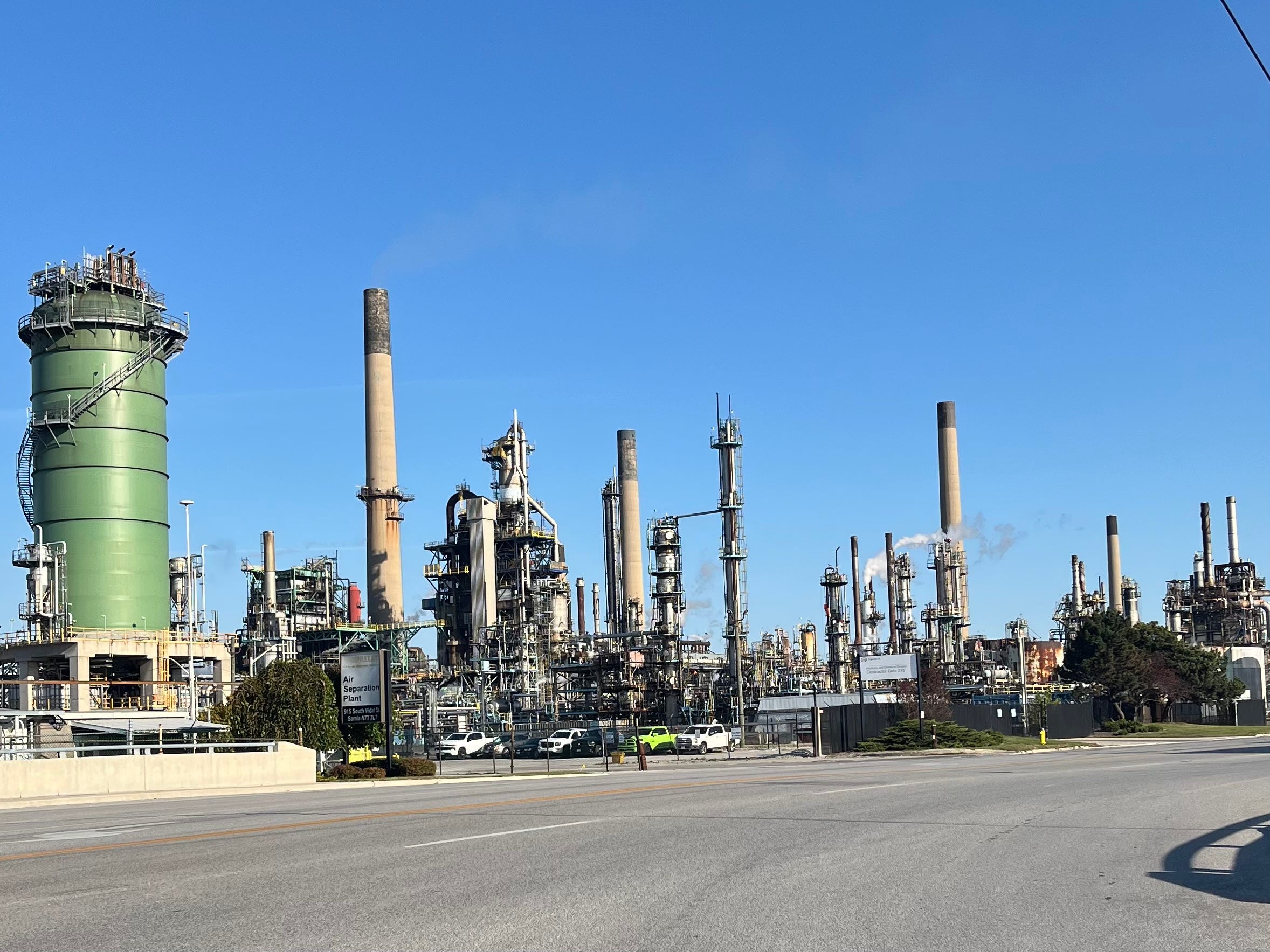
The first story is the latest Enbridge-related oil spill. On March 11, the Suncor refinery in Sarnia, Ontario, identified a “hydrocarbon sheen” on the surface of the St. Clair River. The company quickly responded with containment booms, absorbent material, and vacuum equipment to recover the oil that had somehow made its way into the river. In the days that followed, Suncor announced that the source of the leak was “third-party pipeline infrastructure.” The infrastructure in question turned out to be the Sun-Canadian pipeline, which had developed a half-inch pinhole that released about 400 liters (or roughly 100 gallons) of oil into the river.
The spill was not from Line 5. Not this time. Line 5 has itself leaked in Sarnia repeatedly. According to records from Canada’s National Energy Board, Enbridge is responsible for dozens of releases in Sarnia over the past 50 years, at least one annually. Not all of these are from Line 5; they also include Line 6B (now called Line 78) and Line 9. But it’s all the same.
That’s because Line 5 (and 9 and 78) and the Sun-Canadian line are all part of the same system. Like Line 5, the Sun-Canadian line was built in 1953. It carries refined products from the Sarnia refineries east to markets in London and Toronto. So the two pipelines are linked as in a chain: Line 5 feeds the refineries, which, in turn, feed the Sun-Canadian line.
The Sarnia petrochemical refineries, known collectively as Chemical Valley, are the most troublesome—and in my view, the most unfortunately forgotten— part of the Line 5 story. The refineries are the reason that Line 5 exists, and, in turn, Line 5 is the primary reason the refineries have expanded and flourished. The origins of Chemical Valley date back to the 1850s, when some of the earliest North American oil wells were drilled in nearby Lambton County. The first major refinery was established in Sarnia in 1871, and others soon sprang up, fed first by the local oil fields, then later by oil from the even large Lima oil fields in Ohio.
Later in the mid-twentieth century, when explorers struck oil up in Alberta two thousand miles to the west, it proved more cost-effective to transport the oil to already-existing refineries in Sarnia than to build new ones closer to the site of extraction. Thus, Line 5, an extension of the first Interprovincial Pipe Line from Edmonton to Superior, Wisconsin, was born. And since Line 5 oil transport significantly increased the amount of crude in need of refining, Chemical Valley expanded accordingly. That expansion happened to coincide with extraordinary innovations in the chemical manipulation of hydrocarbon molecules, such that crude oil and gas could be transformed not just into asphalt, kerosene, or gasoline, but into an astonishing variety of chemical substances that form the basis of plastics, fertilizers, pesticides, and so much more.
But those remarkable advancements in chemical science have proven deadly. I’ve written before about the role of Line 5 in plastic pollution (a topic that still receives too little attention). Equally devastating, if not more so, is the role Line 5 has played in the production of herbicides and insecticides. Six decades ago, in her classic book Silent Spring, Rachel Carson described in vivid, horrifying detail the devastating effects that chlorinated hydrocarbons—that is, pesticides created by the petrochemical manipulation of petroleum feedstock—have had on ecosystems and on plant and animal (including human!) life. For almost three quarters of a century, Sarnia refineries like Imperial Oil, fed by Line 5, have produced enormous amounts of material used in the production of those pesticides, which have in turn caused the unintended deaths of untold numbers of creatures—fish, birds, ground squirrels, cattle, even human beings. Line 5 oil and gas has played a key role in making all that killing possible.
In my very first post for The Current just over a year ago, I calculated that, according to the 1,000-ton rule in climate science, Line 5 is responsible for as many as 9 million human deaths. We should add to that tally the amount of nonhuman life Line 5 oil has helped kill by way of plastic pollution and chemical poisons. The number is unquantifiable, but surely exceeds human fatalities by an order of magnitude. Line 5 oil is, to borrow a phrase from Carson, an elixir of death.
So I wonder: what might public discussion of Line 5 look like if it focused less on the prevention of impending catastrophe, or on comparatively trivial matters like the totally-solvable heating needs of a relatively small number of homes in the UP, or on the price of gasoline (subject to far more volatile circumstances than any one pipeline), and focused instead on the staggering amount of death for which Line 5 is responsible?
After all, it only gets worse.
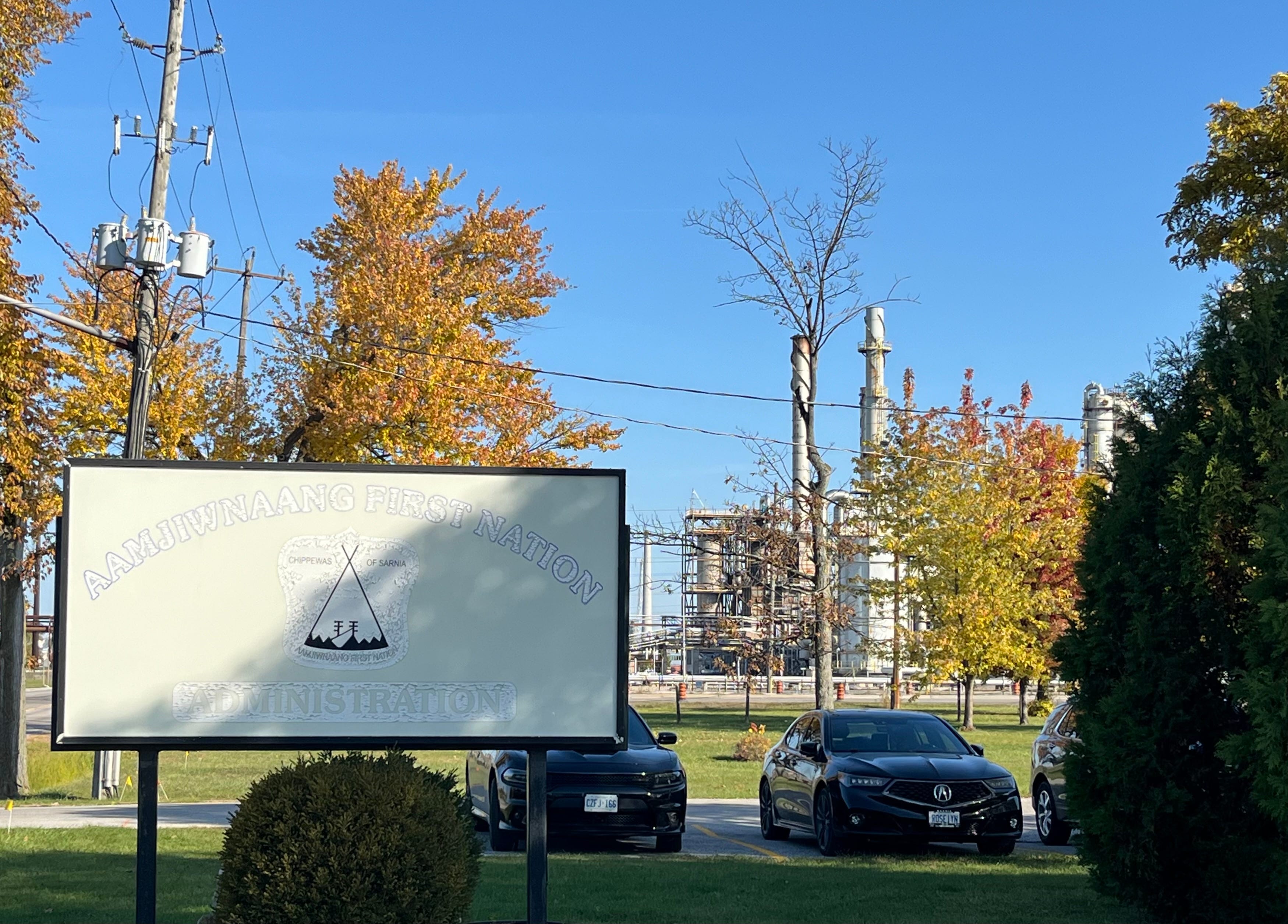
Chemical Valley is also the site of one of the most appalling examples of settler colonial environmental injustice in all of Canada. The Sarnia refineries encircle, almost completely, the reserve of the Aamjiwnaang First Nation. Back in 1952, when Line 5 was first proposed, the tribe objected to it, but as in the U.S., they were overrun and overruled by the settler state that favored Enbridge (then called Lakehead) every step of the way. But in addition to land dispossession (with its echoes of the Bad River situation in Wisconsin), the Aamjiwnaang have been forced to endure the daily, unrelenting emission of toxic pollutants into the air, land, and water. As a result, generations of Aamjiwnaang have suffered from the ill effects of petrochemical poisons. Those horrendous effects upon tribal members have been well-documented in books, films, magazine articles, and numerous scientific studies: rampant migraines and skin rashes, chronic respiratory problems, elevated rates of cancer and miscarriage.
The Aamjiwnaang First Nation reserve, in other words, is a sacrifice zone. This is the story Enbridge and the petrochemical industry doesn’t want you to know. And this is also how you and I save a few cents per gallon at the gas pump. The health of the Aamjiwnaang is the cost of Line 5's ongoing operation.
Let’s not forget that most of us have the luxury of thinking about Line 5 only as a disaster-waiting-to-happen, in precisely the same way that so many of us have the luxury of thinking about climate change as a distant threat. But for others, like the countless innocent critters killed so we can rid ourselves of a few pests, or like the Aamjiwnaang citizens who live in proximity to, rather than safely distanced from, toxic sites of petrochemical production, the disaster is already here.
Next time: The Curious Case of the Presidential Permit
TAKE ACTION
Enbridge is asking the Michigan Department of Environment, Great Lakes, and Energy for permission to dump billions of gallons of wastewater into the Great Lakes during construction of its proposed “Great Lakes Tunnel”–a disastrous oil tunnel through the Great Lakes. SEND A COMMENT to EGLE asking them to reject this permit.
It’s quick and easy to submit a comment here.
No posts
Comments
Nothing yet. Say the first thing.
Sign in to join the conversation.