
Maybe, like me, you’ve been thinking about the Straits lately.
I don’t mean the Straits of Mackinac, which were a topic of conversation last week at the Michigan Supreme Court. That hearing involved a legal challenge to the Michigan Public Service Commission’s (MPSC) approval of Enbridge’s Line 5 tunnel permit. I watched the hearing on Wednesday. And while it’s hard to really know what the Justices are thinking, my impression was that it went quite well for the good guys. Riyaz Kanji, the attorney for the appellants, For Love of Water (now Flow Water Advocates), is a legal marvel and a brilliant litigator. He argued a powerful case. Fingers crossed the Justices heard him.
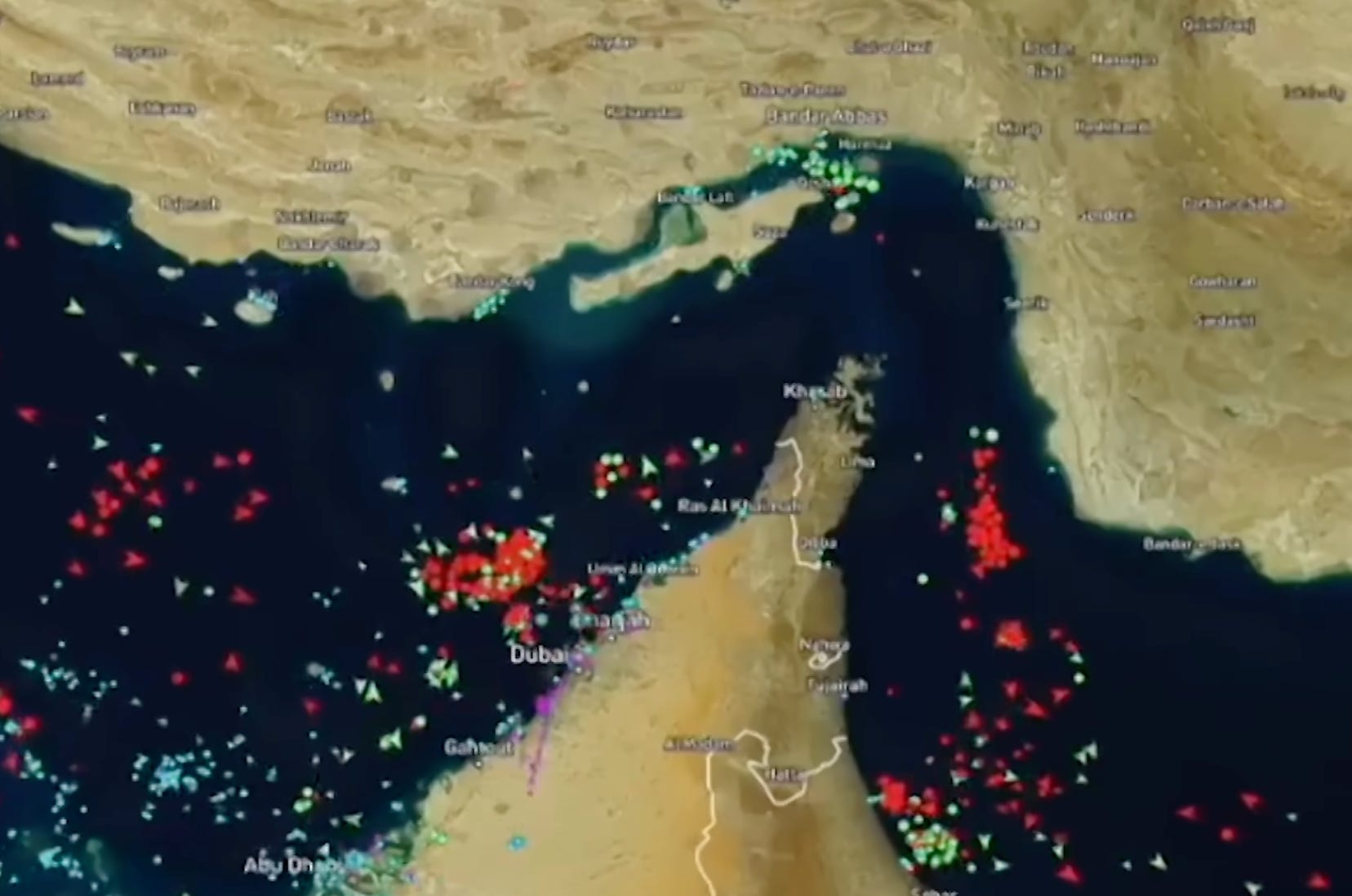
But the Strait I’ve been thinking about these past few weeks is halfway across the world, off the coast of Iran. The Strait of Hormuz between the Persian Gulf and the Gulf of Oman, you might have heard, is a crucial choke-point for the international transport of oil produced in the Middle East. As much as 20 million barrels of oil move through that stretch of water every day, accounting for 20% of global oil consumption. But right now, thanks to our recklessly ignorant President and the warmongering, cosplaying adolescents he’s installed at the Defense Department, we’re in a pointless war with Iran, tanker shipments through the Strait of Hormuz have ceased almost entirely, and the price of oil has shot up to $100 per barrel—nearly twice what it was at the beginning of the year. Prices at the pump and for food and consumer goods are on the rise as well. So much for “energy security.”
As it turns out, the Straits of Mackinac and the Strait of Hormuz, both conduits for the international transport of petroleum, have overlapping histories. In August 1953, while Lakehead (now Enbridge) contractors were pulling the first of the twin pipelines across the Straits, the United States Central Intelligence Agency was plotting a coup to topple Iranian Prime Minister Mohammed Mossadegh and regain Western control of the Iranian oil industry. In some newspapers of the period, you could even read about the unfolding events, oceans apart, side-by-side.
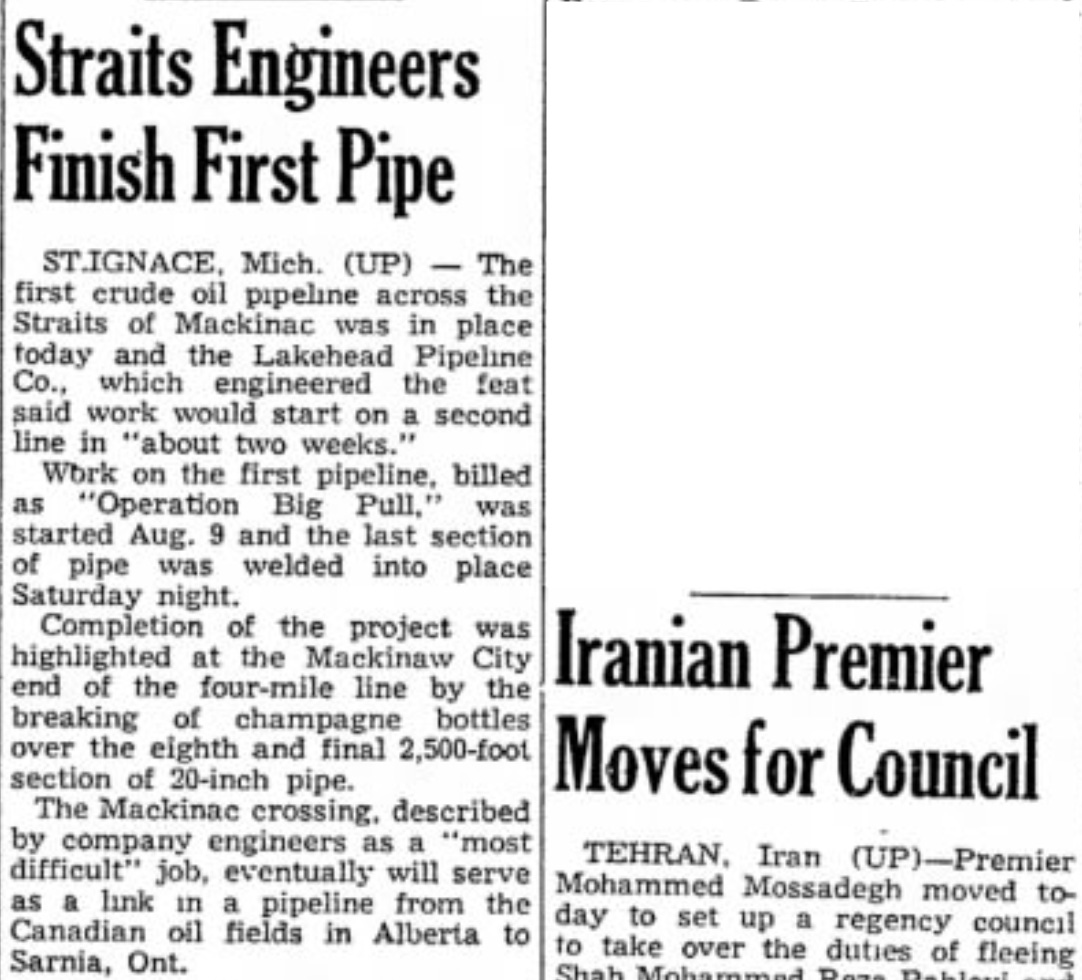
Mossadegh had risen to power as champion of nationalizing Iran’s oil industry. For decades, Iranian oil—as well as profits from that oil—was controlled by the Anglo-Iranian Oil Company. The British company had gained concessions (legal agreements to produce and sell the country’s oil resources) in Persia at the beginning of the century. But after the first World War, a number of factions and groups in Iran had grown increasingly dissatisfied with the terms of those concessions: Anglo-Iranian reaped in annual profits of as much as $250 million while paying the Iranian government less than $90 million in royalties. The charismatic Mossadegh gained political power by exploiting widespread animosity toward the British generally and the Anglo-Iranian Oil Company in particular. Just days after his appointment as Prime Minister in 1951, he helped pass a new nationalization law, declared the end of colonialism, and seized control of Iran’s oil
However, the expulsion of Anglo-Iranian meant that Iran had no way to produce or distribute the oil resources it now controlled. Left with neither profits nor royalties, the country slid into recession. Meanwhile, the British scrambled to try to convince Iran to enter into a new agreement, and the U.S. worried that the whole affair would leave Iran vulnerable to its Cold War rival, Russia, eager to exploit instability in Iran and gain control of the Iranian oil fields.
So the CIA convinced British intelligence and the Iranian Shah Mohammed Reza Pahlavi to oust Mossadegh. But before what was called “Operation Ajax” even began, Mossadegh was tipped off. He rallied his supporters against the Shah, who was forced to flee the country. Unexpectedly, just days later, pro-Shah Iranians themselves rallied to their monarch’s defense. Iranian soldiers joined the protestors, and soon Mossadegh was forced to leave the country. In the aftermath of these turbulent events, the US helped establish a consortium of corporations, including several American oil firms, to advance Iranian oil interests. This group profited from Iranian oil until Iran’s 1979 revolution.
This petrogeopolitical shitshow formed a not insignificant backdrop to the construction of Line 5. Before the pipeline could be built, Lakehead needed approval from the Petroleum Administration for Defense, which approved the allocation of steel for the project. And executives from Lakehead’s contractor Bechtel frequently described the pipeline as a “national defense project.” Instability in Iran, along with decolonization elsewhere in Asia and Africa, played an important role in the framing of Line 5 in terms of national (both Canadian and American) interests—what today the oil industry likes to call “energy independence.”
But the current war in Iran shows how, for at least three quarters of a century now, energy independence has been a fantasy, or simply a convenient fiction. No amount of domestic production, no amount of neo-colonial interference, and no amount of senseless bombing exempts us from the turbulence of global oil markets. What it yields instead is death and ecological destruction. Maybe you’ve seen the recent footage of refineries ablaze in Iran, Iraq, and Saudi Arabia, sending noxious billows of black smoke into the atmosphere, which in some cases returns to the ground in the form of toxic “black rain,” killing flora and fauna, poisoning humans.
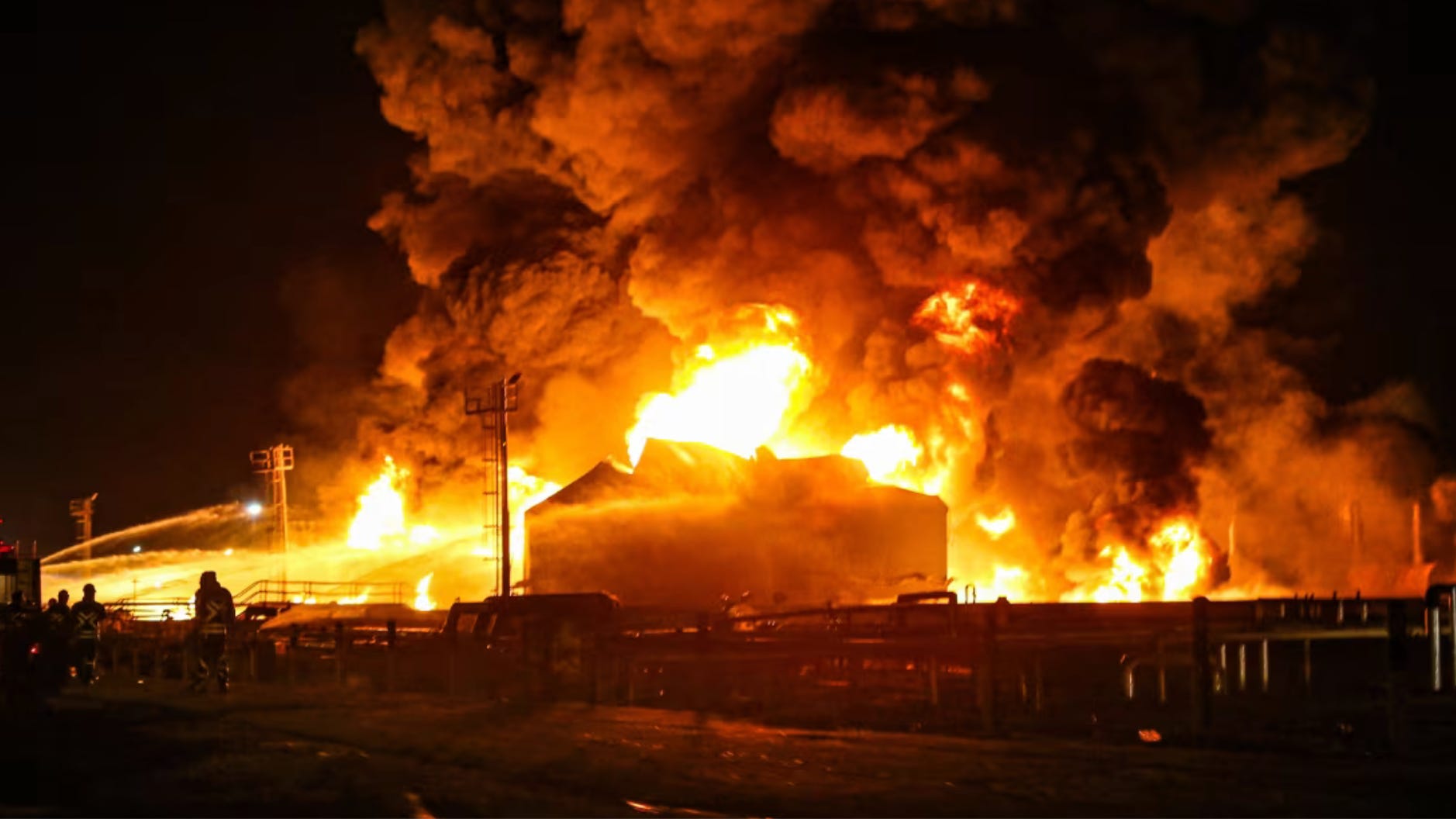
What history shows, in other words, is that global oil production is a death trap. If we were serious about “energy security” or “energy independence”—those terms so favored by the oil industry and its political supporters—we’d be investing in energy forms that can’t be claimed by nation-states. Unlike oil fields, after all, the wind and the sun can’t be contained by borders or hoarded by countries. The current war in Iran offers yet another in a long line of reminders that there can be no security and no independence under the petro-energy regime. Wars and death and pollution are features, not bugs, of the global oil industry.
Which is to say that the tenacious effort by Enbridge and its backers in the US and Canadian governments to keep Line 5 running for another century or more is nothing but an effort to maintain a permanent state of war, to perpetuate ecocide, to commit ourselves to ensuring that the horrors of the past (and present) will continue into the future. “Energy security” assumes the inevitability of war, just as “energy independence” assumes ongoing dependence upon oil. We should reject those assumptions. Shutting down Line 5 is not just a call to embrace less destructive forms of energy; it’s a call to commit ourselves to less violence. It’s a call for peace.
Governor Whitmer’s EGLE is deciding whether to grant Enbridge the permit it needs to keep Line 5 pumping through the Great Lakes for another century. Send her a message: We are awaiting her correct decision.
No posts
Comments
Nothing yet. Say the first thing.
Sign in to join the conversation.