
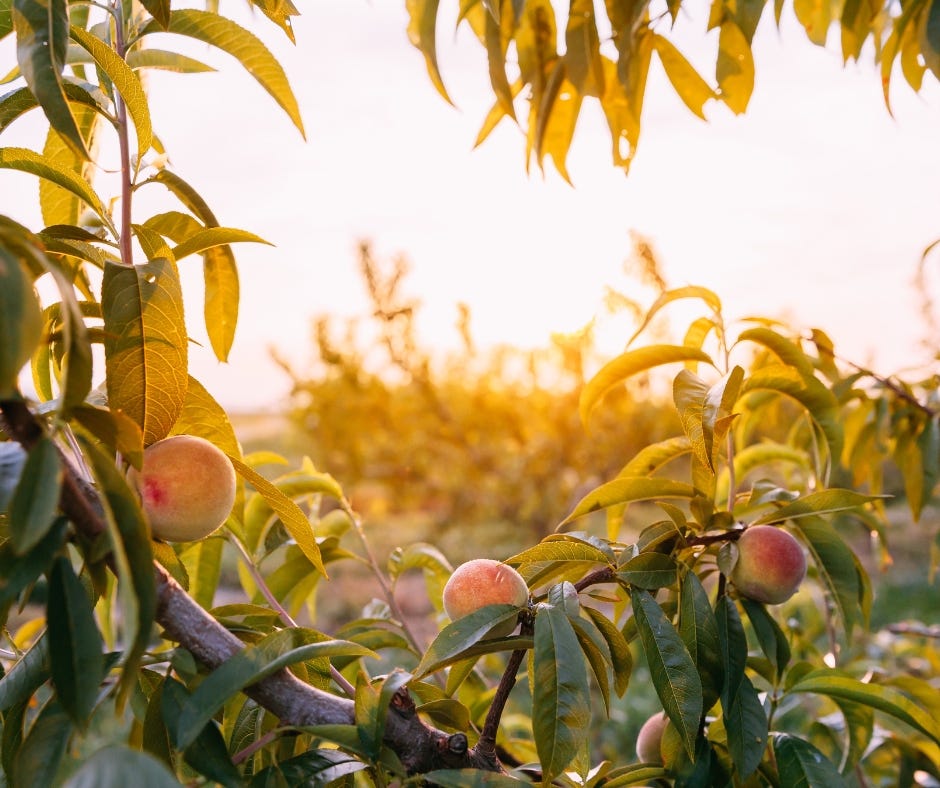
Imagine paradise for yourself.
Everyone’s version will be different, but I’m going to take a wild guess that it doesn’t involve Excel spreadsheets, a delayed Ryanair flight or a long queue at a cash machine that one time you’re really in a rush.
We tend to imagine water. Mountains. Beaches. Gardens. People we love dearly. Good food. Books. Warm evenings. And the luxury of time.
Two and a half thousand years ago, the answer wasn’t so different.
It is hot outside the walls. Unbearably so.
Inside, there is shade. Relief.
Water trickles through narrow runnels beneath the trees. There are figs and pomegranates, flowers and birds, somewhere cool to sit while the heat presses against the world beyond. The wall keeps out the dust and glare. Within it, everything feels abundant.
The ancient Iranians had a word for such a place.
Pairidaeza.
An enclosure, something walled around. It described enclosed parks and gardens, carefully cultivated places of shade, water and abundance. Later, the Greeks borrowed the word as paradeisos.
Centuries later, in Alexandria, that great fulcrum of ancient knowledge, Jewish scholars began translating their scriptures into Greek for a world in which many Jews now spoke Greek rather than Hebrew. When they came to the Garden of Eden, they reached for paradeisos.
A Persian garden had entered the story of creation.
From Greek, the word travelled through Latin and French into English, gathering meanings as it went. Paradise became not simply a garden, but the place humanity had lost, the place the faithful might one day regain, and eventually any place so beautiful or peaceful that we seek it out as an escape from the busyness and chaos of everyday life.
Through it all, the garden remained.
In Judaism and Christianity, Eden is watered by rivers and filled with trees. In Islam, jannah, the word commonly translated as paradise, means garden, and the Qur’an repeatedly imagines it through shade, fruit and flowing water. Even firdaws, the Arabic word used for the highest reaches of paradise, belongs to the same ancient linguistic family as our own word paradise.
Again and again, when people imagined a perfect existence, they planted it.
Spend time in the gardens of the Alhambra in Granada and the idea manifests itself in stone, leaf and water. Water is everywhere: flowing through channels, gathering in pools, spilling from fountains. A balm against the searing heat outside.
A friend once told me that years after visiting, the intricate archways and sunlit courtyards had blurred in his memory. What he remembered was the coolness of the air; the sense of calm that came from the sound of water echoing off stone walls.
In hot, dry landscapes, a garden like this was not simply decorative. Water meant coolness. Shade meant relief. Fruit meant abundance. Walls meant shelter. It was a place where nothing was lacking. Beyond the walls, much of it was.
That’s the thing. Paradise needs an outside. Something from which we can remove ourselves, both physically and mentally. The heat makes the shade delicious. Noise makes silence noticeable. Obligation makes an afternoon with nowhere to be feel precious.
The paradise promised by religion is eternal. Ours cannot be. The difficult world remains beyond the wall: the mortgage, the work, the washing up, the driving licence renewal, the dentist; the things that need fixing and the places we need to be.
But the wall can hold them back for a moment.
Every now and then, we find ourselves sitting in our garden or on our balcony of an evening, sheltered from the world beyond it, with nowhere particularly urgent to be. Someone we love is beside us. That little flower has come back again this year. Next door, the fountain trickles as we talk.
And we think:
This is one of those moments.
- the word collector, behind the counter
Enjoying the Emporium?
Subscribe free for three new words each week, or step upstairs to The Mezzanine for longer essays on language, books and culture - and a key to the entire archive of more than 150 articles.
Comments
Nothing yet. Say the first thing.
Sign in to join the conversation.