
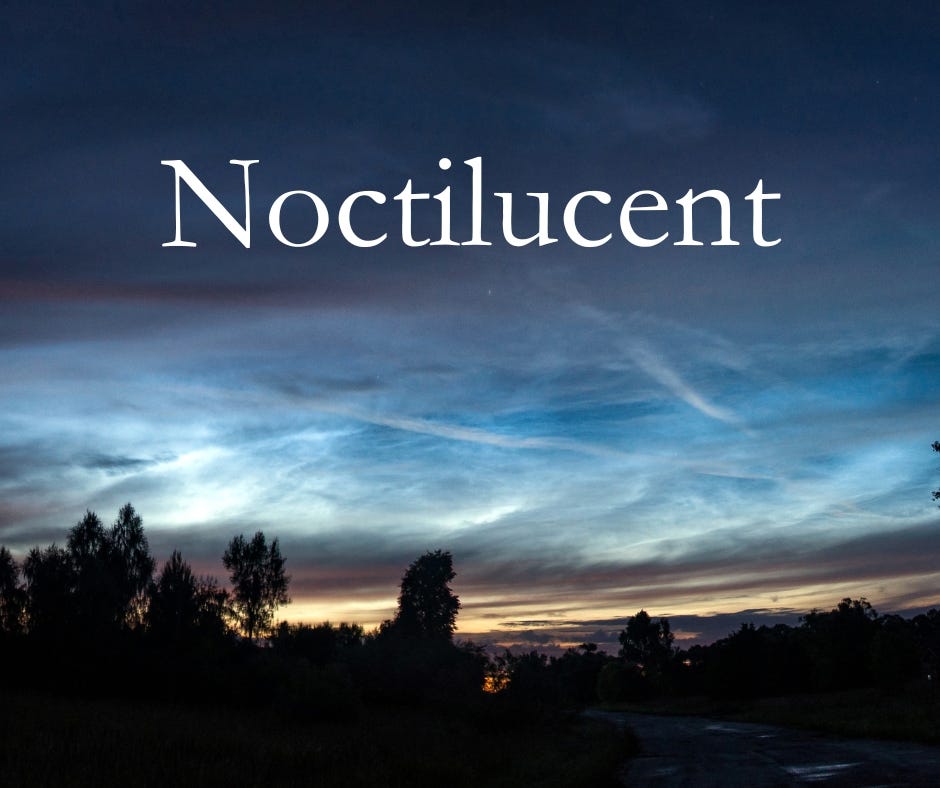
In the summer months, long after sunset, certain clouds continue to glow.
English has a beautiful word for them: noctilucent.
It comes from the Latin nox, meaning night, and lucere, to shine. Few words wear their meaning quite so openly.
These delicate blue-white clouds drift almost 80 kilometres above the Earth, high enough to catch the Sun’s rays long after darkness has fallen below. While the world beneath them slips into night, they remain bathed in sunlight.
Curiously, no one seems to have written about noctilucent clouds before 1885. The first undisputed sightings appeared just two years after the catastrophic eruption of Krakatoa, leading some scientists to wonder whether the volcano helped create the perfect conditions for these shimmering displays.
Long before science offered explanations, people, as ever, offered stories. One intriguing hypothesis is that some sightings of the Loch Ness Monster were actually noctilucent clouds reflected in the still waters of the loch. Their electric-blue ribbons shimmer and shift across the dark water, creating the uncanny illusion of something vast moving just beneath the surface.
Poor Nessie may simply have been moonlighting as a cloud.
But the story of these ethereal, ephemeral clouds doesn’t end there. Scientists now think noctilucent clouds are becoming more common because of us. Not only through the changes we’ve made to the climate, but through rocket launches, whose exhaust leaves water vapour high in the atmosphere, creating the conditions in which these luminous clouds can form.
We leave traces everywhere we go: in books, in languages, in cities. And now, high above our heads. Noctilucent clouds remind us that our story and the Earth’s are deeply intertwined.
For most of history, we looked up at the sky. Now, in ways both beautiful and unsettling, it is beginning to reflect us.
- the word collector, behind the counter
Comments
Nothing yet. Say the first thing.
Sign in to join the conversation.